Table of Contents >> Show >> Hide
- The Sandwich Scandal That Had the Internet Picking Sides
- Why This Cat Story Works So Well Online
- Why Cats Want Your Food in the First Place
- The Big Reason Not To Share Every Bite
- So, Was the Cat Owner Actually Wrong?
- How To Handle a Cat Who Thinks Your Lunch Is Shared Property
- What This Viral Moment Says About Cat Ownership Today
- Extra Experience: Every Cat Owner Has Lived Some Version of This
- Conclusion
There are few forces on Earth more confident than a cat who has decided your lunch belongs to both of you. Not legally. Not ethically. Not nutritionally. Spiritually. So when a cat owner shared a funny AITA-style story about refusing to hand over her chicken sandwich to her feline roommate, the internet responded the only way it knows how: with mock outrage, dramatic loyalty to the cat, and a flood of “ma’am, that sandwich was never yours” energy.
At first glance, it is a tiny domestic comedy. A woman sits down to eat. Her cat attempts a bold lunch heist. The human gently blocks the attempt. End scene. But online, this small standoff landed because it captures one of the funniest truths about modern pet ownership: cats can contribute exactly zero dollars to rent, utilities, groceries, or emotional stability, then still carry themselves like tenured board members with full voting rights over your plate.
That is what makes this story so good. It is not really about a sandwich. It is about the daily power struggle between people who pay the bills and cats who act like they signed the lease, approved the decor, and graciously allowed you to live in their two-bedroom kingdom.
The Sandwich Scandal That Had the Internet Picking Sides
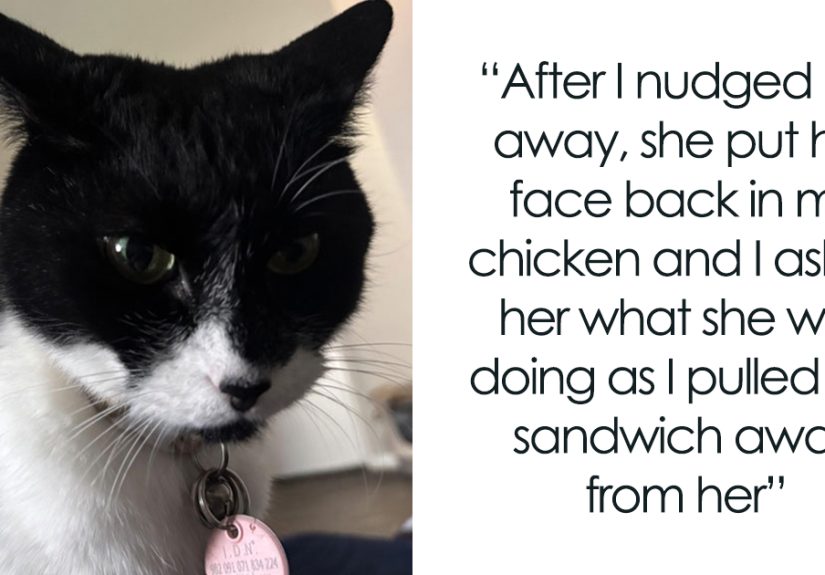
The original post was delightfully simple. A 23-year-old student explained that she was eating a chicken sandwich while studying for midterms when her six-year-old cat, Luna, marched over and put her face directly into the food. The owner gently nudged her away and, in one glorious line that practically begged to become a meme, reminded the world that “the difference is that I pay the bills.”
That one sentence did all the heavy lifting. Suddenly, this was not just an ordinary lunch interruption. This was a labor dispute. A housing conflict. A miniature household constitution crisis involving one overworked human and one very confident cat with no concept of personal boundaries.
People loved it because the setup feels instantly familiar. Anyone who has ever owned a cat knows that their interest in human food is often less about hunger and more about principle. You could provide a perfectly balanced meal in a clean bowl three feet away, and your cat will still choose to inspect the turkey sandwich in your hand like a suspicious health inspector who also happens to be furry.
Why This Cat Story Works So Well Online
It turns ordinary pet behavior into courtroom drama
AITA-style storytelling is basically the internet’s favorite way to dress up everyday nonsense in a fake tuxedo of moral seriousness. Nobody is truly asking whether gently moving a cat away from a sandwich is a grand ethical failure. But frame it like a personal conflict, add one hilariously deadpan line, and suddenly the internet gets to do what it does best: pretend a minor moment in a kitchen is a case headed to the Supreme Court of Cat Affairs.
It taps into the myth that cats are lovable little tyrants
Cats have spent centuries building a reputation for elegant entitlement. Dogs may beg with enthusiasm, but cats beg with expectation. Dogs ask. Cats audit. That difference matters. A dog staring at your lunch says, “Could I maybe have some?” A cat staring at your lunch says, “Explain why you’re eating my property in front of me.”
It feels true even when it is exaggerated
The best pet stories work because they amplify something real. Cats do intrude on meals. Cats do learn routines. Cats do stare at food like they are preparing a formal complaint. So even when the joke gets theatrical, the emotional core feels accurate. The story is funny because it sounds like a hundred cat households rolled into one.
Why Cats Want Your Food in the First Place
Now for the part where comedy meets reality. Veterinary experts have been saying for years that food-seeking behavior in cats is not always a sign of actual hunger. Sometimes it is simple curiosity. Sometimes it is boredom. Sometimes it is a learned behavior that has worked before. And sometimes, yes, it can point to a health issue if the appetite suddenly becomes extreme or is paired with weight changes.
That distinction matters. A cat who hovers around your lunch may not be starving. She may just be smart. Cats are excellent at repeating behaviors that get results. If begging, pawing, staring, or inserting a whiskered face into your sandwich has ever earned even one tiny bite, congratulations: you may have accidentally funded a full-time food lobbyist.
Experts also note that feeding routines matter. Adult cats generally do well on regular, measured meals instead of a chaotic “sure, here’s half my lunch and a mystery snack at 3 p.m.” lifestyle. Consistency helps with appetite management, body weight, and behavior. Translation: your cat may prefer an all-day tapas service, but her body usually benefits more from structure than from sandwich diplomacy.
The Big Reason Not To Share Every Bite
This is where the story becomes more than just funny. Sharing human food with cats can turn into a bad habit fast. First, it teaches them that your plate is part of their dining experience. Then it creates persistent begging. Then it becomes a household ritual in which your pet appears every time you unwrap food, like a tiny furry tax collector.
Even more important, not every human food is safe. Many everyday items can be dangerous for pets, including chocolate, caffeine, alcohol, onions, garlic, grapes, raisins, and foods containing xylitol. Fatty foods are also a problem, especially when they become a regular indulgence. So while the internet may side with the cat for comedic reasons, real-life pet care requires a little less chaos and a lot more common sense.
Even safe foods can be tricky. Table scraps can add hidden calories, upset the nutritional balance of a cat’s regular diet, and encourage more pushy behavior at mealtime. A “just this once” nibble has a magical way of becoming a daily expectation, and cats are nothing if not committed to precedent.
So, Was the Cat Owner Actually Wrong?
In internet comedy court? Absolutely. She was clearly guilty of failing to provide tribute to a tiny monarch with whiskers and opinions.
In the real world? Not at all.
Refusing to share lunch with a cat is not mean. In many cases, it is the responsible thing to do. Human meals are not automatically cat-safe, and allowing a cat to eat directly from your plate can reinforce exactly the kind of behavior most owners later complain about. Today it is a chicken sandwich. Tomorrow it is a paw in your soup, a nose in your cereal, and one deeply unsettling moment where you make eye contact while your cat investigates your tacos like a private detective.
The better move is simple: keep your food for yourself, feed your cat on a consistent schedule, and use cat-appropriate treats if you want to offer a snack. Preferably from a bowl. Preferably not from your sandwich. Definitely not from the side your cat has already claimed with her face.
How To Handle a Cat Who Thinks Your Lunch Is Shared Property
1. Stick to a feeding routine
Cats thrive on predictability. Regular mealtimes help reduce the impression that food appears randomly whenever humans sit down to eat something delicious.
2. Don’t reward begging
This is the brutal truth. If begging works, begging continues. If staring works, the staring gets Oscar-worthy. If sandwich theft works, you are now living with a carb-enabled criminal mastermind.
3. Use enrichment instead of extra calories
Some food-seeking behavior is really boredom wearing a fake mustache. Puzzle feeders, short play sessions, foraging toys, and interactive games can redirect that energy into something healthier than plate surveillance.
4. Watch portions and treats
Treats should be a small part of a cat’s overall diet, not a second lunch, third lunch, and emotional support snack program. Portion control matters, and households do best when everyone follows the same feeding rules.
5. Call the vet if your cat suddenly seems ravenous
If your cat’s appetite changes dramatically, especially alongside weight loss, vomiting, behavior changes, or other symptoms, that is worth professional attention. Sometimes a “hungry all the time” cat is just playing the classics. Sometimes there is a medical reason.
What This Viral Moment Says About Cat Ownership Today
Part of the appeal here is that people increasingly treat pets like full-fledged family members, complete with personalities, routines, jokes, and emotional leverage. Cats are no longer just “the pet.” They are roommates, side characters, chaos agents, unofficial therapists, and domestic celebrities with suspiciously strong opinions about deli meat.
That cultural shift makes stories like this travel fast. We do not just laugh at the cat. We recognize the relationship. The whole dynamic is instantly legible: the human is trying to function like an adult, the cat is sabotaging lunch with total confidence, and somehow everybody online ends up siding with the one who has never once paid rent.
Still, the sweetest part of the story is hidden underneath the joke. A cat only gets this bold around someone she trusts. That lunch intrusion is annoying, yes, but it is also a weird little sign of domestic intimacy. Cats do not casually stick their faces into just anybody’s sandwich. That level of audacity is usually reserved for loved ones.
Extra Experience: Every Cat Owner Has Lived Some Version of This
Let’s be honest: the reason this story exploded is because it feels less like a one-off viral moment and more like a documentary. Every cat owner has a version of “the lunch incident” somewhere in their personal archives. Maybe it was a paw reaching toward a plate of eggs. Maybe it was a nose materializing near a rotisserie chicken with the speed of a paranormal event. Maybe it was the classic move where you look away for one second and your cat has somehow transformed from sleepy loaf into federal sandwich inspector.
Cats have a special talent for making ordinary meals feel like hostage negotiations. You sit down with food, and suddenly there is a furry silhouette beside you, radiating silent legal pressure. No barking. No dramatic whining. Just a stare so intense it could peel paint. It is not a request. It is a campaign.
Many owners know the follow-up scenes by heart. First comes the visual lock-on. Then the slow approach. Then the casual stretch that just happens to place one paw on your leg, your chair, or your soul. If that fails, some cats escalate with a tiny chirp that says, “I see you have chosen selfishness.” Others go for the bold maneuver: face first into the plate, as if boundaries are a rumor invented by humans.
And yet, this is exactly why people adore them. The audacity is maddening, but it is also hilarious. Cats do not merely want food. They want involvement. They want inspection rights. They want to be included in the ritual of whatever seems important to you, whether that is opening a laptop, making the bed, folding laundry, or unwrapping a sandwich you were foolish enough to assume could remain private.
There is also something deeply familiar about the way owners talk to cats during these moments. Entire speeches get delivered to animals who understand approximately three words, none of which are “this is not for you.” People explain budgets to cats. They explain ingredients. They explain that this is garlic aioli and therefore not remotely appropriate. They explain who purchased the groceries. They explain that they, unlike someone in this room, have jobs. The cat listens with the serene confidence of a CEO hearing a quarterly report before approving absolutely nothing.
That is why the “I pay the bills” line hits so well. It sounds ridiculous, but it also sounds exactly like something a real cat owner would say while trying to defend a sandwich with one hand and preserve dignity with the other. The line works because it reveals the secret theater of pet ownership: the human believes they are the responsible adult, while the cat behaves like upper management conducting a surprise audit on lunch.
In that sense, the viral story is not just funny. It is relatable in a very specific, very modern way. It captures the comedy of living with an animal who is equal parts dependent baby, tiny predator, emotional support goblin, and household aristocrat. And every cat owner reading it knows the same thing: today it is a chicken sandwich. Tomorrow it is sushi. The next day it is a bag of deli turkey that somehow summons the cat from three rooms away like a meat-powered bat signal.
Conclusion
The viral “I pay the bills” lunch showdown is funny because it turns a very normal cat-owner moment into high drama, but it also lands because it contains a real truth. Loving your cat does not mean sharing your sandwich. In fact, the most caring thing you can do is keep your plate to yourself, feed your cat properly, and refuse to let adorable begging rewrite the household constitution.
So no, the cat owner was not wrong for defending her lunch. She was simply doing what generations of pet owners before her have had to do: protect a meal from a creature who is cute, manipulative, probably already fed, and somehow still convinced that your food is community property. The internet may keep voting for the cat, but the sandwich, at least this time, belonged to the human who bought it.