Table of Contents >> Show >> Hide
- Meet the Woman Behind the Comics
- Why Everyday Problems Make Such Great Comic Material
- Recurring Themes in Everyday-Problem Comics About Women
- Humor as a Survival Skill
- From Instagram Sketchbook to Bored Panda Favorite
- How These Comics Build Community
- Want to Try Illustrating Your Own Everyday Problems?
- What These Comics Feel Like in Real Life: Extra Everyday Experiences (Part 2)
- Conclusion: Laughing Our Way Through Everyday Chaos
Some people keep a bullet journal. Some people vent to group chats. And some of us… draw ourselves
spilling coffee down a clean shirt, wrestling with a bra that might be cursed, or trying to look cool
while secretly panicking about absolutely everything. That’s the magic of funny, relatable comics
about everyday problems as a woman: they turn the tiny disasters we usually cringe about into
something we can laugh at together.
Part 1 of “I Illustrate My Everyday Problems As A Woman In Funny And Relatable Comics” introduced the
awkward, purple-haired alter ego of Belgian artist Prudence, better known as Planet Prudence. In Part 2,
the universe of messy hair, messy feelings, and messy social situations only expands. The comics feel
like a visual diary of twenty-something (and thirty-something) womanhood: unfiltered, self-aware, and
just dramatic enough to be hilarious.
This follow-up dives into why these comics resonate so strongly with women around the world, what kinds
everyday struggles keep showing up in them, and how humor becomes a survival strategy. We’ll also look
at how other female cartoonists are using similar storytelling to talk about beauty standards, mental
load, social anxiety, and the quiet pressure to be “perfect” all the timespoiler: nobody is.
Whether you’ve discovered these cartoons on Bored Panda, Instagram, or via that one friend who
spams you with “this is so you” screenshots, consider this your behind-the-scenes tour of the funny,
painfully honest world of everyday-problem comics.
Meet the Woman Behind the Comics
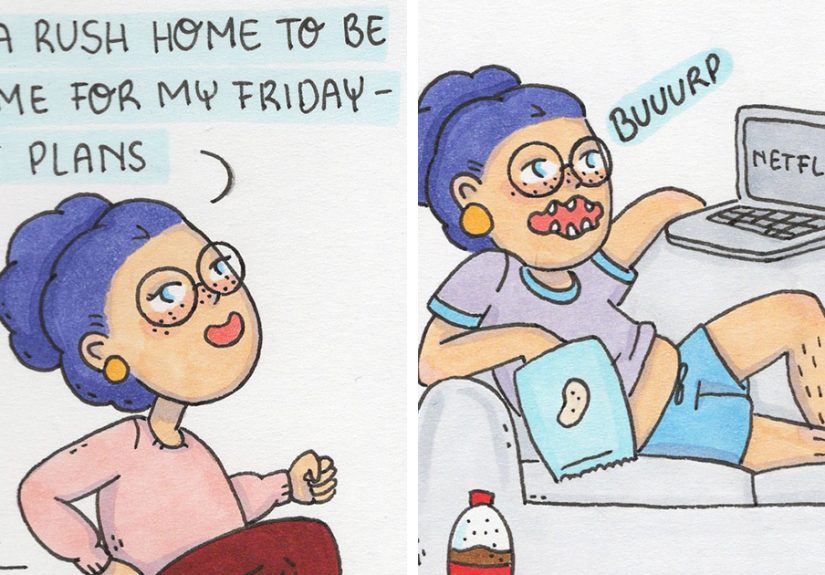
The main character in these comics is a version of the artist herself: a purple-haired, expressive,
slightly chaotic alter ego who reacts to life with maximum honesty. Planet Prudence started drawing her
everyday struggles as a diary-style webcomic, sharing her art online as a way to track her progress and
cope with issues like self-worth, body image, and mental health. Over time, those private doodles grew
into a community of followers who saw their own experiences reflected in her panels.
She’s not alone in this approach. Artists like Cassandra Calin, Bella Sriwantana, Lainey Molnar, and
others have built loyal audiences by turning their personal stories into bite-sized comic strips. Instead
of polished, unattainable versions of womanhood, they show the side most of us actually live: bloated,
overthinking, running late, and still somehow functioning like semi-competent adults.
That’s a big part of the appeal. These comics aren’t about being flawless. They’re about being
delightfully humanand admitting that sometimes the most heroic act of the day is putting on pants and
leaving the house.
Why Everyday Problems Make Such Great Comic Material
There’s a reason so many viral comics focus on tiny moments instead of epic plots. Everyday problems are
universal. You don’t need a complicated storyline to understand the horror of:
- Trying on jeans under dressing-room lighting that definitely hates you.
- Wearing white pants on the one day your period shows up early.
- Debating whether to answer a phone call or just stare at it until it stops ringing.
- Agreeing to “one drink” with friends and forgetting you’re actually 30 and will need three business days to recover.
For women, these “small” problems are loaded with extra layers: beauty expectations, social norms,
safety concerns, and the constant pressure to be polite and composed. Comics cut through all of that
with a single exaggerated facial expression or a funny caption. In one panel, you can see the contrast
between “how I’m supposed to be” and “how I actually am”and it’s oddly liberating.
Other women-centered comic series featured on platforms like Bored Panda and My Modern Met do the same
thing: they poke fun at beauty rituals, clothing mishaps, body image issues, cultural rules, and
relationship drama. By exaggerating these situations, the artists remind us that our private
frustrations are not failuresthey’re shared experiences.
Recurring Themes in Everyday-Problem Comics About Women
1. Body Image and Self-Acceptance
One of the strongest threads running through Planet Prudence’s comics and many similar series is
self-acceptance. The main character has soft rolls, stretch marks, and bad hair days. She tries on
outfits that don’t fit, compares herself to unrealistic standards, and then slowly learns to appreciate
her own body anyway. The joke might be about jeans that refuse to go past mid-thigh, but underneath the
humor is a gentle reminder: you’re not the problem, the expectations are.
Artists like Lainey Molnar take this further, showing side-by-side panels of what society expects from
women versus how women actually feel. That contrast is pure goldespecially when the “real” side is
slumped on the couch in sweatpants wondering why we ever thought low-rise jeans were a good idea.
2. Beauty Standards and Grooming Fails
If you’ve ever burned yourself with a curling iron, smeared mascara all over your eyelids, or shaved one
leg and forgot the other, you already know why grooming comics are so relatable. In Planet Prudence’s
world, a simple plan like “I’ll do a quick makeup look” spirals into eyeliner chaos and foundation that
magically disappears by lunchtime.
The humor lands because we’ve all internalized the idea that women are supposed to look effortlessly
put together. These comics expose the behind-the-scenes reality: the weird poses we contort into to zip
a dress, the ingrown hairs, the painful shoes, and the emotional damage caused by humidity. They say,
“Yes, this is ridiculous,” and we happily agree.
3. Social Anxiety and Awkward Situations
Many of these comics revolve around social awkwardness: replaying every conversation in your head
before bed, forgetting someone’s name mid-introduction, or wanting to cancel plans but also wanting
friends. The main character’s facial expressionswide-eyed panic, fake calm, dead-eyed exhaustioncapture
the emotional rollercoaster of being a socially anxious overthinker in a world that rewards
extroversion.
Other cartoonists, like those behind Happy Fluff Comics and similar series, use the same kind of humor
to talk about social expectations placed on women: be friendly but not flirty, confident but not
“too much,” helpful but not a doormat. The joke is often that no matter what you do, someone will
criticize itso you might as well laugh and do what feels right for you.
4. Relationships, Love, and Dating Disasters
Romantic and family relationships are another rich source of everyday drama. In many of these comics,
partners show up as sweet but clueless, pets steal the spotlight, and parents deliver either unwanted
advice or suspiciously correct observations.
Planet Prudence’s comics and others like them highlight small, intimate moments: eating snacks together
in bed, bickering over chores, texting “I’m fine” while clearly not being fine. The humor often lies in
the gap between what we say and what we mean, or the silent negotiations about who gets the last slice
of pizza.
5. Work, Burnout, and the Mental Load
Adulting is its own genre of horror-comedy. Comics about the mental load show women juggling work
deadlines, household tasks, emotional support, and appointments, all while pretending they’re totally
okay. The main character might be physically sitting at her desk, but mentally she’s tracking the
grocery list, upcoming birthdays, and whether she replied to that one email from three weeks ago.
Artists across the web, from slice-of-life cartoonists to feminist illustrators, use comics to draw
attention to this invisible labor. The jokes land because they’re trueand because many readers have
never seen that chaos represented so clearly before.
Humor as a Survival Skill
At first glance, these comics might just look like silly doodles about period cramps, bad hair, or
relationship quirks. But humor often masks something deeper: frustration, exhaustion, or even pain.
Instead of delivering a long essay on social pressure or sexism, the artist compresses all of that into
a three-panel gag.
Laughing at everyday problems doesn’t mean they’re not serious. It means we’ve found a way to live with
them. When you see your own insecurities drawn on the page and thousands of people commenting “same,”
it normalizes feelings you might have thought were uniquely yours. That sense of “I’m not alone” is a
powerful antidote to shame and isolation.
Comics also offer a tiny break from perfection culture. In a world full of filtered photos and carefully
curated feeds, there’s something refreshing about a character who admits she ate cereal for dinner or
hasn’t folded laundry in three days. She’s not aspirationalshe’s honest. And that honesty is a relief.
From Instagram Sketchbook to Bored Panda Favorite
Many women-led comic series follow a similar path: they start as small personal projects on Instagram or
Tumblr, gain momentum when a few panels go viral, and eventually get picked up by platforms like Bored
Panda, Demilked, or other online magazines. Planet Prudence’s comics are a classic example of this
trajectorywhat began as a way to cope with awkwardness and mental health challenges became a global
conversation about the reality of womanhood.
Bored Panda’s formatimage-heavy lists with quick, punchy captionshelps these comics reach audiences
who might never stumble onto an artist’s personal page. Readers scroll, laugh, tag their friends, and
share their favorite panels. The reach extends far beyond any one platform, and soon the comics are
being reposted on Pinterest, Facebook, and countless blogs.
The result? A kind of informal, international anthology of women’s everyday experiences, all told through
different art styles but unified by the same theme: life is weird and hard and hilarious, and we’re all
doing our best.
How These Comics Build Community
Scroll through the comments under almost any of these comics and you’ll find the same phrases repeated:
“This is so me,” “I feel seen,” “Did you break into my house and watch me?” That’s the heart of it.
These aren’t just jokes; they’re mirrors.
Relatable comics about women’s daily struggles create instant bonding moments. A woman in Belgium can
draw a scene about pulling her tights up for the fifth time that day, and a reader in the U.S., India,
or Brazil will nod in painful agreement. The universality of the struggle makes the world feel a little
smaller and a lot more supportive.
For many readers, following these artists becomes a form of self-care. New comics pop up in their feeds
like mini pep talks: “You’re not the only one.” Comics about body positivity, emotional burnout, or just
being tired of shaving become subtle, shareable reminders that imperfection is not a crime.
Want to Try Illustrating Your Own Everyday Problems?
You don’t need to be a professional artist to start drawing your own everyday-problem comics. In fact,
some of the most beloved series are visually simple; it’s the emotion and timing that make them powerful.
If this “Part 2” collection has you itching to pick up a pen or tablet, here’s a quick roadmap:
- Start with one tiny moment. Think about something that annoyed, embarrassed, or delighted you todayspilling coffee, a weird text exchange, a bad hair surprise.
- Exaggerate the feeling. Maybe your character dramatically melts into a puddle on the floor or screams internally while smiling externally.
- Keep the designs simple. Stick figures, blobs with eyes, or a basic character model are more than enough. Consistency matters more than detail.
- Use captions wisely. A short, punchy line of text can carry the joke. Think more “inner monologue” than essay.
- Share and listen. Post your comics online and pay attention to what people connect with. If everyone comments, “OMG, same,” you’re on the right track.
The goal isn’t to be perfect. It’s to capture real feelings in a way that makes someone else feel a
little less aloneand maybe laugh on a rough day.
What These Comics Feel Like in Real Life: Extra Everyday Experiences (Part 2)
To really understand why “I Illustrate My Everyday Problems As A Woman In Funny And Relatable Comics
(Part 2)” hits so hard, it helps to zoom into the kinds of specific moments these drawings capture.
Imagine a few scenes that could easily become new panels in the series.
Scene one: The Changing Room Spiral. You walk into a store feeling cautiously optimistic.
The lighting seems harmless. The playlist is decent. You grab three pairs of jeans “just to see.” By the
time you’re in the changing room, everything changes. The mirror is at a terrible angle, the fabric is
stiff, and somehow each size either refuses to button or fits your waist but not your hips. In comic
form, the final panel might show you dramatically lying on the floor of the changing room, jeans
half-zipped, with a caption like, “So I guess we’re a leggings-only household now.”
Scene two: The Surprise Video Call. You’re having a peaceful, makeup-free evening,
balancing a messy bun and an even messier T-shirt, when your phone lights up with an incoming video
callmaybe from a coworker, maybe from a family member who never warns you in advance. In reality, you
have exactly two seconds to decide whether to decline, answer, or throw your phone across the room. In a
comic, the character might hit “accept” while frantically smashing “beauty filter” buttons, only for the
last panel to reveal a frozen, unflattering screenshot that will haunt her for years.
Scene three: The Period Plot Twist. You carefully planned your outfit for the day: light
-colored pants, cute top, nothing too tight. Halfway through a meeting or a date, an uncomfortable cramp
hits, followed by the sinking realization that your uterus has chosen violence. In comic form, there’s
a panel of calm, a panel of suspicion, and then a panel of pure panic with the character whispering,
“I knew I shouldn’t have trusted white pants.” The comic doesn’t need to show much to communicate the
entire emotional arcevery woman reading instantly gets it.
Scene four: The Mental To-Do List Overload. Outwardly, you’re just sitting at your desk
answering emails. Internally, you’re juggling the grocery list, a friend’s birthday, a looming deadline,
an unresolved message from three weeks ago, the weird sound your fridge is making, and the fact that
you might be out of clean socks. A comic might show the character calmly typing in the first panel,
while the second panel zooms into her braincrowded with sticky notes and flashing alarms yelling, “Don’t
forget this!” The punchline might be her staring blankly at the screen, thinking, “What was I doing
again?”
Scene five: The Compliment Crisis. Someone tells you, “You look great today!” and your
brain instantly malfunctions. Do you say “thanks”? Do you deflect by making a self-deprecating joke?
Do you over-explain that you only look like this because your laundry pile forced you into this outfit?
In a comic, the character might respond out loud with a tiny, awkward “Oh, uh, you too,” while her
thought bubble screams, “ABORT MISSION, WE WERE NOT PREPARED FOR POSITIVITY.”
These kinds of moments are small, but they’re emotionally dense. That’s why they work so well in comics.
They don’t require complex storytellingjust a clear setup, an honest emotional reaction, and one
exaggerated expression that says, “If you know, you know.” When readers recognize themselves in those
panels, they’re not just laughing at a joke; they’re seeing their own everyday struggles validated and
softened by humor.
Part 2 of this series feels like a continuation of that emotional conversation. It’s the artist saying,
“Okay, we already laughed about the first wave of chaoshere’s more.” Life keeps throwing new situations
at us: new technologies to misunderstand, new trends to ignore, new expectations to dodge. As long as
those things exist, there will always be fresh material for comics that show the real, unfiltered
experience of being a woman in a world that expects you to have it all together.
And honestly? There’s something incredibly comforting about knowing that every weird little crisis you
have today might, one day, be a punchline in someone’s comicand that thousands of strangers will see it
and say, “Same.”
Conclusion: Laughing Our Way Through Everyday Chaos
“I Illustrate My Everyday Problems As A Woman In Funny And Relatable Comics (Part 2)” isn’t just a
collection of cute drawings. It’s a record of what it feels like to be a woman navigating modern life:
the expectations, the awkwardness, the invisible labor, and the tiny joys. By turning those experiences
into comics, artists like Planet Prudence and her peers give us permission to laugh at our chaos instead
of hiding it.
These comics don’t magically fix body image struggles, social anxiety, or burnout. But they do something
almost as important: they remind us that we’re not alone, not broken, and definitely not the only ones
who’ve ever cried over a pair of jeans. In a world that constantly tells women to be more, better,
quieter, or smaller, a messy, honest cartoon version of ourselves can feel surprisingly revolutionary.