Table of Contents >> Show >> Hide
- Why Saudi Arabia Suddenly Became a Star Witness
- The Alathar Discovery: Seven Footprints, One Big Rewrite
- The Earlier Clue: A Finger Bone That Changed the Conversation
- Green Arabia and the Climate Windows That Opened the Door
- So Did Humans Leave Africa Once or Many Times?
- Why Footprints Matter More Than You Think
- What This Means for Human Migration History
- Experiences That Bring This Story to Life
- Conclusion
Note: Body-only HTML for direct web publishing. No source links or extra markup included.
History usually reaches us in pieces: a bone here, a stone tool there, and the occasional skull that sends anthropologists into a collective happy panic. But footprints? Footprints are different. They are not just evidence that someone existed. They are evidence that someone moved. They paused, turned, wandered, followed water, and crossed a landscape that looked nothing like the Saudi Arabia most people picture today.
That is why the ancient human footprints discovered in Saudi Arabia matter so much. Pressed into the sediment of an old lake bed in the Nefud Desert, these prints offer a rare snapshot of early human migration in action. Instead of telling us only who our ancestors were, they hint at what they were doing, where they were going, and why Arabia may have been far more important to human migration history than older textbooks ever admitted.
For decades, the classic version of the story said that modern humans left Africa in one major successful wave around 60,000 years ago. It was a neat story, tidy enough to fit in a classroom diagram. The problem is that archaeology has a rude habit of ruining tidy stories. Finds from Arabia, the Levant, and beyond now suggest a more complicated picture: multiple dispersals, repeated movements, temporary expansions, and a migration history shaped by climate windows that opened and closed like a very moody automatic door.
Why Saudi Arabia Suddenly Became a Star Witness
Today, much of the Arabian Peninsula is harsh, dry, and not exactly the sort of place you would casually choose for a long prehistoric road trip. But in the deep past, Arabia changed dramatically during wetter climatic phases. Researchers have found evidence that ancient Arabia once held rivers, grasslands, and thousands of lakes. In other words, what is now a land of sand and heat was, at key times, a surprisingly inviting corridor between Africa and Eurasia.
This “Green Arabia” idea has transformed the study of early human movement. Arabia is no longer viewed as a dead-end barrier on the edge of the migration story. Instead, it looks more like a crossroads. If people were leaving Africa during humid periods, Arabia was not an obstacle. It was a bridge, a watering stop, a hunting ground, and maybe even a place where early human groups tested new routes before some populations vanished and others pressed onward.
That shift matters because geography has always been destiny in human migration. If water was available, vegetation was present, and large mammals were moving across the land, humans had strong reasons to follow. Ancient people were not random wanderers with excellent optimism and terrible maps. They tracked resources. They moved through landscapes that could sustain them. And when Arabia turned green, it became one of the most logical routes on Earth.
The Alathar Discovery: Seven Footprints, One Big Rewrite
The most famous site in this story is Alathar, whose name fittingly means “the trace.” Located in Saudi Arabia’s western Nefud Desert, Alathar was once an ancient lake. There, researchers identified hundreds of fossil footprints left by animals, along with seven that were attributed to humans. Those human prints were dated to roughly 112,000 to 121,000 years ago, making them the oldest known evidence of Homo sapiens on the Arabian Peninsula.
That alone would be headline material. But the real magic is in the context. The human prints were not isolated. They appeared alongside tracks from elephants, camels, horses, and other large animals. This was not a lonely human crossing a cinematic dune at sunset. This was a lively lakeshore ecosystem where humans and animals converged around precious water.
What the Footprints Reveal About Behavior
Footprints are wonderfully bossy pieces of evidence. Bones tell you that a being died. Footprints tell you that a being was very definitely here, at this spot, on this kind of surface, moving in this direction. At Alathar, the tracks suggest a brief visit rather than a permanent camp. Researchers found no stone tools at the site and no clear signs of butchery on nearby animal remains. That points to a short stop, likely for water and foraging, not a long-term settlement.
Some of the human prints appear to have been made by just two or three individuals moving near the lake margin. That detail is almost cinematic. Not in a fake-Hollywood way with dramatic background music, but in a subtle, eerie way: a small group walking by a shrinking lake while elephants and camels gathered nearby under a drying sky. For a few moments in prehistory, the mud kept the receipt.
Why Scientists Think the Tracks Were Made by Homo sapiens
The age of the site is a major clue. The prints date to the last interglacial, a warm and relatively humid stretch when climate conditions made northern Arabia much more habitable. Researchers argue that these tracks most likely belong to Homo sapiens because definitive evidence for Neanderthals in the region appears later. In simple terms, the timing fits early modern humans better than other candidates.
This matters because Arabia has long been a missing link in the migration debate. The footprints do not solve everything, but they fill a huge gap between Africa and the Levant. They show that humans were not just skirting the edges of Southwest Asia. They were entering Arabia’s interior and doing so during environmental windows when deserts softened into grasslands and lake country.
The Earlier Clue: A Finger Bone That Changed the Conversation
The Alathar footprints did not appear out of nowhere. Two years earlier, another Saudi discovery had already shaken the field: the Al Wusta finger bone. Found in the Nefud Desert and dated to about 95,000 to 86,000 years ago, the fossil represented the oldest directly dated Homo sapiens fossil outside Africa and the nearby Levant at the time of its publication.
That finger bone was small, but scientifically it landed like a drum solo in a quiet room. It showed that modern humans had reached deep into Arabia far earlier than many older migration models allowed. It also came with environmental evidence suggesting wetter conditions and African-linked fauna. Put that together with the footprints, and Arabia starts looking less like a side note and more like a main chapter.
Even more interesting, stone tool discoveries elsewhere in Arabia and the wider region have hinted at human presence going back around 125,000 years and beyond. The pattern is becoming hard to ignore. Human movement out of Africa was likely not a one-time sprint. It was more like a series of attempts, expansions, pauses, retreats, and reruns spread across changing climates.
Green Arabia and the Climate Windows That Opened the Door
If you want to understand ancient human migration, follow the rain. During humid periods, monsoonal systems and changing climate patterns transformed parts of Arabia into semi-arid grasslands with freshwater lakes and river networks. Animals moved in. Plants flourished. Humans followed. When the climate shifted back toward aridity, those same routes became punishing barriers.
This stop-and-go environmental pattern helps explain why the migration record looks messy. Early humans may have expanded into Arabia during favorable periods and then disappeared locally when conditions worsened. Some groups may have continued north through the Levant. Others may have moved along southern routes near the Red Sea. Still others may have reached Arabia and gone no farther. Migration history, it turns out, was less a straight arrow and more a weather-dependent strategy.
Recent research on water corridors in the Levant adds another layer to the story. Wetlands and lakes in southern Jordan may have helped support populations moving out of Africa and into western Asia. That does not settle the argument over northern versus southern routes, but it reinforces the broader point: ancient people needed landscapes with water, food, and game, and those landscapes appeared in pulses.
So Did Humans Leave Africa Once or Many Times?
Probably many times, though not all of those dispersals led to lasting global ancestry. That distinction is important. The ancestors of most living non-African populations are generally linked to later expansions around 60,000 years ago. But archaeological and fossil evidence increasingly suggests that earlier waves of Homo sapiens also ventured out of Africa tens of thousands of years before that.
The Saudi footprints fit beautifully into this revised picture. They support the idea that early humans explored new territory during favorable climate windows. Some of those populations may have died out or been absorbed. Others may have contributed in ways scientists are still teasing apart with archaeology, genetics, and climate modeling. Human migration was not a single heroic departure. It was a long experiment with many chapters, and Arabia keeps handing researchers pages that were missing.
Why Footprints Matter More Than You Think
Archaeologists love tools. Paleoanthropologists love bones. But footprints deserve more fan mail. They capture a moment with extraordinary resolution. At Alathar, researchers argue that the tracks may have been made within hours or days of one another. That means the site preserves a near-instantaneous ecological scene: animals crowding a lake, humans moving through the same space, and a drying environment nudging every living thing toward the same dwindling resource.
That kind of detail is rare. It helps bridge the gap between grand theories and actual lives. Ancient human migration can sound abstract when discussed as arrows on a map. Footprints make it personal. Someone stepped there. Someone adjusted their balance in wet sediment. Someone walked past elephant tracks that were still fresh enough to notice. Suddenly, migration history stops being a diagram and becomes an event.
What This Means for Human Migration History
The ancient human footprints in Saudi Arabia do not just add a new dot to the map. They change the logic of the map itself. Arabia emerges as a dynamic landscape that repeatedly invited and challenged early humans. Migration out of Africa was not simply a march through one corridor at one time. It involved multiple routes, changing climates, ecological opportunities, and episodes of movement that likely succeeded, failed, paused, and restarted.
In that sense, the Saudi footprints are both humble and revolutionary. They are humble because they are only a handful of impressions in old mud. They are revolutionary because they preserve direct evidence of humans moving through Arabia more than 100,000 years ago. That is the sort of discovery that forces science to do what science does best: update the story, sharpen the questions, and admit that our ancestors were even more adventurous than we thought.
Experiences That Bring This Story to Life
One of the most powerful ways to connect with the story of ancient human footprints in Saudi Arabia is to stop thinking of it as a remote scientific puzzle and start imagining the experience of reading a landscape the way early humans did. Modern people often navigate by phone battery, signal bars, and whether the coffee shop has seating. Ancient people navigated by water, animal movement, seasonality, and the shape of the land itself. That alone should make anyone slightly more respectful of prehistoric travelers and slightly less proud of successfully finding parking.
If you visit a desert today, the first impression is usually silence. Not empty silence, but a layered one: wind, distance, heat, and the strange feeling that the land is withholding a secret. In northern Arabia, that silence can be deceptive. Beneath the dry surface is a history of lakes, wetlands, and passing herds. To stand in such a place with the knowledge that elephants once walked there and humans once stopped there for water changes the entire emotional texture of the scene. The desert stops feeling dead. It starts feeling paused.
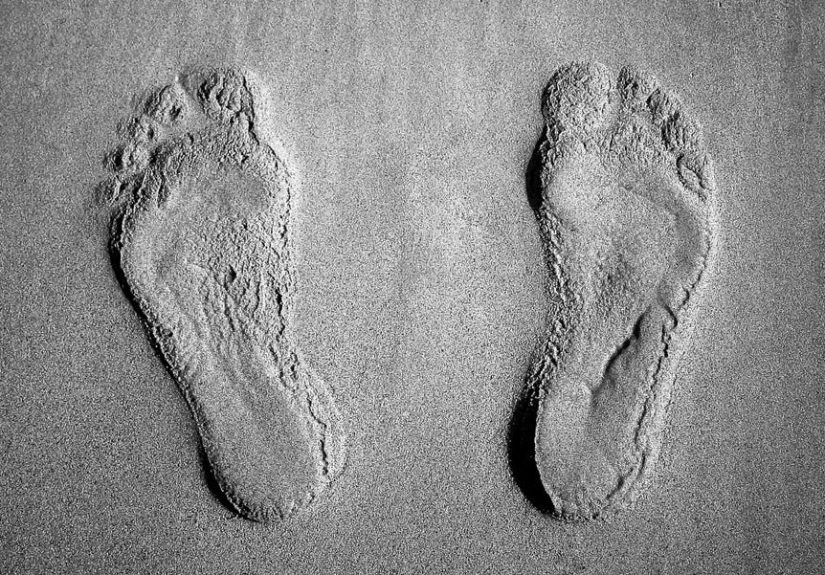
Museum experiences can also make this topic vivid. A footprint cast or a digital elevation model may sound less glamorous than a skull in a glass case, but in person it often hits harder. A bone tells you what a body looked like. A footprint tells you the body was in motion. Viewers tend to lean closer. They trace the toes with their eyes. They compare the print to their own foot. For a brief second, the distance between modern observer and ancient traveler narrows. It is no longer “a specimen.” It is somebody’s step.
Field archaeology adds another layer of experience. Researchers surveying places like Alathar do not walk into a ready-made discovery with dramatic soundtrack cues and conveniently labeled tracks. They deal with glare, heat, blowing sand, long stretches of uncertainty, and the constant possibility that the exciting thing in front of them is just a rock being unreasonably confident. That makes the moment of recognition even more remarkable. Real discovery is often patient, dusty, and powered by a stubborn refusal to quit.
There is also an intellectual experience tied to this subject that many readers find deeply satisfying: the realization that human history is not linear. The Saudi footprints remind us that the past was full of false starts, alternate routes, temporary occupations, and migrations that did not necessarily lead directly to us. That idea can be oddly comforting. Human success was not prewritten. It was improvised, weather-tested, and deeply dependent on adaptation.
Finally, there is the personal experience of perspective. Stories like this shrink modern arrogance in the best possible way. A few footprints by an ancient lake in Saudi Arabia can force a reader to think across 120,000 years and across continents. They remind us that movement, uncertainty, and adaptation are not side notes in the human story. They are the story. Our species has always been shaped by changing climates, shifting routes, and the search for habitable ground. In that sense, those ancient travelers are not strangers at all. They are us, just earlier, muddier, and far less likely to complain about weak Wi-Fi.
Conclusion
The ancient human footprints in Saudi Arabia offer one of the clearest and most compelling windows into early human migration beyond Africa. Found at an old lakeshore in the Nefud Desert, they show that Homo sapiens moved through Arabia more than 100,000 years ago during a greener, wetter phase when water and wildlife made the region livable. Together with the Al Wusta finger bone and other Arabian discoveries, the footprints strengthen a growing scientific view: human migration was not a single, simple event but a series of climate-linked expansions across a changing world.
And that is what makes this discovery so memorable. It is not just ancient mud. It is a frozen moment of decision, survival, and movement. A few steps beside a shrinking lake now help explain one of the biggest stories in human history. Not bad for footprints that lasted longer than most New Year’s resolutions.