Table of Contents >> Show >> Hide
- What You Need Before You Start
- How to Draw a Beach Scene in 11 Steps
- Step 1: Choose the mood and focal point
- Step 2: Draw the horizon line
- Step 3: Block in the biggest shapes first
- Step 4: Add your main foreground subject
- Step 5: Sketch the ocean and waves
- Step 6: Build the middle ground details
- Step 7: Draw the sky and background elements
- Step 8: Refine perspective and proportions
- Step 9: Add shading and value
- Step 10: Create texture in the sand, water, and sky
- Step 11: Add color or final finishing touches
- Tips to Make Your Beach Drawing Look Better
- Common Mistakes Beginners Make
- Conclusion
- Experience Notes: What Drawing a Beach Scene Really Feels Like
- SEO Tags
Note: HTML body only, ready to copy and publish.
A beach scene looks peaceful on paper, but drawing one can feel like trying to organize a family vacation through pure optimism. There is sky, sand, water, light, texture, distance, and at least one object that will accidentally look like a potato if you rush it. The good news is that learning how to draw a beach scene is not about magic. It is about structure.
Once you understand how to place a horizon line, group the foreground, middle ground, and background, and add believable texture to sand and water, the whole scene becomes much easier to manage. This beach drawing tutorial breaks the process into 11 simple steps so you can sketch with confidence instead of staring at a blank page like it just insulted your talent.
Whether you want an easy beach scene drawing for beginners or a more polished coastal sketch with shading and color, this guide will help you create a scene that feels sunny, spacious, and full of life. Grab your pencil, your eraser, and your best “I totally meant to draw it that way” face. Let’s get into it.
What You Need Before You Start
- Drawing paper or sketch paper
- An HB pencil for light sketching
- A softer pencil like 2B or 4B for darker shading
- An eraser
- Colored pencils, markers, or crayons if you want color
- A ruler if you want an extra-straight horizon line
- A photo reference if you prefer drawing from observation
If you are a beginner, keep your materials simple. A pencil and paper are enough. Great beach art starts with good shapes and values, not an expensive art supply shopping spree.
How to Draw a Beach Scene in 11 Steps
Step 1: Choose the mood and focal point
Before you draw a single line, decide what kind of beach scene you want. Is it a calm morning with gentle waves? A busy summer day with towels, umbrellas, and beach balls? A dramatic sunset with a sailboat in the distance? This matters because every strong drawing needs a focal point.
Your focal point is the star of the show. It could be a beach umbrella, a palm tree, a chair, a sandcastle, a surfboard, or a person walking near the shoreline. Without a focal point, your drawing can turn into a random buffet of beach objects, and viewers will not know where to look first.
A simple trick is to pick one main subject and place it slightly off-center. That makes the composition feel more natural and gives the rest of the scene something to support instead of competing for attention like toddlers in a talent show.
Step 2: Draw the horizon line
The horizon line is where the sky appears to meet the water or distant land. In a beach scene, it is one of the most important lines on the page because it creates structure and helps establish depth. Draw it lightly across your paper.
Think about placement. A high horizon gives more space to the sand and foreground details. A low horizon gives more space to the sky, which is perfect if you want fluffy clouds, sunset color, or a dramatic atmosphere. If your beach scene is about the relaxing setup on shore, keep the horizon a little higher. If the sky is the drama queen of your composition, let it have the spotlight.
Keep the horizon straight. A tilted horizon can make the whole beach look like it is about to slide into the ocean. Unless you are intentionally creating a stylized or playful effect, level is your friend.
Step 3: Block in the biggest shapes first
Now separate your page into large zones: sky, ocean, shoreline, and sand. Do not jump straight into tiny seashells or complicated foam patterns. Start with the biggest shapes because those shapes control the entire drawing.
Sketch the shoreline as a gently curving or angled line. Avoid making it perfectly straight unless that is what your reference shows. Most shorelines have a natural rhythm, and a slight curve helps the drawing feel more organic. Then suggest the water area and the dry sand area with simple contours.
This stage is about mapping, not perfection. Press lightly so you can change things easily. If you draw dark lines too early, you will spend the next ten minutes erasing like your pencil is being paid by the hour.
Step 4: Add your main foreground subject
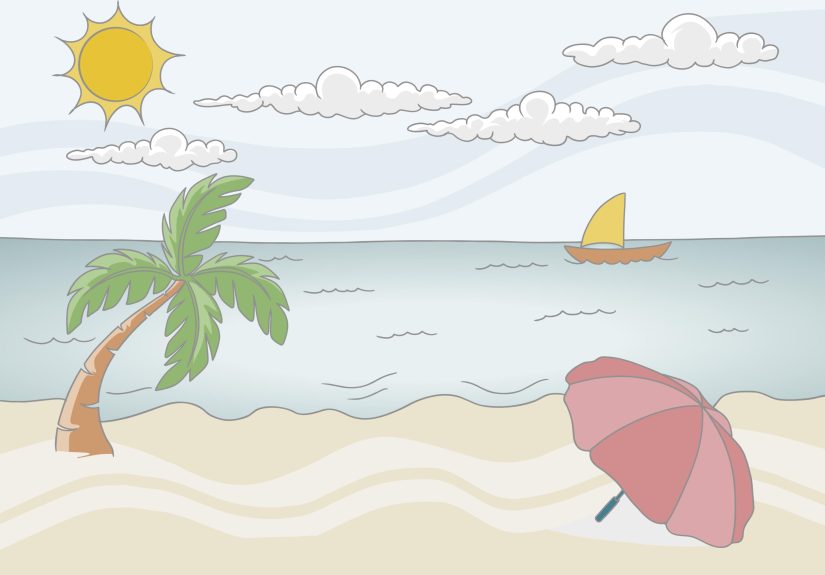
Place your focal point in the foreground or near the front of the middle ground. This could be a striped umbrella, a beach chair, a palm tree, a bucket and shovel, flip-flops, or even a person sitting on a towel. Objects in the foreground help the scene feel deeper because they give the eye something large and clear to compare against the smaller objects in the distance.
Use basic shapes first. A beach umbrella can begin as a dome or half-circle. A chair can begin as rectangles and angled lines. A palm tree starts with a curved trunk and long leaf shapes. Keep it loose and simple at first.
This is also the moment to think about scale. If your umbrella is enormous and your ocean looks like a puddle behind it, the scene may feel awkward. Make sure your main object fits comfortably within the composition and leaves room for the rest of the beach to breathe.
Step 5: Sketch the ocean and waves
Waves are where many beginners suddenly lose confidence and start drawing suspiciously aggressive noodles. Relax. You do not need to draw every splash. You need to suggest movement.
Start by drawing a few horizontal wave bands in the distance. These should be flatter and less detailed as they move toward the horizon. Closer waves can have more curve and variation. Near the shoreline, draw broken, uneven foam shapes rather than perfect zigzags. Water rarely behaves like it took a geometry class.
If you want your beach scene to look more realistic, remember that waves have direction. Let your lines follow the movement of the water. Some lines may sweep diagonally, while others stay more horizontal. This creates a more natural flow and helps the sea look alive instead of laminated.
Step 6: Build the middle ground details
Once the big shapes are in place, add supporting details in the middle ground. This is a great spot for items like smaller umbrellas, towels, beach bags, driftwood, dunes, a boardwalk, or a person strolling along the shore. You can also add a sailboat, a pier, or a few birds if you want extra personality.
Be selective. Good composition is not about adding everything you have ever seen at a beach. It is about choosing details that support the story. If your scene is calm and minimal, a single boat in the distance may be enough. If your scene is cheerful and lively, you can include more objects, but make sure they vary in size and do not clutter the page.
Middle ground details should be smaller and a little less sharp than your foreground subject. That difference in size and clarity is what helps create depth.
Step 7: Draw the sky and background elements
Now work on the background. Add clouds, distant landforms, far-off beach houses, cliffs, or a thin line of trees if they fit your scene. Keep background forms simple. The farther away something is, the fewer details it needs.
Clouds should not all be the same size or shape. Some can be soft and puffy, while others can be stretched and wispy. Leave open sky between them so the drawing does not feel overcrowded. If you are drawing a sunset beach scene, this is also where you can plan where the brightest light will go.
Background elements should sit close to the horizon and appear lighter than objects in the foreground. That lighter touch helps create atmospheric depth, which is a fancy way of saying things look softer and less intense as they get farther away.
Step 8: Refine perspective and proportions
Pause and check your drawing before shading. This is the art equivalent of tasting the soup before serving it. Make sure larger objects are lower on the page and smaller distant objects are placed higher and closer to the horizon. That simple relationship does a lot of work in landscape drawing.
Look for anything that feels off. Is the umbrella handle crooked in a weird way? Does the shoreline cut through an object awkwardly? Are your people too large for the boats in the background? Fix those issues now while the lines are still light.
If something looks flat, consider whether you need more overlap. When one object overlaps another, even slightly, it instantly helps create depth. A towel partly under a beach bag, or a dune in front of the shoreline, can make the scene feel more believable.
Step 9: Add shading and value
This is where your beach drawing starts to look less like a map and more like a real scene. Shading creates depth, form, and mood. Decide where your light source is coming from. Maybe the sun is high overhead, or maybe it is lower in the sky from one side.
Start with the biggest value areas. The sky may be lighter near the horizon and slightly darker higher up. The ocean often has darker bands farther out and lighter foam closer in. Sand is not just one flat color or value either. It has subtle shifts from dry to damp, sunlit to shadowed.
Add darker shading under objects like chairs, umbrellas, buckets, and driftwood. Cast shadows ground those objects so they do not look like they are hovering politely above the beach. Build value gradually. It is much easier to darken a drawing than to rescue one that got too dramatic too fast.
Step 10: Create texture in the sand, water, and sky
Texture is what makes a beach scene feel tactile. For sand, use light broken marks, tiny dots, and soft uneven shading rather than outlining every grain like you are filing paperwork for each speck. Indicate texture more heavily in the foreground and reduce it as it moves back into space.
For water, vary your lines. Some can be long and smooth, others short and broken. Use brighter highlights or erased areas for foam and glints of light. Keep the line direction consistent with the flow of the water so the waves feel natural.
For the sky, blend gently if you want a smooth look, or leave soft pencil strokes visible for a sketchier style. Clouds can be shaped by shading around them rather than outlining them heavily. A hard cloud outline can make the sky look like it was cut from craft paper and glued in place.
Step 11: Add color or final finishing touches
If you are working in pencil only, this final step is about contrast and cleanup. Deepen your darkest darks, brighten your highlights with an eraser, and sharpen a few important edges around the focal point. If you are adding color, keep the palette cohesive. Beaches usually look best with harmonious blues, sandy tans, warm creams, soft greens, and pops of coral, red, or yellow for accents.
Do not color everything with equal intensity. Save your strongest color contrast for the main subject. That helps the viewer’s eye land where you want it to. A bright umbrella against softer water and sky works beautifully. So does a colorful surfboard against neutral sand.
Step back and look at the whole drawing. Ask yourself whether the scene feels balanced, whether the eye moves naturally through the composition, and whether the beach looks like a place a person could actually stand without falling into some very confusing perspective problems.
Tips to Make Your Beach Drawing Look Better
- Use a reference photo if you are unsure about wave shapes or shoreline curves.
- Keep distant details small and soft.
- Make foreground objects larger, darker, and more textured.
- Avoid outlining everything heavily.
- Use overlapping shapes to build depth.
- Let the horizon line stay clean and readable.
- Leave some areas simple so the drawing has room to breathe.
Common Mistakes Beginners Make
One of the biggest mistakes in an easy beach scene drawing is making every part equally detailed. Real depth comes from contrast. Foreground objects need more texture and stronger value. Background shapes need less.
Another common mistake is drawing waves as repeated identical curves. Water has rhythm, but it is not a wallpaper pattern. Change the spacing, size, and shape of your wave marks.
Finally, many beginners forget shadows. Without shadows, chairs, umbrellas, people, and beach toys look disconnected from the sand. Even a light cast shadow makes a huge difference.
Conclusion
Learning how to draw a beach scene becomes much easier when you stop trying to draw everything at once. Start with the horizon. Build the big shapes. Add a focal point. Develop the shoreline, waves, and details in layers. Then use value, texture, and color to bring the whole scene to life.
The best part about beach drawing ideas is that they are flexible. You can keep the scene simple and cartoon-like, or make it more realistic with careful shading and observation. Either way, the process teaches you important drawing skills: composition, perspective, contrast, and patience. Also, it teaches you that drawing a convincing wave is surprisingly satisfying once it stops looking like a crumpled ribbon.
Practice this 11-step process a few times, and you will start noticing real improvement. The first sketch might feel cautious. The second will feel smarter. By the third, you may find yourself adding little beach details just because you can. That is a good sign. That is your confidence showing up with sunscreen and snacks.
Experience Notes: What Drawing a Beach Scene Really Feels Like
There is something oddly memorable about drawing a beach scene, even if you are sitting indoors with regular paper and a pencil that has already survived three bad ideas. A beach drawing does not just test whether you can draw sand, water, and sky. It tests whether you can simplify a busy place into something readable and pleasing. That sounds very artistic and noble, but in real life it usually begins with you wondering why your shoreline looks like spilled gravy.
Most beginners have the same early experience. The horizon line goes down first, and everything feels under control. Then the ocean appears. Then the sand appears. Then somehow the beach chair becomes the size of a compact car, and the sailboat in the distance looks like it belongs in a bathtub. This is normal. In fact, it is almost a rite of passage. Beach scenes teach scale in a very honest way. They will expose proportion mistakes immediately, but they also reward you fast once you start noticing what belongs in the foreground and what should stay small and quiet near the horizon.
Another common experience is realizing that beaches are not empty. Even a peaceful beach has visual layers: wet sand, dry sand, foam, ripples, shadows, cloud shapes, distant waves, maybe a dune, maybe a towel, maybe a family-sized cooler that has no business being that bright. At first, this can feel overwhelming. But after a little practice, it becomes fun because you stop trying to draw every detail and start choosing the right details. That shift is huge. It is the moment you stop copying and start composing.
Many people also discover that drawing a beach scene is strangely calming. There is repetition in the wave lines, softness in the sky, and a natural rhythm in the way shorelines curve. Even when the drawing is not perfect, the process itself feels relaxing. You shade a little here, erase a little there, and suddenly twenty minutes disappear. It is almost like taking a tiny vacation, except there is less sunburn and more graphite on your hand.
The best experience, though, is the moment the scene begins to look believable. Usually it happens after you add shadows under the main object or soften the distant waves near the horizon. Everything clicks. The drawing finally has air in it. It has space. It feels like a place instead of a collection of objects. That breakthrough teaches an important lesson: realistic drawing is often less about drawing more and more about placing things thoughtfully.
Over time, beach scenes become a great way to practice artistic confidence. You can experiment with different moods, different skies, different focal points, and different times of day. You can draw a quiet morning beach, a bright summer beach, or a windy dramatic shoreline. Each version teaches something new. That is why this subject stays popular with beginners and experienced artists alike. A beach scene gives you room to play, room to improve, and just enough challenge to keep you honest.