Table of Contents >> Show >> Hide
- What Does It Mean to Convert Mass Into Mole?
- The Formula for Converting Mass to Moles
- How to Convert Mass Into Mole: 3 Steps
- Why Molar Mass Is the Key
- Mass to Mole Examples
- Common Mistakes When Converting Mass Into Moles
- How Significant Figures Affect the Answer
- Quick Reference: Mass to Mole Conversion Steps
- Practice Problems
- Where Mass-to-Mole Conversions Are Used
- Experience-Based Tips for Learning Mass to Mole Conversions
- Conclusion
Converting mass into moles sounds like the kind of thing chemistry invented just to make your calculator sweat. Good news: it is much friendlier than it looks. In fact, once you know the formula, the whole process is basically chemistry’s version of asking, “How many dozens are in this pile?” Except instead of dozens, chemists use the mole, and instead of eggs, we are counting atoms, molecules, ions, or formula units so tiny they make dust look like furniture.
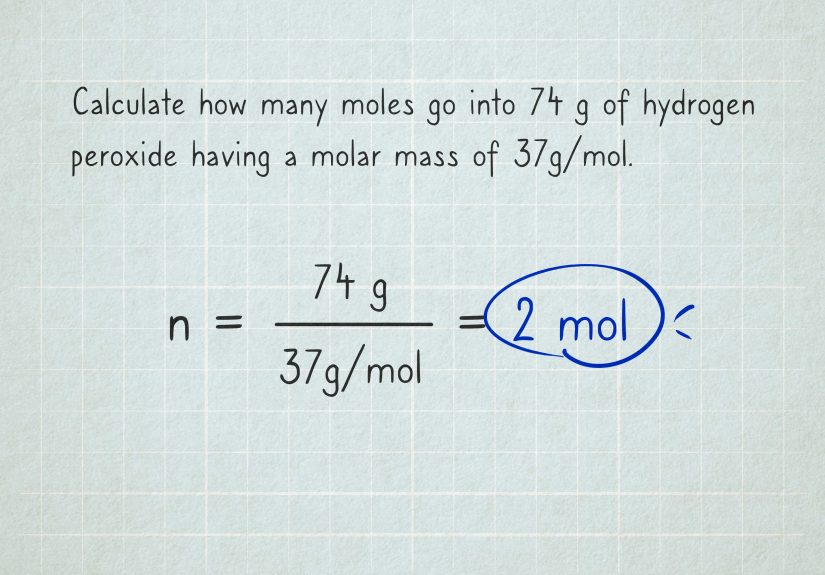
The main idea is simple: mass tells you how heavy a sample is, while moles tell you how many chemical “packages” of particles are present. To convert mass into moles, you use molar mass, which is the mass of one mole of a substance. The formula is:
moles = mass in grams ÷ molar mass in grams per mole
That is the whole magic trick. No smoke machine required. This guide breaks the process into three clear steps, explains why the formula works, shows common examples, and helps you avoid the small mistakes that love to sneak into chemistry homework wearing tiny lab goggles.
What Does It Mean to Convert Mass Into Mole?
To convert mass into mole means to change a measured amount of a substance, usually in grams, into the number of moles it represents. A mole is the SI unit for amount of substance. One mole contains exactly 6.02214076 × 10²³ elementary entities. Those entities may be atoms, molecules, ions, electrons, or formula units, depending on what substance you are studying.
That number is huge. If a dozen is 12, a mole is the “jumbo warehouse club membership” of chemistry. Chemists use it because atoms and molecules are far too small to count one by one. You cannot exactly line up sodium chloride formula units on your desk and count them before lunch. The mole lets you connect the visible world of grams and balances to the invisible world of particles and formulas.
The Formula for Converting Mass to Moles
The basic mass-to-mole conversion formula is:
n = m ÷ M
In this formula:
- n = number of moles, measured in mol
- m = mass of the substance, measured in grams
- M = molar mass of the substance, measured in grams per mole, or g/mol
For example, if you have 18.0 grams of water and water has a molar mass of about 18.015 g/mol, then:
18.0 g ÷ 18.015 g/mol = 0.999 mol
Rounded properly, that is about 1.00 mole of water. The units also prove the formula is working: grams cancel with grams, leaving moles. Chemistry teachers adore unit cancellation. It is their version of a standing ovation.
How to Convert Mass Into Mole: 3 Steps
Step 1: Write Down the Given Mass in Grams
Start by identifying the mass of the substance. In most chemistry problems, the mass is given in grams. If the mass is already in grams, great. Your work here is easier than finding the “on” button on a calculator.
If the mass is given in another unit, convert it to grams first:
- 1 kilogram = 1,000 grams
- 1 milligram = 0.001 grams
- 1 microgram = 0.000001 grams
For example, if a problem gives you 0.250 kg of glucose, you must convert it before using the mass-to-mole formula:
0.250 kg × 1,000 = 250 g
Do not skip this step. Molar mass is usually expressed in grams per mole, so your mass must also be in grams. Mixing kilograms with grams is like trying to bake cookies with one measurement in cups and the other in “vibes.” It will not end well.
Step 2: Find the Molar Mass of the Substance
Molar mass is the mass of one mole of a substance. For an element, you can find molar mass on the periodic table. The atomic mass listed for each element is numerically equal to its molar mass in grams per mole.
For example:
- Carbon, C: about 12.01 g/mol
- Hydrogen, H: about 1.008 g/mol
- Oxygen, O: about 16.00 g/mol
- Sodium, Na: about 22.99 g/mol
- Chlorine, Cl: about 35.45 g/mol
For a compound, add up the molar masses of all atoms in its chemical formula. Pay close attention to subscripts. Subscripts are tiny, but they have big opinions.
Example: Find the molar mass of water, H2O.
Water contains 2 hydrogen atoms and 1 oxygen atom:
(2 × 1.008) + (1 × 16.00) = 18.016 g/mol
So, the molar mass of H2O is about 18.02 g/mol.
Example: Find the molar mass of carbon dioxide, CO2.
Carbon dioxide contains 1 carbon atom and 2 oxygen atoms:
12.01 + (2 × 16.00) = 44.01 g/mol
So, the molar mass of CO2 is 44.01 g/mol.
Step 3: Divide Mass by Molar Mass
Now plug the numbers into the formula:
moles = mass ÷ molar mass
Example: How many moles are in 10.0 grams of sodium chloride, NaCl?
First, find the molar mass of NaCl:
Na = 22.99 g/mol
Cl = 35.45 g/mol
NaCl = 22.99 + 35.45 = 58.44 g/mol
Then divide the mass by the molar mass:
10.0 g ÷ 58.44 g/mol = 0.171 mol
So, 10.0 grams of sodium chloride equals about 0.171 moles of NaCl.
Why Molar Mass Is the Key
Molar mass is the bridge between grams and moles. Without it, you only know how heavy something is. With it, you know how many moles of that substance you have. This matters because chemical reactions are based on particle ratios, not mass ratios.
For instance, the balanced equation for forming water is:
2H2 + O2 → 2H2O
This equation says 2 moles of hydrogen gas react with 1 mole of oxygen gas to form 2 moles of water. It does not say 2 grams of hydrogen react with 1 gram of oxygen. Chemistry speaks in moles first. Grams are what we measure in the lab, but moles are what equations understand.
Mass to Mole Examples
Example 1: Convert 25.0 g of CO2 to Moles
Given mass: 25.0 g CO2
Molar mass of CO2: 44.01 g/mol
Use the formula:
25.0 g ÷ 44.01 g/mol = 0.568 mol
Answer: 25.0 grams of carbon dioxide is 0.568 moles.
Example 2: Convert 5.00 g of CaCO3 to Moles
Calcium carbonate, CaCO3, contains calcium, carbon, and oxygen.
Molar mass:
- Ca = 40.08 g/mol
- C = 12.01 g/mol
- O3 = 3 × 16.00 = 48.00 g/mol
Total molar mass:
40.08 + 12.01 + 48.00 = 100.09 g/mol
Now divide:
5.00 g ÷ 100.09 g/mol = 0.04996 mol
Rounded to three significant figures, the answer is:
0.0500 mol CaCO3
Example 3: Convert 250 g of Glucose to Moles
Glucose has the formula C6H12O6.
Molar mass:
- Carbon: 6 × 12.01 = 72.06 g/mol
- Hydrogen: 12 × 1.008 = 12.096 g/mol
- Oxygen: 6 × 16.00 = 96.00 g/mol
Total:
72.06 + 12.096 + 96.00 = 180.156 g/mol
Now convert:
250 g ÷ 180.156 g/mol = 1.39 mol
Answer: 250 grams of glucose is about 1.39 moles.
Common Mistakes When Converting Mass Into Moles
Using the Wrong Formula
The most common mistake is mixing up the mass-to-mole and mole-to-mass formulas. Remember:
- Mass to moles: divide by molar mass
- Moles to mass: multiply by molar mass
If you start with grams and want moles, divide. If you start with moles and want grams, multiply.
Forgetting to Convert to Grams
If the mass is in kilograms, milligrams, or another unit, convert it to grams before using molar mass. Since molar mass is in g/mol, the mass must be in grams for the units to cancel correctly.
Ignoring Subscripts in Chemical Formulas
Subscripts tell you how many atoms of each element are in the compound. In H2O, the 2 applies only to hydrogen. In Ca(NO3)2, the outside 2 applies to everything inside the parentheses. That means there are 2 nitrogen atoms and 6 oxygen atoms. Parentheses are not decoration; they are chemical group hugs with math attached.
Rounding Too Early
Do not round molar mass too aggressively before finishing the calculation. Keep a few extra digits during the work, then round your final answer based on significant figures. This keeps your answer accurate without turning every calculation into a decimal swamp.
How Significant Figures Affect the Answer
In chemistry, the final answer should usually match the number of significant figures in the given measurement. If the mass is 10.0 g, it has three significant figures, so the answer should usually have three significant figures too.
For example:
10.0 g NaCl ÷ 58.44 g/mol = 0.171115…
Rounded to three significant figures:
0.171 mol NaCl
This may seem picky, but significant figures communicate measurement precision. Saying “0.171115 mol” from a 10.0 g measurement suggests more certainty than the original measurement supports. Chemistry appreciates confidence, but not fake confidence.
Quick Reference: Mass to Mole Conversion Steps
- Write the mass in grams. Convert kilograms, milligrams, or other units to grams if needed.
- Find the molar mass. Use the periodic table and add atomic masses according to the chemical formula.
- Divide mass by molar mass. Use n = m ÷ M and report the answer in moles.
Practice Problems
Problem 1
How many moles are in 12.0 g of magnesium, Mg?
Molar mass of Mg = 24.31 g/mol
12.0 g ÷ 24.31 g/mol = 0.494 mol Mg
Problem 2
How many moles are in 36.0 g of water, H2O?
Molar mass of H2O = 18.02 g/mol
36.0 g ÷ 18.02 g/mol = 2.00 mol H2O
Problem 3
How many moles are in 100.0 g of potassium chloride, KCl?
Molar mass of KCl:
K = 39.10 g/mol
Cl = 35.45 g/mol
KCl = 74.55 g/mol
Now divide:
100.0 g ÷ 74.55 g/mol = 1.341 mol KCl
Where Mass-to-Mole Conversions Are Used
Mass-to-mole conversions appear everywhere in chemistry. Students use them in stoichiometry, empirical formula problems, solution concentration calculations, gas law problems, and laboratory preparation. Professionals use the same idea when preparing reagents, analyzing samples, measuring reaction yields, and scaling chemical processes.
If a lab needs exactly 0.250 moles of a chemical, a chemist must know what mass to weigh. If an experiment produces 4.50 grams of a compound, the chemist may convert that mass into moles to compare it with the theoretical yield. In other words, converting mass into moles is not just a classroom trick. It is one of the basic tools that keeps chemical math from turning into soup.
Experience-Based Tips for Learning Mass to Mole Conversions
One of the best ways to learn how to convert mass into mole is to stop treating the formula like a mysterious spell and start treating it like a unit conversion. Many students struggle not because the math is hard, but because the purpose feels abstract. When you remember that molar mass is simply “grams per one mole,” the conversion becomes much more logical.
Here is a practical experience-based approach: always write the units before you do the arithmetic. For example, instead of jumping straight to 10.0 ÷ 58.44, write:
10.0 g NaCl × 1 mol NaCl ÷ 58.44 g NaCl
Now look at the units. Grams of NaCl cancel, and moles of NaCl remain. This method, called dimensional analysis, is especially helpful when problems become longer. It also catches mistakes quickly. If your units do not cancel to moles, your setup is probably wrong. Units are like tiny chemistry detectives. Let them do their job.
Another useful habit is to estimate before calculating. If the molar mass of NaCl is about 58 g/mol, then 10 g should be much less than 1 mole. So an answer of 0.171 mol makes sense. But if your calculator gives 584 mol, you know something has gone dramatically off the rails, possibly wearing roller skates.
When tutoring students, a common pattern appears: they often understand the division but lose points on molar mass. That is why you should practice finding molar mass separately. Start with simple formulas like O2, CO2, and H2O. Then move to compounds with parentheses, such as Ca(OH)2 or Al2(SO4)3. Parentheses are where many errors hide. For Al2(SO4)3, the 3 applies to sulfur and oxygen inside the parentheses, giving 3 sulfur atoms and 12 oxygen atoms. Missing that detail changes the molar mass and ruins the final mole value.
In the lab, mass-to-mole conversions become even more meaningful. Imagine preparing a solution. The balance gives you grams, but the recipe may require moles or molarity. You weigh the solid, convert grams to moles, and then use the volume of solution to find concentration. This is why the same three-step process keeps returning in general chemistry: grams are measurable, moles are chemically meaningful, and molar mass connects the two.
A final tip: do not memorize dozens of separate conversion formulas. Learn the relationship among mass, moles, and molar mass. If you know that molar mass means grams per mole, you can rebuild the formula anytime. To convert mass into moles, divide grams by grams per mole. To convert moles into mass, multiply by grams per mole. That flexible understanding is far stronger than memorizing a triangle diagram and hoping panic does not erase it during a quiz.
Conclusion
Converting mass into mole is one of the most important skills in chemistry, and thankfully, it is also one of the most straightforward. Start with the mass in grams, find the correct molar mass, and divide. The formula n = m ÷ M turns a measurable mass into a chemically useful amount of substance.
Once you master this three-step method, many other chemistry topics become easier: stoichiometry, empirical formulas, molarity, gas laws, and reaction yield calculations all depend on understanding the mole. The mole may look intimidating because it represents an enormous number of particles, but the conversion itself is beautifully simple. Write the units, divide carefully, check your answer, and let molar mass be the bridge between the scale and the microscopic world.
Note: This article is for educational purposes and uses standard chemistry conventions, including molar mass in grams per mole and the SI definition of the mole.