Table of Contents >> Show >> Hide
- What Is a Repeating Decimal, Really?
- Why Repeating Decimals Turn into Fractions
- The Core Trick (Pure Repeating Decimals)
- When There’s a Non-Repeating Part First
- Step-by-Step Recipe You Can Always Use
- Special Cases (That People Overthink)
- Common Mistakes to Avoid
- Quick Practice (With Answers)
- Real-Life Experiences & Tips: Making Repeating Decimals Feel Easy
- Conclusion & SEO Summary Block
If repeating decimals make you feel like your calculator is trolling you (“Why won’t this thing just end?”), you’re in the right place. The good news: every repeating decimal you meet can be tamed into a clean, exact fraction using a simple, reliable method. No magic. No memorizing 47 formulas. Just a few algebra moves you can use every time.
What Is a Repeating Decimal, Really?
A repeating (or recurring) decimal is a decimal number where one digit or a group of digits repeats forever. We usually mark the repeating part with a bar over it.
0.333...or0.overline{3}(3 repeats)0.727272...or0.overline{72}(72 repeats)0.142857142857...or0.overline{142857}(142857 repeats)
The decimal never ends, but it does follow a perfect pattern. That pattern is what lets us turn it into an exact fraction.
Why Repeating Decimals Turn into Fractions
Behind every repeating decimal (like 0.overline{3} or 0.overline{27}) is a rational number — a number that can be written as a fraction of two integers. When you see a clean repeating pattern, it’s a big neon sign that says: “I am a fraction in disguise.”
Instead of writing the repeating decimal forever, we use algebra to capture that pattern in a fraction. Once you see the trick, you can use it on any repeating decimal, no matter how weird it looks.
The Core Trick (Pure Repeating Decimals)
Start with the easiest case: the decimal starts repeating right after the decimal point.
Example 1: 0.overline{3}
- Let
x = 0.overline{3}. - Multiply both sides by 10 (because one digit repeats):
10x = 3.overline{3} - Subtract the original equation:
10x - x = 3.overline{3} - 0.overline{3}
9x = 3 - Solve:
x = 3/9 = 1/3
So 0.overline{3} = 1/3. That’s the entire idea.
Example 2: 0.overline{72}
- Let
x = 0.overline{72}. - Two digits repeat, so multiply by 100:
100x = 72.overline{72} - Subtract the original:
100x - x = 72.overline{72} - 0.overline{72}
99x = 72 - Solve:
x = 72/99 - Simplify (divide top and bottom by 9):
x = 8/11
So 0.overline{72} = 8/11.
Example 3: 0.overline{142857}
- Let
x = 0.overline{142857}. - Six digits repeat, so multiply by 1,000,000:
1,000,000x = 142857.overline{142857} - Subtract:
1,000,000x - x = 142857
999,999x = 142,857 - So:
x = 142,857 / 999,999 = 1/7(after simplification)
Yes, that famous repeating pattern is just 1/7 dressed up.
When There’s a Non-Repeating Part First
Sometimes the decimal doesn’t start repeating immediately, like 0.1overline{6} or 0.58overline{3}. Same idea, just one extra step.
General Idea
- Let
xbe your decimal. - Move the decimal to the right until just before the repeating part starts.
- Then move it again so a full repeating block lines up.
- Subtract to eliminate the repeating part.
- Solve and simplify.
Example 4: 0.1overline{6} (that is 0.1666…)
- Let
x = 0.1666... - Multiply by 10 (one non-repeating digit):
10x = 1.6666... - Now subtract the original
x:
10x - x = 1.6666... - 0.1666...
9x = 1.5 - Solve:
x = 1.5/9 = 15/90 = 1/6
So 0.1overline{6} = 1/6.
Example 5: 0.58overline{3} (0.58333…)
- Let
x = 0.58333... - First, move past the non-repeating part (5 and 8): multiply by 100:
100x = 58.3333... - Now, to align one repeating digit, multiply the original by 10:
But a cleaner path is to use the standard formula idea:
All digits through first repeat: 583
Non-repeating digits: 58
Compute:
x = (583 - 58) / (100 × 9) = 525 / 900 = 7/12
So 0.58overline{3} = 7/12. You can get this either by direct algebra or using that pattern formula.
The Shortcut Formula (for Mixed Decimals)
If your decimal is 0.(nonrepeating)(repeating):
- Let:
N= all digits (non-repeating + first repeating block) as an integer
R= just the non-repeating digits (or 0 if none) - If the non-repeating part has
ndigits and the repeating part haskdigits, then:
fraction = (N - R) / (10^n (10^k - 1)), then simplify.
Step-by-Step Recipe You Can Always Use
- Identify the repeating part. Put a bar over it in your notes.
- Set the number equal to x.
- Multiply by 10, 100, 1000, … so that one full repeating block is right after the decimal.
- If needed, multiply a second time to handle any non-repeating part.
- Subtract one equation from the other to cancel the repeating decimal.
- Solve for x (you get a fraction).
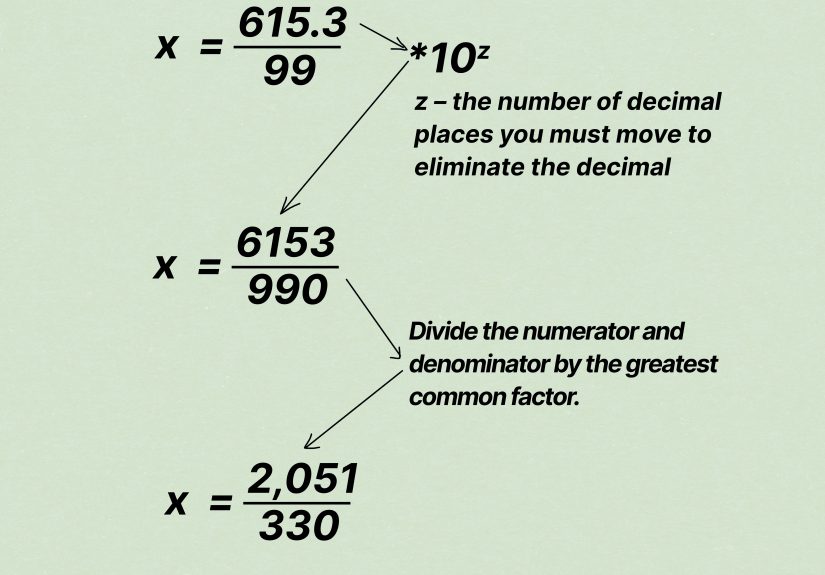
- Simplify the fraction by dividing numerator and denominator by their greatest common factor.
Special Cases (That People Overthink)
1. Negative Repeating Decimals
Easy: convert the positive version to a fraction, then add the minus sign.
Example: -0.overline{27} = -3/11.
2. Whole Number Plus Repeating Decimal
Convert the repeating decimal part, then add the whole number.
Example: 2.overline{3}:
0.overline{3} = 1/3- So
2.overline{3} = 2 + 1/3 = 7/3.
3. Already a Nice Pattern? Use 9s, 99s, 999s
For decimals like 0.overline{3}, 0.overline{27}, 0.overline{142857}, you can go straight to:
- One repeating digit: denominator 9
- Two repeating digits: denominator 99
- Three repeating digits: denominator 999
- Then simplify
Example: 0.overline{27} = 27/99 = 3/11.
Common Mistakes to Avoid
- Stopping the decimal too early. Writing
0.333instead of0.overline{3}changes the value. - Forgetting to multiply by the right power of 10. Match the number of repeating digits.
- Ignoring the non-repeating part. When there’s a “prelude” before the repeat, handle it carefully.
- Not simplifying.
72/99is fine, but8/11is cleaner and more standard.
Quick Practice (With Answers)
Try these, then check below:
0.overline{6}0.overline{81}0.2overline{7}1.overline{09}
Answers:
0.overline{6} = 2/30.overline{81} = 81/99 = 9/110.2overline{7} = (27 - 2)/(10 × 9) = 25/90 = 5/181.overline{09} = 1 + (109 - 1)/(100 × 99) = 1 + 108/990 = 1 + 12/110 = 1 + 6/55 = 61/55
Real-Life Experiences & Tips: Making Repeating Decimals Feel Easy
If converting repeating decimals to fractions feels “too algebraic,” you’re not alone. Let’s talk about how people actually learn this — in classrooms, tutoring sessions, and at kitchen tables covered in scratch paper.
1. The “Wait, That’s It?” Moment. Many students struggle with repeating decimals for years, then see the algebra trick once and suddenly everything clicks. The big turning point usually comes when they understand why subtraction cancels the repeating part: lining up the repeating tails makes them identical, so they disappear when you subtract. Once that logic lands, the method feels less like a trick and more like a superpower.
2. Writing Out Extra Digits Helps. A practical habit: always write several cycles of the repeating pattern before doing the algebra. For example, instead of staring at 0.overline{27}, write 0.272727.... That makes it visually obvious why something like 100x = 27.272727... lines up with x = 0.272727... and why subtraction works so cleanly.
3. Color-Coding the Repeating Part. Teachers and tutors often use different colors or underlines to mark the repeating block. This is especially helpful with decimals like 0.583overline{83}, where there’s a non-repeating part and then a repeating pair. If you highlight the repeating part, it’s easier to set up the right powers of 10 and avoid mixing digits.
4. Connecting to Fractions You Already Know. Another confidence booster is linking repeating decimals back to familiar fractions:
1/3 = 0.overline{3},
2/3 = 0.overline{6},
1/9 = 0.overline{1},
4/9 = 0.overline{4}.
When students see that the method reproduces these “famous” pairs, they trust the process more and are more willing to apply it to new problems.
5. Avoiding Calculator Traps. Calculators often show rounded versions like 0.3333333, not the full repeat. In real life (finance, measurements, science), understanding that a repeating decimal represents an exact fraction can prevent rounding errors and weird results when you scale numbers up. People who work a lot with ratios, probabilities, or interest rates quickly realize that switching to fractions gives them tighter, cleaner answers.
6. Practice With Purpose, Not Pain. The most effective learners don’t brute-force 100 random problems. Instead, they:
- Start with simple pure repeats (
0.overline{4},0.overline{27}). - Move to mixed forms (
0.1overline{6},0.25overline{4}). - Try whole numbers plus repeats (
3.overline{2},5.7overline{81}).
By the time you’ve handled a dozen well-chosen examples, the steps feel automatic. Many students report that after a week of short, focused practice, they can do most of these in their head or with just a couple of lines of algebra.
7. Teaching It to Someone Else. One of the best “experience hacks”: explain the method to a friend, sibling, or your future self on a piece of paper. When you can say, “Let x be the decimal, multiply to line up the repeat, subtract, solve, simplify” without checking notes, you’ve completely owned the concept.
Bottom line: changing repeating decimals into fractions is not a trick reserved for math geniuses. It’s a pattern, powered by simple algebra, that anyone can learn, remember, and even enjoy. The more you play with it, the more satisfying it gets.
Conclusion & SEO Summary Block
Repeating decimals look endless, but they’re secretly well-behaved. With one clear method — define x, multiply, subtract, solve, simplify — you can turn any repeating decimal into an exact fraction. Whether you’re helping a middle schooler with homework, polishing your skills for exams, or building crystal-clear math content for the web, this approach keeps your numbers precise and your explanations solid.
sapo: Repeating decimals don’t have to be intimidating or confusing. This in-depth guide walks you through a simple, universal method to change repeating decimals into fractions, shows how to handle tricky cases with non-repeating parts, highlights common mistakes, and shares real-life learning experiences so students, parents, and educators can finally feel confident working with recurring decimals.