Table of Contents >> Show >> Hide
- The Short Answer
- Start with the Occasion, Not Just the Names
- The Best Ways to Address a Married Gay Couple with the Same Last Name
- Who Goes First?
- Examples for Different Situations
- What Not to Do
- What About Inner Envelopes, Place Cards, and Emails?
- When to Ask the Couple Directly
- Why This Topic Matters More Than It Seems
- Real-Life Experiences and Lessons from Addressing Married Gay Couples
- Final Thoughts
If you have ever stared at an envelope like it just asked you to solve a tax equation, welcome. Addressing mail to a married gay couple with the same last name can feel weirdly stressful, mostly because people are terrified of getting names, titles, or etiquette wrong. Nobody wants their thoughtful wedding invitation, holiday card, or formal note to arrive with the social grace of a potato.
The good news is this: it is not nearly as complicated as people make it. In most cases, you address a married gay couple with the same last name using the same principles you would use for any married couple: be accurate, be respectful, and choose a format that matches the level of formality. That means full names for formal occasions, optional titles depending on the tone, and a healthy respect for the couple’s actual preferences. Revolutionary, right?
This guide breaks down exactly how to address a married gay couple with the same last name, including formal invitation wording, casual mailing options, title choices, examples, common mistakes, and what to do when you are unsure. We will also talk about real-life etiquette experiences, because nothing teaches faster than hearing how actual humans navigated the envelope Olympics.
The Short Answer
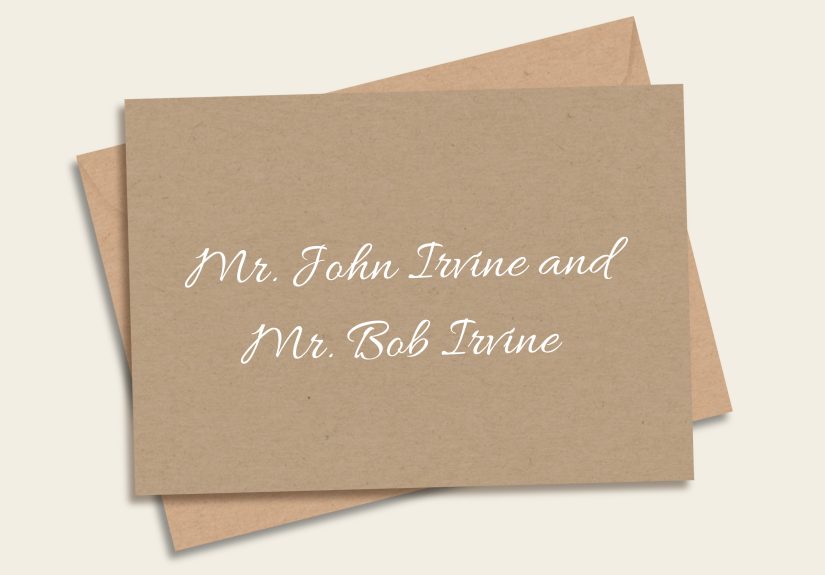
If a married gay couple shares the same last name, the safest and most modern choice is to write both full names clearly. For example:
Mr. Daniel Harper and Mr. Lucas Harper
or
Mrs. Elena Brooks and Mrs. Maya Brooks
That format is respectful, clear, inclusive, and easy to understand. It also avoids awkward old-school constructions that make one spouse disappear into the grammatical fog.
For a more formal style, some people use plural honorifics such as:
The Mssrs. Daniel and Lucas Harper
The Mesdames Elena and Maya Brooks
Those versions are grammatically proper in formal etiquette circles, but they can sound a little grand, a little fancy, and a little like they arrived by carriage. They are correct, but they are not always the most natural option for modern everyday use.
Start with the Occasion, Not Just the Names
Before choosing wording, ask yourself one question: What kind of mail is this?
Formal Wedding Invitation
For a formal wedding invitation, use full names and titles if the event has a traditional tone. Example:
Mr. Daniel Harper and Mr. Lucas Harper
Modern Wedding Invitation or Save-the-Date
If the wedding is modern, relaxed, or design-forward, you can skip titles and go with:
Daniel and Lucas Harper
Holiday Card or Casual Note
For casual mail, you have even more flexibility:
Daniel and Lucas Harper
The Harpers
Simple wins. No gold medal is awarded for sounding like a Victorian butler.
The Best Ways to Address a Married Gay Couple with the Same Last Name
1. Use Both Full Names
This is the clearest and most respectful format, especially when you do not know the couple’s exact title preferences:
Mr. Aaron Cole and Mr. Nathan Cole
Mrs. Hannah Foster and Mrs. Claire Foster
Why this works so well: both spouses are fully named, neither one is treated like an accessory, and there is zero confusion about who is invited.
2. Use First Names and Shared Last Name for a Modern Feel
If the tone is friendly rather than formal, you can trim the repetition:
Aaron and Nathan Cole
Hannah and Claire Foster
This version works beautifully on casual invitations, greeting cards, and personal correspondence. It is warm, readable, and not trying too hard to impress the envelope.
3. Use Plural Titles for Traditional Formality
If you want to lean into formal etiquette, you may use plural titles:
The Mssrs. Aaron and Nathan Cole
The Mesdames Hannah and Claire Foster
This style is polished and technically elegant, but it is not the default for everyone. Some couples love it. Some couples hear it and immediately picture monocles. Know your audience.
4. Use “The [Last Name] Family” Only When the Whole Household Is Invited
If you are inviting the couple and their children, or sending a broad family holiday card, you can write:
The Foster Family
That is convenient, but do not use it when you specifically mean only the spouses. If only the adults are invited to dinner or a wedding, name the adults. Clarity beats guesswork every single time.
Who Goes First?
Ah yes, the classic etiquette panic: whose name comes first?
For a married gay couple with the same last name, there is usually no fixed universal rule that says one spouse must always be listed first. In practice, the most common approaches are:
- list the names alphabetically by first name,
- list the person you know better first, or
- follow the couple’s own preference if you know it.
If you know the couple personally, their preference matters more than tradition. If you do not know, alphabetical order is the cleanest, fairest, least dramatic choice. Nobody can accuse the alphabet of favoritism. It barely has enough energy to keep “Q” employed.
Examples for Different Situations
Formal Outer Envelope
Mr. Benjamin Reed and Mr. Oliver Reed
Formal Traditional Style
The Mssrs. Benjamin and Oliver Reed
Formal Women’s Example
Mrs. Sophia Grant and Mrs. Isabel Grant
Traditional Women’s Example
The Mesdames Sophia and Isabel Grant
Modern Invitation Envelope
Benjamin and Oliver Reed
Sophia and Isabel Grant
Holiday Card
The Reeds
The Grants
When One Spouse Has a Professional Title
Dr. Marcus Lee and Mr. Adrian Lee
Judge Renee Lawson and Mrs. Tara Lawson
In those cases, the spouse with the professional title often goes first. Titles like Doctor or Judge are not decorative sprinkles; they affect the format.
What Not to Do
Let us save you from the top etiquette face-plants.
Do Not Assume One Format Fits Every Couple
Some couples love formal titles. Others would rather eat the envelope than be called “The Mesdames.” Preferences vary. Respect beats rigid rules.
Do Not Erase One Person’s Identity
Avoid formats that reduce one spouse to a shadow, especially if the couple has made their naming preferences clear. Writing both names is almost always the stronger option.
Do Not Guess at Names or Spellings
If you misspell a surname or use the wrong title, the whole thing can feel careless. Double-check spellings, suffixes, hyphenation, and professional titles before sending anything important.
Do Not Use “The Smith Family” When the Kids Are Not Invited
This causes confusion fast. If only the married couple is invited, write their names. If the whole household is included, then family wording makes sense.
Do Not Overthink It Until You Create a Minor Spiritual Crisis
Etiquette exists to help people feel respected, not to trap you in a paper labyrinth. The goal is kindness and clarity, not Olympic-level envelope perfection.
What About Inner Envelopes, Place Cards, and Emails?
Inner Envelopes
If you are using inner envelopes for a formal wedding invitation, you can simplify:
Mr. Harper and Mr. Harper
Daniel and Lucas
The exact format depends on how formal the event is and how much room you have.
Place Cards
Use the names each guest actually goes by at the event. That often means:
Daniel Harper
Lucas Harper
No need to make a dinner place card sound like a legal deposition.
Email or Digital Invitations
Digital invites usually lean more modern:
Daniel and Lucas Harper
That is usually perfect. Clean, direct, and impossible to misread.
When to Ask the Couple Directly
If you are unsure, asking is not rude. In many cases, it is the most respectful move. A simple message works:
“I want to make sure I address your invitation correctly. Do you prefer Daniel and Lucas Harper, Mr. Daniel Harper and Mr. Lucas Harper, or something else?”
This shows care, not ignorance. People generally appreciate being asked how they would like to be addressed, especially when names, titles, and family identity matter to them.
And honestly, five seconds of asking can save thirty minutes of frantic googling and one deeply unnecessary group chat debate.
Why This Topic Matters More Than It Seems
On the surface, this looks like a tiny etiquette issue. It is just an envelope, right? But names are personal. Titles are personal. Marriage is personal. The way you address a married gay couple with the same last name can communicate warmth, respect, equality, and attention to detail, or the exact opposite.
That is why the best etiquette advice is no longer just about tradition. It is about making people feel accurately seen. Modern manners are not less thoughtful than old-school manners. They are thoughtful in a more human way.
So yes, grammar matters. Style matters. But people matter more.
Real-Life Experiences and Lessons from Addressing Married Gay Couples
I have heard versions of this story more than once: someone sits at a kitchen table surrounded by invitations, a calligraphy pen, three cups of coffee, and the growing suspicion that envelopes were invented by chaos. Then they reach the name of a married gay couple with the same last name and freeze like a computer trying to load seventeen tabs at once.
One person I know was addressing wedding invitations for a very formal event. She wanted everything to be elegant and traditional, but she also did not want to use wording that sounded stiff or outdated. She ended up writing Mr. Evan Miller and Mr. Thomas Miller, and later one of the guests told her he appreciated that both names appeared fully. It felt respectful, balanced, and natural. That tiny detail made a good impression because it showed she had thought about the couple as two equal people, not as a formatting problem.
Another experience came from a holiday card situation. A family friend addressed a card to The Johnson Family when only the couple lived in the home and they did not have children. It was not offensive, exactly, but it felt oddly generic, like a label printed by a machine that wished everyone a pleasant fiscal quarter. The next year, the sender changed it to Chris and Adam Johnson, and suddenly the message felt warmer and more personal. Same people, same last name, much better effect.
I have also seen the opposite problem: somebody trying so hard to be formal that the envelope became a linguistic obstacle course. The plural-title version can be correct, but if you are not sure the couple likes that tone, it can sound distant. One couple laughed after receiving an invitation addressed as The Mssrs. Bennett because, in their words, it made them sound “like a law firm with excellent lighting.” They were not offended, but they definitely preferred a simpler approach.
The most successful examples all have one thing in common: the sender paid attention to the couple, not just the rulebook. If the couple used professional titles in daily life, those were included. If they preferred first names in social settings, the invitation reflected that. If there was uncertainty, the sender asked. That question alone often prevented awkwardness.
There is also a deeper lesson here for anyone writing to a married gay couple with the same last name: etiquette is evolving, and that is not a bad thing. The point of good manners is not to preserve dusty formulas in amber. The point is to make people feel respected and welcome. Sometimes that means using a beautifully formal construction. Sometimes it means dropping titles and writing the names in the most human, straightforward way possible.
In real life, people remember how you made them feel more than they remember whether your envelope could pass a 1952 finishing-school exam. If your wording is accurate, kind, and thoughtful, you are already winning.
Final Thoughts
So, how do you address a married gay couple with the same last name? The best answer is usually the simplest one: use both names clearly, match the level of formality to the occasion, and honor the couple’s preferences whenever possible.
If you want the most dependable format, go with full names:
Mr. Daniel Harper and Mr. Lucas Harper
Mrs. Elena Brooks and Mrs. Maya Brooks
If you want something modern and easy, use:
Daniel and Lucas Harper
Elena and Maya Brooks
And if you want to go very formal, plural titles are available, polished, and waiting in the wings like etiquette theater kids.
At the end of the day, the right wording is the one that is respectful, clear, and true to the people receiving it. That is the whole game. The envelope should not steal the show. It should simply open the door with grace.