Table of Contents >> Show >> Hide
- The Core System: The “10-Point Must” Explained (Without the Headache)
- What Judges Are Actually Scoring Each Round
- Common Round Scores: What They Mean in Real Life
- Knockdowns: Why One Moment Can Flip an Entire Fight
- Point Deductions: The “Minus One” Everyone Forgets
- Stoppages From Cuts, Headbutts, and Other Chaos
- How Final Results Are Determined
- Professional vs Amateur Scoring (Quick, Useful Differences)
- How to Score a Fight at Home (And Keep Your Group Chat Civil)
- Frequently Confusing Questions (Answered Like a Human)
- Experience Section: What It Feels Like When You Start Scoring Boxing (500+ Words)
- Conclusion: Reading the Scorecard Without Losing Your Mind
Boxing scoring has a special talent: it can turn a clear “That guy won!” into a post-fight group therapy session for everyone watching. The good news is the system isn’t mysteriousit’s just subjective, layered, and occasionally allergic to your vibes. Once you understand what judges are actually scoring (and what they’re not scoring), most scorecards stop feeling like they were generated by a roulette wheel.
In this guide, we’ll break down the 10-point must system, what wins a round, how knockdowns and fouls change scores, and how those numbers become the final result you hear announced in the ring.
The Core System: The “10-Point Must” Explained (Without the Headache)
Most professional boxing is scored using the 10-point must system. “Must” means the judge must give the round winner 10 points. The other boxer gets 9 or fewer (or, in rare cases, 10 if the round is dead even).
- 10–9: Normal close or clear round.
- 10–8: Usually a knockdown, or a dominant round with big damage/control.
- 10–7: Multiple knockdowns or an extreme one-way round.
- 10–10: Even round. Legal, but uncommon in modern judging.
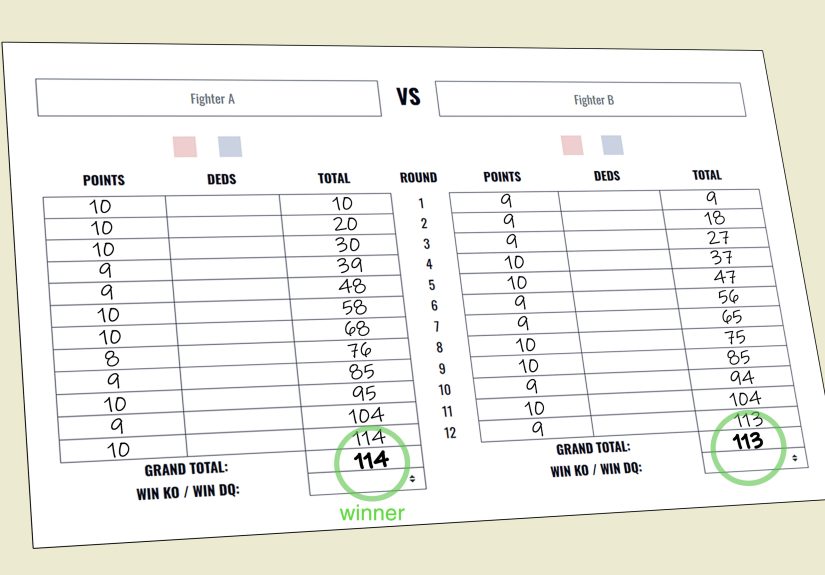
Typically, three judges score the bout independently, round by round. Add up all rounds, and each judge has a final total. Two or three judges agreeing decides the outcome (more on decision types later).
What Judges Are Actually Scoring Each Round
Judges aren’t scoring “who moved forward more” or “who looked cooler doing it.” They’re supposed to evaluate the round using a handful of core factors. Different commissions and organizations phrase them slightly differently, but the big ideas are consistent.
1) Clean, Effective Punching (Quality > Quantity)
“Clean” generally means a legal punch that lands clearly with the knuckle part of the glove on a legal target (usually above the belt and the front/sides of the head and torso). “Effective” means it has visible impactsnapping the head back, moving the opponent, disrupting balance, forcing a reset, or clearly scoring through a guard.
A flurry that mostly hits elbows and gloves might look busy on TV, but ringside judges may score it lower than a few crisp, damaging counters.
2) Effective Aggression (Pressure That Pays Rent)
Aggression matters when it produces results. Marching forward while eating jabs is just cardio with consequences. Judges look for the boxer who is initiating action and landing while avoiding return fire.
3) Ring Generalship (Who’s Running the Round?)
Ring generalship is control: setting the pace, choosing where exchanges happen, making the opponent fight your fight. It can look like cutting off the ring to trap a mover, or staying long and disciplined so a brawler can’t get started.
4) Defense (Making the Other Person Miss Matters)
Slipping, blocking, parrying, rolling, stepping out at anglesgood defense isn’t just “not getting hit.” It’s making the opponent’s offense inefficient and then making them pay for it.
One important reality check: judges weigh these factors differently from round to round depending on what actually happened. In some rounds, clean punching decides it. In others, control or damage swings it.
Common Round Scores: What They Mean in Real Life
10–9: The Standard Round
Most rounds are 10–9. That can mean “close but Boxer A edged it” or “clear win without a knockdown.” The score doesn’t tell you how close it was it just says who won the round.
Example: Boxer A lands the sharper jab and two clean right hands. Boxer B throws more, but most shots are blocked. Even if it feels competitive, many judges go 10–9 for Boxer A.
10–8: The Knockdown (Or the Beatdown) Round
A knockdown often produces a 10–8 because it’s a high-impact event and usually reflects a significant advantage. But a 10–8 can also happen without a knockdown if one boxer dominates with heavy, sustained, damaging offense or overwhelming control.
Example: Boxer A drops Boxer B with a left hook (knockdown), then wins the rest of the round. Many judges score 10–8. If the knockdown was a flash slip-and-fall with little follow-up, you’ll still see 10–8 frequently, but it can be debated.
10–7: Multiple Knockdowns or Total Collapse
Two knockdowns in a round often leads to 10–7. It can also happen if a boxer is badly hurt repeatedly, barely surviving, and offering little offense. It’s less common than fans thinkmany judges “cap” extreme rounds at 10–8 unless knockdowns stack up.
10–10: The Unicorn Score
A 10–10 is allowed, but it’s rare in many pro environments because judges are encouraged to pick a winner. Still, it can appear in rounds where neither boxer clearly separates and action is minimal or perfectly matched.
Knockdowns: Why One Moment Can Flip an Entire Fight
In the 10-point must system, a knockdown creates a bigger points gap than a normal round. Win a round 10–9 and you gain 1 point. Win it 10–8 and you gain 2 points. Across 10 or 12 rounds, that’s enormous.
That’s why you’ll hear fans say things like: “He won more rounds, but the knockdowns cost him the fight.” Yep. That’s not a glitch; that’s the math.
Also: a fighter can win a round overall but still score only 9 if they got dropped. For example, if Boxer A dominates for two minutes, gets caught and knocked down, then finishes strong, judges often land on 9–9 or 10–9 either way depending on how they weigh the dominance versus the knockdown.
Point Deductions: The “Minus One” Everyone Forgets
Referees manage fouls and can deduct points. Judges don’t invent deductions on their own; they apply what the referee signals. Deductions are taken in the round they occur, changing what would’ve been a normal score.
Common Fouls That Can Cost Points
- Low blows
- Headbutts (intentional)
- Hitting behind the head (“rabbit punches”)
- Hitting on the break or after the bell
- Holding excessively (especially to stop offense)
- Using the forearm, elbow, or shoulder illegally
How Deductions Change the Numbers
Deductions usually subtract 1 point, but some rulesets call for 2 points in specific situations (especially intentional fouls that cause injury). The key is this: deductions apply to the offender’s score after the judge decides who won the round.
| What You Thought Happened | Round Before Deduction | After 1-Point Deduction | What It Means |
|---|---|---|---|
| Boxer A wins the round, commits a foul | 10–9 A | 9–9 | Round becomes even on the card |
| Boxer A loses the round, commits a foul | 9–10 B | 8–10 B | Boxer A falls further behind |
| Boxer A scores a knockdown but commits a foul | 10–8 A | 9–8 | Still wins the round, but advantage shrinks |
This is where a lot of “Wait, how did that end up a draw?” moments come from. A single point deduction can swing a tight fight.
Stoppages From Cuts, Headbutts, and Other Chaos
If a fight ends early, the reason matters. A legal punch that causes a cut and leads to a stoppage is often a TKO win. But an accidental headbutt that causes a cut? Now you’re in rulebook territory.
Many jurisdictions follow versions of these principles:
- Intentional foul causing severe injury: can lead to disqualification of the offender.
- Accidental foul causing stoppage early: can result in a No Contest (especially if too few rounds are completed).
- Accidental foul causing stoppage later: can go to the scorecards for a Technical Decision.
The exact thresholds (like how many rounds must be completed) can vary by commission, which is why you sometimes hear commentators say, “We need to check with the commission on this one.” Translation: “Please don’t tweet yet.”
How Final Results Are Determined
At the end, each judge totals the points from all rounds. Then the announcer reads the outcome based on how many judges picked each boxer.
Decision Wins
- Unanimous Decision (UD): All three judges score it for the same boxer.
- Split Decision (SD): Two judges pick Boxer A, one picks Boxer B.
- Majority Decision (MD): Two judges pick Boxer A, one judge has it a draw.
Draws
- Unanimous Draw: All three judges score it even.
- Majority Draw: Two judges score it even; one picks a winner.
- Split Draw: One judge for Boxer A, one for Boxer B, one even.
Non-Decision Outcomes
- KO: Fighter can’t beat the count after a knockdown.
- TKO: Referee, doctor, corner stoppage, or injury ends the bout (fighter can’t safely continue).
- RTD: “Retired”a corner stops the fight between rounds.
- DQ: Disqualification due to fouls (especially intentional fouls causing injury or repeated violations).
- No Contest (NC): Fight ends early due to an accidental issue and can’t be scored as a win/loss under the rules.
- Technical Decision: Early stoppage (often from accidental foul) after enough rounds, goes to scorecards.
Professional vs Amateur Scoring (Quick, Useful Differences)
Amateur boxing in the U.S. also uses a version of the 10-point must system, but the emphasis often leans more toward clean scoring blows, technique, and overall dominance rather than “damage-first” interpretations you’ll sometimes see in pro fights. Amateur events may use more judges than pro fights, depending on the competition.
The big takeaway: the framework is similar, but the judging culture and priorities can feel differentespecially with shorter bouts where every minute matters.
How to Score a Fight at Home (And Keep Your Group Chat Civil)
- Score round-by-round. Don’t “score the fight” in your head and reverse-engineer the rounds later.
- Write down knockdowns and deductions immediately. They’re the biggest math movers.
- Expect close rounds. If you have eight “definitely his” rounds but can’t explain why, you might be scoring vibes.
- Be consistent with criteria. If you reward pressure in Round 2, don’t punish it in Round 6 unless the effectiveness changed.
- Accept subjectivity. Two smart fans can disagree on a swing round without anyone being a villain.
Frequently Confusing Questions (Answered Like a Human)
Can you score 10–8 without a knockdown?
Yes. It’s less common, but a judge can award 10–8 for a dominant round with major damage or control even without an official knockdown.
Can both fighters get knocked down in the same round?
Yes, and it gets spicy. If each scores a knockdown, the “extra point” effect can cancel out, and the round often returns to a 10–9 based on who did better otherwise.
Why do scorecards look weird even when the winner feels obvious?
Because rounds are scored individually. A fighter can win six rounds clearly and lose six rounds narrowlyand the totals can be close. Add one knockdown or one deduction and the math swings fast.
Experience Section: What It Feels Like When You Start Scoring Boxing (500+ Words)
The first time you try to score a fight seriouslypen and paper, round-by-roundyou’ll probably experience all five stages of boxing fandom at once. It usually starts with confidence. Round 1: “Easy. He landed the jab, controlled the center, 10–9.” Round 2: “Also easy.” Round 3: “Okay, that one was close.” By Round 5 you’re sweating like you’re the one fighting, because suddenly you realize scoring is less about counting punches and more about interpreting moments.
One common experience is discovering the difference between “busy” and “effective.” On TV, a fast combination can look like a jackpot. From a judge’s angle, it might be mostly gloves and shoulders. Meanwhile, a quieter fighter lands a short right hand you almost missuntil the opponent’s legs politely request a reboot. When you rewatch later, you’ll notice how often the most meaningful punches are the simplest ones: a jab that snaps the head back, a counter that stops a rush, a body shot that makes the other boxer suddenly hate breathing.
Another experience: you’ll start respecting footwork like it’s a superpower. Early on, a fighter “running” can annoy casual viewers. But when you score, you begin to separate escaping from controlling. A mover who is simply avoiding contact might lose rounds because they aren’t landing enough. A mover who makes the opponent miss, resets the distance, and tags them on the way in? That looks like defense + ring generalship + clean punching, which is a very judge-friendly recipe. The same movement can feel totally different depending on what happens at the end of it.
Then there’s the unforgettable moment you learn what a knockdown does to your neat little math. You can have a fighter “winning” the round in your mindlanding more, looking sharperuntil they get dropped with 20 seconds left. Suddenly you’re staring at your card like it personally betrayed you. Do you score it 10–8 because of the knockdown? Do you go 9–9 because the other fighter dominated everything else? This is where fans realize boxing scoring isn’t just arithmetic; it’s weighting. A knockdown is a giant data point, but it doesn’t erase everything that happened before it. Different judges weigh it differently, and your brain will, too.
You’ll also notice how point deductions create “silent drama.” In the arena, half the crowd misses the referee’s signal. At home, you might hear commentary mention it once, then the fight keeps moving. Three rounds later, the score announcement hits and everyone acts shocked. But if you tracked the deduction when it happened, the result often makes more sense. That’s a classic scoring experience: realizing the weird scorecard wasn’t always weirdsometimes you just didn’t see the penalty that changed the fight’s shape.
Finally, the most relatable experience: the swing round. It’s the round where both fighters land, neither clearly dominates, and your confidence evaporates. You’ll replay it in your head: “He landed the cleaner shots… but the other guy controlled the ring… but those counters were sharp… but the body work mattered…” Welcome to boxing. Swing rounds are where reasonable people disagree, and where judges earn (or lose) the crowd. Once you accept that a close fight can honestly produce different cards, you’ll enjoy the sport moreand you’ll still complain, but with better vocabulary.
Conclusion: Reading the Scorecard Without Losing Your Mind
Boxing scoring comes down to this: judges score each round using the 10-point must system, weighing clean effective punching, effective aggression, ring generalship, and defense. Knockdowns widen the scoring gap, deductions can quietly flip close fights, and the final result is simply the sum of those rounds across three independent cards. You don’t have to love every decisionbut once you know the rules and the math, you can at least argue like a professional. (Or, at minimum, like someone who owns a pen.)