Table of Contents >> Show >> Hide
- What Counts as a “Forgotten Moon Base”?
- The First Serious American Moon Base: Project Horizon
- Apollo’s Hidden Future: Moon Bases on Wheels and in Phases
- Why Apollo Never Became a Moon Neighborhood
- The 1980s Revival: When Moon Bases Returned in Conference Proceedings
- The Space Exploration Initiative and the Return of Big Lunar Thinking
- First Lunar Outpost: The Moon Base That Almost Escaped the Filing Cabinet
- Why These Moon Bases Were Forgotten
- What the Old Moon Base Plans Got Right
- Artemis and the Great Un-Forgotten Moon Base
- The Human Experience These Forgotten Moon Bases Were Trying to Design
- Conclusion
Everybody remembers the Moon landing. The boot prints, the grainy television, the line about one giant leap. What most people do not remember is what came after the applause: stacks of serious plans for moon bases that engineers, soldiers, scientists, and NASA planners spent years sketching in painful detail. These were not comic-book doodles or late-night “what if” napkin scribbles. They were studies with crew counts, reactor layouts, logistics tables, habitat ideas, surface vehicles, and enough acronyms to make a filing cabinet cry.
In other words, America did not just dream about visiting the Moon. It repeatedly tried to figure out how to stay there. And then, again and again, those plans slipped into the background, pushed aside by politics, budgets, changing priorities, and the stubborn fact that building a town on another world is a little more complicated than assembling patio furniture.
This is the history of those forgotten moon bases: the real studies, the abandoned architectures, the half-buried proposals, and the lunar futures that almost became part of everyday history.
What Counts as a “Forgotten Moon Base”?
To be clear, there were no secret American cities on the Moon, no hidden diners serving freeze-dried pie, and no janitor sadly sweeping regolith in a dome somewhere beyond Mare Tranquillitatis. The “forgotten moon bases” of history were design studies, mission architectures, engineering concepts, and follow-on programs that never made it past the paper stage.
Some were military. Some were scientific. Some were stepping stones to Mars. Some were part outpost, part laboratory, part giant homework assignment for future engineers. What unites them is this: each one treated permanent or semi-permanent life on the Moon as a real planning problem, not a fantasy.
The First Serious American Moon Base: Project Horizon
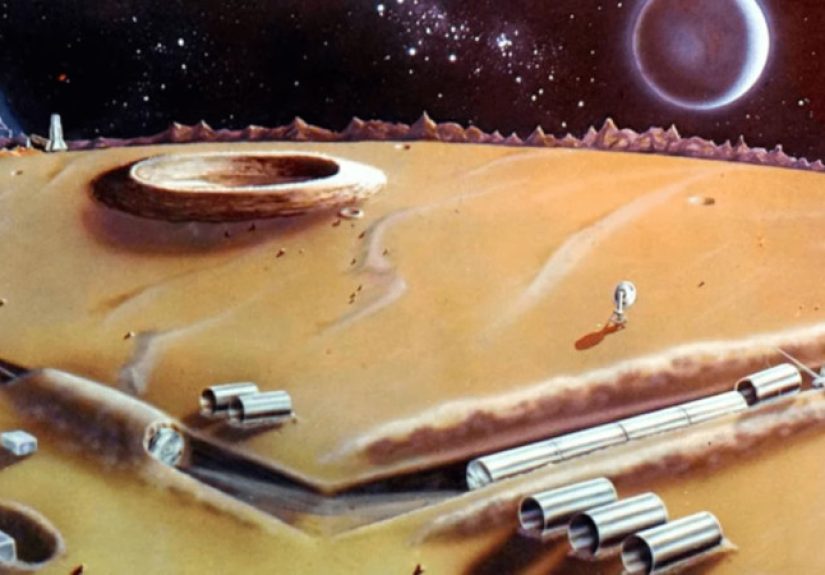
If you want the opening chapter of forgotten lunar bases, start in 1959 with Project Horizon. This U.S. Army study was one of the earliest serious American efforts to design a lunar outpost. And it was not modest. Horizon imagined a moon station staffed by roughly 10 to 20 people, supported by a huge launch effort, protected by buried modules, and powered by nuclear reactors. That is a long way from “let’s plant a flag and head home before dinner.”
A Moon Base with Military Roots
Project Horizon emerged during the Cold War, which meant it mixed science, strategy, and national prestige in one aggressively ambitious package. The base was envisioned as more than a scientific camp. It could protect American interests, support reconnaissance, improve communications, help map the Earth and Moon, and eventually serve as a staging point for deeper space exploration. If that sounds like a scientific station wearing combat boots, that is because it more or less was.
The numbers were eye-popping. The study estimated that dozens upon dozens of heavy launches would be needed to deliver construction material, equipment, food, water, and everything else human beings insist on requiring in order to remain alive. The outpost would include living quarters, recreation space, storage, labs, communications sections, and medical capability. Even more striking, the plan called for using lunar soil and terrain as protection by burying modules for insulation and radiation shielding. That idea has aged surprisingly well.
Project Horizon never became a building program. Once the civilian space effort consolidated under NASA, the Army’s lunar outpost study was effectively handed over for possible future use. So the first great American moon base did not die in a blaze of engineering failure. It died the quieter death of bureaucratic reassignment, which is less cinematic but very common in space history.
Apollo’s Hidden Future: Moon Bases on Wheels and in Phases
By the mid-1960s, NASA was not just trying to land on the Moon. It was already thinking beyond the first footprints. That is where some of the most fascinating forgotten moon base ideas appear, because Apollo was supposed to be the beginning of intensive lunar exploration, not the grand finale.
MOLAB: The Moon Base That Could Drive
One of the best examples is MOLAB, short for Mobile Laboratory. NASA studied it as an early way to support human scientific exploration on the lunar surface. The concept was less “permanent base city” and more “rolling field station with attitude.”
MOLAB was designed to provide shelter and transportation for a two-person crew during stays of about two weeks on the Moon. In essence, it was part habitat, part rover, part survival box with a research grant attached. Engineers evaluated shelters, rover concepts, command systems, logistics, and development costs. This was not casual brainstorming. NASA and its contractors were working through how a mobile lunar laboratory would function as real hardware.
The appeal was obvious. Before you build a permanent base, you need to learn how people move, work, rest, repair equipment, and stay sane on the lunar surface. MOLAB represented that early practical stage: not a city on the Moon, but the kind of experimental outpost that teaches you how a city might one day work.
LESA: From Short Visits to a Real Lunar Presence
If MOLAB was a rolling campsite, LESA, or Lunar Exploration System for Apollo, was the bigger architectural dream. LESA studies dealt with life support, power, fuel, communications, mission objectives, and phased base evolution. That last phrase matters. NASA planners were not merely asking how to survive a visit. They were asking how a sequence of missions could grow into something durable.
This was the point when moon-base thinking became more systematic. Instead of treating the Moon as a destination for brief heroic visits, LESA treated it like a place where infrastructure could evolve over time. Shelters could become outposts. Outposts could become research stations. Mobility systems, logistics modules, and support equipment could all build toward longer habitation. In short, NASA was already drafting the grammar of living off Earth.
Why Apollo Never Became a Moon Neighborhood
Here comes the plot twist: the United States reached the Moon, and that very success helped expose the political problem of what came next. Once Apollo had accomplished President Kennedy’s goal, the urgency that justified huge spending began to fade. NASA’s budget had already peaked in the 1960s and was declining even before the agency finished its lunar triumph.
Post-Apollo planning did continue. In 1969, NASA’s internal thinking included ideas for a space station, a shuttle, a lunar base by the mid-1970s, and eventually human missions to Mars. On paper, the road from Apollo to a permanent lunar presence looked almost straightforward. In reality, it ran straight into the wall of national priorities, Vietnam-era spending pressures, domestic policy competition, and shifting White House enthusiasm.
The result was painful but familiar: long-term lunar ambitions were trimmed, delayed, repackaged, or replaced. The Apollo Applications Program shrank. Skylab survived in modified form. The Moon base did not. Instead of becoming the first suburb of deep space, the lunar surface became a historical memory with excellent photo coverage.
The 1980s Revival: When Moon Bases Returned in Conference Proceedings
Moon-base enthusiasm came roaring back in the 1980s, and it did so in a very American way: through conferences, reports, studies, technical sessions, and enough collected papers to threaten the structural integrity of bookshelves.
The 1984 symposium Lunar Bases and Space Activities of the 21st Century showed that serious lunar-settlement thinking was alive again. The subjects were remarkably practical: lunar transportation, construction methods, oxygen production from regolith, moon-based astronomy, life support, health maintenance, materials processing, and social questions tied to long-term habitation.
This was not old-fashioned flag-and-footprint exploration. It was infrastructure thinking. How do you power a base? How do you shield it? What can you make from local materials? Can the Moon serve as a science platform, an industrial site, and a Mars rehearsal stage all at once? The answer from the 1980s lunar planning crowd was basically, “Yes, obviously, now please pass the binder.”
A second major conference in 1988 pushed the conversation further. Sponsored by NASA’s Office of Exploration and the Lunar and Planetary Institute, it reflected a growing interest in permanent presence rather than isolated missions. The Moon was being reimagined as a place to work, not just visit.
The Space Exploration Initiative and the Return of Big Lunar Thinking
Office of Exploration Studies
In the late 1980s, NASA’s Office of Exploration ran case studies that treated the Moon and Mars as linked problems. One major lesson was that robotic precursors, heavy-lift launch capability, life-science research, and new surface systems would all be necessary for sustained human exploration. Another was that lunar outposts could not just depend forever on Earth for everything. In-situ resource use, especially making useful materials from lunar soil, moved from science-fiction flavoring to serious planning priority.
By 1989, lunar studies were being tied explicitly to Mars strategy. The Moon was valuable not just on its own merits, but as a place to test operations, power systems, life support, mobility, and autonomy before sending people much farther away. If that sounds familiar, congratulations: you have noticed that modern lunar planning still uses basically the same logic.
The Synthesis Group in 1991
Then came the Synthesis Group, one of the more interesting episodes in lunar planning history. This effort examined multiple exploration architectures, including one memorably titled The Moon to Stay and Mars Exploration. NASA and the Vice President’s office cast the net widely for ideas from universities, federal agencies, professional societies, and industry. Thousands of packets went out. More than a thousand submissions came back.
What is striking here is not just the scope, but the underlying mood. The early 1990s briefly reopened the possibility that a permanent return to the Moon might be the first real step in a decades-long national exploration program. Nuclear power, heavy lift, radiation shielding, telerobotics, life support, cryogenic systems, and resource processing all appeared as key technologies. Once again, the Moon was being treated as a serious destination for staying power.
First Lunar Outpost: The Moon Base That Almost Escaped the Filing Cabinet
In 1993, NASA’s First Lunar Outpost, or FLO, became one of the clearest attempts to translate big lunar ambition into a more specific mission architecture. FLO emphasized a direct descent to the Moon, direct return to Earth, large pre-integrated systems, and reduced operational complexity. In other words, NASA wanted a lunar return plan that did not require circus-level choreography every five minutes.
The mission architecture called for a habitat to land first, followed by a crew of four once the site had been confirmed ready. Science plans included geophysics, astronomy, lunar environment measurements, resource-use experiments, and surface operations over an extended stay of roughly 45 days. The idea was to do real work, not just take pretty photographs and leave boot-shaped nostalgia behind.
FLO is especially perfect for an article about forgotten moon bases because later NASA documentation noted something both hilarious and historically tragic: the results of the First Lunar Outpost activity were never formally documented, even though planning data remained at Johnson Space Center. Imagine spending enormous effort defining a lunar return path, only for the official institutional memory to become “trust us, there were folders somewhere.”
Why These Moon Bases Were Forgotten
The short answer is not that the ideas were foolish. Many were technically thoughtful, evolutionary, and surprisingly modern. They were forgotten because long-term space projects live or die by political continuity, budget stability, and strategic patiencethree qualities governments possess in uneven quantities at the best of times.
Some lunar-base concepts were too large for the moment that produced them. Project Horizon belonged to an era intoxicated by Cold War urgency and giant rockets. Apollo follow-on bases were overtaken by post-Apollo retrenchment. The 1980s and 1990s lunar revivals were rich in technical imagination but vulnerable to changing administrations, uncertain budgets, and the difficulty of sustaining public excitement for infrastructure rather than spectacle.
There is also a narrative problem. History remembers firsts better than plans. The first lunar landing becomes legend. The carefully reasoned Phase II habitat growth plan with regolith shielding and power-distribution architecture becomes a paragraph in a report nobody reads unless they are wonderfully strange. Moon bases were not forgotten because they lacked intelligence. They were forgotten because they lacked a ribbon-cutting ceremony.
What the Old Moon Base Plans Got Right
Here is the funny part: many of the “forgotten” ideas were not wrong. They were early.
Old lunar studies repeatedly returned to the same themes that dominate current planning. Habitats need shielding. Surface mobility matters. Long stays require local resource use. Polar regions are attractive. Communication, power, and logistics shape everything. The Moon is valuable as science destination and as a proving ground for Mars. Even the notion of gradually expanding from short visits to a sustainable foothold shows up over and over, like a chorus the space program cannot stop humming.
The old studies also understood something deeply human: staying somewhere is a different problem than arriving there. Arrival is a stunt. Staying is civilization.
Artemis and the Great Un-Forgotten Moon Base
Modern NASA planning has once again revived the base concept through Artemis Base Camp. The architecture includes a lunar terrain vehicle, a habitable mobility platform, and a surface habitat, with the goal of turning short missions into longer stays at the lunar south pole. NASA’s planning documents describe one- to two-month stays, mobility across rough terrain, supporting infrastructure, and long-term buildup tied to Mars preparation.
Sound familiar? It should. Artemis does not come out of nowhere. It is, in many ways, the latest chapter in a much older American habit of reimagining the Moon as a place to build, test, and remain. The names changed. The hardware improved. The slide decks became shinier. But the core logic is the same logic that shaped Project Horizon, MOLAB, LESA, the 1980s lunar conferences, and First Lunar Outpost.
The forgotten moon bases were not dead ends. They were drafts. Some were clumsy. Some were oversized. Some were beautifully ahead of their time. Together, they form the hidden prehistory of any future human settlement on the Moon.
The Human Experience These Forgotten Moon Bases Were Trying to Design
To understand the history of forgotten moon bases, it helps to stop looking only at the rockets and diagrams and ask a more personal question: what kind of life were these planners trying to make possible?
No crew ever actually settled into Project Horizon’s buried modules, and no astronaut ever rolled out of a fully realized MOLAB neighborhood to complain about lunar dust in the equipment bay. But the studies themselves reveal a remarkably grounded picture of daily life on the Moon. Engineers were not designing abstract monuments. They were designing routine. And routine is where all real settlement begins.
Picture the first hours after arrival. A habitat is already on the surface, checked out before the crew comes down. That detail appears again and again because planners knew the Moon would not forgive casual optimism. Inside, the living space would be cramped, highly organized, and obsessed with systems. Air, water, power, temperature control, communications, storage, waste handling, suit maintenance, food preparation, sleeping arrangementsevery ordinary human need would become a design problem. On Earth, you forget your building is protecting you from death. On the Moon, you would never forget it for a second.
Then imagine the rhythm of work. Surface excursions would not be spontaneous strolls. They would be scheduled, rehearsed, measured, and tied to vehicle range, power limits, suit consumables, terrain risk, and science priorities. A rover would not just be transportation. It would be freedom with a battery pack. Every extra mile from the habitat would widen the world. Every successful traverse would teach planners how a true outpost might grow from a safe zone into a working territory.
Psychologically, these forgotten base concepts were also trying to solve a quiet challenge: how to make a place that humans could endure, not just survive. Recreation space appears in early concepts for a reason. So do crew quarters, lab separation, medical areas, and phased growth. A moon base could not function as a glorified tin can forever. The planners knew that a successful outpost would need privacy, workflow, habitability, and some version of morale. Humans do not become noble marble statues in low gravity. They remain humans. They get tired, irritable, focused, homesick, curious, funny, and occasionally weird.
That may be the most moving part of these long-forgotten studies. Hidden beneath the engineering language is a very old human instinct: if we go there, how do we make it livable? How do we sleep, work, repair things, eat, explore, and wake up the next morning ready to do it again? In that sense, the history of forgotten moon bases is not just a history of hardware. It is a history of people trying to design a future in which the Moon stops being a destination and starts becoming a place.
Conclusion
The history of forgotten moon bases is really the history of American space ambition in its most revealing form. Again and again, the United States imagined lunar outposts not as stunts, but as working environments: scientific labs, strategic stations, engineering testbeds, logistics hubs, and rehearsal spaces for Mars. Project Horizon, MOLAB, LESA, the post-Apollo studies, the 1980s lunar conferences, the Space Exploration Initiative, and First Lunar Outpost all shared a central conviction that life on the Moon was not absurd. It was merely hard.
That distinction matters. Because once you realize these moon bases were serious, the story changes. They were not failures of imagination. They were evidence that imagination repeatedly outran policy. Their legacy still lives inside today’s lunar planning, from radiation shielding and mobility systems to phased surface buildup and south-pole strategy. The Moon bases may have been forgotten by the public, but space planners never fully stopped remembering them. And if humans finally build a lasting foothold on the Moon, the blueprints will owe a quiet debt to all those old studies that disappeared into archives instead of headlines.