Table of Contents >> Show >> Hide
- What Was “Icehenge,” Exactly?
- Why This Story Captured So Much Attention
- How Five Friends Turned a Frozen Lake Into a Monument
- More Than a Viral Curiosity: What Icehenge Says About Creativity
- The Historical Layer: Ice Harvesting Was Once Big Business
- The Safety Reality Nobody Should Ignore
- Why “Icehenge” Still Feels Fresh Years Later
- Experiences Related to “Five Friends Build ‘Icehenge’ In The Middle Of A Frozen Lake”
- Conclusion
- SEO Tags
Note: Body-only HTML, English content, ready for web publishing.
Some people deal with winter by making chili. Some buy thicker socks. And then there are the five friends from Lake Mills, Wisconsin, who looked at a frozen lake and thought, “You know what this needs? A Stonehenge made of giant ice blocks.” That is how “Icehenge” was born: a dazzling, short-lived, slightly absurd, and completely unforgettable frozen monument built on Rock Lake.
At first glance, the story sounds like internet folklore, the kind of thing people swear happened “somewhere in the Midwest” between a snowstorm and a questionable decision involving a pickup truck. But Icehenge was real, and that is exactly why people were so fascinated by it. The structure was a handmade circle of massive ice blocks, cut from the lake itself and arranged to resemble England’s iconic stone monument. It was equal parts craftsmanship, winter experiment, community legend, and the most Wisconsin sentence ever written.
This is not just a quirky viral story. It is also a window into winter culture, old-school ice harvesting, local creativity, and the kind of teamwork that only happens when people are either deeply inspired or way too comfortable with subfreezing temperatures. Probably both.
What Was “Icehenge,” Exactly?
Icehenge was a Stonehenge-like sculpture built on frozen Rock Lake near Lake Mills, Wisconsin, by five local friends who used antique-style ice-cutting tools and a lot of muscle. The structure was made from large rectangular blocks cut directly from the frozen surface of the lake. Reports at the time described many of the upright pieces as weighing around 300 pounds, while the crosspieces were lighter but still seriously heavy. In other words, this was not arts-and-crafts with popsicle sticks. This was frozen architecture with a side of back pain.
The builders were inspired by traditional ice harvesting, a once-important winter industry across Wisconsin and much of the United States before modern refrigeration took over. What began as curiosity about old tools and old methods eventually turned into something more creative. Instead of simply harvesting ice to prove they could do it, the friends decided to transform those blocks into something eye-catching, playful, and weirdly majestic.
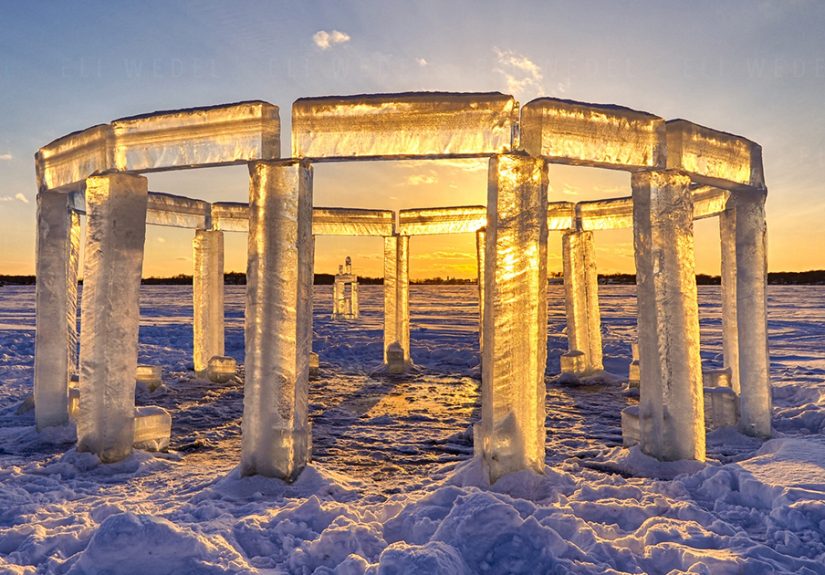
The result looked like a prehistoric monument transported into the American Midwest and dipped in crystal. When sunlight hit the blocks at the right angle, the structure glowed. It was rugged, imperfect, handmade, and beautiful in exactly the way temporary art often is. Unlike permanent monuments, Icehenge came with a built-in deadline. It was always going to melt, shift, or become unsafe once temperatures changed. That fragility made it even more memorable.
Why This Story Captured So Much Attention
There are plenty of winter stories every year, but this one stood out because it hit a rare sweet spot between art, labor, humor, and local identity. Icehenge was visually dramatic enough to go viral, but it also had a human-scale charm. This was not a corporate installation, a sponsored festival stunt, or a luxury winter attraction with timed tickets and cocoa priced like a down payment. It was five friends doing something wildly impractical because they wanted to see if they could.
A Winter Project That Felt Both Serious and Playful
One reason Icehenge worked so well as a story is that it balanced real skill with a sense of fun. The builders were not joking about the work. Cutting, lifting, moving, and positioning huge blocks of ice on a frozen lake requires planning, patience, physical strength, and a decent respect for both weather and gravity. But the concept itself had a grin built into it. A handmade frozen Stonehenge in Wisconsin? That is funny before it is impressive, and then it becomes impressive anyway.
It Revived an Older Part of Wisconsin’s Story
Wisconsin has a long history of ice harvesting. Before electric refrigeration changed daily life, winter ice was a practical commodity. Workers cut blocks from lakes and rivers, stored them in icehouses, and used them to preserve food and cool goods throughout warmer months. By borrowing antique tools and techniques, the Icehenge builders were not just making a sculpture. They were tapping into a real historical tradition and giving it a creative twist.
It Was Beautiful Because It Would Not Last
Permanent landmarks often become background scenery. Temporary works demand attention because you know they are on borrowed time. Icehenge had that quality. People wanted to see it before it disappeared. That urgency added emotional weight to what might otherwise have been dismissed as a winter novelty. It was a reminder that some of the best things are not meant to last forever, including sculptures, snowdrifts, and your confidence after slipping in a parking lot.
How Five Friends Turned a Frozen Lake Into a Monument
The most compelling part of the Icehenge story is not just the finished structure. It is the process. The friends reportedly experimented with old ice saws for years and learned by doing. Their earlier attempt did not fully succeed, but that failure became part of the project’s appeal. Icehenge was not a lucky accident. It was version 2.0 of an idea that survived trial, error, and probably several moments that began with, “Okay, hear me out.”
Using antique-style ice tools connects the project to the physical reality of historical labor. Ice harvesting was never gentle work. It involved scoring frozen surfaces, cutting massive blocks, separating them, hauling them, and stacking them with precision. Even with modern knowledge and cameras around to admire the process, the labor remains demanding. Icehenge did not happen because winter looked pretty from a window. It happened because somebody went outside and wrestled giant frozen rectangles into submission.
The structure itself was assembled using snow and water as a kind of natural bonding material. That detail matters because it shows how closely the project depended on conditions. Temperature, sunlight, surface stability, and timing all had to cooperate. Too warm, and the blocks weaken. Too cold, and the work becomes brutal. Too much public attention, and safety concerns quickly move from theoretical to unavoidable.
According to reports, the team completed the main structure over two weekends when weather conditions allowed. That timeline says a lot. Icehenge was not thrown together overnight for a photo op. It was built in stages, with persistence, coordination, and a willingness to come back and keep shaping the idea until it held together. Literally.
More Than a Viral Curiosity: What Icehenge Says About Creativity
It is easy to treat stories like this as internet candy: fun to look at, easy to share, quickly forgotten. But Icehenge has more going on beneath the frozen surface. It tells us something about how creativity really works in everyday life.
Creativity Does Not Always Look “Artistic” at First
Some of the best creative projects begin as practical curiosity. In this case, the spark was not “Let us make public art.” It was more like, “What was ice harvesting like, and what can we do with these tools?” That is how many memorable ideas develop. They come from play, experimentation, and old-fashioned tinkering. One person wonders, another person helps, and before long a frozen lake has better architecture than some office parks.
Local Identity Can Be a Powerful Creative Engine
Icehenge feels inseparable from Wisconsin. You could not easily move this exact story to Miami or Phoenix and keep the same magic. It grew out of a place where winter is not just weather, but a season people negotiate, endure, complain about, celebrate, and sometimes use as a building material. The sculpture reflected a regional personality: practical, inventive, communal, and not remotely intimidated by cold.
Projects Like This Create Shared Memory
Even though Icehenge was temporary, it became part of local memory. That may be the most important thing public art or communal creativity can do. Long after the sculpture vanished, the story remained. People remembered seeing it from shore, hearing about it on the news, or explaining it to someone out of state who naturally assumed they were being pranked. Shared memory can outlast the object itself, and that is exactly what happened here.
The Historical Layer: Ice Harvesting Was Once Big Business
To fully appreciate Icehenge, it helps to understand the history behind the tools. Before refrigeration became standard, harvesting natural ice was a significant industry in Wisconsin and other northern states. Frozen lakes were not just scenic. They were seasonal supply depots. Workers cut blocks of ice in winter, stored them in insulated icehouses, and distributed them for use in homes, businesses, and food preservation.
This history gives Icehenge a richer context. The sculpture was playful, but the methods referenced a very real labor tradition. Antique ice tools were designed for efficiency and survival, not aesthetics. They belonged to an era when winter work had direct economic value and communities relied on frozen water in ways that now seem almost impossible.
That is one reason the story resonated so strongly. The five builders were not inventing a fantasy out of nowhere. They were reviving a physical relationship with winter that earlier generations understood well. Their project transformed an old trade into a modern act of curiosity and art. Icehenge was whimsical, yes, but it was also a reminder that the line between utility and beauty is thinner than we think. Sometimes the same tool that once stocked an icehouse can also help create a monument that makes strangers stop their cars.
The Safety Reality Nobody Should Ignore
For all its beauty, Icehenge also came with a serious message: frozen lakes are not theme parks. Wisconsin safety officials regularly emphasize that no ice is ever 100 percent safe, and conditions can vary sharply even within the same body of water. Thickness, currents, temperature swings, snow cover, and changing weather can all affect stability. That is one reason the structure was eventually taken down over safety concerns.
This detail is not a gloomy footnote. It is central to the story. Icehenge existed at the intersection of creativity and risk management. The same temporary quality that made it magical also made it vulnerable. As public interest grew, the need to protect people became unavoidable. A frozen monument may look solid in photos, but winter surfaces can deceive even experienced locals.
That tension actually adds depth to the project. Icehenge was not reckless nonsense. It was a carefully made structure in an environment that demands respect. The builders created something remarkable, and the fact that it had to be removed for safety reasons reminds us that nature always gets the last word. On a frozen lake, that word is usually, “Don’t get cocky.”
Why “Icehenge” Still Feels Fresh Years Later
Some viral stories age badly. They depend too much on novelty or timing. Icehenge still works because it touches several timeless ideas at once: friendship, craftsmanship, winter survival, local pride, and the human urge to make something ridiculous and wonderful just because it can be made.
It also belongs to a category of stories people genuinely love: small-scale acts of ambition. Not every memorable project has to be world-changing. Sometimes the best stories are about a handful of people taking an odd idea seriously enough to make it real. There is something deeply satisfying about that. In an era filled with polished content and strategic branding, Icehenge felt handmade in every sense of the word.
And maybe that is why the story continues to circulate. It reminds readers that creativity does not always arrive with a mission statement. Sometimes it shows up wearing insulated boots, carrying antique tools, and hauling frozen blocks across a lake in Wisconsin.
Experiences Related to “Five Friends Build ‘Icehenge’ In The Middle Of A Frozen Lake”
Part of what makes the Icehenge story so easy to connect with is the experience wrapped around it. Even if you have never seen Rock Lake in winter, you can imagine the scene. The air is sharp enough to bite your face. Snow crunches under your boots like broken glass. The lake looks less like water and more like a pale, endless floor stretching into the horizon. In the middle of all that stillness stands a ring of ice blocks, glowing as the late-afternoon sun slides lower in the sky. It feels half sculpture, half mirage.
Experiences like that stay with people because they are sensory, communal, and slightly surreal. You are not just looking at an object. You are feeling the cold in your lungs, hearing the wind skim the ice, and realizing that somebody actually made this thing with their hands. The structure changes the lake around it. What was open space becomes a destination. What was ordinary winter scenery becomes a story people carry home and retell.
There is also the experience of approach. From a distance, Icehenge probably looked improbable, as if it had appeared overnight by magic or alien intervention or a Wisconsin resident with too much free time and absolutely no fear of frostbite. But up close, the details would tell a different story. You would notice rough edges, trapped bubbles, cloudy layers inside the ice, and the subtle variations that come only from natural materials. That is when the sculpture stops being a headline and starts feeling human.
Then there is the experience of collective wonder. Public art in unexpected places creates a special kind of reaction. Strangers talk to each other. Families linger. People point, laugh, take photos, and ask obvious questions like, “How on earth did they move that?” and “Whose idea was this?” The best answer to the second question is probably, “Someone with excellent vision and questionable judgment,” which, to be fair, describes many beloved local legends.
Another experience tied to this story is the pleasure of winter being used for something besides endurance. For a lot of people, winter is about scraping windshields, shoveling driveways, and pretending not to be personally offended by black ice. Icehenge flips that script. It suggests that winter can also be a medium. The cold is not only something to survive. It is something to work with, shape, and reinterpret. That idea feels refreshing because it turns hardship into possibility.
And finally, there is the emotional experience of impermanence. Anyone who saw Icehenge knew it would not last. That knowledge changes how you look at it. You pay closer attention. You do not assume it will be there next week. In a strange way, that makes the moment richer. The sculpture becomes a reminder that temporary things are often the ones we remember most clearly: a first snowfall, a frozen lake at sunset, a winter road trip, a perfect patch of quiet before the wind picks up again. Icehenge fits into that category. It was temporary by nature, but unforgettable by effect.
Conclusion
“Five Friends Build ‘Icehenge’ In The Middle Of A Frozen Lake” sounds like a punchline, but it endures as a genuinely compelling story because it combines beauty, effort, place, and personality. On frozen Rock Lake, five Wisconsin friends turned antique-style ice harvesting into a form of public art, building a Stonehenge-inspired structure from the lake itself. The result was visually striking, historically rooted, and wonderfully human.
Icehenge mattered not because it lasted, but because it did not. It captured a moment when local skill, winter conditions, and a big odd idea aligned perfectly. It celebrated craftsmanship, revived a bit of regional history, and gave people a reminder that creativity does not always need a grand stage. Sometimes it just needs cold weather, strong backs, and a willingness to build something beautiful before it melts.
If nothing else, Icehenge proves a timeless truth: when friendship, curiosity, and Midwestern winter collide, the outcome may be frozen, fleeting, and absolutely worth talking about.