Table of Contents >> Show >> Hide
- What Finish Carpentry Really Is (And Why It Feels So Hard)
- Before You Cut: Prep That Saves Hours Later
- Measure Smarter: Accuracy Without the Stress
- Cut Cleaner: Small Tweaks That Make Big Differences
- Fit Like a Pro: Tricks for Tight Joints and Clean Lines
- Fastening Without Damage: Nails, Glue, and the “No Oops” Method
- Caulk, Paint, and Finish: The “Final 10%” That Looks Like 50%
- Common Finish Carpentry Mistakes (And the Fixes)
- Quick Finish Carpentry Checklist (Print This Mentally)
- of Real-World Experience: What Finish Carpentry Teaches You Fast
- Conclusion
Finish carpentry is the part of a project that makes people say, “Wow,” instead of, “So… it’s technically a wall.”
It’s trim, doors, baseboards, crown molding, paneling, and all the little details that turn a room from
“construction zone chic” into “someone lives here and pays taxes.”
The good news: you don’t need a magic hammer or a secret handshake to do clean finish work. You need patience,
a plan, and a few pro habits that keep mistakes small (and easy to hide). This guide breaks down the tips
that consistently separate “DIY” from “Why is that corner… doing that?”
What Finish Carpentry Really Is (And Why It Feels So Hard)
Finish carpentry is about precision and appearance. Framing can be “good enough” because drywall hides it.
Finish work is the opposite: the whole point is that it’s visible. A 1/16-inch gap you’d never notice in framing
suddenly looks like the Grand Canyon when it’s next to a crisp white casing.
It also lives in the real worldwhere floors aren’t level, walls aren’t plumb, corners aren’t 90 degrees, and
lumber isn’t always straight. The goal isn’t perfection; it’s control. You learn how to measure smarter,
cut cleaner, and fit trim to the house you actually have, not the one in the instruction manual.
Before You Cut: Prep That Saves Hours Later
1) Let wood acclimate to the room
Wood moves with humidity. If you install trim that just came from a cold truck into a warm, humid house,
it can shrink, swell, or twist after installation. Stack it flat, sticker it if possible (small spacers between boards),
and let it sit in the space for at least a couple of days. This is especially helpful with natural wood trim
and wider boards.
2) Check your walls and floors like a detective
Finish carpentry is “problem solving with a miter saw.” Walk the room and spot trouble:
bowed drywall, wavy baseboard lines, out-of-square corners, and floors that slope.
Use a level (or laser), and don’t be shocked when the house behaves like a house.
Knowing where things go weird helps you decide where to hide seams and how to adjust reveals.
3) Pick your paint or stain strategy early
If you’re painting trim, you can fill and caulk more aggressively. If you’re staining, every cut and nail hole is a headline.
For stain-grade projects, plan for cleaner joinery, tighter fits, and often pre-finishing. Pre-finishing (stain/clear coat
before installation) reduces messy brushing near walls and helps avoid unfinished “shadow lines” where trim meets trim.
4) Use a “story stick” instead of trusting your tape for everything
A story stick is a scrap piece of wood marked with key measurements (baseboard height, casing reveal,
hinge locations, outlet centers, etc.). It reduces repeated measuring, prevents transcription mistakes,
and keeps your layout consistent across a room. When you’re doing multiple windows or doors, this is a sanity saver.
Measure Smarter: Accuracy Without the Stress
5) Measure in context: don’t assume corners are square
Inside corners are often 88° or 92°, not 90°. If you cut perfect 45s, you’ll get a gap that mocks you.
Use an angle finder or make test cuts on scrap. For trim, you’ll often “dial in” the miter angle by sneaking up on it
with small adjustments until the joint closes.
6) Mark from the “show face” and label everything
Always mark your cut line on the face that will be visible (the show face). Label orientation:
“top,” “left,” “wall side,” “floor side.” Finish pieces are easy to flip accidentally, especially crown molding
which is basically carpentry origami. A pencil arrow can prevent a trash can full of “almost right” pieces.
7) Use stop blocks for repeat cuts
If you’re cutting multiple equal lengths (balusters, short returns, repeated casing legs), set up a stop block on your
miter saw station. It’s faster and more accurate than measuring each piece. Repeatability is the secret ingredient
in trim that looks “pro.”
8) Measure long runs by “scribing” or “fitting,” not just numbers
For baseboards and long trim runs, measuring with a tape is only part of it. When walls belly in/out,
you may need to scribe trim to the wall or use a backer/shim method to keep the face straight.
If you’re working with tricky areas, dry-fit pieces and use reference marks directly on the wood.
Cut Cleaner: Small Tweaks That Make Big Differences
9) Tune your miter saw (yes, really)
A miter saw that’s slightly out of square will punish you in every joint. Check:
the fence, the bevel stop at 0°, and the miter detents. Use a reliable square and make test cuts.
If your saw is off by a hair, your trim will show it with a neon sign.
10) Use the right blade
Finish work wants a high-tooth-count blade (often 60–80 teeth for a 10-inch saw, and higher for finer cuts).
A sharp blade reduces tear-out, especially on primed MDF and hardwoods. If you see fuzzy edges or chipping,
your blade is either wrong, dull, or both.
11) Support the workpiece to prevent “drop” and splintering
Long trim pieces can sag and shift during the cut, changing the angle. Support both ends with stands
or a miter station. For delicate pieces, clamp if needed. Stability makes your cut accurate and prevents the blade
from grabbing and chewing the edge.
12) Back-bevel for tighter fits
A tiny back-bevel (slight angle) on a cut can help joints close at the visible edge. This is common when coping,
and helpful when two pieces meet and you want the front edge tight even if the back edge has a small gap.
The goal is a crisp seam where eyes actually look.
13) Cope inside corners instead of mitering them
For baseboards and crown molding, coping inside corners often beats mitering because it handles out-of-square corners
and wood movement better. The idea: one piece runs square into the corner, and the other is cut to match its profile.
It’s a little slower upfront, but it’s the kind of “slow” that prevents rework later.
14) Use “test blocks” to match crown molding angles
Crown is notorious because it sits at a spring angle, not flat. Create short test blocks cut at your intended settings
(miter/bevel) and label them. When you return to the project tomorrow (or next weekend), you won’t have to re-invent
your settings like a time traveler with amnesia.
Fit Like a Pro: Tricks for Tight Joints and Clean Lines
15) Control your reveals
A reveal is the consistent offset between trim and the edge it frames (like door jamb to casing).
Even if walls are wavy, consistent reveals make everything look intentional.
Use a reveal gauge or make one from scrap. Pick a standard (like 3/16 inch), then keep it consistent across the room.
16) Use scarf joints on long runs
If a wall is longer than your trim stock, don’t butt two pieces together with a straight seam.
Use a scarf joint (angled overlap) and place it where it’s less noticeable. A scarf joint has more glue surface,
hides better, and tends to stay tighter over time.
17) Hide your “least perfect” joints strategically
Put seams behind doors, under windows, or in corners with less light. Harsh side lighting shows every gap.
If you have one joint that’s “fine” instead of “flawless,” put it where the room won’t spotlight it at 4 p.m.
like a courtroom drama.
18) Scribe, don’t fight
When a wall bows, forcing straight trim tight to it can cause gaps elsewhere. Scribing means you mark the wall’s shape
onto the trim and plane/sand to match. This is common with countertops, baseboard against stone, and built-ins.
It takes practice, but it’s a core finish carpentry skill because houses are rarely perfectly straight.
19) Use returns to avoid raw edges
At the end of baseboard or chair rail that stops without meeting another piece, add a return:
a small mitered piece that turns back into the wall. It hides the end grain and looks finished.
Returns are tiny, but they level-up the whole room’s trim vibe.
20) Grain direction matters more than you think
On stain-grade work, try to keep grain patterns consistent. Also consider how light hits the grain;
two boards can match in color but look different because of grain orientation. When possible, lay pieces out on the floor
in the room’s lighting before installing.
Fastening Without Damage: Nails, Glue, and the “No Oops” Method
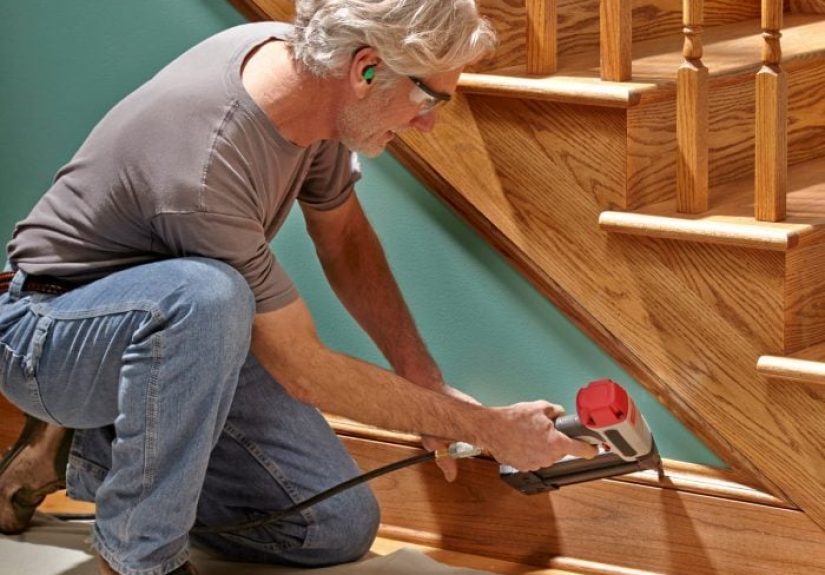
21) Choose the right nailer and nail length
Brad nailers (18-gauge) are great for smaller trim and delicate pieces, while finish nailers (16-gauge or 15-gauge)
offer stronger hold for thicker casing and baseboards. Use nails long enough to penetrate solid framing,
not just drywall. As a rule of thumb, aim for at least 1 inch into framing when possible.
22) Find studs (and mark them lightly)
Use a stud finder and confirm with small test nails if necessary. Mark stud locations with painter’s tape
or light pencil marks. Hitting studs means trim stays tight. Missing studs means trim eventually loosens,
and then you’re in “mystery squeak” territory.
23) Use glue selectively, not everywhere
Construction adhesive can help on tricky surfaces, but it also makes future removal miserable and can telegraph bumps.
Wood glue is great for joints (like returns and scarf joints), where you want the seam to stay closed.
The best practice is: glue joints, nail to structure, and avoid turning the wall into a permanent art installation.
24) Sink nails cleanly and keep holes consistent
If hand-nailing, pre-drill near ends to prevent splitting. If using a nailer, adjust air pressure so you’re not blasting
nails below the surface like you’re trying to send them to the basement. A consistent, shallow set is easiest to fill
and looks cleaner after paint.
25) Don’t overfill (your future self will thank you)
For painted trim, use wood filler or spackle appropriate for trim. For stain-grade, use matching putty or wax fill sticks.
Apply minimally, let it dry, sand lightly. Overfilling creates big sanded craters that show through paint like fossil records.
Caulk, Paint, and Finish: The “Final 10%” That Looks Like 50%
26) Caulk the right places (and skip the wrong ones)
Caulk between trim and wall (paint-grade) to hide small drywall waves. Don’t caulk between trim and floor
floors move, and caulk can crack or look messy. Use paintable acrylic latex caulk for most interior trim,
and apply a smooth bead (small, not a toothpaste commercial). Tool it with a damp finger or caulk tool.
27) Sand smart: edges and profiles need finesse
Use sanding sponges or folded sandpaper for profiles and edges. Power sanders are fast but can round sharp edges,
which makes trim look “melted.” A crisp profile is part of the charmkeep it crisp.
28) Prime MDF and end grain properly
MDF can “fuzz” and absorb finish at cut edges. Seal those edges with primer (or a dedicated MDF sealer)
before painting. For natural wood, end grain absorbs stain and paint differently; sealing or careful priming helps keep
the finish even.
29) Consider pre-painting or pre-finishing
Pre-painting trim (especially crown) can reduce brush marks and speed up final touch-ups. You still paint/fill after install,
but it cuts down on awkward overhead painting. For stain-grade trim, pre-finishing is often the cleanest route,
with final touch-up done carefully after installation.
30) Use lighting to spot flaws before they’re “permanent”
Rake a bright light across the trim (hold a work light low and sideways). This reveals gaps, dents, and sanding scratches
that normal overhead light hides. Fix them before final paint. It’s like a cheat code for getting a professional finish.
Common Finish Carpentry Mistakes (And the Fixes)
Measuring everything twice… and still cutting wrong
The usual culprit is measuring from the wrong reference point or flipping the piece. Fix: mark the show face,
label orientation, and use a story stick or stop block whenever possible.
Gappy corners that won’t behave
Fix: cope inside corners, adjust miter angles for out-of-square corners, and use back-bevel techniques.
Also: check if the wall is bulging. Sometimes the best fix is scribing or shimming the trim to control the face line.
Trim that looks wavy along the wall
Fix: snap a reference line, shim behind the trim where needed, and prioritize straightness on the visible face.
A perfectly “flush” trim line that follows a wavy wall often looks worse than a straight line with minor caulk gaps.
Nail holes and touch-ups that scream “I was here”
Fix: choose the right filler, apply minimally, sand lightly, and spot-prime before paint. If you’re staining,
keep holes small and place fasteners where they’re less noticeable.
Quick Finish Carpentry Checklist (Print This Mentally)
- Acclimate trim in the room
- Find and mark studs; check corners for squareness
- Tune saw settings; use a sharp fine-finish blade
- Label show faces and orientation
- Use stop blocks for repeats; test-fit before committing
- Cope inside corners when possible
- Control reveals for consistency
- Glue joints, nail to framing, fill minimally
- Caulk trim-to-wall (paint-grade), not trim-to-floor
- Use raking light for final flaw-check before paint
of Real-World Experience: What Finish Carpentry Teaches You Fast
The first big lesson finish carpentry teaches most DIYers is that “close enough” has a very short half-life.
In framing, you can be off a little and it still works. In trim, being off a little becomes the first thing your eyes
lock onto when you walk into the room. That’s not bad newsit’s just a different game. The trick is to slow down at the
moments that matter: measuring, marking, and test-fitting. You can work quickly once you have a repeatable setup,
but speed before you’ve built a system is how you end up with a pile of short scraps you swear were “definitely long enough.”
Another experience-based truth: houses are rarely fair. You can buy beautiful casing, cut flawless miters, and still get a gap
because the corner is 91 degrees or the jamb is twisted. That’s when finish carpentry stops being “cut and attach” and becomes
“fit and finesse.” Learning to cope an inside corner feels like leveling up. At first it seems like extra work. Then you see how
it forgives weird corners and seasonal movement, and suddenly coping isn’t “extra”it’s the shortcut to fewer callbacks… even if
the only person calling you back is your own conscience.
It’s also where you learn the value of dry-fitting. Dry-fitting isn’t indecision; it’s previewing reality. A quick test fit can show
you that the floor dips, the wall bows, or the last piece needs a tiny adjustment. That tiny adjustment is the difference between
a joint that closes with a gentle tap and a joint that requires a “motivational hammer” (also known as a mistake). The more trim you do,
the more you realize that a calm, controlled fit looks professionaleven if the house itself is doing gymnastics behind the scenes.
Finish carpentry teaches humility with tools, too. A slightly out-of-square miter saw will make you doubt your intelligence.
A sharp blade will restore your faith in humanity. You start noticing that your best days happen when you set up supports,
clamp small parts, and keep your work area organized. It’s not glamorous, but neither is crawling around looking for a tiny return piece
that launched itself into another dimension.
Finally, you learn that the last 10%filling, sanding, caulking, and touch-upcan be the loudest part of the whole job.
That’s where rooms get their “finished” feeling. A neat caulk line and consistent paint coverage can make average trim look excellent.
On the flip side, sloppy touch-up can make excellent joinery look questionable. The best finish carpentry experiences aren’t about never
making mistakes. They’re about making smart choices that keep mistakes small, fixable, and mostly invisible. Because the real goal is simple:
when someone walks in, they admire the roomnot the corner joint.