Table of Contents >> Show >> Hide
- Why Tables Are Secretly Great Storage (Even When They’re Just…Tables)
- The Remodelista Move: Stacking Two Tables to Create an “Island” (With Storage Built In)
- Wall-Mounted Tables: Two Smart PathsFold-Down Surfaces and “Upside-Down” Shelving
- Planning Like a Pro: Measurements, Clearances, and “Don’t Bonk Your Hip” Rules
- Safety and Installation: Make It Sturdy Enough for Real Life
- Making It Look Intentional: Styling Tricks That Keep It “Designed,” Not “Desperate”
- Smart Variations: How Different Kitchens Can Use the Same Idea
- Common Mistakes (So You Don’t Have to Learn Them the Hard Way)
- FAQ: Stacked and Wall-Mounted Tables for Kitchen Storage
- of “Experience” Notes: What This Looks Like in Real Kitchens
If your kitchen feels like it’s playing a daily game of “Where did I put that?” (and you keep losing),
you’re not alone. Small kitchens and busy kitchens share the same problem: too many things and not enough
real estate. The usual advice is to add cabinets, add shelves, add organizersbasically, add more stuff
to hold your stuff. But there’s a sneakier, more design-forward solution that Remodelista spotlighted:
use tables as storagestacked tables as an island and wall-mounted tables
as shelving or fold-down work surfaces.
It sounds almost too simple, which is exactly why it works. Tables are already built to hold weight.
Many have open frames that behave like shelves. And unlike bulky cabinetry, they can look airy,
intentional, anddare we say itkind of cool. Below is a deep dive into how to pull off
stacked and wall-mounted tables as kitchen storage, with practical sizing, safety notes, and
style tips so your “hack” doesn’t look like a “temporary situation.”
Why Tables Are Secretly Great Storage (Even When They’re Just…Tables)
Design pros love pieces that do double duty, and tables are basically overachievers with legs. In small
kitchens, a table can be a prep station, a coffee bar, a dining nook, a homework desk, and a landing pad
for mail that you swear you’ll sort later. When you start treating tables as structuresnot just
surfacesyou unlock storage that feels built-in without actually rebuilding anything.
What Makes Table-Based Storage Work
- Open frames = visual breathing room: Box-frame and metal-base tables store plenty while staying light-looking.
- Stackability: Nesting or “box” designs can create multi-tier shelving with almost no carpentry.
- Flexibility: Move it, swap it, re-style itno demolition required.
- Cost control: Thrifted tables, flea market finds, or flat-pack options can mimic high-end looks.
- Rent-friendly potential: Many solutions are freestanding; wall-mounted options can be chosen with minimal anchoring.
The Remodelista Move: Stacking Two Tables to Create an “Island” (With Storage Built In)
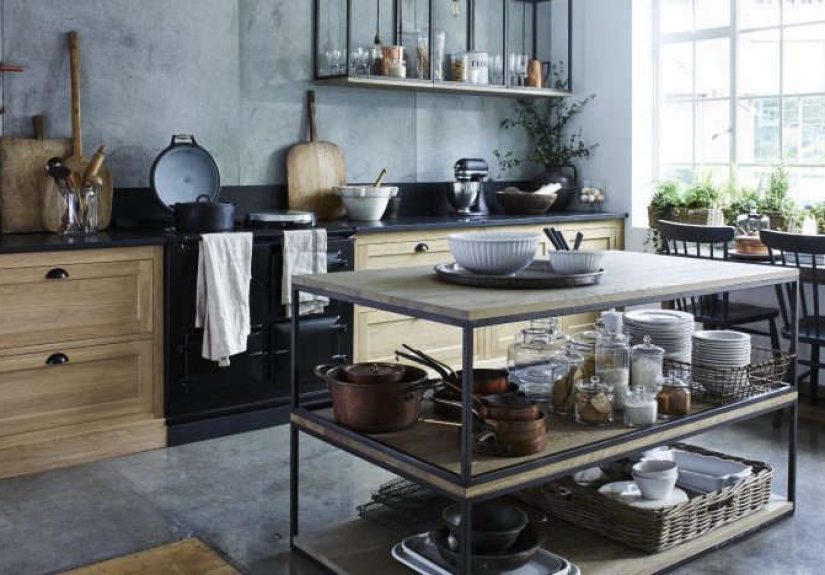
The Remodelista “design sleuth” idea that kicked this off is deliciously straightforward:
stack two industrial-style coffee tables to create an open kitchen island/worktop. Because many
box-frame tables have a lower shelf and a sturdy top, stacking effectively builds a multi-level
island: prep surface up top, storage shelf in the middle, and often an additional surface or shelf at
the base if you add a board or tray.
The magic is that it doesn’t look like a compromise. It looks like a considered piece of furniturelike
you planned it, and not like you measured your kitchen while holding a sandwich and whispering,
“Please fit.”
How to Stack Tables Without Making It Wobbly (Or Weird)
- Match footprints: Ideally, the top table is the same width or slightly smaller than the bottom table.
- Look for “box-frame” builds: Steel frames with wood tops are commonly rigid and visually clean.
- Secure the stack: Use non-slip pads, furniture grippers, or discreet brackets/straps so the top table doesn’t skate.
- Add a middle “tray shelf”: A fitted wood panel, a metal tray, or a thick cutting board can create an extra layer.
- Mind the height: Traditional kitchen counters are around 36 inches; a stacked island should land in that neighborhood
if you want it to work comfortably for prep.
What You Can Store in a Stacked-Table Island
Think “open storage that you don’t hate looking at.” This is where attractive, repeatable shapes win:
baskets, bins, matching jars, uniform cookbooks, cutting boards, and a few “yes, I style my storage”
moments like a bowl of citrus or a stack of folded dish towels.
- Everyday tools: mixing bowls, colanders, salad spinner, utensil crock
- Pantry overflow: labeled containers for rice, pasta, coffee, snacks
- Small appliances: toaster, blender, air fryer (if you can stand seeing it)
- Cookware: sheet pans, Dutch oven, sauté pan on a lower shelf
- Entertaining stash: trays, linens, napkins, candles (the “we’re classy” drawer, but open)
Wall-Mounted Tables: Two Smart PathsFold-Down Surfaces and “Upside-Down” Shelving
Wall-mounted tables earn their keep in two big ways. First, as fold-down work surfaces (drop-leaf,
flip-down, Murphy-style). Second, as a sculptural storage trick: up-end a side table and mount it to
the wall so the “legs” become brackets and the frame becomes open shelving. Remodelista highlighted
this exact kind of moveturning table forms into a run of display-and-storage space above standard
base cabinetry.
Option 1: The Fold-Down (Drop-Leaf) Wall Table
A wall-mounted drop-leaf table is the small-kitchen classic for a reason: it appears when you need it,
disappears when you don’t, and instantly creates a “breakfast bar,” extra prep zone, or laptop perch.
Many designs fold nearly flush, freeing walkways (a big deal in galley kitchens).
For daily use, look for a surface deep enough to be functionaloften in the range of an actual place
setting or a chopping board plus elbow room. Add a pair of folding chairs or stackable stools, and you
have a micro dining area that doesn’t permanently occupy your floor.
Option 2: The “Upside-Down Side Table” as Wall Storage
This is the clever Remodelista-adjacent trick that makes design people grin. If you have a side table
with a box frame (especially an industrial metal-and-wood style), you can mount it to the wall so the
frame becomes open shelving. In other words: the table stops being a table and starts being
architecture.
Done right, it reads like a custom shelving unitespecially when you align multiple pieces in a row.
It’s a strong look above fitted cabinets, along an empty wall, or as a coffee/tea station where you
want cups, canisters, and a few pretty things within reach.
Planning Like a Pro: Measurements, Clearances, and “Don’t Bonk Your Hip” Rules
Table-based storage shines when it respects how people actually move through a kitchen.
Your layout shouldn’t require gymnastics to open the dishwasher or reach the fridge.
Before you buy anything, measure like you mean it.
Clearances That Keep Kitchens Functional
- Walkway space: Keep enough room to pass comfortably even when cabinet doors or the dishwasher are open.
- Fold-down table swing: Ensure the leaf can open without hitting a handle, a light fixture, or a human.
- Stool tuck-in: If you plan seating, confirm the seats can slide under or stack nearby without blocking circulation.
- Island reach: A stacked-table island should allow you to access key zones: sink, stove, fridge.
Height and Ergonomics (Because Your Back Has Opinions)
Prep is easiest around standard counter height. If your stacked island lands much lower, it becomes a
pastry table (cute!) but less comfortable for chopping. Much higher, and it turns into a standing bar
(also cute!) but awkward for serious cooking. For wall-mounted fold-down tables, you can choose a
height that matches either dining or prepjust stay consistent with how you’ll use it most.
Safety and Installation: Make It Sturdy Enough for Real Life
Let’s be honest: the internet is full of “floating” furniture ideas that look gorgeous right up until
someone leans on them with the confidence of a person who has never met physics.
If you’re wall-mounting anything meant to hold weight, treat it like a serious install.
Wall-Mounting Basics (No Fear, Just Respect)
- Anchor to studs when possible: Especially for fold-down tables that will hold plates, laptops, or elbows.
- Use rated hardware: Brackets and hinges should be designed for load-bearing use, not “decorative shelf vibes.”
- Check the wall type: Drywall, plaster, masonry, and tile over backer board all require different fasteners.
- Account for leverage: A fold-down surface creates torque; strong hinges and solid anchoring matter.
- Keep it maintainable: Choose finishes that wipe clean and hinges that don’t require constant fussing.
If you’re not confident drilling into your wall (or your wall is a mystery novel written in tile and
regret), a freestanding stacked-table solution may be the better hero move. Safety is always in style.
Making It Look Intentional: Styling Tricks That Keep It “Designed,” Not “Desperate”
The difference between “smart storage” and “why is there a table bolted to the wall?” is finishing.
This is where you borrow a page from design editors: repeat materials, align edges, and give the eye a
reason to relax.
Easy Ways to Elevate Table-Based Storage
- Repeat a material: If your table top is oak, echo oak in cutting boards, stools, or frames.
- Use matching containers: A set of uniform jars or baskets makes open storage look calm.
- Limit the color palette: Two or three main tones keeps open shelves from feeling chaotic.
- Create “zones”: Coffee supplies together, baking tools together, snack bins togetherlike a tiny store you actually like.
- Add one pretty thing: A plant, a bowl, a sculptural pepper mill. One. Not twelve.
Smart Variations: How Different Kitchens Can Use the Same Idea
Galley Kitchens
Galley kitchens live and die by walkway space. A wall-mounted drop-leaf table is a classic fit here:
breakfast when you want it, clear path when you don’t. A slim stacked-table island can work toojust
keep the footprint narrow and the shelves tidy so the space still feels open.
Studio Apartments and One-Wall Kitchens
In a one-wall kitchen, wall-mounted solutions shine because they add function without adding furniture
sprawl. A fold-down surface can be your dining table and your prep space. A wall-mounted “up-ended”
table frame can become an open pantry for the items you use daily.
Family Kitchens That Need “Overflow” Space
Even bigger kitchens can benefit from table-as-storage thinking. A stacked-table island can hold the
lunchbox station, snack bins, and weeknight tools without demanding a custom built-in. It’s also easier
to reconfigure as your needs change (because kids grow, hobbies multiply, and suddenly everyone is into
sourdough).
Common Mistakes (So You Don’t Have to Learn Them the Hard Way)
- Overloading open shelves: Open storage should be edited, not packed like a moving truck.
- Choosing a table that’s too deep: Depth steals walkway space fast. Measure twice, shop once.
- Ignoring wobble: Stack stability matters. Use grippers or discreet fasteners.
- Mounting without a plan: A wall-mounted table needs real support, not wishful thinking.
- Turning “flexible” into “clutter magnet”: A fold-down surface is not a permanent mail shrine.
FAQ: Stacked and Wall-Mounted Tables for Kitchen Storage
Are stacked tables stable enough to use as a kitchen island?
They can be, especially with sturdy box-frame tables and simple anti-slip or securing methods.
The goal is to prevent sliding and wobble, so the stack behaves like one piece.
What’s the best use for a wall-mounted drop-leaf table?
Breakfast and quick meals, extra prep space during cooking, or a compact work-from-home nook.
It’s ideal when you need a surface sometimesnot always.
Can I wall-mount a side table as shelving?
Yesif the piece is structurally sound and you mount it with appropriate load-bearing hardware.
Treat it like installing shelving: anchor securely and don’t exceed what the wall and fasteners can support.
How do I keep open storage from looking messy?
Use matching containers, group items by category, limit colors, and keep a little empty space.
Open storage looks best when it’s intentional, not jammed.
of “Experience” Notes: What This Looks Like in Real Kitchens
Let’s talk about what happens after the photo shootwhen the kitchen is used by actual humans who
cook, snack, rush, and occasionally set a hot pan down in a moment of questionable judgment.
Table-based storage tends to succeed when it’s treated like a system, not a stunt.
One common scenario: a tiny apartment kitchen where the “dining area” is basically a rumor. A
wall-mounted drop-leaf table becomes the daily MVP. Breakfast is a quick flip-up with two stackable
stools pulled from a corner. Dinner for friends? The leaf stays up longer, and the surface becomes a
serving station. Then the table folds down again and the walkway returnsno permanent furniture
footprint, no squeezing sideways past chairs like you’re auditioning for a sitcom.
Another frequently seen win is the stacked-table island in a rental where adding cabinetry isn’t an
option. The bottom shelf holds “ugly-but-useful” itemspaper towels, the salad spinner, the big mixing
bowltucked into baskets so the chaos looks curated. The middle layer becomes the “active zone” for
things that are used daily: cutting boards, a tray for oils and vinegar, a jar of wooden spoons. The top
stays mostly clear, because the moment your main prep surface becomes storage, you’re back to chopping
onions in a corner like it’s a punishment.
The upside-down side-table shelf trick tends to shine in kitchens that already have base cabinets but
lack personality (and easy access). Mounting box-frame pieces above the counter creates open storage
that feels architectural. People often use the lower “shelf” line for mugs and glasses and the upper
line for lighter itemstea tins, spices in uniform jars, small bowls. The best results come when the
display is edited. If everything is visible, everything needs to behave. This is not the place for
mismatched plastic lids that migrated from three different decades.
And here’s the most honest experience note of all: the first week is always perfect. The second week
is when the table tries to become a landing pad for mail, backpacks, and random chargers. The fix is
simple: add one small “catch tray” and give clutter a designated containment zone. When the mess has a
home, the system holds. When it doesn’t, your beautiful table-based storage becomes a very stylish
problem.
Bottom line: stacked and wall-mounted tables work best when you decide what the surfaces are for.
If you assign rolesprep zone, coffee station, pantry overflow, display shelfthe furniture starts
doing real labor. If you don’t, it just becomes another flat place where life piles up. Tables are
helpful like that: they will either organize your kitchen or quietly enable your clutter. Choose your
adventure.