Table of Contents >> Show >> Hide
- Why Bee Intelligence Has Scientists Buzzing
- Tiny Brain, Big Skills
- Yes, Bees Can Handle Number-Like Tasks
- Problem-Solving That Looks Downright Showy
- Do Bees Play? Maybe, and That Changes the Conversation
- Why This Learning Ability Matters in the Real World
- What Everyday Experiences Teach Us About Smart Bees
- Conclusion
For years, people treated bees like tiny flying vending machines: insert flower, receive pollination. Helpful? Absolutely. Cute? Usually. But smart? That part got wildly underestimated. Modern research has turned that old stereotype into compost. Bees may have brains smaller than a sesame seed, yet they can learn colors, shapes, routes, and reward patterns. In carefully designed experiments, they have also shown surprisingly flexible behavior in tasks involving number discrimination, simple arithmetic-like rules, social learning, and even play-like activity.
That does not mean bees are tiny professors wearing striped sweaters and grading each other’s math homework. It does mean scientists are taking insect cognition much more seriously. The bigger lesson is not that bees think exactly like humans. It is that intelligence can come in compact, efficient forms. A brain does not need to be huge to solve real-world problems when evolution has had millions of years to tune it for survival.
And that matters beyond pure scientific curiosity. Bees pollinate a huge share of flowering plants and food crops, so understanding how they learn helps researchers protect pollinators, design better habitats, and even build smarter low-power AI systems inspired by nature. In other words, when bees get clever, humans should pay attention.
Why Bee Intelligence Has Scientists Buzzing
Bees live in a world that demands fast decisions. A forager must find flowers, remember which blossoms are rewarding, ignore lousy options, avoid danger, navigate home, and sometimes communicate useful information back to nestmates. That is a lot to ask from an animal with fewer than a million neurons. Yet bees do it every day without opening a map app or muttering, “Recalculating.”
Researchers have long used honeybees as models for studying learning and memory because their behavior is measurable, flexible, and consistent. Bees can associate odors, colors, visual patterns, temperature cues, and locations with food rewards. They can also retain information over time and adjust behavior when conditions change. That combination of learning and memory is exactly what makes cognition worth studying in the first place.
Even more impressive, bees do not rely on just one kind of information. They combine multiple sensory cues while foraging. A flower is not just a flower. To a bee, it can be a color signal, a scent pattern, a shape, a location, a landmark in a route, and a memory of whether the last visit ended in sweet success or floral disappointment.
Tiny Brain, Big Skills
Bees Learn Colors, Shapes, and Reward Patterns
One of the clearest signs of bee intelligence is associative learning. Bees quickly learn that certain flower colors or patterns predict nectar. If blue flowers pay off and yellow ones do not, bees soon start choosing blue more often. That may sound simple, but it is the foundation of flexible behavior. The bee is not just reacting blindly. It is updating choices based on experience.
Scientists have found that bumblebees can also learn increasingly complex tasks when training is scaffolded step by step. In one line of research, bees succeeded on artificial flower problems when they encountered easier versions first, then built toward harder ones. Throw them straight into the hardest puzzle and many gave up. Give them a learning path, and suddenly they looked much more capable. Honestly, that makes them sound less like bugs and more like every student before coffee.
They Remember Routes and Landmarks
Learning is useful only if memory sticks. Bees shine here, too. Honeybees are well known for remembering locations, using landmarks, and navigating through space with striking accuracy. Research on bee navigation suggests they can rely on different forms of spatial memory, including route-based memories and broader landscape memories. That helps explain how a bee can leave the hive, visit multiple food sources, and still make it home without wobbling into the neighbor’s rosebush in total confusion.
Bees also learn the timing of rewards. If a food source becomes productive at a certain time of day, bees can remember that pattern and return when it makes sense. That ability makes ecological sense. Nature does not hand out nectar on a perfectly predictable all-day buffet schedule. Bees that learn when and where rewards appear save time and energy.
They Can Transfer Information Across Senses
Another mind-bending finding is cross-modal learning. In one striking study, bumblebees explored objects such as cubes and spheres through one sensory route and later recognized them through another. That suggests bees can build a usable internal representation of what an object is like, rather than simply memorizing one narrow visual snapshot. For such a small nervous system, that is a big deal. It hints that bees are not just living moment to moment. They form information-rich memories they can apply later.
Yes, Bees Can Handle Number-Like Tasks
This is the part of bee science that makes people sit up straight and say, “Wait, the fuzzy flower bugs can do what now?” Over the last several years, researchers have shown that bees can perform surprisingly sophisticated tasks involving quantities and symbols.
Some studies suggest honeybees can rank quantities and treat zero as being less than one, two, three, or more. Others found that bees can be trained to use color cues as rules for simple addition and subtraction tasks. Another study suggested they can link symbols with numerical quantities. These results do not mean bees understand mathematics the way people do. Nobody should hand a bee your taxes. But the experiments do show that miniature brains can support rule use, working memory, and flexible choice behavior in ways that once seemed far beyond insects.
Scientists are careful here, and rightly so. Some researchers argue that bees may solve these tasks through efficient visual scanning strategies rather than deep, human-style abstract reasoning. That caution matters. The goal is not to turn every clever animal result into a cartoon headline. The real wonder is subtler and, frankly, cooler: bees may achieve complex outcomes with lean, elegant neural shortcuts. That is impressive whether the process looks like human thought or not.
Problem-Solving That Looks Downright Showy
From Ball Rolling to Puzzle Boxes
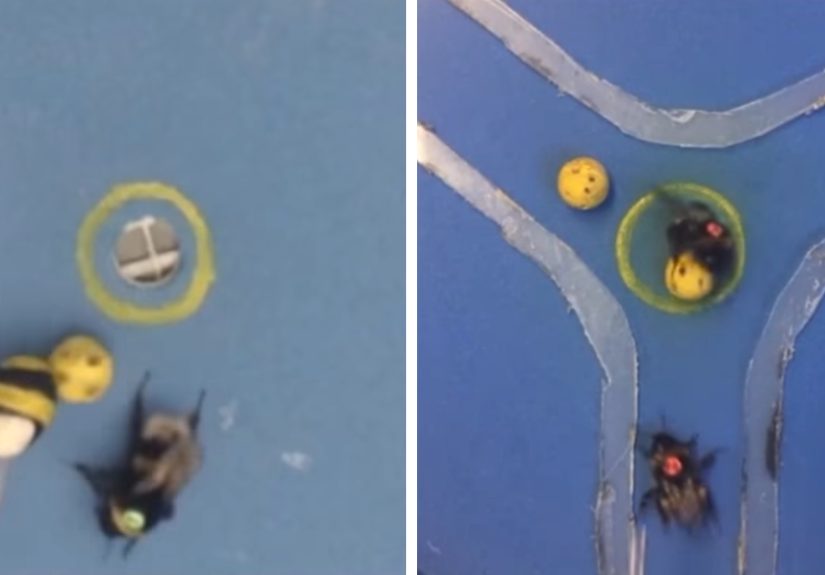
One famous experiment trained bumblebees to roll a small ball into a goal to get a sugary reward. The task was artificial and not something bees do in nature, which is exactly why it mattered. It tested behavioral flexibility. Bees were not just repeating a natural foraging routine. They learned a novel action sequence to solve a problem.
Even more striking, bees that watched a demonstration often learned faster than bees without one. That moved the conversation from individual trial-and-error learning into the realm of social learning. In other words, bees can sometimes pick up useful behavior by observing others, not merely by stumbling into success alone.
Then came an even bigger headline in 2024. Researchers reported that bumblebees could learn a novel two-step puzzle-box task socially, even though untrained bees failed to solve it on their own despite extended exposure. Roughly a third of observer bees learned the sequence after watching trained demonstrators. That finding challenged the idea that only humans socially learn behaviors too complex to reinvent individually. Scientists still debate how far that comparison should go, but the result was a major milestone in animal cognition research.
Face Recognition, With an Important Asterisk
Bees have also been shown to distinguish human faces in experiments. Before we get carried away, this does not mean your backyard pollinator knows your passport photo or secretly judges your haircut. The likely explanation is advanced pattern recognition. Bees can learn the arrangement of visual features and choose the correct image when rewarded for doing so. The finding is still remarkable because it shows that tasks once assumed to require a large mammalian brain may instead be solved by efficient visual processing and learning.
Do Bees Play? Maybe, and That Changes the Conversation
One of the most charming discoveries in recent bee research involves play-like behavior. In a widely discussed study, bumblebees repeatedly rolled wooden balls without training and without food rewards. Some individuals returned to the balls again and again, which suggested the activity itself might be rewarding.
Scientists are appropriately cautious about words like “fun,” because animals cannot fill out a satisfaction survey after recess. Still, the finding matters because play is often associated with flexible behavior, curiosity, and a richer internal life than simple reflexes would predict. If bees engage in play-like activity, then the old view of insects as tiny biological robots gets even shakier.
Why This Learning Ability Matters in the Real World
Bee cognition is not just a cool science story to tell at dinner while someone passes the cornbread. It has practical value. Pollinators are essential to ecosystems and agriculture. A large share of flowering plants and many food crops depend on animal pollination. When bees learn efficiently, they forage more effectively, remember rewarding plants, and help maintain the systems humans depend on for food and biodiversity.
That is why habitat quality matters so much. Bees need healthy floral resources, safe nesting conditions, and landscapes that support learning and navigation. A world with fewer flowering plants, more chemical stress, and more habitat fragmentation is not just bad for bee numbers. It can also make the information landscape harder for bees to read. A pollinator cannot learn a good route through a neighborhood that has become a floral wasteland with a parking lot haircut.
There is also an engineering lesson here. Researchers studying bee brains often point out how much these insects accomplish with extremely limited hardware. That has inspired interest in bio-inspired robotics and AI. Instead of assuming that intelligence requires endless computing power, bee research suggests that efficient rules, active sensing, and well-designed shortcuts can go a long way. The bee brain is basically a master class in doing more with less.
What Everyday Experiences Teach Us About Smart Bees
If the lab findings sound abstract, spend enough time around flowers and the idea of a learning bee starts to feel very real. Gardeners often notice that bees do not move randomly from bloom to bloom like tiny tourists with no itinerary. They seem to develop preferences. One week they work the lavender with fanatical loyalty. Another day they focus on salvia, clover, or squash blossoms as if they got a group memo overnight. That pattern fits what scientists describe in formal studies: bees learn which flowers are worth the effort and then become efficient, repeat visitors.
Beekeepers describe something similar from the hive side of the story. A colony does not behave like a chaos cloud. Foragers leave, return, adjust, and repeat. On strong nectar days, the activity feels almost purposeful enough to make a human observer self-conscious about their own time management. You can practically hear the bees saying, “You spent 20 minutes looking for your car keys, and we’re the ones with tiny brains?”
Teachers and parents who introduce kids to pollinator gardens also tend to notice that bees reward patience. At first glance, all buzzing looks the same. After a few quiet observations, patterns emerge. A bee may circle once, reject one flower, land on another, probe quickly, and move on in a route that looks suspiciously like decision-making. Children often respond to this with immediate fascination because the bee stops being a generic insect and starts feeling like an animal with goals. That shift matters. Curiosity is often the first step toward conservation.
Farmers and backyard growers see the practical side. Bees that repeatedly return to productive crops are not just being adorable overachievers. They are helping improve pollination outcomes. When people notice that certain patches draw more reliable bee traffic than others, they are seeing the intersection of environment and learning in real time. Rich, diverse planting gives bees better information and better rewards. Sterile landscapes do the opposite.
Even casual observers can experience the difference between a panicked bee moment and a purposeful one. A bee trapped against a window looks confused. A bee working a flowering herb bed looks like a tiny professional with a full calendar. The contrast hints at how much context matters. When the environment offers meaningful cues, bees appear astonishingly competent.
There is also something humbling in watching bees closely. Humans love to rank intelligence as if nature were a talent show with one oversized trophy at the end. Bees remind us that cognition is often specialized, efficient, and beautifully matched to a way of life. Their intelligence is not flashy in a human sense. It is practical. It is embodied. It is tied to scent, motion, landmarks, timing, and reward. And once you start noticing that, a garden never looks quite the same again.
That may be the most memorable experience this research offers: not just the surprise that bees can learn, but the realization that the natural world is full of minds solving problems in forms we almost overlooked. The next time a bee zips past your shoulder, it is not just wandering around on vibes. It is navigating a rich mental map of a very complicated world. And honestly, that is un-bee-lievable in the best possible way.
Conclusion
Bees are rewriting the public story of what a small brain can do. Study after study suggests they are capable of learning far more than simple flower associations. They remember routes, track rewards, solve novel problems, use number-like information, learn from one another, and may even engage in play-like behavior. None of this makes bees tiny humans in fuzzy jackets. It makes them something better: highly specialized, brilliantly efficient learners shaped by evolution to solve hard problems in a demanding world.
The more scientists learn about bee cognition, the clearer the message becomes. Protecting bees is not just about saving pollinators in an abstract environmental sense. It is about preserving one of nature’s most elegant examples of compact intelligence. And that alone should earn them a little more respect, a few more flowers, and maybe a permanent apology from everyone who ever used the phrase “birdbrain” when “bee brain” was right there and wildly inaccurate.