Table of Contents >> Show >> Hide
- Who Was Katz Chiao, and Why Did This Project Matter?
- The Big Idea: A House Within a House
- Why the Design Still Feels Fresh
- Brooklyn, Bushwick, and the Logic of the Loft
- Beyond One Loft: What the Project Says About Katz Chiao’s Bigger Thinking
- Design Lessons Worth Borrowing
- The Experience of Visiting Katz Chiao in Brooklyn
- Conclusion
If you have ever looked at a giant Brooklyn loft and thought, “Beautiful, but where does anyone actually sleep without feeling like they’re camping in an airport hangar?” Katz Chiao had a better answer than most. Instead of chopping up an old industrial space with predictable drywall partitions, the designers turned a former Bushwick textile-factory loft into something far more memorable: a cabin and a treehouse set inside the apartment itself. Yes, inside. The result was part architecture experiment, part domestic theater, and part love letter to the weird, improvisational magic that has long defined Brooklyn loft living.
This is what makes an architect visit to Katz Chiao in Brooklyn so irresistible as a design story. It is not just a clever “small-space hack,” though it certainly has enough ideas to make studio dwellers sit upright and take notes. It is also a sharp lesson in how architecture can create privacy without killing openness, how domestic life can feel communal without feeling crowded, and how a home can be playful without becoming precious. In an era when many interiors seem determined to look like a beige waiting room with a coffee table, Katz Chiao’s Brooklyn loft still feels gloriously awake.
At the center of the project is a deceptively simple question: what if the best way to divide an open loft is not to flatten it into rooms, but to add small freestanding structures that preserve volume, light, and character? That one idea transformed an ordinary need for bedrooms into a spatial concept with genuine personality. The loft became not a container with walls, but a tiny neighborhood under one roof.
Who Was Katz Chiao, and Why Did This Project Matter?
Katz Chiao was the collaborative practice associated with Deborah Grossberg Katz and Terri Chiao, and the Brooklyn loft project remains one of its most beloved works for a reason: it distilled serious architectural thinking into an approachable, almost fairy-tale form. This was not showy luxury design. It was intelligent urban design dressed in humble materials, human scale, and a wink of humor.
That balance matters. Plenty of small-space projects are efficient but emotionally flat. Plenty of whimsical projects are charming but impractical. Katz Chiao managed to land in the sweet spot between the two. The loft demonstrates that compact living does not have to mean compromise in the dreary sense. It can mean invention. It can mean borrowing the emotional language of cabins, porches, treehouses, and gardens, then translating those ideas into a dense urban setting.
In other words, this Brooklyn project was not cute for cute’s sake. It was a real answer to the realities of city life: rent, roommates, privacy, storage, and the eternal New York problem of wanting more space than your square footage is willing to provide.
The Big Idea: A House Within a House
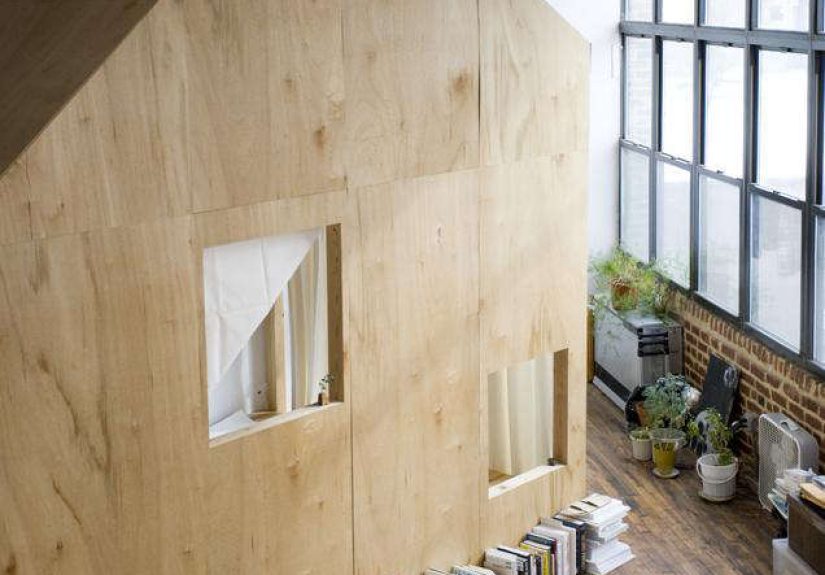
The loft’s defining move was the creation of two freestanding sleeping structures: a pitched-roof cabin and a lofted treehouse. Rather than sealing off bedrooms with full-height walls, Katz Chiao inserted these compact volumes into the open plan. The move preserved the airy character of the old factory space while still giving each resident a room with real psychological boundaries.
The Cabin
The cabin is the more archetypal of the two structures. Its pitched roof instantly signals “shelter” in the most universal way possible. It looks like the kind of shape a child might draw when asked to sketch a house: simple, direct, and oddly comforting. That familiarity is part of its genius. In a huge industrial loft filled with brick, windows, and hard edges, the cabin softens the atmosphere by introducing a more intimate domestic silhouette.
But it is not just a charming shape. The cabin also works hard. Built-in storage in the raised floor gives it useful density, while cut-out openings keep air moving and allow light to pass through. Instead of becoming a dark wooden box sulking in the corner, it stays connected to the rest of the home.
The Treehouse
Then there is the treehouse, which sounds whimsical because it is whimsical. Thankfully, it is also smart. Raised above the floor, it uses vertical space to create a sleeping zone overhead and a study or storage area below. That is exactly the kind of move loft living rewards. When you cannot grow outward, you grow upward.
The treehouse also changes the emotional tone of the loft. A conventional bedroom says, “Please close the door quietly.” A treehouse says, “Maybe architecture can still surprise us.” It adds a sense of play without descending into theme-park nonsense. The structure feels integrated, useful, and oddly calm.
The Shared Space Between Them
Perhaps the most underrated part of the layout is the open common space between the two sleeping volumes. This shared zone includes the kitchen, living area, and a large table for dining and working. That table is not just furniture; it is the social anchor of the home. Instead of organizing life around private rooms and hallways, Katz Chiao arranged the loft like a miniature settlement, with shared civic life in the middle and private shelter at the edges.
Even the small semi-private garden areas near the structures matter. They create thresholds rather than abrupt boundaries. You do not go from “public” to “private” in one step; you pass through layers. That kind of sequencing is what makes architecture feel thoughtful rather than merely assembled.
Why the Design Still Feels Fresh
Some design ideas age badly. They arrive trendy, then die surrounded by their own brass fixtures. Katz Chiao’s Brooklyn loft has held up because it solves enduring problems with unusually clear thinking.
First, it respects light. In a former factory loft, daylight is one of the great luxuries. Standard bedroom walls would have blocked views, darkened the interior, and made the space feel smaller. By using cabin-like structures with openings and setback entries, the design lets sunlight travel through the loft instead of stopping at the first partition like a commuter hitting a stalled train.
Second, it respects air. Ventilation is not glamorous copy for a design magazine, but it matters in everyday life. The cut-out windows and partial openness of the structures allow the rooms to breathe. There is a difference between a compact room and a cramped one, and airflow is often the deciding factor.
Third, it respects emotion. This may be the most important point. A home is not a storage diagram with rent attached. People respond to shapes, thresholds, and little rituals of arrival. The cabin and treehouse create the feeling of retreat, perch, nook, and shelter. They make privacy feel designed rather than reluctantly carved out.
And fourth, it respects the original building. Too many renovations treat old industrial spaces as empty shells waiting to be domesticated into submission. Katz Chiao did the opposite. The design works because it keeps the loft feeling like a loft. The exposed brick, volume, and old-factory character are not erased; they are framed by the inserted structures. The project understands that adaptive reuse works best when the old and the new remain in lively conversation.
Brooklyn, Bushwick, and the Logic of the Loft
This project also makes sense in its specific place. Bushwick has long been tied to the afterlife of industrial buildings: factories, warehouses, and workspaces that gradually became studios, homes, and hybrid living-working environments. The neighborhood’s loft culture was never just about aesthetics. It was about opportunity, improvisation, and making something livable from what the city had left behind.
That is why Katz Chiao’s design feels so Brooklyn in the best sense. It is resourceful rather than flashy. It is collaborative rather than corporate. Reports on the project noted that friends and neighbors helped build the structures over the summer, which only strengthens the impression that this was architecture as community effort, not just architecture as image production.
Even the modest budget gives the project a certain urban honesty. A design idea does not become less intelligent because it costs less. If anything, the opposite is often true. The loft proves that constraints can sharpen imagination. When the goal is to preserve openness, create privacy, add storage, and make the place feel special, brute force is rarely the most elegant solution.
Beyond One Loft: What the Project Says About Katz Chiao’s Bigger Thinking
The Brooklyn loft becomes even more interesting when viewed alongside Katz Chiao’s broader work. Deborah Grossberg Katz and Terri Chiao were not only interested in charming interiors. Their related projects and research touched housing, urbanism, and questions of how design shapes everyday life for people under real pressure. That broader perspective helps explain why the loft feels so conceptually strong.
You can see that mindset in work connected to micro-lofts and affordable housing, where compact units were imagined not as glorified closets but as dignified, flexible dwellings with light, air, and vertical generosity. You can also see it in research focused on social issues, including how design can respond to the needs of vulnerable urban populations. In that light, the Brooklyn loft reads less like an isolated stunt and more like a built sketch of a larger philosophy: design should make constrained lives feel more open, more usable, and more humane.
That may be the real legacy of this architect visit. The cabin and treehouse are the memorable image, sure. But behind the image is an argument: small spaces deserve imagination, and urban living should not force people to choose between privacy and generosity.
Design Lessons Worth Borrowing
You do not need a Bushwick loft or an indoor treehouse ambition to learn something from Katz Chiao. The project offers several ideas that translate beautifully to ordinary homes.
Use freestanding elements to define space
Not every room needs a full wall. Cabinets, platforms, partial volumes, shelving, and raised elements can divide functions while preserving sightlines.
Think in sections, not just floor plans
The treehouse works because the design uses height as actively as square footage. Mezzanines, loft beds, overhead storage, and varied ceiling relationships can change a home more dramatically than moving walls around.
Design transitions, not just rooms
The little garden-like thresholds and entry moments give the loft softness. A narrow strip for plants, a built-in bench, a small reading nook, or a recessed doorway can do emotional work far beyond its size.
Let practicality have personality
A closet rail hung from the ceiling is efficient, yes, but it also looks wonderfully unfussy. The best small-space design often feels a little improvised and a little intentional at the same time.
The Experience of Visiting Katz Chiao in Brooklyn
What would it actually feel like to visit Katz Chiao in Brooklyn? Not in the glossy “every surface has been styled within an inch of its life” sense, but in the real, embodied sense of walking into the space and letting it reveal itself? That is where the project becomes more than a layout and starts behaving like architecture.
First, you would probably notice the scale of the loft itself: the old industrial shell, the generous windows, the sense that the room once belonged to labor before it belonged to domestic life. Then, instead of seeing that openness chopped into obedient boxes, you would find two wooden forms sitting within it like little buildings in a streetscape. The effect is immediate. Your brain does not read the loft as one room anymore. It reads it as a place with destinations.
You would walk toward the cabin and understand, almost instinctively, why the pitched roof matters. It shrinks the vastness of the loft into something psychologically graspable. It says: here is a room, yes, but also here is refuge. The cabin would feel especially striking because it is not pretending to be a conventional bedroom. It announces its identity. It is a room that knows it is a room.
The treehouse would deliver a different sensation. Because it is lifted off the ground, it creates that mild, pleasurable weirdness that all good spatial experiences share. Part of you understands it functionally: raised sleeping area, useful zone below. Another part of you responds with the less respectable but more human reaction: this is delightful. A proper visit would remind you that delight is not a decorative extra. It is part of how architecture earns memory.
Then there is the space between the two structures, which may be the project’s quiet masterpiece. Many homes are organized around avoidance: private rooms at war with shared living. Here, the central zone feels like common ground. The large table suggests conversation, meals, work, and the kind of overlap that makes a home feel alive. You can imagine coffee becoming lunch, lunch becoming a work session, and a work session becoming an evening with friends before anyone notices the day has changed clothes.
The planted in-between areas would likely make the strongest impression over time. They are small, but they stop the project from becoming a clever geometry exercise. They bring softness to the wood, brick, and daylight. They make the interior feel less like a machine for fitting bodies into square footage and more like a habitat. That is the right word, really: habitat. Katz Chiao did not just subdivide a loft. They cultivated an environment.
And perhaps that is the emotional takeaway from a visit like this. You leave with the sense that architecture does not need to be huge to be generous, expensive to be intelligent, or polished to be persuasive. The Brooklyn loft works because it treats daily life as something worthy of imagination. It assumes that sleeping, reading, cooking, hosting, storing, and simply moving through a home can all be made richer by form. Not louder. Not fancier. Just richer.
That is why the project lingers. You may come for the indoor cabin because, frankly, an indoor cabin is excellent bait. But you stay with the deeper idea: that even in a crowded city, even in an old factory shell, even on a lean budget, architecture can still create wonder. And in Brooklyn, where reinvention is practically a local utility, that feels exactly right.
Conclusion
Architect Visit: Katz Chiao in Brooklyn remains compelling because it solves ordinary urban problems with extraordinary clarity. The project did not ask how to make a loft look trendy. It asked how to make it livable, communal, private, bright, and memorable all at once. The answer was a cabin, a treehouse, a few threshold gardens, and a refusal to flatten architectural possibility into boring rooms.
More than a decade later, that answer still feels sharp. In a design culture often obsessed with surfaces, Katz Chiao offered something better: a spatial idea with soul. The Bushwick loft showed that small-space architecture can be emotionally generous, that adaptive reuse can preserve character rather than sterilize it, and that a home can feel like a tiny village without losing the intimacy of a retreat.
In short, this was never just a clever Brooklyn loft. It was a manifesto in miniature. And yes, it also happened to include an indoor treehouse, which is the sort of detail that makes architecture feel less like homework and more like life.