Table of Contents >> Show >> Hide
- Who Are Burd Haward?
- What Makes a Burd Haward Building Feel Like a Burd Haward Building?
- Projects That Explain the Practice
- Bluebell House: Small House, Big Lesson
- Brooke Coombes House: Early Proof of Serious Talent
- Mottisfont Welcome Buildings: Arrival as Architecture
- Gospel Oak Housing: Urban Stitching, Not Urban Swagger
- Queen’s College Porters’ Lodge: Access with Grace
- Palace of Holyroodhouse and Abbey Strand: Heritage That Lives
- Why Burd Haward Matters in London Right Now
- A Longer Reflection on the Experience of “Visiting” Burd Haward in London
- Conclusion
London is full of architecture that wants your attention right now. It flashes, curves, shimmers, and occasionally behaves like it expects applause. Then there is Burd Haward, a practice that seems far more interested in earning a second look than demanding a first one. That is exactly what makes it memorable.
If you spend time with Burd Haward’s work, a pattern emerges. This is architecture that likes context, loves materials, and has no interest in showing off for the sake of it. The buildings are calm but not bland, contemporary but not cold, and practical without losing a sense of delight. In a city that often swings between fussy nostalgia and glass-box fatigue, that is no small achievement.
An architect visit focused on Burd Haward in London is less about chasing spectacle and more about learning how thoughtful design can transform everyday spaces. Their projects move across housing, heritage, education, and workplace design, but the underlying attitude stays remarkably consistent: understand the site, respect the life already there, and then make something quietly extraordinary.
Who Are Burd Haward?
Burd Haward Architects was founded in 1998 by Catherine Burd and Buddy Haward. The practice has built a reputation for carefully crafted, sustainable architecture that combines structural clarity with sharp attention to detail. That sounds polished on paper, but in real life it means their buildings often feel well tuned rather than overdesigned. They are not trying to win a shouting match with the street. They are trying to make the street, the garden, the courtyard, or the campus work better.
The studio’s portfolio is broad, but not random. Burd Haward works on homes, mixed-use projects, heritage interventions, community spaces, and institutional buildings. Many of those commissions sit in historically sensitive or environmentally delicate settings. That matters because the practice’s best work often comes from constraint. Tight sites, listed fabric, floodplains, access challenges, awkward adjacencies, and inherited urban mess are not treated as annoyances. They are treated as design material.
That approach helps explain why the firm has earned recognition for projects ranging from the Brooke Coombes House and Bluebell House to the Mottisfont Welcome Buildings and Gospel Oak Housing. The awards are impressive, but more impressive is the consistency behind them. There is no sense that one brilliant building happened by accident while the rest of the office had an off day. Burd Haward’s work feels like the product of a stable design mind.
What Makes a Burd Haward Building Feel Like a Burd Haward Building?
Context Comes First
Some architects talk about context as if it were a box to check before they get to the fun part. Burd Haward treats it as the fun part. Look at their work and you notice how often each project seems to grow directly out of a specific place. The practice is skilled at reading what already exists, whether that is a row of Georgian terraces, a mews street in Kentish Town, a National Trust landscape, or a historic college quad in Oxford.
This does not mean copying the past. Burd Haward is not in the business of costume drama architecture. Instead, the studio tends to borrow scale, rhythm, proportion, and material cues from the surroundings, then reinterpret them in a crisp contemporary way. The result is architecture that belongs without pretending to be old.
Materials Do Real Work
Burd Haward has a gift for choosing materials that age well and say something useful about the building. Brick, timber, zinc, steel, stone, and glass all appear regularly, but never as trendy decoration. The materials help describe structure, frame views, shape thresholds, and create a sense of tactile honesty. In a lot of projects, you can almost read the design philosophy through the wall section.
That is part of the reason the work feels grounded. You do not get the impression that the architect chose a finish because it was hot on social media for eight minutes. You get the impression that someone thought about weather, maintenance, craft, and atmosphere. What a radical concept.
Sustainability Is Integrated, Not Performed
One of the most appealing things about Burd Haward’s architecture is that its environmental thinking is often woven into the building rather than announced with a megaphone. Prefabricated timber structures, low-energy strategies, flood-sensitive siting, retrofit logic, and careful reuse all show up repeatedly. The sustainability is there, but it is not wearing a sandwich board.
That restraint makes the work feel more credible. Burd Haward tends to treat environmental performance as part of good architecture, not a separate publicity department. When it works best, the green thinking improves the actual experience of the place: better light, more adaptable space, lower energy use, gentler impact on the site, and smarter circulation.
Projects That Explain the Practice
Bluebell House: Small House, Big Lesson
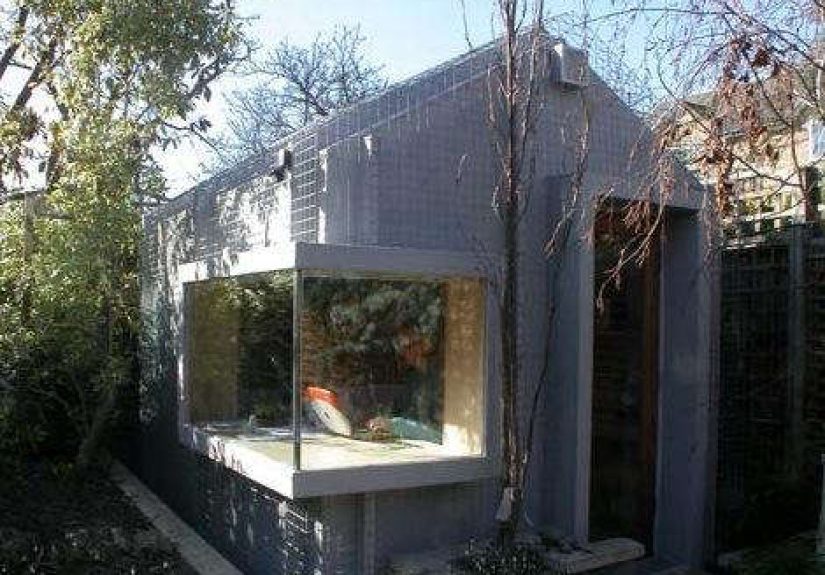
Bluebell House is one of the clearest demonstrations of Burd Haward’s strengths. Built on a secluded back-land site in west London, it was designed as an accessible, energy-efficient home with low running costs, along with space for a painting studio and workshop. The site had all the ingredients that usually make architects mutter into their coffee: restricted access, listed trees, a massive oak, and nearby neighbors who probably did not want an architectural spaceship parked next door.
The response was elegant. The home’s form grew out of a close reading of the site, with a long single-story wing tucked along the northern edge and a smaller two-story element helping organize the garden. The building is slightly raised on mini piles to protect tree roots, while its prefabricated timber structure, rainwater harvesting, solar panels, air-source heat pump, and green roof show how environmental thinking can be quietly embedded in domestic architecture.
Bluebell House is compact, but it does not feel stingy. That is a Burd Haward hallmark: using planning, section, and relationship to landscape to make modest spaces feel expansive.
Brooke Coombes House: Early Proof of Serious Talent
The Brooke Coombes House, one of the practice’s early landmark projects, already contained many of the ideas that would define the office. Designed as a low-cost modern family home in a conservation area, it challenged the assumption that economical construction had to look dull or improvised. Burd Haward aimed for something buildable and efficient, but also spatially rich.
The house rethinks the typical suburban arrangement by pushing the main living spaces into an economical strip and using a glazed courtyard as both climate buffer and transitional space. It is a smart piece of low-energy design, but it is also an architectural argument: sustainability does not have to mean aesthetic sacrifice, and self-build logic does not have to end in glorified shed chic.
Mottisfont Welcome Buildings: Arrival as Architecture
If you want to understand how Burd Haward handles landscape, heritage, and visitor experience, Mottisfont is essential. The practice designed a group of welcome buildings for the National Trust property on the River Test, raising the structures above the floodplain and using prefabricated methods and screw piles to minimize site disturbance. The buildings take cues from agricultural forms at the edge of an estate, yet they feel fully contemporary.
What is especially impressive is how the project turns arrival into a meaningful sequence. You move from car park to reception to courtyard to walkway and onward into the landscape. That transition is not treated as dead time. It becomes the architecture. Burd Haward understands that a welcome building should do more than process people; it should prepare them for a place.
The material palette helps too. Weathering steel, timber, zinc, glazing, and expressed timber structure create a building that feels both robust and light-footed. It is a good example of the practice’s ability to be visually distinctive without becoming loud.
Gospel Oak Housing: Urban Stitching, Not Urban Swagger
Housing is where many design ideals go to die in a swamp of compromise. Burd Haward’s Gospel Oak Housing shows that compromise does not have to kill character. Delivered on infill sites under Camden’s Community Investment Programme, the project inserts new homes among very different urban neighbors, including Victorian housing and notable mid-century estates.
Rather than force a single heroic gesture across the sites, the practice created a recognizable family of buildings that share materials and detail while adjusting massing and layout to each immediate context. Pale brick with a raking bond mediates between surrounding building types, while carefully designed openings, balconies, and social staircases bring light and dignity into compact homes.
The phrase “urban stitching” fits here. Burd Haward is not trying to dominate the neighborhood; it is trying to repair it. That sounds modest, but in London housing terms it is actually pretty bold.
Queen’s College Porters’ Lodge: Access with Grace
The new Porters’ Lodge at The Queen’s College, Oxford may sit outside London, but it says a great deal about what makes Burd Haward compelling. Working within a Grade I listed setting, the practice devised a deceptively simple scheme that resolved heritage, access, and security issues with unusual finesse. Existing offices were converted into the new lodge, partitions were removed, the historic floor was lowered, and the relationship between the quad and entrance was transformed.
The project’s brilliance lies in how subtle it looks compared with how much it accomplishes. New stairs, lift access, gates, joinery, and structural alterations were introduced with enormous care. For the first time in the college’s long history, the lodge and quad became accessible from the High Street for all users. That is not a flashy intervention. It is something better: a deeply humane one.
Palace of Holyroodhouse and Abbey Strand: Heritage That Lives
Burd Haward’s work for the Palace of Holyroodhouse and the Abbey Strand Buildings pushes the office into the territory of major public heritage projects. The studio helped deliver a program of works designed to improve visitor welcome, learning spaces, access, wayfinding, and the display of objects from the Royal Collection. At Abbey Strand, a group of 15th-century listed buildings was refurbished and converted into a learning center with apartments above.
What stands out is the refusal to treat historic buildings as fragile museum props. Burd Haward works to reveal old fabric, restore significance, improve access, and create new public life. Openings are re-established, breathable materials are used, thick stone walls are upgraded intelligently, and circulation becomes clearer and more democratic. Heritage here is not trapped behind velvet rope. It is made usable again.
Why Burd Haward Matters in London Right Now
London needs more architecture that behaves the way Burd Haward’s does. The city is dealing with housing pressure, retrofit demands, accessibility expectations, climate concerns, and the constant tension between preservation and change. Burd Haward offers a model that is neither nostalgic nor arrogant. It suggests that contemporary architecture can be inventive, sustainable, and civic-minded without becoming theatrical.
That balance is especially important in a culture that often rewards the image before the experience. Burd Haward’s projects photograph well, certainly, but they are not designed only for the camera. They are designed for weather, movement, use, aging, and daily life. In other words, they are designed for the annoying reality that people actually have to live with architecture once the launch party is over.
A Longer Reflection on the Experience of “Visiting” Burd Haward in London
What does an architect visit centered on Burd Haward really feel like? Not in the influencer sense, where someone points at a wall finish and declares it “iconic,” but in the slower, more useful sense of architectural experience. It feels like moving through a series of places where nothing is random and nothing is trying too hard.
You begin to notice thresholds. Burd Haward is especially good at them. Courtyards, mews, entrances, ramps, stairs, garden edges, and transitional rooms matter in this work. They are not leftovers between “important” spaces. They are where the architecture earns your trust. A Burd Haward project often guides you in gently, letting light, material, and proportion do the talking. No jazz hands required.
You also notice how often their buildings improve your sense of orientation. In a dense city like London, that is a gift. Their work tends to clarify rather than confuse. You understand where to go, where to pause, what belongs to the public realm, and what becomes more intimate. That is true in housing, where privacy and openness have to be negotiated carefully, and it is equally true in heritage settings, where access has to be inserted without wrecking character.
Then there is the atmosphere. Burd Haward’s interiors and exteriors often feel warm without being rustic, precise without being sterile. Timber is tactile. Brick has weight. Steel and zinc are used with discipline. Glass opens views instead of dissolving the building into nothingness. Even when the architecture is minimal, it still feels inhabited, as though it expects real coats, real mud, real books, real conversations, and maybe a kettle boiling somewhere nearby.
For students of architecture, the visit is a lesson in restraint. For homeowners, it is a lesson in how good planning can make modest square footage feel generous. For city lovers, it is a lesson in how infill, retrofit, and conservation can add value without flattening local character. And for anyone tired of buildings that look like they were generated by a software demo and a mood board full of buzzwords, Burd Haward is refreshingly human.
That may be the best takeaway from spending time with the practice’s work. Burd Haward does not separate craft from practicality, sustainability from beauty, or heritage from present-day life. The projects suggest that architecture works best when it is deeply observant: observant of people, observant of landscape, observant of structure, and observant of history. London, with all its layers and contradictions, is exactly the kind of city where that mindset matters.
So yes, an architect visit to Burd Haward in London is worth your time. Not because you will leave with a dramatic skyline selfie, but because you will leave noticing more. You will notice how a building meets the ground, how a courtyard changes pace, how a stair can solve more than circulation, and how modesty in architecture can still feel rich. In a profession that sometimes confuses volume with intelligence, Burd Haward’s quiet confidence is a welcome reminder that the smartest building in the room is not always the loudest one.
Conclusion
Burd Haward represents a thoughtful, durable version of contemporary British architecture: rooted in context, serious about craft, and quietly inventive. From award-winning homes to public heritage work and urban housing, the practice has shown that good design does not need to perform like a celebrity to have real impact. If your idea of great architecture includes intelligence, warmth, and a little less ego, Burd Haward in London is a practice worth knowing well.