Table of Contents >> Show >> Hide
- What “Swaps Diffusion for Reflection” Actually Means
- Why This Shift Matters Right Now
- Signals from the Field: Art, Tech, Law, and Audience Behavior
- From Prompt Theater to Reflective Systems Design
- Design Blueprint for an AI Installation That Prioritizes Reflection
- Concept Example: “Mirror Choir”
- How to Evaluate Success Without Killing the Magic
- Common Mistakes (and Fast Fixes)
- The Next Chapter: Post-Diffusion Aesthetics
- Extended Experience Essay (500+ Words): What Reflection-First AI Feels Like in Practice
- Conclusion
For the last few years, AI art has mostly followed one ritual: type a prompt, wait a few seconds, receive a gorgeous image, pretend you totally meant “baroque astronaut raccoon librarian,” and post it online like an oracle spoke through your keyboard. That era is still alive, but a new creative direction is quietly stealing the spotlight: AI installations that swap diffusion for reflection.
In plain English, this means fewer systems that generate endless images from text and more systems that respond to people in real timeyour movement, your voice, your timing, your hesitation, your decisions, your social dynamics, your presence. The artwork becomes less “machine imagination on demand” and more “a feedback loop between human behavior and machine interpretation.”
This shift is not a trendy gimmick. It’s a meaningful creative evolution, shaped by museum experimentation, audience fatigue with generic AI aesthetics, legal uncertainty about authorship, and a growing demand for trust, transparency, and participation. If diffusion art was the big fireworks show, reflective AI installation is the campfire conversation after the fireworks: slower, deeper, and weirdly more memorable.
This article synthesizes real-world signals from leading U.S.-relevant institutions and publications in art, law, and technologysuch as museum documentation, major legal reporting, public opinion research, and model-development historythen translates those signals into a practical framework for artists, curators, and creative technologists building what comes next.
What “Swaps Diffusion for Reflection” Actually Means
Diffusion, in one sentence
Diffusion systems generate media by learning how to reverse noise into images (and increasingly video, audio, and 3D forms). In the popular imagination, diffusion equals prompt-to-image magic: type words, get visuals.
Reflection, in one sentence
Reflective installations prioritize interaction over output volume. Instead of “What image can the model make?” the question becomes “What can this system reveal about usindividually and togetherthrough interaction, interpretation, and response?”
The philosophical upgrade
Diffusion art tends to externalize imagination. Reflective installation internalizes it. One gives you pictures of possibilities; the other gives you a structured encounter with your own behavior, assumptions, and attention. In that sense, reflective AI is less like a printer and more like a social mirror with a sense of humor and a slightly unsettling memory.
Why This Shift Matters Right Now
1) Audiences want to participate, not just consume
People are no longer amazed just because a machine made a pretty image. The novelty curve has flattened. Interactive systems that involve the visitor as co-author now create stronger emotional recall than passive “look-only” experiences.
2) Curators increasingly care about process legibility
Museums and institutions are asking harder questions: What data trained this system? What is the human role? Is the artwork actually saying anything, or just rendering technically polished wallpaper? Reflective installations can make process visible, not just outputs.
3) Legal and ethical pressure is forcing more human-centered design
As debates over copyright, training data, authorship, and attribution intensify, reflection-first formats create clearer creative accountability. They foreground human intent, composition, and decision-making instead of hiding everything inside a black-box prompt pipeline.
Signals from the Field: Art, Tech, Law, and Audience Behavior
Museums have already laid the groundwork
AI art in institutions is not brand new. The Whitney’s work on Harold Cohen’s AARON reminds us that the lineage reaches back to the late 1960s and early 1970s. In other words: before people argued about prompt engineering on social media, artists were already exploring machine-assisted art as a long-form creative practice.
MoMA’s presentation and cataloging of AI-based generative media, including data-driven installations, helped normalize AI as museum-scale artistic infrastructure rather than a novelty plugin. LACMA pushed interactivity further through works like Diffuse Control, where the audience actively participates in transforming visual material in real time.
Even the “anti-AI visual” movement is becoming creative fuel
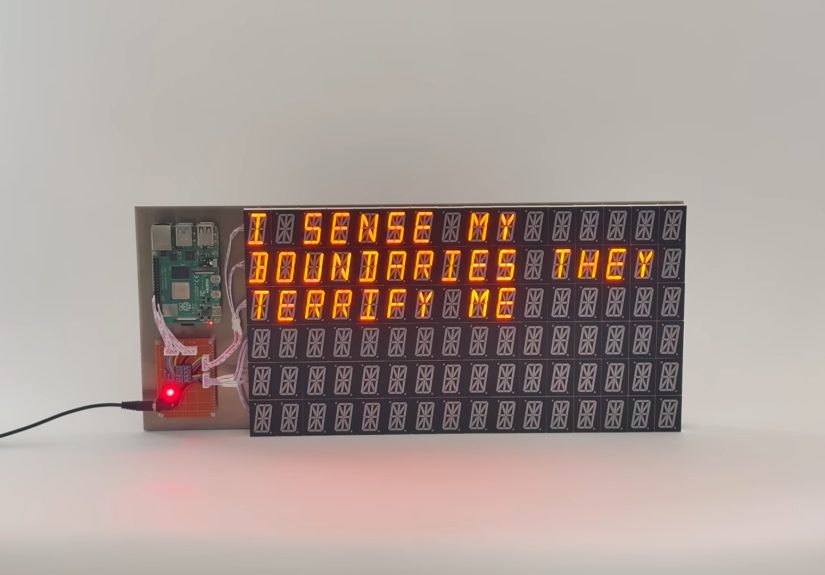
A fascinating example from the maker-art scene described an installation concept that intentionally avoided AI-generated visuals and large language models while still using machine logic to interpret language and manipulate live media. That’s a useful clue: artists are no longer asking “Should I use AI?” but “Which part of AI belongs in this artistic idea?”
The market says people will pay attentionbut not uncritically
High-profile AI-focused auction activity proved that collectors and new audiences are curious. But the commercial momentum has arrived with backlash, scrutiny, and deeper public argument. Translation: interest is real, but legitimacy now depends on artistic rigor and ethical clarity, not buzzwords.
Law is drawing bolder boundaries
U.S. legal and policy direction has become clearer: purely machine-generated outputs without sufficient human authorship generally do not enjoy the same copyright treatment as human-authored works. At the same time, AI-assisted works with meaningful human creative contribution can qualify for protection. Courts and policy bodies are effectively nudging creators toward workflows where human judgment is visible and substantial.
Public trust remains fragile
Audience research continues to show concern about AI’s social effects, especially around authenticity, creativity, and human connection. Reflection-first installation answers that anxiety better than infinite auto-generation because it centers human agency and openly stages the human–machine relationship instead of pretending it doesn’t exist.
From Prompt Theater to Reflective Systems Design
If you are building an installation today, the core strategic question is not “Which model is newest?” It is: “What kind of encounter do I want visitors to leave with?”
Diffusion-first projects optimize for output quality. Reflection-first projects optimize for cognitive and emotional resonance. Both can be beautiful. But they are different instruments:
- Diffusion-first: high visual variety, rapid generation, “look what it made.”
- Reflection-first: responsive feedback, interpretive depth, “look what this interaction revealed.”
Think of it this way: diffusion gives you images of imagined worlds; reflection gives you a structured way to notice the world you’re already in, including your own role in it.
Design Blueprint for an AI Installation That Prioritizes Reflection
1) Start with behavior, not graphics
Define the human behavior you want to surface: mimicry, hesitation, collaboration, crowd influence, empathy, bias, boredom, curiosity, rhythm, attention drift. Then select technology that can reveal that behavior.
2) Build a transparent “data diet”
Your training and runtime inputs are part of the artwork’s ethics. Use clearly scoped, explainable datasets. Public-domain collections, artist-owned material, or purpose-built participatory datasets can reduce legal and reputational risk.
3) Use AI in modular roles
You do not need one giant model doing everything. A stronger installation often uses small, legible components:
- Perception model (detect motion, posture, proxemics, speech tone)
- Interpretation layer (map behavior to conceptual states)
- Transformation engine (visual, sonic, textual, kinetic response)
- Narrative memory (short-term adaptation, no creepy persistence)
4) Design for consent and boundaries
Clear signage. Optional participation zones. No hidden biometric extraction. Immediate opt-out. If your installation “reflects” people, make sure it also respects people.
5) Make the mechanism part of the art
Reflection works best when visitors can infer why the system responded the way it did. This can be subtle: a side panel showing active input channels, a visual legend of states, or a “trace mode” that reveals transformation steps.
6) Include friction on purpose
Not every response should be instant dopamine. Occasional delay, ambiguity, or unresolved output can increase contemplation. The goal is not to win the internet in 8 seconds; the goal is to produce durable thought.
Concept Example: “Mirror Choir”
Imagine a room with a wide reflective surface, overhead directional sound, and floor pressure mapping. Visitors step in. Instead of generating fantasy imagery, the system composes a living portrait of group dynamics:
- If people synchronize movement, harmonic textures become richer.
- If one person dominates space, the reflection visually fragments around them.
- If strangers maintain respectful distance, layered “social geometry” appears.
- If someone pauses, the installation rewards stillness with finer detail.
No dragons. No neon cyberpunk city. No “make it cinematic.” Just human interaction translated into an expressive audiovisual mirror. You leave less impressed by machine output and more aware of how you show up around other humans. That’s reflection.
How to Evaluate Success Without Killing the Magic
Creative metrics
- Average dwell time per visitor or group
- Repeat interaction rate during the same visit
- Depth of behavioral exploration (not just selfie count)
- Quality of post-experience conversation
Ethics and trust metrics
- Visitor understanding of what data was used
- Comfort level with participation and consent options
- Perceived fairness of system responses
- Clarity of authorship and creative credit
Institutional metrics
- Educational programming fit (talks, workshops, school tours)
- Cross-disciplinary collaboration (art + engineering + humanities)
- Longevity beyond launch week hype
- Ability to evolve via updates without concept drift
Common Mistakes (and Fast Fixes)
Mistake: “More model, more meaning”
Fix: Start with a strong artistic question. Add only the minimum technical complexity needed to express it.
Mistake: Treating interactivity like a gimmick
Fix: Map each interaction to a conceptual intent. If a gesture changes color, ask why that matters narratively.
Mistake: Black-box aesthetics
Fix: Build lightweight explainability into the visitor journey.
Mistake: Ignoring legal context
Fix: Document human contributions, training provenance, and rights assumptions from day one.
Mistake: Designing for social media before physical experience
Fix: Optimize the room first. If the in-person encounter is strong, documentation will follow naturally.
The Next Chapter: Post-Diffusion Aesthetics
“Post-diffusion” does not mean anti-diffusion. It means diffusion stops being the main character. The real innovation frontier is compositional:
- Blending generative media with behavioral sensing
- Moving from solitary prompting to collective authorship
- From static output to evolving environments
- From novelty images to sustained meaning-making
In this future, an AI installation isn’t judged by how photorealistic its outputs are. It is judged by whether it creates insight, relation, and memory. The machine does not replace the artist; it extends the choreography between artist, audience, and space.
Extended Experience Essay (500+ Words): What Reflection-First AI Feels Like in Practice
Picture a Friday evening at a contemporary art museum. The lobby is loud with polite museum voices, shoe squeaks, and a tiny espresso machine fighting for its life. You turn a corner and enter a darkened room labeled “Reflective System: Collective Mirror Study.” There’s no keyboard. No prompt box. No “Type your dream world.” Just a soft instruction on the wall: “Stand where you can see each other.”
The first thing you notice is that nothing happens right away. That is surprisingly powerful. In diffusion-style experiences, immediate output is the dopamine contract. Here, the work asks for patience. A couple near you starts waving dramatically, expecting fireworks. The system responds with… almost nothing. A faint ripple. A ghosted contour. It feels like being ignored by a very polite robot therapist.
Then three strangers unconsciously align their stancejust enough that their spacing forms a loose triangle. Suddenly the room lights respond, not in bright spectacle, but in subtle coherence. A low harmonic tone appears. The mirrored surface begins layering their silhouettes into a shared shape that belongs to none of them individually. People stop performing and start paying attention.
Ten minutes in, the social choreography gets interesting. A teenager tests boundaries by rushing in front of everyone. The reflection fractures into sharp lines and the audio destabilizes. He laughs, steps back, then tries againthis time slower, matching the group’s pace. The system softens. You can practically watch him discover that the artwork rewards relation more than domination. No lecture. No didactic panel. Just immediate experiential feedback.
Across the room, a parent and child play a mirroring game. The child moves first, the parent follows, and the system traces their lag as colored delay trails that eventually converge. It feels less like “AI made art” and more like “AI visualized trust.” That distinction is everything. The artwork is not asking, “Can a machine be creative?” It asks, “What patterns in our behavior become visible when a machine is tuned to reflect, not impress?”
After a while, you notice another design choice: the installation never stores identity in an obvious way. No faces on display. No public ranking. No giant scoreboard yelling “Best Participant of the Hour.” You feel observed, but not harvested. That subtle ethics design changes your willingness to engage. You try a longer stillness, and the system responds with more texture. You test collaborative movement with a stranger and get unexpected audiovisual harmony. You leave with something rare in AI discourse: not just an opinion, but a felt understanding.
On the way out, two visitors debate whether what they experienced counts as “real art” or “responsive software.” The best part is that neither person can dismiss the other. They both have a point. The installation did not resolve the argument; it matured it. That is what reflection-first work does at its best: it upgrades conversation quality.
A week later, what you remember is not a single image. You remember a social moment: when five strangers realized the room got more coherent when they paid attention to one another. In a media culture optimized for solitary scrolling, that is radical. The installation becomes memorable not because it generated infinite visuals, but because it generated a temporary civic behaviora small rehearsal for how humans and machines might coexist with more care.
If diffusion-era AI art asked, “What can the model make?”, reflective AI installations ask, “What can we notice together?” That second question is harder, slower, less screenshot-friendly, and dramatically more important. It points to a future where AI in art is not just about output abundance, but about relational intelligence. And honestly, that future feels less like a tech demo and more like culture.
Conclusion
AI art is maturing from generation to interpretation. Diffusion remains a powerful medium, but the most meaningful installations now treat AI as a reflective partner in a human-centered encounter. Museums, markets, policy, and public sentiment are all signaling the same thing: audiences want depth, not just novelty. The winning creative strategy is not to abandon generative toolsit is to orchestrate them inside ethical, legible, participatory systems that help people see themselves and each other more clearly.