Table of Contents >> Show >> Hide
- The Viral Legend: A Bike, a Boy, and the Shadow of 1914
- The Real Location: Vashon Island’s Bicycle in the Tree
- Who Was Don Puz?
- How Did the Tree “Eat” the Bicycle?
- Why the 1914 War Story Became So Popular
- What the Story Gets Right Emotionally
- Urban Legends and the Internet: A Perfect Match
- The Role of Local Memory
- Why This Story Still Matters
- Lessons From the Bicycle in the Tree
- Experiences Related to “A Boy Chained His Bike When He Went to War in 1914”
- Conclusion
Note: This article is written for web publication and synthesizes reputable historical, local, fact-checking, and educational sources. The famous 1914 war-bike story is treated as a powerful legend, while the article clearly explains the better-supported real story behind the bicycle in the tree.
Few internet stories arrive with as much instant emotional punch as this one: a boy chains his bicycle to a tree, leaves for war in 1914, never returns, and decades later the tree grows around the bike like nature itself is preserving a memorial. It sounds like a perfect little historical tearjerkerpart World War I tragedy, part fairy tale, part “please pass the tissues.” No wonder the image of an old bicycle trapped in a tree has traveled across social media for years.
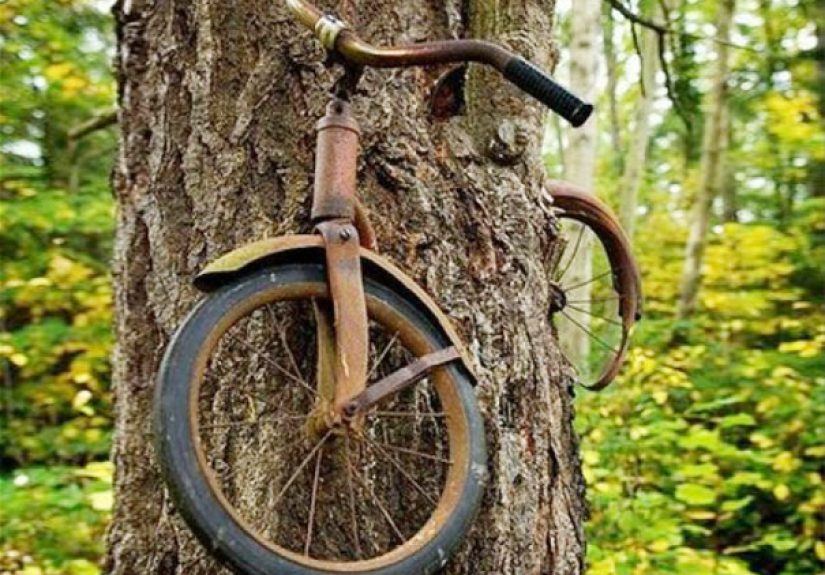
But the truth is more interesting than the caption. The bicycle is real. The tree is real. The strange sight can be found on Vashon Island in Washington State, where a small bike appears to be swallowed by a tree. What is not well supported is the claim that it belonged to a boy who went to war in 1914. In fact, the widely shared war story is best understood as an urban legendone that says a lot about how people turn mysterious objects into emotional history.
The real story is not quite as cinematic, but it has its own quiet charm. It involves a boy named Don Puz, a donated bicycle, a family recovering from a house fire, a swampy patch of woods, and a tree that apparently had no respect for private property. Over time, that forgotten bicycle became a local landmark, a tourist curiosity, a children’s-book inspiration, and one of the internet’s favorite examples of “nature always wins.”
The Viral Legend: A Bike, a Boy, and the Shadow of 1914
The popular version usually goes something like this: in 1914, a young boy chained his bicycle to a small tree before leaving to fight in World War I. He never came home, and his family left the bike there as a memorial. Decades passed. The tree grew, thickened, and slowly wrapped itself around the bicycle, lifting it into the air as though refusing to forget him.
It is easy to understand why this story spreads. It is short, visual, emotional, and almost impossible not to share. The year 1914 immediately gives the tale historical weight because it marks the beginning of World War I. The bike becomes a symbol of youth interrupted. The tree becomes a living monument. The missing boy becomes every soldier who left home too soon. That is a lot of meaning for one rusty bicycle to carry.
However, there are problems with the claim. The United States did not enter World War I in 1914; it remained officially neutral until 1917. A boy from Washington State leaving for war in 1914 would not fit the common American timeline unless he had joined another nation’s forces, and there is no solid evidence connecting the Vashon bicycle to such a person. The story also claims the bike was chained to the tree, but available accounts of the real bicycle do not support that detail.
In other words, the viral caption works beautifully as a legend, but poorly as history. It is the kind of story the internet loves: emotionally tidy, historically foggy, and just mysterious enough to survive fact-checking attempts like a raccoon in a garage.
The Real Location: Vashon Island’s Bicycle in the Tree
The actual bicycle-in-a-tree landmark is associated with Vashon Island, a wooded island in Puget Sound, not far from Seattle. The bike is often described as a child’s bicycle lodged in a tree near Vashon Highway Southwest and Southwest 204th Street. Visitors have long treated it as an odd roadside attraction, the kind of place where people stop, stare, take a photo, and say, “Well, that’s not something you see next to every grocery store.”
Local reporting and historical summaries connect the bike to Don Puz, who grew up on Vashon Island. The better-supported account places the beginning of the story not in 1914, but around 1954. Don’s family had experienced a devastating house fire, and members of the community donated items to help them rebuild their lives. Among those donated items was a small bicycle.
According to accounts from Don Puz and his family, the bicycle was not exactly the dream machine of childhood. It was reportedly a small bike with hard rubber tires and handlebars that made it feel less like a glamorous ride and more like a punishment with pedals. Don was already big enough to dislike it, and after playing with friends in a wooded area near his home, he left the bike behind. Whether he forgot it or abandoned it with the quiet determination of a child rejecting an uncool gift, the result was the same: the bicycle stayed in the woods.
Who Was Don Puz?
Don Puz was not a vanished World War I soldier. He was a local boy who later became a King County sheriff’s deputy. His connection to the bicycle emerged when the odd landmark became famous enough that people began asking where it came from. Don recognized the bike and the area, and his family’s recollections helped replace the war legend with a more grounded local story.
This does not make the bike less meaningful. In fact, it may make it more human. The true story is not about a dramatic battlefield departure. It is about a child, a family trying to recover from loss, neighbors helping after tragedy, and an ordinary object being forgotten in an ordinary place. That is how real history often works. It rarely arrives with violins. Sometimes it arrives with a donated bike nobody really wanted to ride.
How Did the Tree “Eat” the Bicycle?
The bicycle appears to be swallowed by the tree, but trees do not eat metal for breakfast, no matter how suspiciously determined they look. What likely happened is a slow process of growth around a stationary object. Trees increase in diameter by adding layers of new growth beneath the bark. If an object is fixed in place against the trunk or in a fork, the growing wood can gradually surround it.
That said, the exact mechanics of the Vashon bike remain debated. Some observers have pointed out that the bicycle’s position in the tree may not be explained by a simple “leaned against the trunk and nature did the rest” scenario. It may have been placed in a fork of the tree, raised off the ground, or moved before becoming embedded. The tree’s growth then locked parts of the bike into place over time.
The result is visually unforgettable: a bicycle suspended in a tree, part object and part organism, as if a forest decided to create its own museum exhibit. For SEO purposes, people search for it as the “Vashon Island bike tree,” “bicycle in a tree,” “bike swallowed by tree,” and “old bicycle in tree Washington.” For visitors, however, the search term is usually much simpler: “Wait, is that a bike?”
Why the 1914 War Story Became So Popular
The 1914 version survives because it gives the image a complete emotional script. Without the legend, viewers see a strange object. With the legend, they see sacrifice, memory, family grief, and the passage of time. The story transforms a quirky landmark into a memorial, and people are naturally drawn to objects that seem to hold grief in a visible form.
There is also something symbolic about bicycles and childhood. A bike is often a child’s first taste of freedom. It represents speed, independence, summer afternoons, scraped knees, and the heroic belief that you can ride no-hands if only adults would stop worrying so much. When a story says a boy left his bike behind to go to war, the bicycle becomes shorthand for innocence abandoned.
World War I adds even more emotional gravity. The Great War reshaped nations, families, politics, technology, and memory. It also created countless real stories of young people leaving home and not returning. The bicycle legend borrows that historical sorrow, even though it does not appear to be factually connected to the Vashon landmark.
What the Story Gets Right Emotionally
Even false legends can reveal true feelings. The boy-went-to-war version may not be accurate, but it captures a real human fear: that ordinary life can be interrupted suddenly, and the things we leave behind may outlast us. A bicycle, a lunchbox, a jacket, a letter, a bedroom left unchangedobjects often become powerful because they sit quietly while people change, move away, grow up, or disappear from the story.
The bicycle in the tree works as a symbol because it looks like time made a decision. The metal rusted, the tree expanded, and the woods kept their secret until people rediscovered it. That combination of nature and memory makes the image feel like a message from the past, even when the exact message has been rewritten by social media.
Urban Legends and the Internet: A Perfect Match
The internet did not invent urban legends, but it did give them running shoes and a double espresso. Before social media, a story like this might have spread locally through postcards, tourist chatter, newspaper features, or a friend saying, “My cousin saw this thing in Washington.” Online, the same story can circle the world in days, often with the original context stripped away.
The Vashon bicycle story is a textbook example. A real image meets an emotional caption. The caption is repeated. Then it becomes “according to locals.” Then it becomes “true history.” Eventually, anyone who questions it risks being the person who ruined the campfire story. Nobody likes that person, even when that person is correct.
For writers, bloggers, and publishers, this is a reminder to treat viral history with care. A moving story is not automatically a true story. Before publishing, it is worth checking local reporting, historical timelines, museum records, and fact-checking organizations. That small effort can prevent an article from becoming another link in the chain of misinformationyes, pun fully intended.
The Role of Local Memory
One reason the bike remains fascinating is that it belongs partly to local memory and partly to public imagination. Vashon Island residents have seen the landmark become famous, vandalized, repaired, photographed, and mythologized. Some people love the mystery. Others prefer the more accurate Don Puz account. Many visitors are happy to enjoy both: the factual story for the brain and the legend for the goosebumps.
Local landmarks often work this way. A strange object becomes a community mascot. People tell stories about it, argue about it, protect it, and occasionally roll their eyes when tourists block traffic to photograph it from six angles. Over time, the landmark becomes less about the original event and more about shared identity. The bicycle in the tree is not just a bike; it is a conversation starter with pedals.
Why This Story Still Matters
The story matters because it shows how history, memory, nature, and media overlap. It reminds us that facts do not always travel as quickly as feelings. It also shows how objects can gather meaning far beyond their original purpose. A child’s bicycle that may once have been unwanted became famous precisely because it was left behind.
There is a gentle irony here. The bike’s first owner reportedly did not like it very much. Decades later, thousands of people became fascinated by it. That is the strange magic of time. Today’s forgotten object can become tomorrow’s landmark. The thing you ignore in the garage may become a family treasure someday, though preferably not after a tree absorbs it.
Lessons From the Bicycle in the Tree
1. A Good Story Should Still Be Checked
The 1914 war version is memorable, but the evidence points elsewhere. Writers and readers should enjoy legends while still respecting the difference between folklore and documented history.
2. Ordinary Objects Can Carry Extraordinary Meaning
The bike was not a royal artifact or a priceless invention. It was a child’s bicycle. Yet its unusual fate turned it into a symbol of time, memory, and curiosity.
3. Nature Has Excellent Patience
Human beings lose interest quickly. Trees do not. Give a tree several decades and a stationary object, and it may produce something that looks like sculpture, accident, and magic all at once.
4. Communities Shape the Stories of Places
Vashon Island’s bike tree became famous because locals, visitors, writers, journalists, and internet users kept talking about it. A landmark lives through the stories people attach to it.
Experiences Related to “A Boy Chained His Bike When He Went to War in 1914”
Experiencing a story like “A Boy Chained His Bike When He Went to War in 1914” is less about standing in front of a bicycle and more about feeling the strange pull of time. Imagine walking through a quiet wooded area and seeing a child’s bike caught in a tree several feet above the ground. At first, your brain tries to solve it like a puzzle. Was it lifted there? Did the tree grow around it? Did someone stage it? Then the emotional part of the mind arrives late, carrying a suitcase full of questions: Who owned it? Why was it left behind? Did someone miss it?
That is why this topic works so well for readers. It invites people to connect the landmark to their own memories. Nearly everyone has lost or abandoned something from childhood: a toy, a bicycle, a baseball glove, a notebook, a pair of shoes that once seemed important enough to define an entire summer. Most of those objects disappear quietly. The Vashon bicycle did the opposite. It stayed visible, became strange, and turned into a public memory.
For travelers, the experience of visiting a place like the bike tree can be surprisingly reflective. You may arrive expecting a quick photo and a quirky roadside attraction. You may leave thinking about how landscapes remember what people forget. The tree does not explain itself. It simply stands there, holding the bike in a wooden grip, letting humans argue over the caption.
For families, the story can open conversations about truth and legend. Children may prefer the dramatic version because it feels complete and heroic. Adults may explain that the real story is different, but still meaningful. That conversation is valuable. It teaches that history is not less interesting when corrected; sometimes it becomes richer. Don Puz’s story includes grief, community generosity, childhood preference, and the ordinary messiness of memory. That is not a downgrade. That is real life refusing to fit inside a neat social media caption.
For writers and content creators, this story is a reminder that emotional hooks are powerful, but responsibility matters. The title “A Boy Chained His Bike When He Went to War in 1914” attracts attention because it promises mystery and heartbreak. A strong article can use that curiosity honestly by saying: here is the legend, here is why people believe it, and here is what the evidence suggests. That approach keeps the emotional doorway open without misleading readers.
For anyone who has ever left a place and returned years later, the bicycle in the tree carries another lesson. Time changes the background while we are busy elsewhere. Trees grow. Houses disappear. Roads shift. Childhood shortcuts become parking lots. The ordinary places we once knew can become almost unrecognizable. And sometimes, against all odds, one small object remainsrusted, awkward, stubborn, and full of stories.
Conclusion
The story of a boy chaining his bike before going to war in 1914 is a moving legend, but the real Vashon Island bicycle-in-a-tree story is rooted in a different past. The better-supported account points to Don Puz, a child in the 1950s who left behind a donated bicycle after his family experienced hardship. Over the decades, the tree grew around the bike, and the forgotten object became famous.
That truth does not ruin the story. It makes it more layered. The bicycle is still a symbol of time. The tree is still a living frame around memory. The legend still reveals how deeply people want objects to mean something. But good storytelling should not confuse emotional beauty with historical accuracy. The real lesson is simple: sometimes the past is not exactly what the caption says, and sometimes the truth is still worth stopping for.