Table of Contents >> Show >> Hide
- 1. Neuschwanstein Castle, Germany
- 2. Alcázar of Segovia, Spain
- 3. Hohenzollern Castle, Germany
- 4. Château de Chambord, France
- 5. Château de Chenonceau, France
- 6. Eilean Donan Castle, Scotland
- 7. Predjama Castle, Slovenia
- 8. Himeji Castle, Japan
- 9. Dunrobin Castle, Scotland
- What These Real-Life Castles Have in Common
- The Experience of Visiting Castles That Feel Like Disney
- Final Thoughts
Some buildings make you think, “What a lovely historic landmark.” Castles, on the other hand, make you think, “I should absolutely be arriving here by horse, dramatically late, while a soundtrack swells in the background.” That is the power of a truly beautiful castle. With the right towers, cliffs, bridges, and just-a-little-bit-unnecessary grandeur, a real-life fortress can feel less like architecture and more like a full-blown fairy tale.
And yes, a few of them really do have Disney connections. Others simply give off the same enchanted energy: sky-high turrets, misty mountain settings, elegant stonework, and enough visual drama to make an ordinary hotel look like a shoebox. If you love fairy-tale travel, storybook architecture, and real-world places that look almost suspiciously magical, these are the castles worth daydreaming about.
This list is not just about famous landmarks. It is about castles that feel cinematic. Some are perched on cliffs. Some float over rivers. Some glow white against the sky like they were designed by a committee of swans and poets. All nine are real, all are beautiful, and all look like they belong in a Disney opening sequence before a bluebird lands on somebody’s shoulder.
1. Neuschwanstein Castle, Germany
Why it feels straight out of Disney
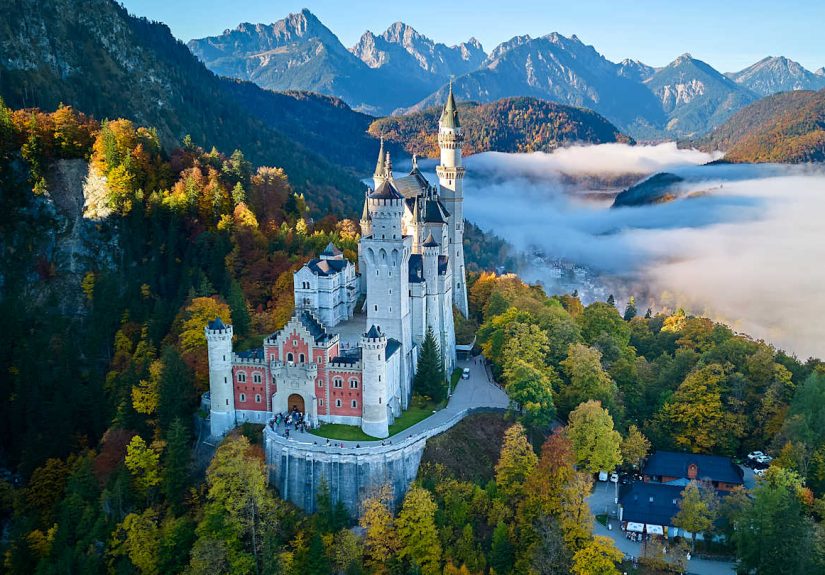
If one real-life castle has the strongest case for saying, “Actually, I started the whole vibe,” it is Neuschwanstein. Rising above the Bavarian Alps with pale limestone walls, dreamy towers, and a setting so scenic it almost feels rude, this 19th-century castle is the definition of storybook architecture. It was commissioned by King Ludwig II of Bavaria as a romantic medieval fantasy, which explains why it looks less like a practical royal home and more like a place where a princess would sing to woodland animals before breakfast.
What makes Neuschwanstein so unforgettable is the full package: mountain backdrop, dramatic perch above a gorge, and interiors inspired by legend and opera. It is theatrical in the best way possible. This is not a castle that whispers. It twirls. Even people who know nothing about European history tend to look at it and say, “Wait, that’s real?” That alone earns it a permanent spot on any list of Disney-like castles.
2. Alcázar of Segovia, Spain
Why it feels straight out of Disney
The Alcázar of Segovia looks like a castle someone drew after being told to make it extra royal. Built high on a rocky crag above the landscape, with elegant towers and a sharply pointed silhouette, it has the kind of profile that belongs on postcards, movie title cards, and the walls of children who went through a very serious castle phase. Which, to be fair, many of us never fully outgrew.
Its history is every bit as rich as its appearance. It served as a fortress and a royal palace, and it is linked to Spanish monarchy in a big way. But visually, what makes it so irresistible is its balance of strength and grace. It feels regal without feeling cold. The stone façade and steep roofs give it a stern medieval edge, while the towers make it look almost delicate from a distance. If your mental image of a fairy-tale stronghold includes a hilltop throne room and a sweeping view over an ancient city, Segovia absolutely delivers.
3. Hohenzollern Castle, Germany
Why it feels straight out of Disney
Hohenzollern Castle sits high above the Swabian Alps like it knows it is photogenic. Because it is. Very. The current castle is a 19th-century reconstruction, but its neo-Gothic style gives it all the ingredients of a fantasy fortress: spires, battlements, ornate details, and a mountaintop location that practically begs for dramatic fog to roll in on schedule.
Unlike some castles that charm you through softness and romance, Hohenzollern is beautiful in a more commanding way. It looks like the headquarters of a kingdom with excellent taste and very serious stationery. Inside, it is known for royal treasures and Prussian history, but from the outside, it is pure atmosphere. This is the kind of place that makes hikers pause, stare upward, and suddenly feel underdressed. If Disney ever needed a castle for a noble but intimidating monarch who secretly has a sentimental side, Hohenzollern would be a strong audition tape.
4. Château de Chambord, France
Why it feels straight out of Disney
Chambord is what happens when Renaissance ambition collides with castle fantasy and nobody bothers to say, “Maybe that is enough towers.” The result is glorious. With its enormous scale, elaborate roofline, conical towers, lanterns, chimneys, and decorative symmetry, Chambord looks like a castle designed by someone who never once considered the phrase “too much.” Bless that person.
Originally associated with King Francis I, the château is one of the Loire Valley’s true showstoppers. What makes it feel so magical is the way it blends different identities at once. It has traces of fortress design, palace elegance, and almost surreal ornamentation. The famous staircase at its heart only adds to the sense that this place was built as much for spectacle as for living. If Neuschwanstein is fairy-tale romance, Chambord is fairy-tale extravagance. It is the kind of castle that does not merely stand in the landscape; it poses in it.
5. Château de Chenonceau, France
Why it feels straight out of Disney
Chenonceau has one feature that instantly moves it into fairy-tale territory: it stretches gracefully across a river. That alone is enough to make it look enchanted. Add elegant arches, refined Renaissance lines, and beautifully kept grounds, and you get a château that feels less like a fortress and more like a very cultured spell.
Known for spanning the River Cher, Chenonceau has a softer, more romantic beauty than some of the heavier stone strongholds on this list. It does not need to loom from a mountaintop to make an impression. Instead, it charms with balance, grace, and the kind of symmetry that makes every photograph look pre-approved by an art director. Historically, it also carries a strong legacy of influential women, which somehow feels fitting for a castle so poised and elegant. If your Disney castle preferences lean toward moonlit gardens, elegant ballrooms, and swans minding their business nearby, Chenonceau is your castle.
6. Eilean Donan Castle, Scotland
Why it feels straight out of Disney
Eilean Donan is proof that a castle does not need to be flashy to feel magical. Set on a small island where three lochs meet in the Scottish Highlands, it has one of the most cinematic settings of any castle in the world. Stone walls, moody skies, a graceful bridge, rugged mountains in the background: the whole scene looks like a storyboard panel for a fantasy adventure.
The original fortress dates back centuries, though the version visitors see today incorporates a later reconstruction. Even so, the atmosphere is ancient, romantic, and unmistakably heroic. It is easy to imagine bagpipes in the distance, a hidden prophecy, and a stubborn but lovable sidekick tagging along. Eilean Donan does not scream “Disney” in the candy-colored sense. It feels more like Disney after the opening act gets serious and the quest begins. For travelers who like their fairy tales with mist, legend, and a little noble melancholy, this one is irresistible.
7. Predjama Castle, Slovenia
Why it feels straight out of Disney
Predjama Castle is built directly into the mouth of a cave in the side of a towering cliff, which is the sort of architectural choice that sounds fictional until you see it. Then you immediately understand why people fall in love with it. It is dramatic, weird, beautiful, and just a little over-the-top in a way that fairy tales absolutely adore.
Unlike the softer romantic castles on this list, Predjama feels adventurous. It is the castle for people who wanted the hidden passageway, the secret tunnel, and the cliffside hideout. The Gothic structure seems almost fused with the rock behind it, giving it an unforgettable look that feels half fortress, half legend. If many castles say “royalty,” Predjama says “outlaw noble with a mysterious backstory.” It is the kind of place that seems made for torchlight, echoes, and whispered rumors. Disney magic is not always pastel and polished. Sometimes it is cave-castle chaos, and frankly, that is part of the fun.
8. Himeji Castle, Japan
Why it feels straight out of Disney
Himeji Castle offers a completely different kind of fairy-tale beauty. Instead of chunky stone romanticism or dramatic European turrets, it gives you layered white elegance, sweeping roofs, and a silhouette so refined it almost seems weightless. Often called the White Heron Castle, Himeji looks as if it might lift off the hill and glide into the sky if left unsupervised.
Its brilliant white exterior and graceful design make it one of the most visually striking castles in the world. But it is not just beautiful; it is also a masterpiece of defensive architecture, with a complex layout that once helped protect it from attack. That blend of grace and strategy is part of what makes it so compelling. Himeji feels regal, serene, and impeccably composed. If the European castles on this list feel like ballrooms and banquets, Himeji feels like precision, poise, and elegance. It belongs in this roundup because Disney-like wonder is not limited to one style. Sometimes enchantment wears white plaster and curved roofs.
9. Dunrobin Castle, Scotland
Why it feels straight out of Disney
Dunrobin Castle has the tall spires, manicured grounds, and stately silhouette of a full-on fairy-tale residence. Overlooking the Moray Firth in the Scottish Highlands, it is one of those places that looks like it should come with a dress code requiring velvet capes and dramatic glances out the window.
Its appearance is especially striking because it feels almost French in its ornament and verticality, even while rooted in Scottish history. The estate dates back centuries and grew into a grand residence associated with the Earls and Dukes of Sutherland. With its many rooms, formal gardens, and elegant exterior, Dunrobin feels more polished than rugged, which gives it a classic animated-castle energy. It is easy to picture it as the home of a kind queen, a misunderstood prince, or a family with suspiciously good cheekbones. If your Disney castle ideal includes soaring towers, trimmed hedges, and serious “once upon a time” energy, Dunrobin is a dream.
What These Real-Life Castles Have in Common
Even though these castles come from different countries, centuries, and architectural traditions, they share a few traits that make them feel universally magical. First, they have unforgettable silhouettes. A truly fairy-tale castle is recognizable from far away, whether that comes from sharp towers, sweeping roofs, or a wildly dramatic location. Second, they all understand the power of setting. A castle over a river, on a mountain, inside a cliff, or on an island already feels halfway to myth before you even walk in.
And finally, these castles know how to be a little impractical in the best way. They are not plain. They are not shy. They were built to impress, defend, symbolize power, or indulge royal imagination. Today, that same excess is exactly why travelers love them. They remind us that beauty can be bold, history can be theatrical, and sometimes the world really does contain places that look borrowed from animation.
The Experience of Visiting Castles That Feel Like Disney
Seeing photos of these castles is one thing. Actually visiting them is an entirely different experience, because the magic is not just in the architecture. It is in the approach. It is in the winding road, the first glimpse through trees, the sound of footsteps on stone, and that weird little moment when your grown-up brain says, “This is just a historical structure,” while the rest of you is already mentally assigning yourself a royal title.
At a place like Neuschwanstein or Hohenzollern, the climb and the setting do a lot of the work. You arrive with the landscape already telling a story. Mountains, mist, and elevation make everything feel bigger, older, and more dramatic. At Chenonceau or Chambord, the experience is different. There, the spell comes from symmetry, water, gardens, and detail. You are not just looking at a castle; you are moving through an idea of elegance that was designed to impress guests long before social media existed. Honestly, royalty was curating vibes centuries before the rest of us caught up.
Then there are castles like Predjama and Eilean Donan, which offer a more atmospheric kind of wonder. These are the places that make you slow down. The weather matters. The light matters. A cloudy day can make them feel even more magical, which is one of the few times in travel when bad weather is not a total betrayal. You look at a cliffside castle or a fortress surrounded by Highland water and suddenly understand why so many legends, ghost stories, and heroic epics start in places exactly like these.
What also stands out is scale. Some of these castles look huge in photos and even larger in person. Others surprise you by feeling more intimate, more detailed, more human. Himeji, for example, has a delicacy in its lines that photographs do not fully capture. Dunrobin feels stately and theatrical, but the gardens and coastal light give it an almost dreamlike softness. Segovia has that glorious “main character” silhouette, but standing near it also reveals its toughness as a real medieval stronghold.
And perhaps that is the best part of visiting real-life castles that look like Disney creations: they are not only beautiful, they are layered. They carry war, monarchy, reinvention, craftsmanship, and myth all at once. They are fantasy with footnotes. They let you enjoy the wonder without losing the history. You can admire the towers like a child and appreciate the engineering like an adult, all in the same afternoon.
If you love travel that feels immersive, memorable, and just a little cinematic, these castles deliver better than almost any category of landmark. They are romantic without being fake, historic without being dull, and grand without needing special effects. The special effects are already built in. They are called cliffs, rivers, fog, gardens, mountains, and centuries of human ambition. Disney may have polished the fairy-tale castle into a cultural icon, but these real places prove the world had the blueprint all along.
Final Thoughts
The most beautiful real-life castles do more than look impressive. They trigger imagination. They make travelers pause, smile, and maybe become a little embarrassingly dramatic for five minutes. That is part of the charm. Whether you are drawn to Germany’s sky-high storybook silhouettes, France’s elegant river-spanning châteaux, Scotland’s misty island fortresses, Slovenia’s cliffside marvel, Spain’s royal stronghold, or Japan’s graceful white icon, these castles prove that fairy-tale architecture is not just a Disney invention. It is a real and very travel-worthy part of the world.
So if you are building a bucket list around beautiful castles, dreamy destinations, and unforgettable historic landmarks, start here. Just be warned: after seeing enough real-life castles this magical, regular buildings may begin to feel a little undercommitted.