Table of Contents >> Show >> Hide
- Why Great Arrangements Work
- Step 1: Decide on the Look Before You Buy Anything
- Step 2: Choose the Right Vase First, Not Last
- Step 3: Prep Your Flowers Like You Mean It
- Step 4: Build a Hidden Support System
- Step 5: Start with Greenery to Create Shape
- Step 6: Add Focal Flowers and Let Them Lead
- Step 7: Layer in Secondary Flowers and Fillers
- Step 8: Edit the Arrangement and Keep It Alive
- Common Flower Arranging Mistakes to Avoid
- Two Easy Beginner Formulas That Always Work
- Extra Experiences and Real-World Lessons from Arranging Flowers at Home
- Final Thoughts
- SEO Tags
Flower arranging has a reputation for being fancy, fussy, and somehow reserved for people who casually own twelve vases and say things like “foraged texture” without laughing. The good news? A beautiful bouquet is not a mystery. It is mostly a formula, plus a little restraint, plus the willingness to trim one stem that is clearly trying to ruin the vibe.
If you have ever brought home a grocery store bouquet, dropped it into a vase, stepped back, and thought, Why does this look like flowers waiting for a bus?, you are not alone. Professional-looking arrangements usually come down to a few repeatable habits: choosing a palette, matching flowers to the right vase, prepping stems correctly, building structure with greenery, and layering blooms with intention. Once you understand that rhythm, flower arranging gets dramatically easier.
This guide breaks the process into eight simple steps so you can build an arrangement that feels balanced, polished, and natural rather than stiff or overcrowded. Whether you are styling flowers from your backyard, a farmers market haul, or a supermarket bundle with suspiciously ambitious marketing, these techniques will help you make them look far more expensive than they were.
Why Great Arrangements Work
Before jumping into the steps, it helps to know what makes a bouquet look “professional.” Most strong arrangements include a few essential ingredients: a clear color story, a vessel that supports the stems, some kind of hidden mechanic to hold shape, greenery for structure, focal flowers that catch the eye, and smaller blooms that soften the design and fill empty spaces. Good arrangements also have movement. They are not flat, not perfectly identical on every side, and definitely not a bouquet of stems all cut to the emotional energy of a fence post.
Now let’s build one properly.
Step 1: Decide on the Look Before You Buy Anything
The easiest way to make flowers look intentional is to start with a visual plan. That does not mean sketching a bouquet like an architect. It simply means choosing a mood, a color palette, and a destination for the arrangement before you shop.
Ask yourself a few basic questions. Where will this arrangement live? A coffee table usually needs something lower and wider, while an entry table can handle more height. Do you want something airy and garden-inspired, or a tighter, more classic design? Are you going monochromatic, soft and romantic, bright and cheerful, or dramatic enough to make your dining room feel like it has trust-fund energy?
If you are a beginner, pick one of these simple directions:
- Monochromatic: several flowers in one color family for an elegant, easy win
- Complementary: colors that gently contrast, like peach and blue or yellow and purple
- Seasonal: tulips and ranunculus in spring, sunflowers and zinnias in summer, mums and dahlias in fall
Having a plan keeps you from buying “a little of everything,” which is how many arrangements become beautiful chaos with commitment issues.
Step 2: Choose the Right Vase First, Not Last
A lot of flower frustration begins with the vase. People often buy blooms first and then try to force them into whatever container is available. That is how you end up wrestling top-heavy stems into a vessel that was clearly designed for pencils.
For beginners, a vase with a narrower opening is the friendliest choice because it naturally keeps stems closer together. Wide-mouth vases can be gorgeous, but they often require support mechanics and a bit more skill. Straight-sided vases are helpful for flowers like tulips, while heavier, bottom-weighted vessels are better for tall branches or large-headed blooms.
A helpful rule of thumb is to aim for flowers that stand about one and a half to two times the height of the vase. That proportion usually looks balanced instead of squat or overly stretched. You can bend the rule for modern designs, of course, but it is a great starting point.
And yes, the vessel matters aesthetically too. Rustic flowers in a mason jar tell a different story than crisp white roses in a glass cylinder. Your vase is not just a container. It is part of the outfit.
Step 3: Prep Your Flowers Like You Mean It
This is the step people skip, and it shows. Fresh flowers need prep before they need styling. If you arrange them straight out of the wrap, you are basically asking tired stems to perform without coffee.
Start with a clean vase. Not “looks clean” clean. Actually clean. Bacteria in the vase water shortens flower life, so wash the container well before you begin. Then fill it with fresh water and flower food if you have it.
Next, condition the stems:
- Trim about 1 to 2 inches from each stem
- Cut at an angle with sharp shears or a knife
- Remove any leaves that would sit below the waterline
- Pull off bruised petals or damaged foliage
- Let thirsty flowers hydrate for a bit before arranging if possible
Angled cuts help stems absorb water more efficiently, and removing submerged leaves keeps the water cleaner. It is not glamorous, but neither is a murky vase smelling like pond regret two days later.
Step 4: Build a Hidden Support System
Professional arrangements rarely rely on hope alone. They use mechanics. That sounds technical, but it can be wonderfully simple. If your flowers need help staying in place, create a grid of floral tape across the mouth of the vase. You can also use chicken wire or a flower frog to hold stems where you want them.
This step is especially useful with wide-opening containers, asymmetrical designs, or arrangements with fewer stems that need to look airy instead of clumped. Mechanics let you place each bloom intentionally rather than jamming everything together and pretending gravity is part of the concept.
If you are using a bowl or low vessel, a tape grid is often enough. If you want something looser and more sculptural, chicken wire or a flower frog gives you far better control. The point is not to over-engineer the bouquet. It is to create a structure that keeps it from collapsing into floral spaghetti halfway through.
Step 5: Start with Greenery to Create Shape
Greenery is the skeleton of an arrangement. It creates volume, establishes the outline, and gives your flowers something to lean into. Without it, bouquets can look like a crowd gathered in an elevator.
Begin by placing greenery around the outer edge of the vase to define the overall silhouette. Eucalyptus, fern, ivy, ruscus, olive branches, or even interesting backyard clippings can work beautifully. Use a mix of textures if you can. Something soft, something wispy, something broad. That variety adds depth before a single bloom goes in.
A classic beginner-friendly shape is an inverted triangle or a soft dome. You can also work from the outside in, turning the vase as you go so the structure feels balanced from every angle. Some florists build hand-tied bouquets using a spiral technique, but inside a vase, the idea is similar: layer stems so the arrangement feels supported, open, and cohesive.
Think of greenery as the quiet interior designer of the bouquet. Nobody always notices it first, but when it is done well, everything looks better.
Step 6: Add Focal Flowers and Let Them Lead
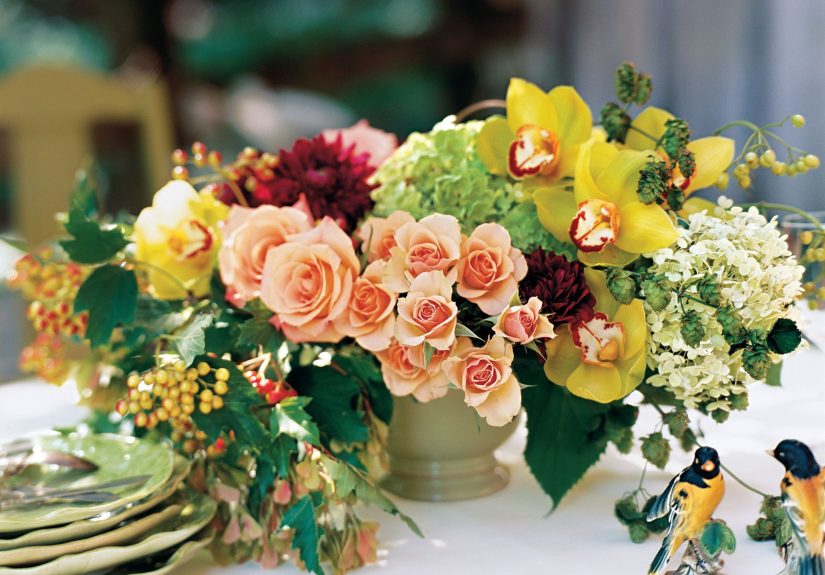
Now bring in the stars. Focal flowers are the largest, most striking, or most attention-grabbing blooms in the arrangement. Roses, peonies, hydrangeas, dahlias, sunflowers, and large tulips all work well depending on the season and style.
Place focal flowers first so you can decide where the eye lands. Usually, one to three main visual moments are enough. Odd numbers tend to look more natural than even ones, and slightly varied heights keep the arrangement from looking rigid. If every bloom sits at the exact same level, the bouquet can start to resemble a flower haircut.
Avoid sticking all the large flowers straight around the edge like satellites. Instead, nest them into the greenery and distribute them through the arrangement so the bouquet feels dimensional. One flower may sit slightly higher, another more forward, another tucked deeper into the center.
Rotate the vase as you work. A bouquet might look fantastic from the front and deeply confused from the side. Professionals check all angles. So should you.
Step 7: Layer in Secondary Flowers and Fillers
Once the focal blooms are in place, the arrangement needs support. This is where secondary flowers and fillers do their best work. Secondary flowers bridge the gap between the big statement blooms and the small finishing details. Fillers soften hard edges, add texture, and cover awkward gaps.
Good secondary flowers include spray roses, lisianthus, carnations, mums, and smaller tulips. Fillers might be baby’s breath, wax flower, feverfew, delphinium, solidago, or branching stems with tiny blooms. Use them to connect your focal flowers and create movement through the bouquet.
Cluster small flowers in groups of three or five for a more natural effect. Nature rarely grows in perfectly even, formal little pairs. Also, do not be afraid of negative space. A bouquet does not need to be packed tighter than a holiday airport. Let some air remain between stems so each flower has room to read clearly.
This is also the stage where texture becomes your secret weapon. A fluffy bloom next to something spiky or airy makes the entire design more interesting.
Step 8: Edit the Arrangement and Keep It Alive
The final step is not “done.” It is “edit.” The difference matters. Once your bouquet is assembled, step back and look at it honestly. Is one flower sticking out like it is trying to escape? Is the shape uneven in a bad way rather than an artistic way? Is there a hole in the center? Snip, shift, rotate, and refine.
You can also add a final airy element near the end, such as yarrow, sedum, or baby’s breath, to soften the arrangement without crushing delicate stems under heavier blooms. A light mist can freshen the look, though the real long-term secret is good aftercare.
To keep flowers looking fresh:
- Top off or replace the water every 1 to 3 days
- Re-cut stems when changing water
- Keep the arrangement out of direct sun and away from heat vents
- Do not park it next to ripening fruit, which releases ethylene gas
- Remove fading blooms before they drag down the rest
A great arrangement is not only beautiful on day one. It still looks respectable a few days later, which is more than many of us can say about cilantro.
Common Flower Arranging Mistakes to Avoid
- Using too many flower varieties: More is not always merrier. Sometimes it is just noisy.
- Ignoring scale: Tiny vase, giant hydrangea, immediate drama.
- Leaving leaves underwater: This shortens vase life fast.
- Making every stem the same height: Flat and stiff is rarely the goal.
- Forgetting the back side: Unless the bouquet sits against a wall, every angle matters.
- Skipping hydration and cleaning: Pretty flowers still need practical care.
Two Easy Beginner Formulas That Always Work
The Grocery Store Upgrade
Use 1 greenery, 1 focal flower, and 1 filler. For example: eucalyptus, roses, and wax flower. Keep the palette tight, trim aggressively, and use a narrow glass vase. It will instantly look more polished than the bouquet straight out of the sleeve.
The Farmer’s Market Garden Style
Use branches or airy greens first, then add one hero bloom like dahlias or peonies, then layer in smaller stems like feverfew or spray roses. Let a few pieces lean naturally and do not overfill the center. This style should feel relaxed, abundant, and just a little bit poetic.
Extra Experiences and Real-World Lessons from Arranging Flowers at Home
One of the most useful things I have learned about flower arranging is that the first five minutes can feel wildly unpromising. You clean the vase, trim the stems, place a few greens, and suddenly your “future masterpiece” looks like three leaves having a meeting. That is normal. Good arrangements usually pass through an awkward teenager phase before they become charming adults.
Another lesson: supermarket flowers can absolutely look expensive if you edit them hard enough. Remove the plastic wrap, strip off the sad leaves, cut the stems properly, and separate the bouquet by role. Which flowers are the stars? Which ones are support? Which stems are just there to make everybody else look better? As soon as you stop treating the bouquet like one fixed object and start treating it like design material, everything changes.
I have also learned that fewer varieties often make stronger arrangements. The temptation is to buy every pretty stem in sight, especially when the flower buckets are working overtime to charm you. But three thoughtfully chosen ingredients often look better than eight unrelated ones. A tight palette with varied textures feels sophisticated. A random rainbow can work, but it takes more skill than people expect.
Stem length is another sneaky game changer. Early on, many people cut too short too fast. Then there is no room to adjust shape, and the flowers sit in the vase like they have given up. Start longer than you think you need. You can always trim more. You cannot negotiate with a stem after you have chopped off its future.
The best home arrangements also feel a little alive. Not messy, not chaotic, but not overly controlled either. A branch that arches slightly, a tulip that leans, a filler flower that dances above the rest of the design, these details make an arrangement feel natural and modern. Perfection can actually make flowers look fake. A bit of movement makes them feel freshly gathered.
And finally, flower arranging gets easier when you stop expecting instant genius. The people who make it look effortless usually rotate the vase, step back often, move stems around, and edit repeatedly. They are not magically born knowing where the third rose should go. They are paying attention. That is the real pro move: not perfection, but observation. Once you get comfortable with that process, arranging flowers becomes less about following rigid rules and more about learning how balance, color, and shape talk to each other. That is when it starts to feel fun instead of intimidating.
Final Thoughts
Arranging flowers like a pro is not about memorizing complicated floral theory or buying expensive tools. It is about making a series of smart, simple choices: plan the look, choose the right vase, prep the stems, create structure, build with greenery, place focal flowers intentionally, fill with texture, and keep the whole thing fresh. Do that consistently, and your bouquets will look better, last longer, and stop giving “last-minute gas station apology flowers” energy.
In other words, you do not need to be a florist. You just need a process, a pair of sharp shears, and the confidence to remove the one stem that keeps acting like the main character.