Table of Contents >> Show >> Hide
- Why Kuczynski’s Satirical Illustrations Hit Like a Truth-Taser
- What the “78 More” Collection Really Shows: A Thematic Autopsy of Modern Society
- 1) The Attention Economy: When Your Focus Becomes a Product
- 2) Social Media: Connection That Sometimes Feels Like Loneliness With Stickers
- 3) Misinformation and Disinformation: When Truth Becomes a Team Sport
- 4) Surveillance and Privacy: The Cozy Panopticon
- 5) Consumerism: Buying Identity One Cart at a Time
- 6) Inequality: When the System Has a VIP Section and You’re Not on the List
- 7) Politics and Power: The Theater, the Puppets, and the Applause Sign
- 8) War and Violence: Normalized Horror With a Clean UI
- 9) Climate and Environmental Breakdown: The Bill Comes Due
- 10) Empathy Fatigue: When Everything Is Urgent, Nothing Feels Real
- How to Read Satirical Illustrations Without Missing the Point
- So… What Do You Do After You Scroll Past the Mirror?
- FAQ: People Always Ask These About Brutally Honest Satirical Art
- Reader Experiences: What These Illustrations Tend to Trigger (500+ Words)
- Conclusion
- SEO Tags
Some art whispers. Some art sings. And then there’s Pawel Kuczynski’s satire, which grabs you by the collar,
points at the chaos, and politely says: “Yeah… we should probably talk about this.”
The internet loves to share his work as a quick jolt of truthone scroll, one gut-punch metaphor, one
awkward laugh you didn’t plan on making. This “78 more” wave of brutally honest illustrations isn’t just
a greatest-hits playlist of modern anxiety. It’s a mirror with Wi-Fi and zero chill.
In this deep dive, we’ll unpack why Kuczynski’s satirical illustrations land so hard, what recurring themes
they target, and what those themes say about today’s societyour screens, our systems, our shiny distractions,
and the way we’ve normalized the abnormal.
Why Kuczynski’s Satirical Illustrations Hit Like a Truth-Taser
Satire works best when it’s simple enough to “get” instantly, but layered enough to keep bothering you later.
Kuczynski’s visual satire does exactly that: clean compositions, surreal twists, and symbolism that feels obvious
in the way a dentist’s “You’ve been flossing, right?” feels obvious.
His drawings often do three things at once:
- Compress complex problems (politics, inequality, climate, media manipulation) into a single image.
- Expose contradictions (we want privacy, we trade it for convenience; we want truth, we reward outrage).
- Make you complicitnot in a cruel way, but in a “oh no, that’s me” way.
It’s the difference between reading a 3,000-word analysis about the attention economy and seeing a person
happily carrying their own cage because it has a charging port.
What the “78 More” Collection Really Shows: A Thematic Autopsy of Modern Society
No, we’re not going to list and caption all 78 pieces (your eyeballs deserve a lunch break). Instead, let’s
map the recurring problems these brutally honest illustrations keep returning tobecause repetition is the point.
When an artist draws the same wound from multiple angles, it’s usually because the wound is still bleeding.
1) The Attention Economy: When Your Focus Becomes a Product
Modern life runs on a quiet trade: you get “free” platforms, and those platforms get your time, attention,
and behaviorsliced, packaged, and sold like deli meat. Kuczynski’s work often frames attention as something
harvested: baited hooks, conveyor belts, puppet strings, or people staring into glowing rectangles as the world
outside quietly burns down.
The satire isn’t “phones are bad.” It’s sharper: the business model is designed to keep you looking.
Outrage, fear, desire, envyanything that holds your gazebecomes a feature, not a bug.
2) Social Media: Connection That Sometimes Feels Like Loneliness With Stickers
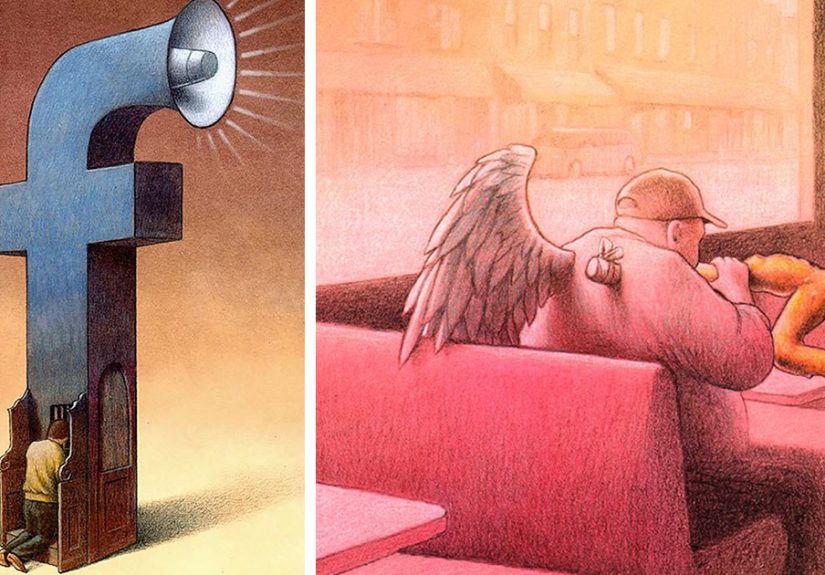
Social platforms promise connection, but Kuczynski’s imagery frequently questions what kind. The “friends”
are there, but the person looks isolated. The “likes” rain down, but the room feels empty. The megaphone is loud,
but the listener is missing.
His visual metaphors often suggest that we confuse visibility with belongingand confuse being watched with being loved.
(Those are not synonyms. Those are barely even cousins.)
3) Misinformation and Disinformation: When Truth Becomes a Team Sport
One of the most unsettling modern shifts is how information has become tribal: people don’t just disagree about
opinions; they disagree about reality. Kuczynski’s satire often depicts truth as something filtered, repainted,
packaged, or censoredlike a newspaper that prints what power prefers, or a TV that shows a “safer” version of the world.
The point isn’t that everyone is lying all the time. It’s that confusion is profitable, outrage spreads fast,
and certainty (even fake certainty) feels comforting. The result: citizens overloaded with “news” and starving for clarity.
4) Surveillance and Privacy: The Cozy Panopticon
Many of Kuczynski’s most memorable illustrations flip the script: the watcher isn’t a shadowy villain; it’s
a helpful device, a smiling platform, a friendly service. The satire lives in the contrastcomfort on the surface,
extraction underneath.
Think of metaphors like: a camera disguised as a gift, a lock made of glass, or a person willingly handing over keys
because the keychain looks cute. In the modern world, surveillance doesn’t always arrive with boots; sometimes it arrives
with push notifications.
5) Consumerism: Buying Identity One Cart at a Time
Kuczynski’s work often treats consumer culture like a treadmill: always moving, never arriving. You chase the next product,
the next upgrade, the next status signaluntil the objects own you back. His satire turns “shopping therapy” into something
darker: addiction disguised as retail.
And it’s not just the stuff. It’s the idea that your value can be improved by purchasing. The joke is cruel because it’s close
to home: when everything is marketed as a solution, the problem starts to look like you.
6) Inequality: When the System Has a VIP Section and You’re Not on the List
Wealth inequality isn’t new, but the modern experience of it is weirdly public. You can watch luxury in real time while
struggling to pay rent, and the algorithm will politely suggest you “manifest abundance.”
Kuczynski often symbolizes inequality with scale: tiny people carrying heavy loads, giant hands moving pieces, ladders that
lead nowhere for most and directly into comfort for a few. The images imply a rigged gameone where the rules are invisible,
but the results are loud.
7) Politics and Power: The Theater, the Puppets, and the Applause Sign
Political satire is ancient, but modern politics often feels like a performance optimized for cameras. Kuczynski’s illustrations
frequently suggest that power is maintained through distraction: bread, circuses, headlines, and constant noise.
His metaphors can be blunt: leaders framed as magicians, citizens as an audience, and policy as a stage trick performed while
something important is quietly removed from your pocket. You laugh because it’s clever; you wince because it’s plausible.
8) War and Violence: Normalized Horror With a Clean UI
Another recurring theme is how violence gets abstracted. Wars become numbers, maps, “operations,” and scrolling updatesuntil
tragedy feels like background content. Kuczynski’s satire often visualizes the distance between decision-makers and consequences:
hands pushing buttons far from the smoke, comfortable rooms feeding conflict, or weapons treated like toys.
The unsettling implication: when suffering is mediated through screens, empathy competes with fatigueand fatigue wins a lot.
9) Climate and Environmental Breakdown: The Bill Comes Due
Climate change satire can be tricky because it’s both massive and slowuntil it’s suddenly not slow at all. Kuczynski often uses
simple symbols (melting, flooding, smoke, dying nature) paired with human denial: people ignoring warnings, painting over cracks,
or celebrating while the foundations rot.
The message isn’t subtle: the planet doesn’t care about our excuses. Physics doesn’t negotiate. And nature doesn’t accept “but it was
inconvenient” as a valid defense.
10) Empathy Fatigue: When Everything Is Urgent, Nothing Feels Real
One of the quiet tragedies of the internet era is that we can witness everythingevery crisis, every injustice, every disasterwithout
having the emotional bandwidth to process it. Kuczynski’s imagery often captures that overload: people drowning in information, faces
turned away, suffering treated like wallpaper.
It’s not “people are bad.” It’s “people are exhausted.” And exhaustion can look a lot like indifference.
How to Read Satirical Illustrations Without Missing the Point
Satire is a language. If you want to get more out of Kuczynski’s work (and similar social commentary art), try this quick method:
- Spot the symbol: What object is doing the heavy liftingphone, mask, money, weapon, camera, ladder?
- Find the reversal: What’s flipped? Who is controlling whom? Who benefits? Who pays?
- Name the emotion: Is the image making you laugh, feel guilty, feel angry, or feel tired?
- Ask the uncomfortable question: “Where am I in this picture?”
The goal isn’t to feel miserable. It’s to become more awake. Satire isn’t a lectureit’s an alarm clock with better design.
So… What Do You Do After You Scroll Past the Mirror?
Satire can leave you with two impulses: share it or shrug. Sharing can be useful, but shrugging is how problems get promoted to “background.”
If these brutally honest illustrations resonate, consider a few practical moves:
- Audit your attention: Turn off notifications you don’t need. Curate your feeds like you curate your diet.
- Slow down your information intake: Fewer sources, better sources, more context.
- Support accountability: Privacy protections, transparency rules, and real consequences for manipulation.
- Practice “small empathy”: Not heroic gestureshuman ones. Check on a friend. Volunteer locally. Do one tangible thing.
The point of satirical art isn’t to make you despair. It’s to make complacency harder to maintain.
FAQ: People Always Ask These About Brutally Honest Satirical Art
Is satire supposed to be funny or depressing?
Both. Satire uses humor as a delivery system for discomfort. It’s basically vegetables hidden inside mac and cheese.
Are Kuczynski’s illustrations “anti-technology”?
The stronger read is that they’re anti-manipulation, anti-complacency, and anti-pretending that incentives don’t shape behavior.
Technology is the stage; the critique is about the play.
Why do surreal metaphors work better than literal commentary?
Because metaphors bypass defenses. A literal rant makes you argue. A surreal image makes you feel firstand then think.
Reader Experiences: What These Illustrations Tend to Trigger (500+ Words)
People often describe the experience of seeing Kuczynski’s satirical illustrations as a weird emotional combo platter:
a laugh, a pause, and then that slow “uh-oh” as the metaphor keeps unfolding in your head. It’s the same sensation as
realizing a joke is about youexcept the punchline is a cultural diagnosis, not a roast. You might scroll past one image
quickly, but it follows you into the rest of your day like a catchy song you didn’t ask to hear.
A common experience is the phone-check reflex. You look at an illustration that frames screens as cages,
leashes, bait, or mirrors, and suddenly you’re aware of how many times you’ve unlocked your phone without a plan. Not because
you needed anythingjust because your brain wanted a tiny hit of novelty. Many readers say the most uncomfortable part isn’t
that they use social media; it’s that the habit sometimes feels automatic, like a muscle memory the platforms trained into them.
Then there’s the news overload whiplash. You see a drawing that treats headlines like a flood or a weapon, and it
clicks: modern media can make you feel both informed and helpless at the same time. People talk about the moment they realize
they’ve been “doomscrolling”consuming tragedy as contentuntil everything starts to blur together. The illustration doesn’t accuse
you of not caring; it highlights how nonstop exposure can dull even sincere empathy. You don’t become cold on purpose. You become tired.
Another relatable reaction is what you could call consumer hangover clarity. After seeing an image that frames shopping
as a treadmill or a trap, some readers recall purchases that felt exciting for about twelve minutesand then quietly turned into clutter.
It can feel oddly freeing to admit that the “treat yourself” culture sometimes works like a pressure valve for stress, and that marketing
is very good at turning insecurity into a checkout process. People often report a small shift afterward: fewer impulse buys, more skepticism,
and the realization that “upgrading” doesn’t automatically equal “improving.”
The deeper experiences usually show up in conversations. Someone shares an illustration in a group chat, and suddenly the chat turns serious:
privacy, politics, inequality, climate, war. That’s one of satire’s superpowersit makes heavy topics discussable. A surreal image gives people
a starting point that doesn’t require a thesis statement. “This reminds me of…” is easier than “Here is my complete worldview.”
Finally, there’s the experience of feeling seen without being judged. The best social commentary art doesn’t scream “you’re awful.”
It says “look what we’ve normalized.” Readers often describe a quiet motivation after the discomfort fades: to set boundaries with technology, to verify
information before sharing, to support better policies, or simply to be more intentional. The experience isn’t purely negative. It’s clarifyinglike turning
on a light in a room you’ve been living in half-darkness. You may not love what you see, but at least you can stop bumping into the furniture.