Table of Contents >> Show >> Hide
- Why Okan Uçkun’s Work Feels Different
- What Makes These Geometric Tattoos So Addictive to Look At
- Why Geometric Tattooing Works So Well Right Now
- If You’re Inspired by This Style, Here’s What to Know First
- What a 49-Piece Roundup Like This Really Shows
- The Bigger Takeaway for Tattoo Lovers
- Extended Reader Experience: What It Feels Like to Choose, Wear, and Live With a Geometric Tattoo
- Final Thoughts
Some tattoos tell a story. Some tattoos make a statement. And then there are the tattoos that do something far more dangerous: they make you stare at someone’s arm for an awkwardly long time while your brain whispers, “Wait… how is that so clean?” That is the territory geometric tattoo artist Okan Uçkun lives in.
Known for minimal, fine-line, and sharply composed work, Uçkun brings a distinctly architectural eye to tattooing. That makes perfect sense, because his creative background is rooted in both architecture and modern art. You can feel that influence immediately. His designs don’t just sit on the body; they appear measured against it, mapped to it, and in some cases almost engineered for it. The result is tattoo work that feels modern, balanced, and oddly calming, even when the design itself is bold.
In a world where tattoo trends can sometimes feel louder than they are thoughtful, a collection like 49 Amazing Geometric Tattoos By Turkish Artist Okan Uçkun stands out for a different reason. These pieces are not trying to win a screaming contest. They win through control. Through symmetry. Through the kind of restraint that says, “I could overdo this, but I have better taste than that.”
This article takes a closer look at why Okan Uçkun’s geometric tattoos are so memorable, what makes geometric tattoo design so compelling in the first place, and what anyone inspired by this style should know before booking an appointment. If you love tattoo inspiration with brains, beauty, and a little mathematical swagger, welcome in.
Why Okan Uçkun’s Work Feels Different
Plenty of tattoo artists can draw a crisp line. Fewer can make a tattoo feel visually quiet and still impossible to ignore. That is part of Uçkun’s magic. His style often leans into fine lines, minimal layouts, disciplined spacing, and a strong respect for anatomy. The body becomes part of the design instead of a random place where the design gets parked like a car in the last empty spot.
That matters in geometric tattooing because geometry is unforgiving. A rose can be a little loose and still look romantic. A watercolor tattoo can blur at the edges and still feel dreamy. But with geometric tattoos, every line, gap, angle, and ratio has a job. If the composition is even slightly off, the whole piece can look clunky, crowded, or oddly tense. When it is done right, though, the tattoo looks effortless. And of course, that “effortless” feeling usually comes from an absurd amount of effort.
What makes Uçkun especially interesting is that his work does not feel cold. That is a trap some geometry-heavy tattooing can fall into. The design becomes so technical that it stops feeling human. His better pieces avoid that completely. They still have emotion. They still breathe. The structure is strict, but the mood is not.
What Makes These Geometric Tattoos So Addictive to Look At
1. Precision Without Looking Robotic
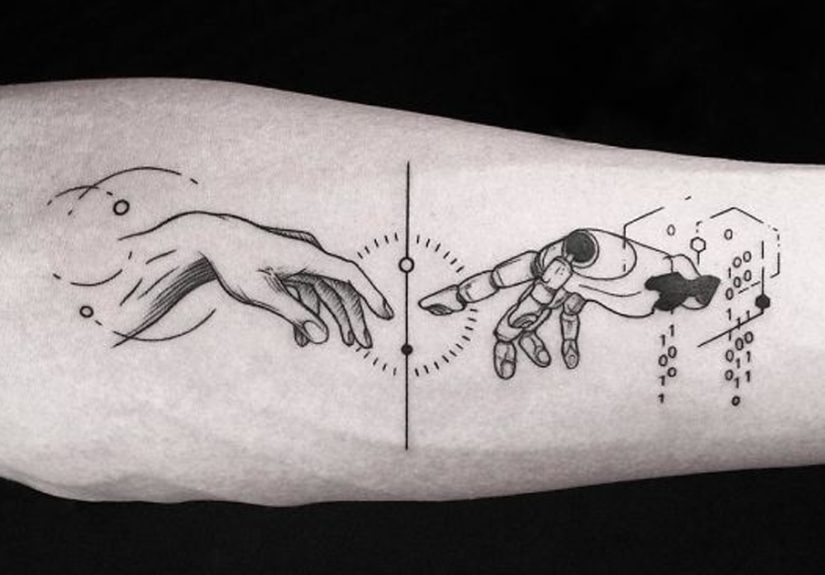
The first thing that draws people in is precision. Lines are clean. Shapes feel intentional. Spacing is rarely accidental. But the strongest geometric tattoos are not just technical flexes; they create rhythm. That is why a great geometric forearm piece can feel almost musical. Your eye moves from circle to line to negative space to shadow without getting stuck.
That visual rhythm is one reason geometric tattoos photograph so well online. They read clearly from a distance, but they also reward close inspection. A piece might look simple in one quick glance, then reveal dotwork gradients, micro-line structures, or layered symbolic details as you study it longer. It is the tattoo equivalent of realizing the “minimalist” apartment you admired actually took a designer 47 decisions to make feel effortless.
2. Minimalism That Still Has Personality
Minimal tattooing can be gorgeous. It can also be aggressively boring when handled badly. Uçkun’s style works because the minimalism has shape and intention. His tattoos are rarely minimal in a lazy way. They are minimal in a refined way.
That distinction matters. A thin triangle on a wrist is not automatically meaningful just because it is small and trendy. What makes a geometric tattoo memorable is how the elements relate to each other. Are the circles aligned to the muscle line? Does the pattern follow the natural taper of the arm? Is the empty space doing as much work as the ink? Those decisions separate design from decoration.
3. Anatomy-Aware Placement
One of the smartest things about high-level geometric tattooing is placement. On a flat sketchpad, symmetry is one challenge. On a moving human body with curves, muscles, joints, and different skin tension? That challenge gets upgraded immediately.
Geometric tattoos look best when they respect the body’s structure. A banded pattern wrapping the forearm, a centered sternum composition, a shoulder piece that radiates with the curve of the deltoid, or a calf design that elongates the leg can all feel incredibly satisfying because the tattoo seems to belong there. It is not floating. It is anchored.
That is a major reason this style has such a strong modern appeal. It feels designed, not merely applied.
4. Symbolism Without the Usual Clichés
Geometric tattoos often carry themes people love: balance, order, transformation, infinity, spiritual harmony, repetition, and interconnectedness. Mandala-inspired structures, repeating polygons, celestial layouts, and abstract line systems all tap into that language. But the best versions do not beat you over the head with symbolism like a motivational poster wearing black ink.
Instead, the symbolism arrives through form. A circular composition can suggest wholeness. Repeating angles can imply discipline or continuity. Negative space can hint at absence, restraint, or clarity. It leaves room for personal meaning, which is exactly what many tattoo collectors want. They want a design that means something without having to explain it to strangers in the coffee line.
Why Geometric Tattooing Works So Well Right Now
Geometric tattoos sit at the sweet spot between art, design, and identity. They appeal to people who love tattoos but do not necessarily want a traditional flash look. They appeal to architecture nerds, minimalists, abstract-art fans, spiritual-symbol collectors, and people who simply want something sleek and contemporary.
They also fit the current visual culture beautifully. We live in the age of mood boards, clean branding, interior design obsession, and “quiet luxury.” Of course a tattoo style built on balance, discipline, and elegant restraint would thrive. It is the same reason people love clean typography, curated spaces, and monochrome wardrobes. Geometry feels smart. It feels edited. It feels intentional.
At the same time, geometric tattoos do not have to feel sterile. Some of the strongest designs combine hard structure with softer imagery: an animal face broken into facets, a mountain line framed by circles, a flower emerging from a symmetrical grid, or a portrait interrupted by abstract geometry. Those hybrids create contrast, and contrast is where a lot of tattoo magic lives.
If You’re Inspired by This Style, Here’s What to Know First
Choose the Artist, Not Just the Idea
If geometric tattooing has a golden rule, it is this: do not take a precision-based design to an artist whose portfolio does not show precision-based results. A healed geometric tattoo tells the truth fast. Fine lines can soften. Tiny details can blur. Spacing that looked perfect on day one may not age beautifully if the design was too delicate or applied poorly.
That is why it is important to look at healed work, not only fresh photos. A fresh tattoo is still in its “best lighting, best angle, just-left-the-gym” era. Healed work shows whether the artist truly understands longevity.
Placement Changes Everything
Placement affects aesthetics, pain, and durability. Larger, flatter areas can give geometry room to breathe. Areas with constant movement or friction may challenge fine-line clarity over time. More muscular or fleshier spots often feel easier to tolerate than highly bony locations like ribs, wrists, ankles, or the tops of the feet.
That does not mean you should avoid certain areas completely. It means you should choose placement with open eyes, not just based on what looked cool on somebody else’s Pinterest board at 1:12 a.m.
Aftercare Is Not Optional Theater
Geometric tattoos depend on clarity, and clarity depends on healing. If you are investing in a tattoo built on precise lines and crisp negative space, sloppy aftercare is basically sabotage with moisturizer on your hands.
Good aftercare generally means following your artist’s instructions carefully, cleaning the tattoo gently, using appropriate fragrance-free products, and avoiding behaviors that can irritate or contaminate healing skin. That includes picking scabs, over-moisturizing, sun exposure, and jumping into pools, hot tubs, lakes, or oceans before the tattoo is fully healed. No, your new tattoo does not want a vacation in chlorinated water. It wants peace.
And if something seems wrong, like increasing redness, unusual warmth, pus, fever, or pain that worsens instead of improving, do not play detective with your skin. Get medical guidance.
What a 49-Piece Roundup Like This Really Shows
A gallery-focused title like 49 Amazing Geometric Tattoos By Turkish Artist Okan Uçkun promises visual variety, but the deeper appeal is not just the number. It is the consistency. A strong artist can move across different motifs, placements, and scales while still maintaining a signature language.
In Uçkun’s case, that language is built from control, elegance, and restraint. Some pieces likely read as soft and meditative. Others probably lean sharper, darker, and more graphic. Some may flirt with sacred geometry. Others may stay fully abstract. But the connective tissue is the same: disciplined composition and a respect for visual balance.
That is the reason a collection like this can feel satisfying even when the individual tattoos are very different from one another. You are not only looking at separate pieces of ink. You are looking at a coherent artistic philosophy being translated onto skin over and over again.
The Bigger Takeaway for Tattoo Lovers
Okan Uçkun’s appeal says something important about where tattoo culture is now. People still love bold traditional work, realism, script, Japanese body art, and every other established style. But there is also a growing appetite for tattoos that feel edited, contemporary, and design-forward. Not every collector wants a tattoo that tells the whole story in one glance. Many want a piece that reveals itself slowly.
Geometric tattooing offers exactly that. It can be deeply symbolic or purely visual. It can look spiritual, futuristic, architectural, or organic depending on how it is executed. And in the hands of an artist with strong compositional instincts, it becomes something more than fashionable. It becomes timeless.
That is why a title like this lands. It is not just about seeing 49 tattoos. It is about seeing 49 reminders that ink can be disciplined without being dull, expressive without being messy, and minimal without feeling empty.
Extended Reader Experience: What It Feels Like to Choose, Wear, and Live With a Geometric Tattoo
If you have ever seriously considered a geometric tattoo, you already know the experience begins long before the machine starts buzzing. It usually starts with screenshots. Then more screenshots. Then a folder that looks suspiciously like a design thesis mixed with a mild obsession. You tell yourself you are “just researching,” but by day four you are zooming into forearm tattoos like an art critic evaluating cathedral windows.
That is part of the appeal of this style. Geometric tattoos invite thought. They make people slow down. You are not simply choosing a subject; you are choosing a structure, a rhythm, a visual personality. A floral tattoo may lead with emotion. A script tattoo may lead with language. A geometric tattoo leads with form. It asks, “How do you want this to feel every time you look at it?” Calm? Sharp? Balanced? Mysterious? Clean?
Then comes the placement phase, which is where fantasy meets human anatomy and the body politely reminds you that it is not, in fact, a sheet of printer paper. A design that looked amazing centered on someone else’s arm may need to be resized, curved, softened, or completely reworked to suit your shoulder, calf, chest, or wrist. This is also the moment when many people realize a truly great geometric tattoo is not only about the image. It is about fit. The fit is what makes it look expensive, thoughtful, and strangely inevitable.
The day of the appointment tends to bring a cocktail of excitement and “Why is my heart acting like I am about to take a final exam?” Once the stencil goes on, the experience becomes very real. And when the artist places that design perfectly, there is a satisfying little click in your brain. It feels right. Not trendy. Not random. Right.
The tattooing process itself is often an interesting contrast. Geometric work can look serene when finished, but getting there may involve a decent amount of stillness, concentration, and patience. Long straight lines, repeating patterns, and delicate spacing demand precision from the artist and cooperation from the client. This is not the moment to test whether you can laugh through every line or suddenly decide to gesture with both arms while talking.
Healing introduces a whole new relationship with the tattoo. At first, you are protective. Then mildly paranoid. Then deeply invested in whether that tiny line is supposed to flake like that. During this stage, people often realize how much discipline geometric work requires after the appointment too. Because fine details look best when you treat healing like part of the art, not an annoying chore wedged between your shower and your phone charger.
Once healed, though, geometric tattoos have a special kind of reward. They age into your body in an elegant way when done well. You notice different things in different lighting. A circle becomes more striking when your arm moves. A symmetrical chest or sternum piece suddenly looks almost architectural in the mirror. The tattoo becomes part of your silhouette, not just part of your skin.
And perhaps the best part is how these tattoos keep their mystery. People ask about them, but not always in the same predictable way. They do not just say, “What is it?” They say, “Wow, that’s clean.” Or, “That placement is perfect.” Or they stare for a second too long and try to solve it like a puzzle. Honestly, that may be the most geometric-tattoo outcome possible: half admiration, half analysis, and a tiny bit of envy.
Final Thoughts
49 Amazing Geometric Tattoos By Turkish Artist Okan Uçkun is the kind of title that promises visual appeal, but the real draw is deeper than that. Uçkun’s work speaks to what makes modern geometric tattooing so powerful: precision, balance, thoughtful placement, and a rare ability to make minimal design feel emotionally rich.
Whether you are already tattooed, planning your first piece, or simply admiring great artistry from a safe and commitment-free distance, this style has undeniable pull. It is clean without being clinical. Symbolic without being obvious. And when done at a high level, it proves a beautiful point: a tattoo does not have to be loud to leave a lasting impression.