Table of Contents >> Show >> Hide
- What Is Electronegativity, Exactly?
- Why Are There Different Ways to Calculate Electronegativity?
- Method 1: Estimate Electronegativity from Periodic Trends
- Method 2: Calculate Electronegativity with the Pauling Method
- Method 3: Calculate Electronegativity with the Mulliken Method
- Method 4: Calculate Electronegativity with the Allred-Rochow Method
- Which Electronegativity Method Is Best?
- Common Mistakes When Calculating Electronegativity
- Real-World Uses of Electronegativity Calculations
- Extra Experience and Practical Insights: Learning to Work with Electronegativity
- Final Thoughts
Electronegativity sounds like one of those chemistry words invented solely to frighten innocent students before coffee. But it is actually a practical idea: it tells you how strongly an atom attracts shared electrons in a chemical bond. If you have ever wondered why fluorine behaves like the clingiest atom in the periodic table, or why some bonds are politely covalent while others are basically a custody battle, electronegativity is the answer.
In this guide, we will break down four ways to calculate electronegativity in plain American English, with clear examples and just enough math to feel smart without needing a support group. We will also look at when each method makes sense, what its limitations are, and how to avoid the classic mistake of treating every electronegativity number like it came down from a mountaintop on a stone tablet. Spoiler: different scales exist, and chemistry loves making things interesting.
What Is Electronegativity, Exactly?
Electronegativity is the tendency of an atom to attract bonding electrons toward itself. It is not measured directly with a single universal instrument. Instead, chemists estimate or calculate it using several models. That is why you will see different electronegativity scales in textbooks and scientific discussions.
The concept matters because it helps explain:
- Bond polarity which atom pulls harder on shared electrons
- Molecular shape and reactivity where electron density tends to collect
- Acid-base behavior especially in trends across the periodic table
- Ionic vs. covalent character whether a bond acts more like sharing or stealing
At a broad level, electronegativity generally increases from left to right across a period and decreases down a group. That is why fluorine sits at the top of the chart like the overachiever it is.
Why Are There Different Ways to Calculate Electronegativity?
Because chemistry enjoys making one idea wear multiple outfits. More seriously, electronegativity is a model-based property. It depends on what physical behavior you want to emphasize. Some methods focus on bond energies, some on ionization energy and electron affinity, and others on effective nuclear charge and atomic size.
So if two sources give slightly different values, do not panic and throw your periodic table across the room. They may simply be using different scales.
Method 1: Estimate Electronegativity from Periodic Trends
How this method works
This is the fastest and most beginner-friendly method. It is not an exact calculation in the mathematical sense, but it is still a reliable way to predict relative electronegativity when you do not need a precise number.
Use these trend rules:
- Electronegativity increases from left to right across a period
- Electronegativity decreases from top to bottom down a group
- Nonmetals usually have higher electronegativity than metals
- Fluorine is the highest commonly listed element on the Pauling scale
Example
Which is more electronegative: oxygen or sulfur?
Both are in Group 16, but oxygen is above sulfur. Since electronegativity decreases down a group, oxygen is more electronegative.
When to use it
- Quick comparisons between elements
- Predicting bond polarity
- Intro chemistry homework
- Moments when your calculator has emotionally checked out
Pros and cons
Pros: Fast, intuitive, and excellent for conceptual understanding.
Cons: Does not give a computed numerical value by itself.
Method 2: Calculate Electronegativity with the Pauling Method
What the Pauling scale is based on
The Pauling electronegativity scale is the most famous scale in general chemistry. Linus Pauling developed it by looking at bond dissociation energies. The core idea is simple: if the bond between two different atoms, A–B, is stronger than expected from the average of A–A and B–B bonds, the extra stability is related to electronegativity difference.
Core formula
In practical classroom terms, the electronegativity difference is often written like this:
|χA − χB| = √Δ
Where Δ is derived from bond energy data:
Δ = D(A–B) − √(D(A–A) × D(B–B))
Depending on the units used for bond energies, the equation may include a conversion constant. That is important because textbooks and data tables do not always use the same units. Welcome to chemistry, where even the numbers need a translator.
Example idea
Suppose you know the bond energies for H–H, Cl–Cl, and H–Cl. If the H–Cl bond is significantly stronger than the geometric mean of H–H and Cl–Cl, that added strength reflects a difference in electronegativity between hydrogen and chlorine.
If you already know one atom’s Pauling value, you can estimate the other. In real practice, chemists often use standard tables rather than rebuilding the entire scale from scratch every time. That is probably for the best.
When to use it
- When bond dissociation data are available
- When discussing classic electronegativity theory
- When you want the traditional scale used in many textbooks
Pros and cons
Pros: Historically important, chemically meaningful, widely recognized.
Cons: Depends on bond energy data and unit conventions; less convenient for quick direct calculation.
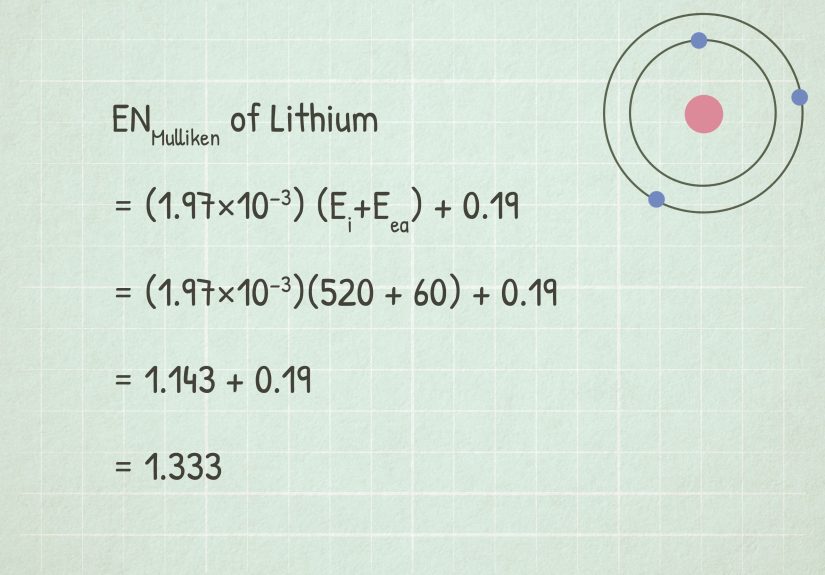
Method 3: Calculate Electronegativity with the Mulliken Method
The big idea
The Mulliken electronegativity treats electronegativity as the average of two measurable atomic properties:
- Ionization energy (IE) how much energy it takes to remove an electron
- Electron affinity (EA) how much energy is associated with adding an electron
The logic is elegant: an atom that resists losing electrons and likes gaining them should be quite electronegative.
Formula
χ = (IE + EA) / 2
This is often expressed in electron volts for an absolute Mulliken scale. To compare with Pauling-style values, chemists may use a conversion relationship.
Example
Let us say an atom has:
- Ionization energy = 13.6 eV
- Electron affinity = 3.4 eV
Then:
χ = (13.6 + 3.4) / 2 = 8.5 eV
That gives the atom’s Mulliken electronegativity on an absolute energy-based scale.
Why students like this method
Because it feels satisfyingly direct. You grab two known properties, average them, and boom: electronegativity. No bond-energy acrobatics. No dramatic square roots lurking in the shadows.
When to use it
- When ionization energy and electron affinity data are available
- When comparing atomic properties in a more physically intuitive way
- In theoretical chemistry discussions
Pros and cons
Pros: Straightforward formula, grounded in atomic energetics.
Cons: Electron affinity data can be tricky or less straightforward for some elements; values are not always presented on the same scale as classroom Pauling numbers.
Method 4: Calculate Electronegativity with the Allred-Rochow Method
The basic concept
The Allred-Rochow scale connects electronegativity to the electrostatic attraction between the nucleus and valence electrons. It uses:
- Effective nuclear charge (Zeff)
- Covalent radius (r)
The idea is that a stronger nuclear pull and a smaller atomic radius should make an atom better at attracting bonding electrons.
General formula
The relationship is commonly expressed in a form proportional to:
χ ∝ Zeff / r2
A more specific equation may include empirical constants, depending on the version being used.
How to apply it
- Estimate the effective nuclear charge using shielding rules, often Slater’s rules.
- Find the atom’s covalent radius.
- Plug the values into the equation.
Example idea
If two atoms have similar effective nuclear charges but one has a smaller covalent radius, the smaller atom will usually have a higher Allred-Rochow electronegativity because the attractive force on valence electrons is stronger.
When to use it
- When discussing the link between atomic size and nuclear attraction
- When comparing trends across related elements
- In more advanced chemistry courses
Pros and cons
Pros: Gives a strong physical picture based on charge and distance.
Cons: Requires estimates for effective nuclear charge and radius; not as commonly used in basic classrooms as the Pauling scale.
Which Electronegativity Method Is Best?
That depends on your goal:
- Need a quick comparison? Use periodic trends.
- Need the classic textbook value? Use the Pauling approach or a Pauling table.
- Want a direct atomic-property formula? Mulliken is your friend.
- Want to relate electronegativity to nuclear pull and size? Allred-Rochow is a strong choice.
In practice, chemists often use tabulated values instead of recalculating everything from zero. That is not cheating. That is called being efficient and keeping your weekend intact.
Common Mistakes When Calculating Electronegativity
1. Mixing scales without noticing
Pauling, Mulliken, and Allred-Rochow values are related, but they are not identical. Always check which scale you are using.
2. Ignoring units
Especially in the Pauling and Mulliken methods, the units matter. Bond energies may be in kJ/mol, kcal/mol, or eV. Conversion constants are not optional decorations.
3. Confusing electronegativity with electron affinity
Electron affinity is one measured property. Electronegativity is a broader concept describing how strongly an atom attracts bonding electrons.
4. Assuming one number tells the whole story
Electronegativity is useful, but context still matters. Oxidation state, bonding environment, and molecular structure can all influence real chemical behavior.
Real-World Uses of Electronegativity Calculations
Electronegativity helps chemists predict and explain all kinds of useful behavior:
- Why water has polar O–H bonds
- Why sodium chloride behaves ionically
- Why carbon forms a huge range of covalent compounds
- Why certain functional groups in organic chemistry pull electron density away from nearby atoms
- Why some materials conduct, insulate, react, or corrode differently
In short, electronegativity is one of those concepts that quietly shows up everywhere. It is the chemistry equivalent of a supporting actor who somehow steals the whole movie.
Extra Experience and Practical Insights: Learning to Work with Electronegativity
One of the most useful experiences students have with electronegativity is realizing that it becomes easier once they stop treating it like a random list of numbers and start seeing it as a pattern. Early on, many learners memorize fluorine as 3.98 on the Pauling scale, oxygen as 3.44, nitrogen as 3.04, and so on. That can help, but the real breakthrough comes when they notice the story behind the values: smaller atoms with a stronger effective pull on electrons usually act more electronegatively. Suddenly the periodic table stops looking like a wall poster and starts behaving like a map.
Another common experience is frustration with the fact that different sources can list slightly different electronegativity values. Students often think they made a mistake when their textbook, homework site, and chemistry video disagree by a few hundredths. In reality, that tiny mismatch is often normal. Different scales and rounding conventions exist. This is actually a great lesson in scientific thinking: numbers are meaningful, but the model behind the number matters too. Chemistry loves precision, but it also loves context.
In lab and classroom settings, electronegativity becomes especially memorable when tied to visible outcomes. A student may calculate a significant electronegativity difference and predict a polar bond, then later connect that idea to the actual behavior of a substance. Why does water dissolve salt? Why does oil stay annoyingly separate? Why do some molecules have dipoles that affect boiling point or intermolecular forces? That is the moment electronegativity stops being a chapter heading and becomes a practical tool.
Students working through the Mulliken method often have another interesting experience: they realize chemistry is deeply connected to energy. Instead of thinking only in terms of “this atom wants electrons more,” they start seeing that desire in energetic terms. High ionization energy means an atom does not easily let go of electrons. Favorable electron affinity means it has a stronger tendency to accept electron density. Averaging those values gives electronegativity a more physical interpretation. For many learners, this is the point where the concept feels less like a classroom invention and more like a scientific model grounded in measurable behavior.
The Pauling method creates a different kind of insight. When students compare actual bond energies to expected values, they see that bond polarity can contribute to bond strength. That is a subtle but powerful lesson. A bond is not just a line drawn between atoms in a Lewis structure. It has measurable energy, and the character of the atoms involved changes that energy. Once that clicks, many students become much better at understanding reaction stability, bond polarity, and why some compounds behave more ionically than others.
There is also a practical study skill hidden in electronegativity problems: approximation is often enough. In many real homework situations, you do not need to calculate a precise value to answer correctly. If you know chlorine is more electronegative than carbon, and oxygen is more electronegative than hydrogen, you can already predict bond polarity, partial charges, and likely intermolecular behavior. That can save time and reduce errors. Chemistry does not always reward overcomplication, even if it occasionally seems determined to try.
Perhaps the most valuable long-term experience with electronegativity is learning that it is a bridge concept. It connects atomic structure, periodic trends, chemical bonding, molecular polarity, reactivity, and materials behavior. Students who genuinely understand electronegativity often find later topics easier because the concept keeps reappearing in useful ways. It may start as a small calculation, but it grows into one of the most practical ideas in all of chemistry.
Final Thoughts
If you want to calculate electronegativity, you have more than one valid route. You can estimate it with periodic trends, derive it from bond energies using the Pauling method, calculate it from ionization energy and electron affinity with Mulliken’s formula, or connect it to effective nuclear charge and atomic radius with Allred-Rochow. Each method shines in a different context.
The best approach is to match the method to your goal. If you are solving a quick chemistry problem, trend-based reasoning may be enough. If you are diving deeper into theory, energy-based and electrostatic models reveal why electronegativity works the way it does. Either way, once you understand this concept, a huge chunk of chemical behavior starts making more sense. And that is always a satisfying moment especially in a subject where the periodic table sometimes feels like it is judging you.