Table of Contents >> Show >> Hide
- Why Objectives Matter in a Research Proposal
- Goals vs. Objectives: Know the Difference Before You Write
- 4 Simple Ways to Write Objectives in a Research Proposal
- 1. Start With the Research Problem, Not With Fancy Verbs
- Weak example
- Better example
- Quick tip
- 2. Use One Clear Action Verb and Keep the Sentence Specific
- Messy example
- Improved version
- Quick tip
- 3. Make Each Objective Realistic, Measurable, and Limited in Scope
- Too broad
- More realistic
- Quick tip
- 4. Align Every Objective With Your Questions, Methods, and Expected Outcomes
- Aligned mini-example
- Quick tip
- Common Mistakes to Avoid When Writing Research Objectives
- A Simple Formula You Can Use
- Sample Set of Objectives for a Research Proposal
- What Writers Learn in Real Life: Proposal Experiences That Sharpen Objectives
- Final Thoughts
- SEO Tags
Writing objectives in a research proposal sounds easy until you actually try it. Then suddenly your brain produces a sentence like, “This study will explore various things related to several important issues in modern society.” Beautiful? No. Helpful? Also no. That kind of objective is the academic version of pointing at a map and saying, “Somewhere over there.”
Strong research proposal objectives do something much better: they tell the reader exactly what the study plans to accomplish, why it matters, and how the work is realistically focused. In other words, they make your proposal sound like a plan instead of a wish.
If you are trying to figure out how to write objectives in a research proposal without sounding robotic, vague, or wildly overconfident, you are in the right place. This guide breaks the process into four simple ways you can use right away. You will also see examples, common mistakes, and practical writing tips that make your proposal easier to understand and much harder to reject.
Why Objectives Matter in a Research Proposal
Before we get into the how-to, let’s clear up one thing: proposal objectives are not filler. They are one of the most important parts of your research proposal because they show the reader what your study will actually do.
A good objective creates direction. It helps connect your research problem, purpose statement, questions, hypothesis, methodology, and expected outcomes. When your objectives are weak, the rest of the proposal starts wobbling like a chair with one short leg.
Clear objectives also help your reader answer the questions that matter most:
- What exactly is this study trying to accomplish?
- Is the project focused enough to be realistic?
- Do the proposed methods actually match the stated purpose?
- Will the research contribute something meaningful?
That is why learning how to write research objectives well is not just a technical skill. It is a persuasion skill.
Goals vs. Objectives: Know the Difference Before You Write
One of the most common reasons students struggle with proposal objectives is that they confuse goals with objectives.
Research Goal
A goal is broad. It describes the larger purpose or long-term intention of the study.
Example: To understand how remote learning affects college student engagement.
Research Objective
An objective is narrower and more specific. It states what the study will do to move toward that goal.
Example: To compare self-reported engagement levels among first-year and senior college students enrolled in fully online courses during the fall semester.
Think of the goal as the destination and the objectives as the driving directions. One tells you where you want to go. The other tells you how you are getting there without ending up in a scholarly ditch.
4 Simple Ways to Write Objectives in a Research Proposal
1. Start With the Research Problem, Not With Fancy Verbs
The first simple way to write strong objectives is to begin with the actual research problem. Too many writers jump straight into verbs like analyze, evaluate, or investigate before they have clearly defined what needs to be studied.
Your objective should grow naturally out of the problem statement and research purpose. If the problem is unclear, the objective will usually be vague too.
Ask yourself these questions before drafting an objective:
- What gap in knowledge am I trying to address?
- What issue, population, relationship, process, or phenomenon am I studying?
- What specific part of the problem is manageable within this proposal?
Once you answer those questions, the wording becomes much easier.
Weak example
To explore the impact of technology on students.
Better example
To examine how daily use of AI writing tools influences revision habits among first-year college composition students at a public university.
Notice the difference. The second version gives the reader a population, a topic, and a more precise focus. It sounds like a study someone could actually conduct rather than a conversation starter at a coffee shop.
Quick tip
Before writing your objective, summarize your research problem in one plain-English sentence. Then draft the objective from that sentence. This keeps you grounded in substance instead of drifting into academic fog.
2. Use One Clear Action Verb and Keep the Sentence Specific
The second simple way to write proposal objectives is to use a clear action verb. Objectives work best when they state what the study will do in direct, observable language.
Useful verbs often include:
- analyze
- compare
- determine
- describe
- evaluate
- examine
- identify
- measure
- test
These verbs are stronger than fuzzy phrases like look into, learn about, deal with, or understand better. Vague wording makes it harder for the reader to see what the study will produce.
There is another important trick here: keep one main action in each objective. When writers try to cram multiple tasks into a single sentence, the objective becomes messy fast.
Messy example
To examine student stress, compare coping strategies, evaluate academic outcomes, and recommend campus interventions for improving wellness.
That sentence is trying to do the work of an entire committee. Instead, break it up.
Improved version
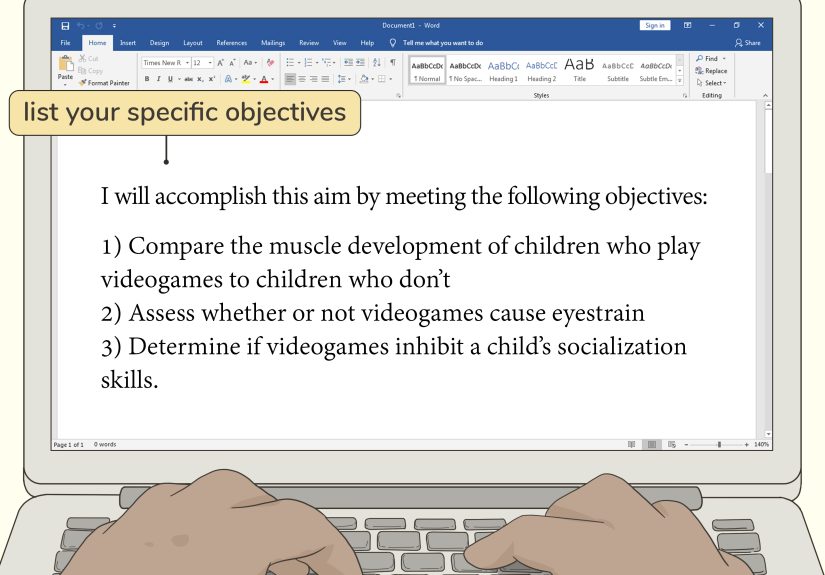
- To measure reported stress levels among undergraduate nursing students during exam periods.
- To compare the coping strategies used by students with high stress and low stress scores.
- To examine the relationship between stress levels and self-reported academic performance.
Now each objective has one job. Readers love that. Reviewers love that. Your future self editing the proposal at 1:13 a.m. will also love that.
Quick tip
If your objective contains more than one main verb, it may actually be several objectives wearing a trench coat.
3. Make Each Objective Realistic, Measurable, and Limited in Scope
The third simple way to write research proposal objectives is to make them doable. This is where many proposals become unintentionally ambitious. A writer may have a good topic, a worthy purpose, and a giant objective that would require five years, three grants, and a small army of research assistants.
Strong objectives are usually specific enough to be assessed and modest enough to be completed within the time, resources, and methods available.
That means your objective should usually answer at least some of these questions:
- Who or what is being studied?
- What variable, issue, or relationship is being examined?
- In what setting or context?
- Over what period of time?
- How will success or completion be recognized?
This does not mean every objective needs to sound like a robot wrote it. It just means the reader should be able to tell what the study intends to accomplish.
Too broad
To determine the causes of burnout in healthcare workers.
More realistic
To identify the workplace factors associated with burnout among emergency room nurses in two urban hospitals during a six-month study period.
The revised objective is still meaningful, but it is much more manageable. It narrows the population, the setting, and the type of information being sought.
A practical way to test scope is to ask: “Could I complete this study with the resources described in my proposal?” If the honest answer is “Only if I gain superpowers,” the objective needs tightening.
Quick tip
Use the spirit of SMART thinking when drafting research objectives. In plain terms, the objective should be specific, measurable, achievable, relevant, and tied to a realistic timeframe or phase of work.
4. Align Every Objective With Your Questions, Methods, and Expected Outcomes
The fourth simple way to write objectives in a research proposal is to check alignment. Your objectives should not sit alone like decorative plants in the corner of your proposal. They need to connect directly to the rest of the document.
Every objective should support the proposal’s core logic:
- Research problem: What issue needs investigation?
- Purpose: Why is the study being conducted?
- Questions or hypotheses: What is the study asking or testing?
- Methods: How will the data be collected and analyzed?
- Outcomes: What will the study clarify, show, or contribute?
Here is what misalignment looks like. Suppose your proposal says it will use interviews to understand teachers’ experiences with burnout, but your objective says you will measure the statistical effect of burnout on district retention patterns. That is a mismatch. The objective points one way, and the method walks the other way.
Aligned writing feels much stronger.
Aligned mini-example
Research question: How do first-generation college students describe the role of mentoring in their academic adjustment?
Objective: To explore how first-generation college students describe the academic and emotional support they receive through faculty mentoring during their first year of college.
Method: Semi-structured interviews with first-year students.
That works because the objective clearly matches the question and the method. The reader can follow the logic without doing interpretive gymnastics.
Quick tip
After drafting your objectives, place them next to your research questions and methods. If you cannot draw a clear line between them, revise until the connection is obvious.
Common Mistakes to Avoid When Writing Research Objectives
Even good writers trip over the same problems. Here are a few common mistakes that weaken proposal objectives:
Being too vague
Phrases like study the issue or understand the topic do not tell the reader enough.
Being too broad
If the objective could describe a dissertation, a national report, and an eight-part documentary, it probably needs narrowing.
Confusing methods with objectives
“To conduct interviews” is a method. “To identify how employees describe leadership communication during organizational change” is an objective.
Stacking too many ideas into one sentence
An objective should be focused. When it tries to do everything, it usually communicates very little.
Ignoring feasibility
Your objective should fit the study’s time frame, participants, data access, and research design.
A Simple Formula You Can Use
If you want a practical template, this one works well:
To + action verb + specific focus + population or context + optional timeframe or condition
Examples
- To compare attitudes toward online privacy among adults ages 18 to 25 and adults ages 40 to 55.
- To identify barriers to preventive dental care among uninsured parents in rural counties.
- To examine how social media use before bedtime relates to sleep quality in high school students during the academic year.
This formula is not a cage. It is training wheels. Use it until writing objectives feels natural.
Sample Set of Objectives for a Research Proposal
Let’s say the proposed topic is the effect of hybrid work on employee collaboration. Here is how a strong set of objectives might look:
- To identify the communication tools most frequently used by hybrid teams in mid-sized technology companies.
- To examine employee perceptions of collaboration quality in hybrid and fully in-office work settings.
- To compare reported challenges in project coordination among managers and non-managerial employees working in hybrid arrangements.
- To determine whether meeting frequency is associated with perceived team cohesion in hybrid workplaces.
These objectives are specific, focused, and connected to a clear topic. They also suggest possible methods, populations, and variables without sounding inflated.
What Writers Learn in Real Life: Proposal Experiences That Sharpen Objectives
One of the most useful lessons about writing proposal objectives comes from experience, especially the slightly painful kind. Many students and early-career researchers begin with objectives that sound impressive but collapse under basic follow-up questions. For example, a writer may draft, “To evaluate the social effects of digital media on teenagers.” At first glance, that sounds serious and academic. Then the questions begin. Which teenagers? Which digital media? What counts as a social effect? Over what time period? In what setting? Suddenly the objective looks less like a research plan and more like a vague promise made by an overcaffeinated philosopher.
A common experience is realizing that the first draft of an objective is often really just a topic statement. That is not failure. It is part of the process. Writers usually start broad because broad ideas are easier to think about. Narrowing takes more effort because it requires decisions. You have to choose the population, the variables, the setting, and the angle. That can feel uncomfortable, but it is exactly what makes the objective useful.
Another common experience is discovering that methods quietly expose weak objectives. A student may say the study will “measure the impact” of a program, but the proposal only includes a handful of interviews. Interviews can be excellent for exploring experiences, perceptions, and meanings, but they may not support the kind of causal language suggested by the word impact. That moment of mismatch is frustrating, but also incredibly helpful. It teaches writers to choose verbs more carefully and to align objectives with actual methods rather than idealized ones.
Writers also learn, often the hard way, that ambitious objectives create avoidable chaos. It is tempting to promise everything: identify causes, compare groups, evaluate interventions, and produce recommendations for policy reform all in one proposal. That may sound impressive until the project timeline enters the room and ruins the fantasy. Experienced researchers get better at resisting that temptation. They know a focused objective is not a weak one. It is a credible one.
Perhaps the most encouraging experience is this: once the objectives become clear, the rest of the proposal often improves quickly. The literature review becomes easier to organize. The research questions become sharper. The methodology feels more logical. Even the title sometimes gets better. Clear objectives act like a backbone for the proposal. Without them, everything slouches. With them, the entire document stands up straighter.
So if writing your objectives feels harder than expected, that is normal. It usually means you are doing the real intellectual work of defining the study. And once that part clicks, the proposal stops sounding like a loose collection of academic paragraphs and starts sounding like a serious plan.
Final Thoughts
If you want to write better objectives in a research proposal, do not chase complicated wording. Chase clarity. The best objectives are not the ones that sound the most scholarly. They are the ones that make your study easy to understand, easy to evaluate, and easy to believe.
Start with the research problem. Use a clear action verb. Make the objective realistic and limited. Then check that it aligns with your research questions, methods, and expected outcomes. Do those four things, and your objectives will be stronger than most first drafts by a mile.
And that matters, because in proposal writing, a clear objective does more than organize a study. It quietly tells your reader, “I know what I am doing.” In research, that is a very attractive sentence, even when you never actually write it.