Table of Contents >> Show >> Hide
- Before You Start: The 15-Minute Setup That Makes Every Idea Work Better
- The 33 Clever Small Walk-In Closet Ideas
- 1) Make a “zone map” before you buy a single bin
- 2) Protect your walkway (aka: stop turning your closet into a maze)
- 3) Go floor-to-ceiling with vertical shelving
- 4) Use adjustable track standards for a “future-proof” closet
- 5) Try a one-wall layout for ultra-narrow closets
- 6) Add a corner hanging rod to unlock dead space
- 7) Replace bulky furniture with wall-mounted drawers
- 8) Put daily essentials at eye level
- 9) Double-hang rods to instantly increase capacity
- 10) Install a pull-out valet rod for outfit planning
- 11) Add extra hanging only where it pays off
- 12) Swap to slim velvet hangers
- 13) Use cascading hangers for “category stacking”
- 14) Put hooks on side panels for grab-and-go items
- 15) Add shallow shelves for folded tees and knits
- 16) Use pull-out wire baskets for breathable sweater storage
- 17) Add shelf dividers to stop the “leaning tower of denim”
- 18) Try vertical “file folding” in drawers
- 19) Put small accessories in labeled bins (and be oddly proud of it)
- 20) Use clear-front bins for quick scanning
- 21) Build an angled shoe wall to keep pairs visible
- 22) Add a boot solution that prevents “sad slouchy boots”
- 23) Store handbags upright with dividers
- 24) Create a “bag parking spot” near the door
- 25) Use a small tray or turntable for fragrances and daily accessories
- 26) Add a jewelry drawer insert to avoid tangled necklaces
- 27) Install a pull-out tie/belt rack for easy access
- 28) Hang scarves on a multi-ring hanger (tiny space, big win)
- 29) Swap a swinging door for a pocket or sliding door
- 30) Add a full-length mirror to bounce light and expand the feel
- 31) Layer your closet lighting (ceiling + task + motion)
- 32) Choose bright, neutral paint and a light-catching finish
- 33) Style one “boutique moment” and leave some empty space on purpose
- Real-World Lessons From Small Walk-In Closet Makeovers (Extra 500+ Words)
- Wrap-Up: Your Closet Doesn’t Need More SpaceIt Needs a Smarter Plan
A small walk-in closet is a magical place: it can make you feel like you’ve got your life together…
or it can become a tiny room where sweaters go to reproduce. The good news? You don’t need a celebrity-sized
dressing suite to get a boutique-style closet. You need smart layout choices, ruthless editing,
and storage that works with your habits (not against them).
Below are 33 small walk-in closet ideas designed to help you squeeze more function out of every inchwithout
turning your closet into an obstacle course. Expect practical organization, design upgrades that make the
space feel bigger, and a few “why didn’t I do this sooner?” moves.
Before You Start: The 15-Minute Setup That Makes Every Idea Work Better
Measure once, win forever
Grab a tape measure and note your closet’s length, width, and height, plus the location of outlets, vents,
and door swing. The goal is to avoid buying organizers that don’t fitor installing shelves that block
drawers from opening (the storage equivalent of stepping on a LEGO).
Declutter like you mean it
Small walk-in closet organization starts with editing. If your closet is stuffed, no system will “fix”
itsystems don’t do miracles, they do math. Pull everything out, create quick piles (Keep / Donate / Maybe),
and be honest about what you actually wear.
Create zones, not chaos
Think of your closet like a tiny store: you want categories, visibility, and easy access. Most people do
best with zones for hanging clothes, folded items, shoes, bags, accessories, and a small “staging” spot for
tomorrow’s outfit.
The 33 Clever Small Walk-In Closet Ideas
1) Make a “zone map” before you buy a single bin
Sketch a quick plan: where will long-hang items go, where will shoes live, where do accessories belong?
A zone map prevents the classic mistake of installing beautiful shelves… then realizing you have nowhere
to hang a dress.
2) Protect your walkway (aka: stop turning your closet into a maze)
A small walk-in needs breathing room. Keep the center path clear so you can step in, turn, and actually
reach things. If a solution eats your floor space, it’s probably stealing your sanity too.
3) Go floor-to-ceiling with vertical shelving
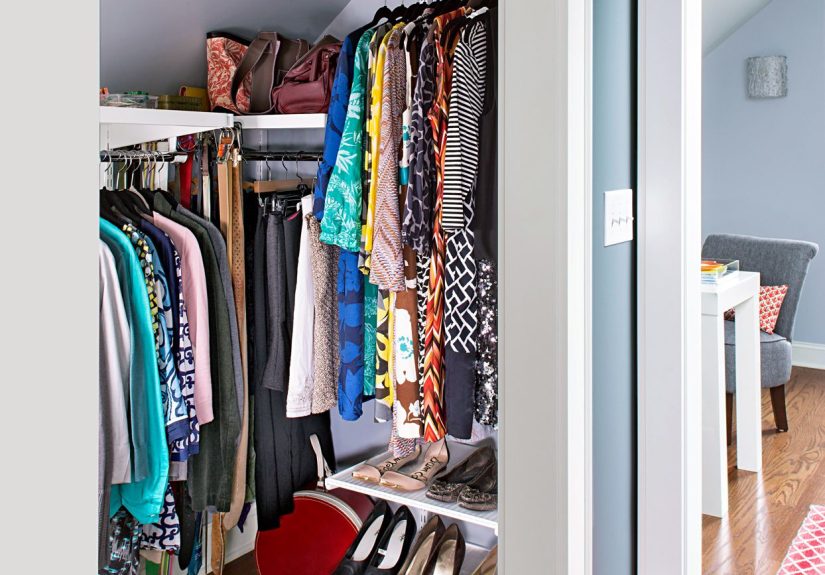
Vertical space is your best friend in a tiny walk-in closet. Add shelves up top for rarely used items
(luggage, keepsakes, seasonal gear) and keep everyday items in the middle where you can see and grab them.
4) Use adjustable track standards for a “future-proof” closet
Your wardrobe changesso your closet should, too. Adjustable track systems let you move shelves and rods
as your needs evolve, which is ideal if you’re building a small walk-in closet on a budget.
5) Try a one-wall layout for ultra-narrow closets
If your closet is more “walk-in hallway” than “walk-in room,” put storage on one long wall and keep the
opposite side open. You’ll gain usability even if you sacrifice a little storage volume.
6) Add a corner hanging rod to unlock dead space
Corner space is often wasted, especially in L-shaped closets. A corner rod (or corner shelves) can turn
that awkward angle into prime hanging space for short items or frequently used layers.
7) Replace bulky furniture with wall-mounted drawers
Dressers inside a small walk-in closet can feel like parking a truck in a bike lane. Instead, opt for
shallow drawer units or floating cabinets that keep the floor open and the closet feeling larger.
8) Put daily essentials at eye level
The easiest closet “upgrade” is simply moving your most-worn items to the easiest-to-reach spots. Make the
center zone your VIP section: work basics, favorite jeans, go-to shoes, and everyday bags.
9) Double-hang rods to instantly increase capacity
Double hanging is a classic small walk-in closet idea for a reason: shirts, blouses, skirts, and folded
pants don’t need long-hang height. Two rods can nearly double hanging space for short garments.
10) Install a pull-out valet rod for outfit planning
A valet rod gives you a mini staging area: hang tomorrow’s outfit, air out dry-cleaning, or prep a travel
capsule. It’s a small add-on that makes mornings smootherlike a personal assistant, but cheaper.
11) Add extra hanging only where it pays off
Instead of double-hanging the whole closet, apply it strategically. One section for short-hang, one for
long-hang, and one for mixed storage keeps your closet layout flexible and realistic.
12) Swap to slim velvet hangers
Bulky mismatched hangers waste space and make clothes slip off at the worst possible time (usually when
you’re late). Slim non-slip hangers help you fit more on the rod and keep garments looking neat.
13) Use cascading hangers for “category stacking”
Cascading hangers or multi-tier organizers work especially well for camis, bras, scarves, or work pants.
Keep it targetedif you cascade everything, you’ll create a “clothing chandelier” that’s hard to access.
14) Put hooks on side panels for grab-and-go items
Hooks are tiny, mighty storage solutions. Add them to side walls or cabinet panels for belts, hats,
handbags, or the hoodie you wear every day and pretend is “just for errands.”
15) Add shallow shelves for folded tees and knits
Deep shelves become messy caves. Shallow shelves keep stacks visible and prevent avalanches. If you can
see your folded items, you’ll actually wear them instead of forgetting they exist.
16) Use pull-out wire baskets for breathable sweater storage
Wire or ventilated baskets are great for bulky sweaters, gym gear, or linens. Pull-out styles reduce the
“digging” problem and help you avoid yanking out half a shelf just to find one hoodie.
17) Add shelf dividers to stop the “leaning tower of denim”
Shelf dividers are a low-cost, high-impact upgrade for stacks of jeans, sweaters, or handbags. They keep
piles upright and separated so everything doesn’t melt into one wrinkly mountain.
18) Try vertical “file folding” in drawers
Instead of stacking tees or leggings, file-fold them so you can see every item at once. It turns drawers
into a visual inventory and reduces the temptation to dig (and re-destroy your work).
19) Put small accessories in labeled bins (and be oddly proud of it)
Socks, belts, gloves, scarves, and workout headbands need boundaries. Use small bins, label them, and
you’ll stop playing “Where did my other belt go?” every time you leave the house.
20) Use clear-front bins for quick scanning
Clear or clear-front storage helps you find what you need fasterespecially for seasonal accessories,
clutches, or special-occasion shoes. If you can see it, you’ll use it. If you can’t, it becomes closet folklore.
21) Build an angled shoe wall to keep pairs visible
Shoes are space hogs. Angled shelves (or step-style risers) let you see pairs at a glance and prevent the
dreaded shoe pile. If you’re tight on space, store everyday shoes at the bottom and dress shoes higher up.
22) Add a boot solution that prevents “sad slouchy boots”
Boot racks, boot clips, or even simple boot shapers keep tall boots upright and protect the shape.
Bonus: it frees floor space and makes your closet look instantly more polished.
23) Store handbags upright with dividers
Handbags do best standing upright, separated by dividers so they don’t topple like dominoes. A dedicated
“bag shelf” also keeps straps from tangling into a dramatic knot that only appears on busy mornings.
24) Create a “bag parking spot” near the door
If you enter the closet to grab your daily bag, give it an obvious homehook + shelf combo, or a dedicated
cubby. This is how you stop bags from migrating to the floor like they pay rent there.
25) Use a small tray or turntable for fragrances and daily accessories
A compact tray (or lazy Susan) keeps perfume, watch, sunglasses, and keys from scattering across shelves.
It also makes your closet feel intentionally styledlike a boutique, not a storage unit.
26) Add a jewelry drawer insert to avoid tangled necklaces
Jewelry storage is easier when it’s separated and visible. Drawer inserts, small trays, or a wall-mounted
organizer reduce tangles and make it faster to get dressedno more improvising a necklace “un-knotting ritual.”
27) Install a pull-out tie/belt rack for easy access
Pull-out racks keep belts and ties flat and easy to browse. They also work for scarves or small handbags.
This is one of those upgrades that makes your closet feel custom without a custom price tag.
28) Hang scarves on a multi-ring hanger (tiny space, big win)
Multi-ring hangers organize scarves vertically so you can see patterns and colors quickly. It’s simple,
compact, and saves you from the classic scarf pile that looks like a textile landslide.
29) Swap a swinging door for a pocket or sliding door
Door swing steals valuable square footage in small spaces. Pocket doors and sliding doors can make a closet
feel more open and easier to accessespecially when your closet entrance is in a tight bedroom corner.
30) Add a full-length mirror to bounce light and expand the feel
Mirrors are a small walk-in closet’s favorite illusion. A full-length mirror improves function (outfit
check!) and reflects light, which makes the space feel brighter and more open.
31) Layer your closet lighting (ceiling + task + motion)
Good closet lighting changes everything. Combine an overhead fixture with LED strip lighting near shelves
or rods, and consider motion sensors for convenience. The goal is fewer shadows and fewer “Is this navy or black?”
moments.
32) Choose bright, neutral paint and a light-catching finish
Light colors help small spaces feel bigger, especially if your closet has no natural light. Soft whites,
warm off-whites, and pale neutrals reflect light and make the closet feel clean, calm, and intentional.
33) Style one “boutique moment” and leave some empty space on purpose
The most expensive-looking closets aren’t always the largestthey’re the most curated. Add a small rug,
a framed print, or a tidy shelf vignette (tray + fragrance + jewelry). And yes, leave a little empty space.
Your closet should feel usable, not packed like a suitcase.
Real-World Lessons From Small Walk-In Closet Makeovers (Extra 500+ Words)
When people renovate or reorganize a small walk-in closet, the biggest surprise is usually this:
the “right” solution isn’t the most storageit’s the most usable storage. In real homes, a closet
only works if you can maintain it on a rushed weekday, not just the day you install it and take victory photos.
One common pattern is the overconfidence trap: someone measures the walls, installs shelves everywhere,
and feels like a geniusuntil they realize they’ve eliminated the only comfortable standing area.
A closet that forces you to shuffle sideways like you’re sneaking past someone in a movie theater becomes
annoying fast. People who end up happiest tend to protect a clear walkway first, then build storage around it.
This also explains why wall-mounted drawers and shallow shelving often outperform bulky dressers in tight closets:
you keep floor space open, which makes the entire closet feel calmer.
Another real-life insight: “perfect” organization usually fails if it ignores how someone gets dressed.
If you always grab gym clothes first, put them near the entrance or at eye level. If you change shoes twice
a day, shoe storage needs to be obvious and accessibleotherwise shoes drift to the floor like they’re
trying to start a new civilization down there. This is why zones matter. People who create simple categories
(work, casual, workout, dressy, seasonal) spend less time hunting and re-hanging items. It’s less about being
“neat” and more about reducing friction.
Lighting is the silent hero in almost every successful small walk-in closet makeover. Many closets start with
a single overhead bulb that casts shadows in all the wrong places. Once people add LED strips near shelves or
rods, they stop buying duplicate black sweaters because they can finally see what they own. Motion-activated
lighting is another upgrade people love because it matches real behavior: you walk in with arms full of laundry,
the light turns on, and you feel like your closet respects your time.
On the design side, small closets benefit from “visual quiet.” Homeowners who choose matching hangers, repeat a
few storage container styles, and use labels tend to keep the space tidy longer. The closet looks less busy,
which makes it easier to spot when something is out of place. It’s the same reason clear-front bins work well:
when you can scan quickly, you avoid rummaging (and rummaging is the beginning of chaos).
Finally, there’s the seasonal reality check. Even the best small walk-in closet ideas struggle if you try to store
every season’s wardrobe in one tiny space at the same time. People who rotate off-season clothingusing top shelves,
bins, or an alternate storage spotreport that their closet feels bigger overnight. And once you experience a closet
where you can actually see and reach your daily clothes, it’s hard to go back. The “secret” isn’t a secret at all:
make decisions that reduce daily effort, and your closet will stay organized longerwithout requiring weekend-long
cleanup marathons.
Wrap-Up: Your Closet Doesn’t Need More SpaceIt Needs a Smarter Plan
The best small walk-in closet ideas focus on three things: layout (protect your walkway),
visibility (so you use what you own), and habit-friendly systems (so it stays tidy).
Start with zones, upgrade your hanging and shelving, improve closet lighting, and finish with a small style moment
that makes the space feel like yoursnot just a storage cave.