Table of Contents >> Show >> Hide
- 30 Favorite Non-English Phrases and Their Literal Meanings
- 1. French: Quand on parle du loup, on en voit la queue
- 2. French: Poser un lapin à quelqu’un
- 3. French: On n’est pas sorti de l’auberge
- 4. French: Être dans la galère
- 5. German: Ich verstehe nur Bahnhof
- 6. German: Ins Fettnäpfchen treten
- 7. German: Auf dem Schlauch stehen
- 8. German: Alles hat ein Ende, nur die Wurst hat zwei
- 9. German: Auf dem Zahnfleisch kriechen
- 10. German: Abwarten und Tee trinken
- 11. Italian: Quando il gatto non c’è, i topi ballano
- 12. Italian: Cane non mangia cane
- 13. Italian: Stare con le mani in mano
- 14. Italian: In bocca al lupo
- 15. Spanish: Pensando en la inmortalidad del cangrejo
- 16. Spanish: Ser pan comido
- 17. Spanish: Estar como una cabra
- 18. Spanish: No tener pelos en la lengua
- 19. Spanish: Tirar la casa por la ventana
- 20. Spanish: Dar gato por liebre
- 21. Japanese: 猫の手も借りたい (neko no te mo karitai)
- 22. Japanese: 猿も木から落ちる (saru mo ki kara ochiru)
- 23. Japanese: 腹が立つ (hara ga tatsu)
- 24. Japanese: 間一髪 (kan ippatsu)
- 25. Korean: 눈이 높다 (nun-i nop-da)
- 26. Korean: 바람을 넣는다 (barameul neonneunda)
- 27. Korean: 손바닥으로 하늘을 가린다 (sonbadageuro haneureul garinda)
- 28. Korean: 고래 싸움에 새우 등 터진다 (gorae ssaume saeu deung teojinda)
- 29. Chinese: 加油 (jiā yóu)
- 30. Chinese: 七窍生烟 (qī qiào shēng yān)
- Why These Literal Meanings Stick in Your Head
- What These Phrases Say About the People Who Use Them
- Personal Experiences With Non-English Phrases and Literal Meanings
- Final Thoughts
- SEO Tags
Literal translation is where language stops being polite and starts being wildly entertaining. One minute you are learning how people say “good luck” in another language, and the next minute you are standing “in the mouth of the wolf,” borrowing help from a cat, or wondering why someone is “thinking about the immortality of the crab.” Honestly, English idioms are weird too, but other languages often turn the weirdness up to eleven and hand it a tiny espresso.
So yes, the title sounds like a dinner party where 30 language nerds refused to go home. In spirit, that is exactly what this article is. Think of it as a curated roundup of beloved non-English phrases, literal meanings, and foreign idioms that reveal how much humor, history, and personality can fit into a few words. These expressions are funny on the surface, but they also show how people around the world picture embarrassment, luck, exhaustion, love, confusion, and everyday chaos.
30 Favorite Non-English Phrases and Their Literal Meanings
1. French: Quand on parle du loup, on en voit la queue
Literal meaning: “When you talk about the wolf, you see its tail.”
What it means: Speak of the devil. This phrase is wonderfully cinematic. You are chatting about someone, and suddenly they appear, metaphorical wolf tail and all. It is spooky, playful, and way more stylish than saying, “Wow, weird timing.”
2. French: Poser un lapin à quelqu’un
Literal meaning: “To put a rabbit to someone.”
What it means: To stand someone up. French somehow turned flaky behavior into a rabbit delivery system. It is rude, yes, but at least the literal image is adorable. Emotionally devastating, but adorable.
3. French: On n’est pas sorti de l’auberge
Literal meaning: “We have not left the hostel.”
What it means: We are not out of the woods yet. This is the perfect phrase for long projects, family drama, or any week that begins with confidence and ends with spreadsheets on fire.
4. French: Être dans la galère
Literal meaning: “To be in the galley.”
What it means: To be in a mess or in a rough situation. It sounds old, dramatic, and slightly nautical, which is exactly what many personal disasters feel like anyway.
5. German: Ich verstehe nur Bahnhof
Literal meaning: “I only understand train station.”
What it means: I do not understand a thing. If confusion had a mascot, it might be this phrase. It perfectly captures that moment when someone explains something to you and your brain simply boards a different train.
6. German: Ins Fettnäpfchen treten
Literal meaning: “To step into the little bowl of fat.”
What it means: To put your foot in your mouth. It is hard to improve on this image. Social awkwardness becomes visible, slippery, and probably impossible to clean up quickly.
7. German: Auf dem Schlauch stehen
Literal meaning: “To stand on the hose.”
What it means: To be clueless or slow to understand. When the flow stops, so does the brain. Few phrases explain mental lag this neatly.
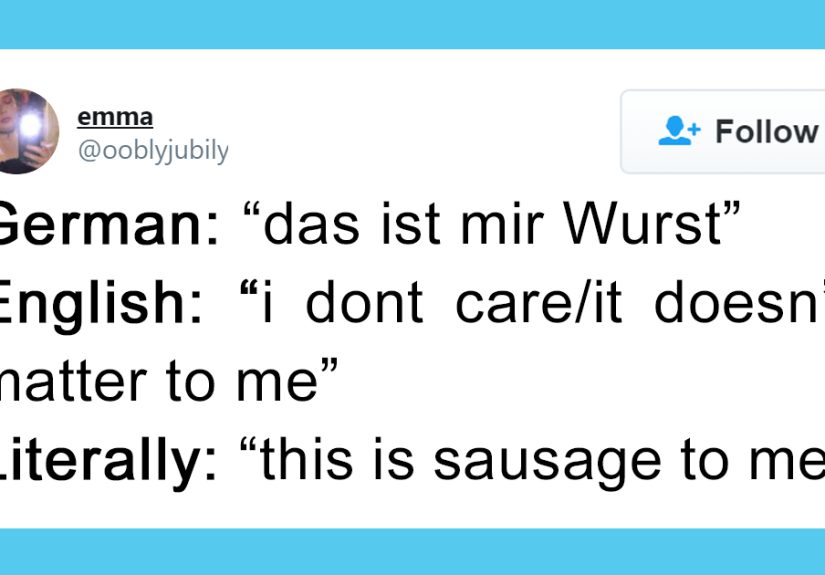
8. German: Alles hat ein Ende, nur die Wurst hat zwei
Literal meaning: “Everything has an end, only the sausage has two.”
What it means: Everything ends eventually. It is philosophical, comforting, and deeply committed to sausage as a teaching tool. Germany understood the assignment.
9. German: Auf dem Zahnfleisch kriechen
Literal meaning: “To crawl on your gums.”
What it means: To be completely exhausted. This is not tired. This is final-exam week, double-shift, no-coffee-left tired.
10. German: Abwarten und Tee trinken
Literal meaning: “Wait and drink tea.”
What it means: Wait and see. It sounds like advice from the calmest person in the world, the kind who never panics because they are already halfway through a chamomile.
11. Italian: Quando il gatto non c’è, i topi ballano
Literal meaning: “When the cat is not there, the mice dance.”
What it means: When the cat is away, the mice will play. This phrase wins points for rhythm, mischief, and universal truth. Leave the room for five minutes and somebody will absolutely start dancing.
12. Italian: Cane non mangia cane
Literal meaning: “Dog does not eat dog.”
What it means: People in the same circle usually protect one another. It is sharp, memorable, and a reminder that loyalty can be noble, inconvenient, or suspicious depending on the situation.
13. Italian: Stare con le mani in mano
Literal meaning: “To stay with your hands in hand.”
What it means: To sit around doing nothing. In a culture famous for expressive hand gestures, having your hands uselessly occupied is practically a crime against communication.
14. Italian: In bocca al lupo
Literal meaning: “Into the mouth of the wolf.”
What it means: Good luck. Yes, it sounds deeply alarming. No, it is not an insult. It is one of those phrases that proves language learners must develop trust issues and courage at the same time.
15. Spanish: Pensando en la inmortalidad del cangrejo
Literal meaning: “Thinking about the immortality of the crab.”
What it means: Daydreaming. This is one of the most poetic ways to accuse somebody of mentally leaving the room while their body remains seated.
16. Spanish: Ser pan comido
Literal meaning: “To be eaten bread.”
What it means: To be a piece of cake. It is charming because it makes easy tasks sound wholesome, like the universe handed you a warm loaf and said, “Relax, you’ve got this.”
17. Spanish: Estar como una cabra
Literal meaning: “To be like a goat.”
What it means: To be a little crazy. Goats everywhere may object, but as a phrase it is excellent: quick, visual, and just dramatic enough.
18. Spanish: No tener pelos en la lengua
Literal meaning: “Not to have hairs on your tongue.”
What it means: To speak bluntly or tell it like it is. The phrase is gross in the most effective way possible. It makes honesty sound hygienic.
19. Spanish: Tirar la casa por la ventana
Literal meaning: “To throw the house out the window.”
What it means: To spare no expense. It is the language equivalent of confetti cannons and financial irresponsibility wearing a party hat.
20. Spanish: Dar gato por liebre
Literal meaning: “To give cat for hare.”
What it means: To deceive someone or pass off something inferior as better. It is ancient scam energy, compactly expressed.
21. Japanese: 猫の手も借りたい (neko no te mo karitai)
Literal meaning: “I even want to borrow a cat’s hand.”
What it means: I need all the help I can get. This may be the cutest way on earth to describe being overwhelmingly busy. Useless assistance is still assistance, apparently.
22. Japanese: 猿も木から落ちる (saru mo ki kara ochiru)
Literal meaning: “Even monkeys fall from trees.”
What it means: Even experts make mistakes. It is simple, elegant, and comforting. If the monkey slips, maybe your typo is not the end of civilization.
23. Japanese: 腹が立つ (hara ga tatsu)
Literal meaning: “The stomach stands.”
What it means: To get angry. This phrase turns emotion into posture. You can practically feel the irritation rising before the sentence even finishes.
24. Japanese: 間一髪 (kan ippatsu)
Literal meaning: “The width of one hair.”
What it means: A close call. It is a tiny image carrying huge tension, which is exactly what a near miss feels like.
25. Korean: 눈이 높다 (nun-i nop-da)
Literal meaning: “Eyes are high.”
What it means: To have high standards or be picky. It is such a clean metaphor that once you hear it, it feels obvious. Standards are not low, average, or practical. They are floating somewhere above the skyline.
26. Korean: 바람을 넣는다 (barameul neonneunda)
Literal meaning: “To put in wind.”
What it means: To pump someone up, coax, or encourage. It sounds like emotional tire maintenance, and honestly, sometimes that is exactly what motivation is.
27. Korean: 손바닥으로 하늘을 가린다 (sonbadageuro haneureul garinda)
Literal meaning: “To cover the sky with your palm.”
What it means: You cannot hide the truth. It is beautifully dramatic. The image instantly tells you how ridiculous denial can look.
28. Korean: 고래 싸움에 새우 등 터진다 (gorae ssaume saeu deung teojinda)
Literal meaning: “The shrimp’s back bursts in a whale fight.”
What it means: Small, powerless people get hurt when the powerful clash. It is funny for a second and sadly accurate right after that.
29. Chinese: 加油 (jiā yóu)
Literal meaning: “Add oil.”
What it means: Come on, keep going, you can do it. Few phrases are this practical and this charming at the same time. It sounds like encouragement from a mechanic, but in the best possible way.
30. Chinese: 七窍生烟 (qī qiào shēng yān)
Literal meaning: “Smoke comes from the seven openings.”
What it means: To be furious. Compared with plain old “angry,” this phrase arrives with special effects.
Why These Literal Meanings Stick in Your Head
The best phrases from other languages do not survive because they are efficient. They survive because they are vivid. “Wait and drink tea” is better than “be patient” because you can see it. “Cover the sky with your palm” is better than “you cannot hide the truth” because it gives your brain a tiny movie. And “add oil” is so cheerful and odd that it practically installs itself in your memory.
That is also why non-English phrases with literal meanings are such a gift for writers, travelers, language learners, and curious readers. They reveal how culture compresses experience into images. One language reaches for wolves. Another chooses goats. Another trusts cats, shrimp, pears, bowls of fat, or exploding crustacean philosophy. The metaphor may change, but the human feeling under it usually does not.
What These Phrases Say About the People Who Use Them
These expressions are not random. They are tiny cultural fingerprints. Food shows up a lot because daily life shows up a lot. Animals show up because people have always watched them, lived with them, laughed at them, and blamed them for things they absolutely did not do. Body parts appear because emotion is physical. Anger rises. Shame stings. Exhaustion crawls. Confusion blocks the hose.
That is the real fun of foreign idioms. They remind us that language is not only about accuracy. It is also about attitude. Some languages explain a feeling. Others stage it. The best ones do both, then leave you wondering why English has not yet adopted “thinking about the immortality of the crab” as a medically recognized condition during long meetings.
Personal Experiences With Non-English Phrases and Literal Meanings
The first time I really fell in love with non-English idioms was not in a classroom. It was in a conversation where someone translated a phrase word for word, and the room instantly changed. Everybody laughed, but not because the phrase was silly in a cheap way. We laughed because it was so perfect. The literal version sounded ridiculous, yet the meaning underneath it was painfully familiar. That is the strange magic of these expressions: they can feel foreign and personal at exactly the same time.
I remember hearing “add oil” for the first time and thinking it sounded like advice from a pit crew. Then I saw how naturally it was used to encourage someone before a challenge, and suddenly it did not seem odd at all. It seemed efficient, warm, and surprisingly energetic. The phrase had personality. It was not trying to be elegant. It was trying to get you moving, and it succeeded.
Another unforgettable moment came with “I only understand train station.” That one lands especially well when you are learning a language and pretending to follow along while your brain quietly leaves your body. There is something comforting about discovering that confusion has a comic tradition. People everywhere have clearly been overwhelmed before us, and instead of giving up, they turned that feeling into memorable language.
Then there are the phrases that feel like miniature novels. “When you talk about the wolf, you see its tail” does more than mean “speak of the devil.” It creates suspense. “The shrimp’s back bursts in a whale fight” does more than describe collateral damage. It tells a whole story about power in one line. A good idiom does not simply label reality. It stages it, costumes it, and gives it dramatic lighting.
What makes these phrases especially enjoyable is how they change the way you listen. Once you start noticing them, you stop treating language like a plain delivery service for information. You hear the architecture of thought. You hear what a culture chooses to compare, exaggerate, soften, or joke about. A phrase about a rabbit, wolf, cat, or sausage may look playful, but it often carries history, habit, and shared social experience inside it.
There is also a personal side to all of this. Learning expressions from other languages makes ordinary conversations feel less ordinary. It adds texture. It reminds you that there is never just one way to describe being tired, embarrassed, hopeful, blunt, lucky, or overwhelmed. Sometimes the most human thing in the world is realizing that somebody on the other side of the planet once felt exactly what you felt and decided the best possible description involved a monkey, a palm, or a bowl of fat.
That is why lists like this never get old. They are fun, yes, but they are also tiny bridges. They make other languages feel less distant and your own language feel a little less automatic. After spending time with these phrases, even plain English starts to feel suspiciously underdressed. Suddenly “be patient” seems bland when you could be waiting and drinking tea. “Good luck” seems boring when you could be stepping directly into the mouth of a wolf and hoping for the best.
Final Thoughts
The joy of non-English phrases is not just that they are funny when translated literally. It is that they prove people everywhere are constantly turning life into imagery. We do not simply say we are angry, awkward, unlucky, or exhausted. We light the sky on fire, step in the wrong bowl, crawl on our gums, or ask a cat for help. And somehow, that makes the world feel both weirder and more understandable.
So the next time you come across one of these literal meanings from other languages, do not rush past it. Sit with it. Picture it. Laugh at it a little. Then admire the fact that a few ordinary words, arranged in just the right order, can carry an entire culture’s sense of humor in one breath.