Table of Contents >> Show >> Hide
- Why We Can’t Look Away From Death-Defying Photos
- 30 Death-Defying Photo Moments
- 1) Lunch on a Beam, a Long Way From the Sidewalk
- 2) The Rooftop “Legs Dangling” Shot
- 3) Standing on a Crane Like It’s a Viewing Platform
- 4) Window-Washer Suspended Over a Glass Canyon
- 5) The “One Hand on the Ledge” Portrait
- 6) Free-Solo Climber on a Blank Wall
- 7) A Hand Jam Above a Thousand Feet of Air
- 8) The “Mid-Fall” Climbing Shot
- 9) Ice Climber With Shards Flying
- 10) The Knife-Edge Ridgeline Traverse
- 11) BASE Jumper at the Step-Off
- 12) Wingsuit “Proximity” Lines Along a Cliff
- 13) Paraglider Above a Volcano Landscape
- 14) Skydivers in Formation Over an Endless Drop
- 15) The “Tiny Human, Huge Storm” Aerial Photo
- 16) Big-Wave Surfer Dropping Down a Mountain of Water
- 17) Kayaker at the Lip of a Waterfall
- 18) Cliff Diver Into a Narrow Slot
- 19) A Swimmer Face-to-Face With a Massive Predator
- 20) Storm Chaser Beneath a Rotating Sky
- 21) Downhill Mountain Bike on a Ridge No Wider Than a Desk
- 22) Motocross Jump With a Horizon for a Landing
- 23) Parkour Between Rooftops
- 24) “Train Surfing” or Transit Stunt Photos
- 25) Skater on a Rooftop Gap With No Runoff
- 26) Firefighter Emerging From a Wall of Smoke
- 27) Utility Line Worker on a Tower in the Wind
- 28) Photographer Near Flowing Lava (From a Safe Distance)
- 29) Skier or Snowboarder on an Avalanche-Prone Face
- 30) The “One Wrong Step” Cliff-Edge Tourist Shot
- What These Photos Reveal About Real Risk (Not Just the Vibes)
- How Pros Get the Shot Without Becoming the Headline
- The Ethics of “Exposure Porn” (And Why It’s Not Always Brave)
- Conclusion: Keep the Thrill in the Frame
- Extra: of Heart-in-Throat Experiences You Might Recognize
There are photos that make you smile. There are photos that make you cry. And then there are photos that make your palms sweat like they’re trying to escape your body. You know the ones: a person perched on a ledge that appears to be one sneeze away from disaster, a climber clinging to a cliff face like a sticker that refuses to peel off, or a surfer dropping down a wave that looks like it was designed by a vengeful ocean god.
This article is a guided tour of that third categorydeath-defying photosthe images that hit your nervous system before your brain even finishes the sentence, “Wait… is that real?” We’ll break down why these shots feel so intense, what kinds of risks they often involve, and the reality behind the thrill (spoiler: the most dramatic photos usually have a cocktail of skill, planning, and luck… and sometimes a lack of judgment that should not be rewarded with “likes”).
One important note before we dive in: this is admiration, not a tutorial. Many scenes below involve trained pros, controlled environments, permits, safety systems, or years of experience. Others are examples of what not to do. If your takeaway is “I want a photo like that,” your second takeaway should be “I want to live long enough to look at it.”
Why We Can’t Look Away From Death-Defying Photos
Your brain treats height, speed, fire, and unstable surfaces as high-priority threats. A single image can trigger that ancient alarm systemheart rate up, breath held, shoulders creeping toward your ears. Add a human subject (especially one who looks calm), and the tension doubles: your body screams “danger,” while the photo whispers “I’m fine.” That contradiction is catnip for attention.
The internet adds another ingredient: performance. Cameras aren’t just recording moments anymorethey’re proof of bravery, identity, or status. That’s why “dangerous selfies” have become a recognized risk pattern in public safety conversations, especially when cliffs, water, traffic, or wildlife enter the frame. The photo is the prize; the hazard is treated like background decoration. Unfortunately, gravity never agreed to be an extra.
30 Death-Defying Photo Moments
-
1) Lunch on a Beam, a Long Way From the Sidewalk
Eleven workers sitting on a steel beam high above Manhattancasual, composed, and absolutely allergic to railings. This kind of iconic construction shot still startles because it collides two realities: “these are normal guys eating lunch” and “they are doing it in the sky.”
-
2) The Rooftop “Legs Dangling” Shot
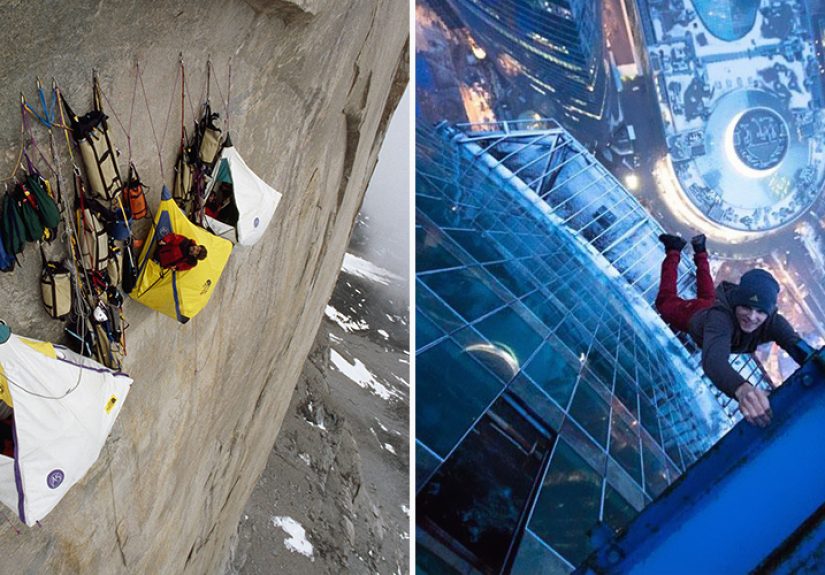
A person seated on a building edge, sneakers hovering over a city grid. The composition is simpleedge, drop, skylineyet your stomach flips because your eyes understand distance instantly. Even if the subject is safe, the image weaponizes perspective.
-
3) Standing on a Crane Like It’s a Viewing Platform
Cranes exist to move steel, not to become your personal Instagram balcony. Photos taken from a boom or counterweight feel terrifying because they’re “industrial height,” not “scenic height”no guardrails, no design for visitors, just open air and consequences.
-
4) Window-Washer Suspended Over a Glass Canyon
A worker hanging by lines beside a mirror-like skyscraper façade, tiny against a wall of glass. The photo is scary because it’s real-life exposure: wind, vertigo, and the knowledge that someone’s full-time job includes dangling over traffic like a human ornament.
-
5) The “One Hand on the Ledge” Portrait
The subject grips a rooftop lip with one hand while the other handbecause the internet demands dramawaves or holds a phone. Your brain hates this because the pose looks improvised. Improvised and high up is a combo nobody should ever romanticize.
-
6) Free-Solo Climber on a Blank Wall
A climber on a sheer face with no visible rope is the purest form of “don’t blink.” The photo’s tension comes from the absence of safety cues. When you can’t spot protection, your mind fills in the worst-case scenario.
-
7) A Hand Jam Above a Thousand Feet of Air
Crack climbing photos can look oddly calmjust hands and stoneuntil the camera pulls wide and reveals the void. The contrast between the tiny technical move and the massive drop is what makes your heartbeat do parkour.
-
8) The “Mid-Fall” Climbing Shot
A climber peeled off the wall, body arcing, chalk dust floating like snow. In many cases, a rope and belayer are doing their jobs off-camerayet the moment still feels primal because falling is a universal language.
-
9) Ice Climber With Shards Flying
An ice tool bite, a boot kick, and suddenly the frame is full of exploding crystals. Ice climbing photos look extra violent because the surface is literally breaking as the athlete ascends. It’s beautifullike climbing inside a shattered chandelier.
-
10) The Knife-Edge Ridgeline Traverse
One ridge, two drop-offs, and a person moving across it like they misplaced their fear. These photos terrify because there’s no “safe side.” The ridge is the whole decision.
-
11) BASE Jumper at the Step-Off
The most stomach-dropping moment isn’t the flightit’s the pause before the leap. Photos capturing the step-off freeze the exact instant when the body commits and the brain has no take-backs button.
-
12) Wingsuit “Proximity” Lines Along a Cliff
Wingsuits are already intense. Shots that appear to skim rock faces add a new layer: speed plus closeness. Even in controlled settings, the margin is thin enough to make a viewer physically recoil.
-
13) Paraglider Above a Volcano Landscape
A tiny canopy floating over black lava fields and vents feels surreallike a postcard from another planet that also happens to be trying to kill you. Volcano terrain reads as unstable even when you’re far away, so the air shot amplifies the drama.
-
14) Skydivers in Formation Over an Endless Drop
A perfect circle of bodies above cloud tops looks joyful… until you remember the context is “freefall.” The fear is less about impact (parachutes exist) and more about the sheer scale of the void.
-
15) The “Tiny Human, Huge Storm” Aerial Photo
A balloon or aircraft near towering storm clouds makes nature feel like a living wall. These images spike your heart because storms imply sudden changewind shear, lightning, and that unsettling sense of being outvoted by weather.
-
16) Big-Wave Surfer Dropping Down a Mountain of Water
The wave face looks like a moving building. Photos capture the moment the surfer commits to gravity on a surface that’s trying to fold over itself. Water seems soft until it’s moving like a freight train.
-
17) Kayaker at the Lip of a Waterfall
The kayak hangs on the edge, river rushing under the bow. It’s suspense in one frame: either a clean line… or a violent reminder that “downstream” can be a cliff.
-
18) Cliff Diver Into a Narrow Slot
A silhouette midair above a tiny ribbon of water, rock walls closing in. These photos feel so dangerous because the landing zone looks like a coin slotprecision required, consequences guaranteed.
-
19) A Swimmer Face-to-Face With a Massive Predator
Sharks, alligators, big catsany wildlife “close encounter” photo triggers instinct. Even when experts and safety protocols are involved, the viewer’s brain sees teeth and chooses panic.
-
20) Storm Chaser Beneath a Rotating Sky
A person standing near a road while a tornado-shaped cloud structure builds behind them. The danger isn’t just windit’s unpredictability. Your eyes can’t calculate “safe distance” from something that doesn’t RSVP.
-
21) Downhill Mountain Bike on a Ridge No Wider Than a Desk
Bikes at speed feel risky on flat ground. Put that speed on a cliff-side ribbon of dirt and the photo becomes a logic puzzle your body refuses to solve: “Where is the margin for error?” Answer: “Not in the picture.”
-
22) Motocross Jump With a Horizon for a Landing
A rider suspended over a gap so large the landing can’t even be seen in the frame. The photo is terrifying because your brain can’t finish the trajectory; it just imagines gravity finishing it instead.
-
23) Parkour Between Rooftops
A body stretched mid-leap between buildings. The athleticism is real; the risk is that the environment is not a gym. Concrete does not spot you. Photos like this feel like watching someone bet their future on friction.
-
24) “Train Surfing” or Transit Stunt Photos
These images are less “thrill” and more “please don’t.” They’re frightening because the hazard is mechanical and unforgiving: moving parts, electrical systems, and speed. If the photo looks illegal, it probably isand that’s not edgy, it’s expensive.
-
25) Skater on a Rooftop Gap With No Runoff
A skateboard trick above street level turns a normal fall into a major injury. The photo’s tension comes from the lack of a recovery zone: no grass, no padding, no “oops.” Just hard geometry.
-
26) Firefighter Emerging From a Wall of Smoke
A silhouette in turnout gear framed by orange flame and swirling ash. These photos are terrifying because the danger is invisible: heat, toxic gases, structural collapse. The heroism is realand so is the risk.
-
27) Utility Line Worker on a Tower in the Wind
A worker clipped in high above the ground, power lines stretching into the distance. It’s “death-defying” because the threats stack: height, weather, and electricity. It’s also a reminder that some of the scariest photos aren’t stuntsthey’re Tuesday.
-
28) Photographer Near Flowing Lava (From a Safe Distance)
Lava photos feel apocalyptic: glowing rivers, dark rock, heat shimmer. Even when taken from approved overlooks, the imagery screams danger because it’s literally Earth’s insides outside.
-
29) Skier or Snowboarder on an Avalanche-Prone Face
One perfect slope can hide unstable layers. Photos of riders cutting across steep snow look sereneuntil you remember the mountain can move. The quiet is part of the fear.
-
30) The “One Wrong Step” Cliff-Edge Tourist Shot
This is the most common and most preventable category: people stepping too close to cliff edges for a photo. The frame often looks harmlessuntil you realize loose sand, wet stone, or distraction can turn “vacation memory” into a rescue call.
What These Photos Reveal About Real Risk (Not Just the Vibes)
Heights + Distraction Is a Predictable Recipe
Many “heart-skip” images combine two things that don’t play well together: elevation and divided attention. Cameras narrow focus. Phones encourage awkward body positions. And the most dramatic angles often require backing upsometimes toward the one place you should never casually back up: an edge. Park rangers have been blunt about this for years: stay back from cliff edges, especially when using cameras or binoculars.
Viral Proof Can Warp Judgment
Dangerous selfies aren’t just a memethey’re a documented pattern. Research reviews of selfie-related fatalities and incidents repeatedly point to falls from height as a leading mechanism, with water and transportation also appearing frequently. In plain English: the most common way to “win” a risky photo is to lose your footing.
Some Risks Are Also Risks to Rescuers
When people do illegal jumps or stunts in restricted areas, it’s not only about the person in the photo. Rescues can expose responders to hazardous terrain and unnecessary danger. That’s why agencies take a hard line on certain activities in certain placesbecause the consequences ripple.
How Pros Get the Shot Without Becoming the Headline
Professional photographers and crews (in sports, construction, and documentary work) typically treat “cool angle” as the last step, not the first. The first step is safety: permits, site assessments, redundant systems, trained personnel, weather checks, and clear boundaries on where people can stand.
Fall protection is boring on purpose
Safety rules may not go viral, but they keep people alive. In workplaces, fall protection standards often kick in at relatively modest heights because the human body is fragile and gravity is consistent. Real professionals plan for slip hazards, swing hazards, and anchor strengthbecause “I’ll be careful” is not a system.
The best crews plan for the “stupid moment”
The “stupid moment” is the split-second when someone’s brain drifts: checking a screen, turning to talk, stepping backward, laughing, adjusting a strap. Good planning assumes that moment will happen and builds layers to keep it from becoming the last moment.
The Ethics of “Exposure Porn” (And Why It’s Not Always Brave)
Some death-defying photos document legitimate achievementexpeditions, professional sports, critical work, or historical moments. Others are pure attention economics: risk as content. If the shot requires breaking into a site, ignoring closures, or putting others at risk, it’s not “edgy.” It’s selfish with a filter.
A useful litmus test: if the photo encourages copycats who don’t have the training, permissions, or safety systems, the image isn’t just dramaticit’s contagious. And contagious risk is still risk.
Conclusion: Keep the Thrill in the Frame
Death-defying photos hit hard because they compress high stakes into a single rectangle: height, speed, uncertainty, and the fragile confidence of a human body doing something that looks impossible. But the best way to enjoy these images is the safest: with your feet on stable ground, your curiosity turned on, and your imitation turned off.
Let the photos make your heart skip a beat. Just don’t let them convince you that your life needs to.
Extra: of Heart-in-Throat Experiences You Might Recognize
You don’t have to dangle from a skyscraper to understand why these images feel personal. Your body has a memory for dangereven secondhand dangerand photos are incredibly good at poking that memory with a sharp stick. Think about the last time you stood at a scenic overlook. You were safe, probably behind a railing or at least on solid rock, but your toes still curled slightly in your shoes. You may have leaned forward for a better view, then instantly leaned back, as if your spine had its own opinions. That’s your balance system running a quiet background calculation: “How close is too close?”
Now add a phone. Suddenly you’re not just lookingyou’re composing. Your eyes stop scanning the ground and start scanning the screen. You rotate your body a few degrees for better light. You take a half-step to get the horizon straight. And that’s when the weird thing happens: the world becomes less real than the photo you’re trying to make. It’s not stupidity; it’s tunnel vision. Cameras reward narrow focus, and narrow focus is exactly what edges punish. It’s why a cliff can feel stable until the moment you move without thinking.
Or picture a different scene: driving on a mountain road while someone in the passenger seat says, “Pull over right herethis view is insane.” You stop, step out, and the wind hits you with that cold, clean slap that only high places deliver. The shoulder is narrower than you expected. The ground drops away faster than your brain wants to admit. Even if you’re ten feet from the edge, your knees tighten as if they’re bracing for negotiation. That’s the same involuntary reaction you get from a death-defying photoyour body rehearsing “what if.”
The most intense images don’t just show danger; they suggest a tiny mistake. The hand that could slip. The loose gravel that could roll. The gust that could show up uninvited. Your mind fills in the missing motion, and you feel it like a phantom stumble. That’s why you sometimes grimace at a photo without knowing you’re doing it. You’re not reacting to the person in the frame. You’re reacting to the version of you your brain imagines in that spotand how quickly it could go wrong.
And yet, there’s a strange admiration mixed in. The best death-defying photos also show focus: a climber’s calm posture, a surfer’s commitment, a worker’s practiced stance, a rescuer moving with purpose. In those moments, the photo becomes less about flirting with disaster and more about the human capacity to concentrate under pressure. That’s the healthiest way to consume these images: not as dares, but as reminders. The world is big, physics is real, and courage is most impressive when it’s paired with good judgment.