Table of Contents >> Show >> Hide
- 27 fictional universe stats that are almost suspiciously large
- 1. The Marvel machine crossed the $30 billion box office mark
- 2. Marvel has produced 10 billion-dollar movies
- 3. Marvel had 33 straight No. 1 domestic openings before its next leap
- 4. Avengers: Endgame opened with $1.209 billion worldwide
- 5. Endgame still leads the MCU’s domestic chart with $858.4 million
- 6. Spider-Man: No Way Home still managed $804.8 million domestically
- 7. Star Wars: The Force Awakens blasted to $936.7 million domestic
- 8. The Last Jedi still pulled in $620.2 million domestic
- 9. Rogue One proved a spinoff can still feel gigantic with $532.2 million domestic
- 10. The Force Awakens soared to $2.071 billion worldwide
- 11. The Harry Potter books have sold more than 600 million copies worldwide
- 12. More than 230 million Harry Potter books have sold in the United States alone
- 13. The series has been published in 85 languages
- 14. Deathly Hallows: Part 2 leads the Potter films domestically at $381 million
- 15. Sorcerer’s Stone nearly hit $975 million worldwide in its original release
- 16. The Lord of the Rings has sold more than 150 million copies
- 17. The Avatar franchise has passed $6.35 billion worldwide
- 18. Avatar: Fire and Ash crossed $1.083 billion
- 19. Avatar: The Way of Water reached $2.3 billion
- 20. Pokémon is estimated to have generated $147 billion
- 21. Mario Kart 8 Deluxe sold 70.59 million copies
- 22. The Legend of Zelda: Breath of the Wild sold 33.64 million copies
- 23. Super Mario Odyssey moved 30.27 million copies
- 24. The Simpsons launched a 24/7 stream with 767 episodes
- 25. Disney+ now lists 37 seasons of The Simpsons
- 26. Fox has already labeled an 800th episode
- 27. Wednesday and Stranger Things turned spooky universes into streaming giants
- What these fictional universe stats actually tell us
- Experiences that make fictional universes feel bigger than stats
- Conclusion
- SEO Tags
Fictional universes used to be places we visited for a few hours, closed the book, and politely returned to reality. Now they are industrial-sized ecosystems with movies, spinoffs, games, streaming charts, fan theories, theme park energy, and enough lore to make a family tree look like a sticky note. In other words, these worlds are not just popular. They are enormous, persistent, and a little greedy with our attention.
This roundup pulls together some of the most eyebrow-raising numbers behind the biggest fictional universes in entertainment. Some of these stats measure box office dominance. Others show book sales, game units, or streaming power. Together, they reveal the same thing: imaginary places are doing very real business.
27 fictional universe stats that are almost suspiciously large
1. The Marvel machine crossed the $30 billion box office mark
The Marvel Cinematic Universe did not simply become successful. It became a gravitational force. Marvel Studios crossed $30 billion at the worldwide box office, which is the kind of number that makes ordinary blockbuster math curl up in a corner and rethink its life choices. That figure helps explain why the MCU became the template every studio wanted, even when the copycats forgot the part about having Iron Man.
2. Marvel has produced 10 billion-dollar movies
Getting one movie past $1 billion is a career highlight. Doing it 10 times is franchise empire behavior. Marvel has also pushed two films beyond $2 billion globally, proving that this universe is not powered by gamma rays alone. It is also fueled by repeat viewings, post-credit scenes, and a fan base that treats release weekends like national holidays.
3. Marvel had 33 straight No. 1 domestic openings before its next leap
At one point, every one of Marvel Studios’ first 33 feature films opened at No. 1 domestically. That is not just consistency. That is industrial-grade consistency. It means the MCU spent years turning opening weekend into its own private parade route.
4. Avengers: Endgame opened with $1.209 billion worldwide
Yes, that was the opening. Not the final total. The opening. Avengers: Endgame launched with an estimated $1.209 billion globally, becoming the first movie ever to clear $1 billion in its opening weekend. It also crossed the billion-dollar mark in just five days. That was less “release strategy” and more “pop culture detonation.”
5. Endgame still leads the MCU’s domestic chart with $858.4 million
Even within a universe stuffed with hits, Endgame remains the domestic king at roughly $858.4 million. That number matters because domestic box office is often the clearest snapshot of how deeply a franchise has embedded itself in the American moviegoing habit. In plain English: people showed up, then told other people to show up, then probably showed up again.
6. Spider-Man: No Way Home still managed $804.8 million domestically
The MCU’s second-place domestic earner is Spider-Man: No Way Home with about $804.8 million. Nostalgia, multiverse chaos, and the cinematic equivalent of a group hug turned this movie into a generational event. It was not just a superhero film. It was a collective “you had to be there” moment.
7. Star Wars: The Force Awakens blasted to $936.7 million domestic
Star Wars does not merely return. It arrives with trumpets. The Force Awakens remains the top domestic earner in the franchise at roughly $936.7 million, a reminder that when the galaxy far, far away came back in 2015, audiences treated it like a homecoming and a coronation rolled into one.
8. The Last Jedi still pulled in $620.2 million domestic
Love it, debate it, write a 14-post thread about it, The Last Jedi still brought in about $620.2 million domestically. That is the thing about giant fictional universes: even the entries that divide fans can still tower over the rest of the industry.
9. Rogue One proved a spinoff can still feel gigantic with $532.2 million domestic
Standalone stories are supposed to be the side dishes. Rogue One refused that assignment and delivered about $532.2 million domestically. It showed that Star Wars had reached the point where side stories could behave like main events.
10. The Force Awakens soared to $2.071 billion worldwide
Its worldwide haul of roughly $2.071 billion put The Force Awakens into rarefied air. That kind of total is not just about brand recognition. It signals that a fictional universe has become a cross-generational meeting place, where longtime fans, casual viewers, and brand-new converts all buy tickets to the same myth.
11. The Harry Potter books have sold more than 600 million copies worldwide
Some fictional universes become cultural landmarks on screen. Harry Potter did it first on the page. More than 600 million copies sold worldwide means Hogwarts is not just a school in a story. It is practically a citizenship test for modern pop culture.
12. More than 230 million Harry Potter books have sold in the United States alone
The U.S. share of that total is over 230 million copies, which is a jaw-dropping reminder that this franchise did not simply attract readers. It trained generations to queue up for midnight releases, argue over houses, and believe that a train platform could be emotionally important.
13. The series has been published in 85 languages
When a fictional universe works in 85 languages, it has clearly escaped the limits of local fandom. It becomes something bigger: a global symbolic system. Also, it becomes very hard to insist you are “not really a fantasy person” when half the planet appears to know what a Horcrux is.
14. Deathly Hallows: Part 2 leads the Potter films domestically at $381 million
The top domestic earner in the franchise is Harry Potter and the Deathly Hallows: Part 2 at about $381 million. That makes perfect emotional sense. After a decade of buildup, audiences were not going to miss graduation day for wizard trauma.
15. Sorcerer’s Stone nearly hit $975 million worldwide in its original release
The first Potter film’s original theatrical rollout reached about $974.8 million worldwide. That matters because it shows how quickly the world recognized that this was not a one-hit wonder. Hogwarts arrived as a destination franchise from the beginning.
16. The Lord of the Rings has sold more than 150 million copies
Middle-earth remains one of fantasy’s most durable addresses. More than 150 million copies sold means Tolkien’s world did not just influence modern fantasy. It more or less built the neighborhood, zoned the streets, and handed later franchises the map.
17. The Avatar franchise has passed $6.35 billion worldwide
Pandora has become one of the most lucrative fictional settings ever created. With three films delivering more than $6.35 billion combined at the global box office, Avatar has turned immersive world-building into a box office superpower. Say what you want about blue aliens; they absolutely know how to sell tickets.
18. Avatar: Fire and Ash crossed $1.083 billion
The third film, Avatar: Fire and Ash, climbed past $1.083 billion globally, including $777.1 million from international markets. That overseas share is a reminder that some fictional universes are not merely popular in America. They are practically a world language.
19. Avatar: The Way of Water reached $2.3 billion
Disney described Avatar: The Way of Water as a $2.3 billion theatrical phenomenon and the third highest-grossing film of all time. At that level, the franchise is no longer proving viability. It is demonstrating that cinematic world-building can function like a global event business.
20. Pokémon is estimated to have generated $147 billion
If you ever suspected Pokémon was quietly running the world economy from a backpack, the numbers will not calm you down. Guinness World Records estimates the franchise at $147 billion as of April 2024, making it the best-selling media franchise on record. That is not a hobby. That is a continent.
21. Mario Kart 8 Deluxe sold 70.59 million copies
The Mushroom Kingdom does not need a cape to dominate. Mario Kart 8 Deluxe has sold 70.59 million units, which is absurdly high for a game that is, at its core, about cheerful sabotage with shells. It is one of the clearest examples of a fictional universe thriving through replayability, social play, and character familiarity.
22. The Legend of Zelda: Breath of the Wild sold 33.64 million copies
Hyrule’s modern benchmark is Breath of the Wild at 33.64 million units sold. What makes that stat especially telling is that Zelda has long been treated as a prestige game universe rather than a mass-market frenzy. This title proved it could be both.
23. Super Mario Odyssey moved 30.27 million copies
Super Mario Odyssey reached 30.27 million units sold, which tells you something important about legacy universes: freshness matters, but familiarity is gold. Mario keeps evolving just enough to feel current while still looking like someone who would absolutely help you fix a sink and then jump on a turtle.
24. The Simpsons launched a 24/7 stream with 767 episodes
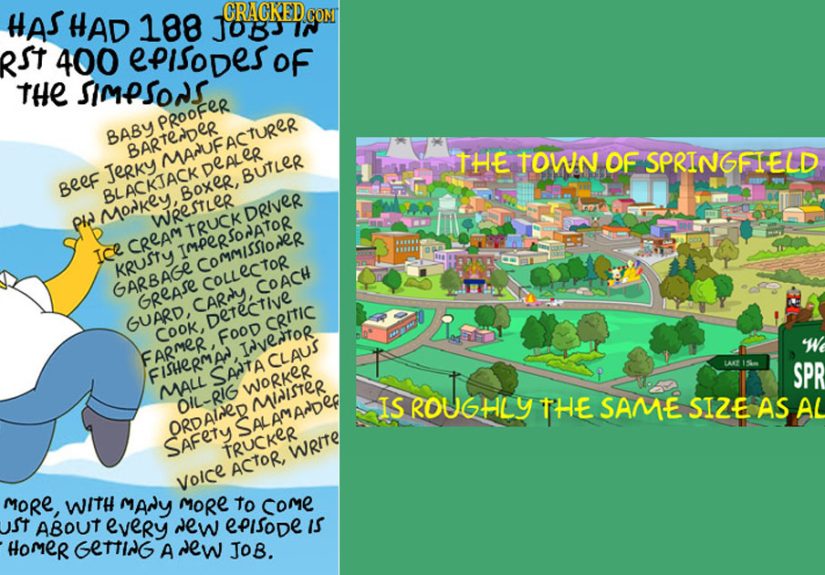
Springfield has become less of a TV setting and more of a broadcast ecosystem. Disney+ launched a 24/7 Simpsons stream with 767 episodes from seasons 1 through 35, totaling nearly 300 continuous hours. That is not bingeing. That is residency.
25. Disney+ now lists 37 seasons of The Simpsons
Yes, 37 seasons. Most shows are thrilled to make it to syndication. The Simpsons became a multi-decade fictional universe with enough continuity, parody, and cultural memory to outlast entire genres, hairstyles, and presidential administrations.
26. Fox has already labeled an 800th episode
In February 2026, Fox labeled “Irrational Treasure” as the show’s 800th episode. That kind of longevity changes the scale of the conversation. Springfield is no longer just a setting. It is one of television’s longest-running shared realities, sustained by pure cartoon stubbornness.
27. Wednesday and Stranger Things turned spooky universes into streaming giants
Wednesday Season 1 became Netflix’s most popular English-language TV series, spending 20 weeks in the Global Top 10, reaching the Top 10 in 93 countries, and landing 252.1 million views. Meanwhile, Stranger Things 4 reached 140.7 million views and 1.838 billion hours viewed in its first 91 days. In other words, eerie fictional worlds are not niche anymore. They are mainstream appointment viewing with monster-sized numbers.
What these fictional universe stats actually tell us
The big takeaway is not simply that franchise entertainment is huge. We already knew that. The more interesting point is how these fictional universes scale. They grow in layers. Books become films. Films become streaming libraries. Games become evergreen sellers. TV worlds become comfort viewing, meme factories, and algorithm darlings all at once.
Another pattern jumps out: the strongest fictional universes are not just big. They are flexible. Marvel can do cosmic spectacle and family dysfunction. Star Wars can support saga entries and side missions. Pokémon can live in games, cards, toys, animation, and merchandise without looking confused. These worlds do not survive by repeating themselves forever. They survive by letting fans enter through different doors.
And then there is the emotional angle. People do not just consume fictional universes because the numbers are huge. The numbers are huge because these universes become rituals. Families pass them down. Friends debate them. Online communities stretch them into daily conversation. The fictional map becomes social glue.
Experiences that make fictional universes feel bigger than stats
Here is the funny thing about fictional universe stats: no matter how enormous the numbers get, they still do not fully capture the lived experience of being a fan. Numbers can tell you that a franchise made billions, sold millions, or dominated a streaming chart. What they cannot fully explain is the strange, delightful feeling of letting an imaginary place move into your real life and quietly redecorate the furniture.
Anyone who has spent time inside a giant fictional universe knows the sensation. You begin casually. Maybe you watch one movie because everyone at school, work, or online will not stop talking about it. Then suddenly you are looking up timelines, asking whether release order or chronological order is better, and learning that “quick recap” is a phrase with no meaning in fandom. Three hours later, you are deep in lore and somehow emotionally invested in a side character with fourteen minutes of screen time.
That experience is part of what makes fictional universes so sticky. They are not just stories. They are environments. A good universe gives you the sense that life continues offscreen, off-page, and between installments. There are roads you have not traveled, creatures you have not met, and politics you did not mean to learn but now somehow understand. This creates a rare kind of audience relationship: the pleasure of returning, not just watching.
There is also the communal experience. Huge fictional universes are one of the last places where mass pop culture still feels genuinely collective. You line up for opening night. You avoid spoilers like you are dodging laser fire. You text friends in all caps. You trade theories, rank entries, and pretend your rankings are objective scholarship instead of emotional weather reports. The fun is not just in the content. It is in the shared anticipation and post-release chaos.
For longtime fans, these universes often become memory machines. People remember who they watched with, where they were, and what stage of life they were in when a major book, game, or season landed. A franchise becomes a timeline marker. “That was the summer I got into Harry Potter.” “That was the year I played Breath of the Wild nonstop.” “That was the opening weekend we all lost our minds during Endgame.” The fictional universe becomes a filing system for real emotions.
There is a comfort factor too. Returning to a familiar universe can feel like revisiting a city you know well enough to stop checking the map. You understand the tone. You know the rules. You recognize the music, the symbols, the architecture, even the kind of joke that world likes to make. In a chaotic media landscape, that familiarity has value. It lowers the barrier to re-entry and makes fans more willing to spend time there again and again.
Of course, there is a downside. Big fictional universes can become so sprawling that keeping up starts to feel like unpaid internship work. There are watch orders, side quests, canon debates, prequels explaining prequels, and enough bonus content to make a normal person whisper, “Maybe I will just read the Wikipedia summary and lie.” That fatigue is real. But even that says something powerful: these worlds have grown so dense that audiences now experience them less like single stories and more like ongoing cultural landscapes.
Ultimately, that is why the stats matter. They are not just measurements of revenue or reach. They are signs that fictional universes have become a major way modern audiences organize entertainment, identity, and shared experience. We do not only visit these worlds anymore. We carry them around, quote them, compare them, and use them to connect with other people. The universes may be fictional. The attachment definitely is not.
Conclusion
The biggest fictional universes are not successful by accident. They combine scale, flexibility, emotional loyalty, and repeatability in a way few standalone stories ever can. Whether the numbers come from movie tickets, book sales, game units, or streaming views, the same truth keeps showing up: when a world is vivid enough, audiences do not just visit it. They move in, decorate the place, and invite friends.
That is why these 27 eyebrow-arching stats matter. They are not random trivia for your next group chat, although they will absolutely improve your group chat. They reveal how fictional universes have become one of the defining engines of modern entertainment. From Hogwarts to Hyrule, from Springfield to Pandora, imaginary places are delivering very real results.