Table of Contents >> Show >> Hide
- Why “Killer Toys” Are a Real Thing (and Not Just a Horror-Movie Plot)
- 25 Random Bits of “Killer Toy” Trivia
- 1) Lawn darts were literally bannedand the ban came with a blunt message: destroy them.
- 2) The lawn dart ban has an actual date stampDecember 19, 1988.
- 3) Clacker balls had so many shattering issues they ended up regulated.
- 4) A flying doll was recalled after reports of scratched corneas and even temporary blindness.
- 5) Not every scary-sounding hazard becomes a recallYo-Yo Water Ball toys are a famous example.
- 6) Easy-Bake Ovens were recalled because kids could get hands stuckand burned.
- 7) Aqua Dots weren’t just a choking issuekids became unconscious after swallowing the beads.
- 8) The chemistry behind Aqua Dots is a trivia mic-drop (and a safety nightmare).
- 9) In 2007, magnet-related recalls hit big-name toys in massive numbers.
- 10) Buckyballs sets contained 216 rare earth magnetssmall, shiny, and way stronger than they look.
- 11) Swallowing multiple high-powered magnets can cause holes in the stomach or intestines.
- 12) Water beads can expand inside the bodyso the hazard isn’t just choking.
- 13) CPSC data showed thousands of U.S. ER visits tied to water bead ingestion injuries (2018–2022).
- 14) Major retailers began pulling water beads marketed to kids as safety concerns grew.
- 15) In 2025, CPSC approved a federal safety standard specifically aimed at water bead toys.
- 16) Button batteries are the “silent boss level” of toy safety.
- 17) Yes, there are toy recalls in 2026 for button battery accessright now.
- 18) U.S. law uses a “small parts cylinder” to define what counts as a choking hazard for under-3s.
- 19) Balloons are a top non-food choking hazardespecially uninflated balloons.
- 20) Strangulation hazards don’t only come from cordssometimes it’s a hook on a play kitchen.
- 21) Some toy recalls are about “age grading,” not just the toy itself.
- 22) Pull-string teething toys can be recalled if the strings are small enough to lodge in a child’s throat.
- 23) Lead paint violations still show up in toy recallseven in major brands.
- 24) Toy jewelry has been recalled for exceeding the total lead limit (think: metal connectors and charms).
- 25) The toy safety rulebook has a name: ASTM F963and it’s mandatory in the U.S.
- Quick “Killer Toy” Red Flags (So You Can Enjoy Trivia Without Panic)
- Conclusion: The Real “Killer” Move Is Knowing the Patterns
- Extra: 5 “Killer Toy” Experiences That Feel Weirdly Universal (About )
Some toys are “killer” because they’re so fun they wipe out boredom on contact. Others are “killer” because… well, the Consumer Product Safety Commission had to get involved.
This article is a fact-based (and slightly cheeky) tour through dangerous toys, famous toy recalls, and the surprisingly nerdy world of toy safety standards.
Nobody’s here to ruin playtimejust to make sure it doesn’t bite back.
Why “Killer Toys” Are a Real Thing (and Not Just a Horror-Movie Plot)
In the U.S., toy hazards tend to fall into a few repeat-offender categories: sharp points, projectiles, small parts (aka choking hazards), cords/straps (strangulation hazards),
chemicals (lead, certain plasticizers, or weird “why is that in there?” ingredients), and “tiny power sources with a big attitude” (hello, button batteries).
The good news: today’s toy industry is heavily regulated, testing is stricter than ever, and recalls are public.
25 Random Bits of “Killer Toy” Trivia
1) Lawn darts were literally bannedand the ban came with a blunt message: destroy them.
Lawn darts (often sold as “Jarts”) were heavy, pointy projectiles marketed as a backyard game. The U.S. government ultimately banned their sale, and later re-issued warnings
reminding families that old sets are still dangerous and should be thrown awaynot donated, not “saved for summer,” not “for the cool uncle.”
2) The lawn dart ban has an actual date stampDecember 19, 1988.
If you love trivia with receipts, this one’s for you: the sale of lawn darts in the United States was banned effective December 19, 1988.
Which means any “vintage set” is vintage danger, too.
3) Clacker balls had so many shattering issues they ended up regulated.
Clackers (those two hard balls on a string you smack together) became famous for sending fragments flying like tiny plastic meteors.
CPSC action and durability requirements followedbecause “my toy exploded” is not a whimsical childhood memory.
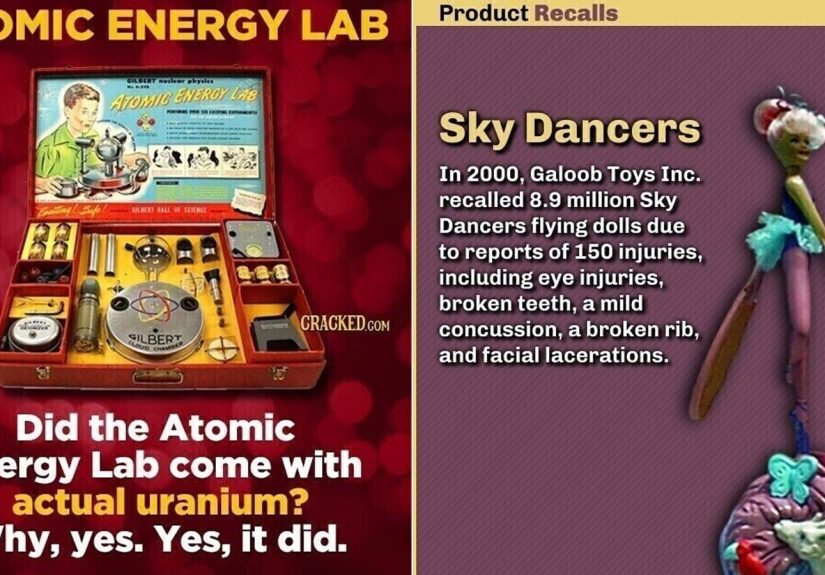
4) A flying doll was recalled after reports of scratched corneas and even temporary blindness.
The Sky Dancers recall reads like a cartoon that forgot it had to obey physics. Reports described the dolls flying in unpredictable directions and striking faces.
Injuries ranged from eye damage to broken teeth and facial lacerationsproof that “whirling plastic wings” is not a neutral design choice.
5) Not every scary-sounding hazard becomes a recallYo-Yo Water Ball toys are a famous example.
Yo-Yo Water Ball toys sparked strangulation fears and public pressure. CPSC staff investigated and concluded the product posed a low risk based on the information available at the time,
and it did not meet the standard for a recallan underrated lesson in how risk is evaluated.
6) Easy-Bake Ovens were recalled because kids could get hands stuckand burned.
The wholesome idea (tiny cakes!) met a not-so-wholesome reality (tiny fingers!). A major Easy-Bake recall warned that children could insert hands into the opening, get them caught,
and suffer burnsturning “snack time” into “bandage time.”
7) Aqua Dots weren’t just a choking issuekids became unconscious after swallowing the beads.
Aqua Dots were a popular craft toy with small beads that fuse together. The recall notice didn’t mince words: children became unconscious after swallowing beads,
which is wildly outside the normal “toy risk” vibe.
8) The chemistry behind Aqua Dots is a trivia mic-drop (and a safety nightmare).
Investigations reported that the beads contained a chemical that can metabolize into GHB in the body, explaining severe symptoms like unconsciousness.
It’s one of those stories that makes you appreciate boring, well-tested ingredients.
9) In 2007, magnet-related recalls hit big-name toys in massive numbers.
Tiny magnets became a major hazard when they detached and could be swallowed. High-powered magnets can attract through tissue, creating internal damage.
Several major 2007 recalls involved dolls and play sets with magnetsan era that made “magnet inside” a sentence that parents now side-eye.
10) Buckyballs sets contained 216 rare earth magnetssmall, shiny, and way stronger than they look.
Buckyballs were marketed as a desk-toy/building set, but the magnets were powerful and small enough to swallow.
The risk isn’t “one magnet,” it’s “two or more,” because that’s when they can clamp together inside the body.
11) Swallowing multiple high-powered magnets can cause holes in the stomach or intestines.
This is the key “why it’s different” fact: multiple magnets can attract through intestinal walls, causing perforations, blockages, infection, and worse.
It’s the rare toy hazard where the physics is the villain.
12) Water beads can expand inside the bodyso the hazard isn’t just choking.
Water beads (superabsorbent polymer balls) are designed to grow dramatically in water. If swallowed, they can expand and cause internal obstruction.
CPSC warnings also highlight that hazards can extend beyond simple expansion.
13) CPSC data showed thousands of U.S. ER visits tied to water bead ingestion injuries (2018–2022).
Water beads aren’t a niche issue. CPSC reported nearly 7,000 water bead-related ingestion injuries treated in emergency departments from 2018 through 2022,
plus awareness of a child death reported in 2023sobering stats for something sold as “sensory play.”
14) Major retailers began pulling water beads marketed to kids as safety concerns grew.
Retail policies shifted as injuries and warnings gained attention. Several major sellers announced restrictions or removals of water beads marketed for children,
showing how safety debates can change shelves even before new rules take effect.
15) In 2025, CPSC approved a federal safety standard specifically aimed at water bead toys.
Water beads became enough of a public hazard that regulators moved toward a dedicated consumer product safety standard.
That’s a big dealmost toy hazards get handled under broader toy rules, not a category spotlight.
16) Button batteries are the “silent boss level” of toy safety.
Button/coin batteries can cause severe internal chemical burns if swallowed. Recent CPSC recalls repeatedly cite battery compartments that are too easy for children to access,
turning a simple light-up toy into a medical emergency.
17) Yes, there are toy recalls in 2026 for button battery accessright now.
CPSC continues issuing recalls where toy battery compartments fail mandatory standards. The pattern is consistent: a compartment door that pops open without a tool,
missing warnings, or bothproblems that shouldn’t exist in modern children’s products.
18) U.S. law uses a “small parts cylinder” to define what counts as a choking hazard for under-3s.
There’s an actual test device: if a part fits entirely into the cylinder (without compressing it, and in any orientation), it’s considered a “small part.”
It’s basically the least fun toy “cup challenge” everbut it saves lives.
19) Balloons are a top non-food choking hazardespecially uninflated balloons.
Balloons show up again and again in choking prevention guidance because latex can form a tight seal in the airway.
The extra-tricky moment is when kids try to inflate balloons and accidentally inhale them.
20) Strangulation hazards don’t only come from cordssometimes it’s a hook on a play kitchen.
A KidKraft play kitchen recall focused on hooks used to hold toy accessories. A tragic incident report involved clothing getting caught on a hook,
demonstrating how hazards can come from “normal-looking” features, not just obvious strings.
21) Some toy recalls are about “age grading,” not just the toy itself.
A toy can be marketed for age 3+ and still be considered too risky for younger kids who are likely to use it. In at least one recall, CPSC staff designated the toy
for toddlers based on play patternsbecause real households do not enforce packaging recommendations with courtroom precision.
22) Pull-string teething toys can be recalled if the strings are small enough to lodge in a child’s throat.
Some recent teething toy recalls cite silicone strings that are smaller than permitted and can reach the back of the throat.
That’s a different kind of “small parts” hazardless “it breaks off,” more “it was designed that way.”
23) Lead paint violations still show up in toy recallseven in major brands.
Lead is toxic, and federal limits apply to children’s products. CPSC recall notices have documented toys with surface paints containing excessive lead,
leading to replacement or refund remedies and a lot of very unhappy parents.
24) Toy jewelry has been recalled for exceeding the total lead limit (think: metal connectors and charms).
It’s not always paintsometimes it’s a metal component. A recall for children’s toy jewelry cited a cylindrical metal connector containing total lead above the legal limit,
a reminder that “cute accessory” can still be a compliance problem.
25) The toy safety rulebook has a name: ASTM F963and it’s mandatory in the U.S.
ASTM F963 is the main toy safety standard covering many mechanical and chemical requirements. Under CPSIA, ASTM F963 became the mandatory toy standard,
and updates to the standard can also become mandatory through a federal processmeaning the rules evolve as hazards evolve.
Quick “Killer Toy” Red Flags (So You Can Enjoy Trivia Without Panic)
- Loose magnets or magnet parts that can detach.
- Accessible button batteries (no tool needed to open the compartment).
- Water beads in homes with toddlers (especially if marketed as sensory play).
- Projectile toys used without eye protection and clear safety limits.
- Strings/cords longer than you’d expect on a child product.
- Small detachable parts anywhere near kids who still mouth objects.
Conclusion: The Real “Killer” Move Is Knowing the Patterns
The trivia takeaway isn’t “toys are scary.” It’s that hazards repeat. If you recognize the usual suspectssmall parts, magnets, batteries, cords, projectiles, and questionable materials
you can spot problems fast, check recall databases, and keep playtime fun instead of frantic.
Extra: 5 “Killer Toy” Experiences That Feel Weirdly Universal (About )
1) The LEGO ambush. You’re walking through the living room at night. The lights are low. The floor is peaceful. Thenone tiny brick meets one bare foot and suddenly you’re auditioning
for an opera role called “Agony in Three Acts.” Nobody dies, but your dignity considers resigning. This is the most common “killer toy” story because it’s a perfect mix of pain, surprise, and
the haunting realization that the toy did exactly what it was engineered to do: be indestructible.
2) The Great Toy Bin Archaeological Dig. At some point, every household becomes a museum of mysteries: a plush animal with one eye, a tiny wheel that belongs to nothing you recognize,
and a battery door that looks like it was last opened during the Obama administration. You start checking for loose parts and you feel like a safety inspector with a very small flashlight. The experience
is oddly satisfyingright up until you find a magnet-shaped gap where a magnet used to be. That’s when you realize why toy recalls exist: not because parents are careless, but because kids
are incredibly talented at turning “fine” into “how did that even happen?”
3) The birthday party balloon moment. Balloons show up at celebrations like confetti with better branding. Then you catch a toddler trying to chew an uninflated balloon and suddenly
you are the fastest adult alive. The vibe goes from “cute party” to “safety lecture” in 0.3 seconds. You don’t become a killjoyyou become the hero who keeps the day fun by preventing the worst-case scenario.
4) The button-battery paranoia spiral. You buy a light-up toy that seems harmless. Then you learn what happens if a child swallows a coin battery, and you start checking every battery compartment
like it’s a bank vault. You look for screws. You test the door. You do a tiny tug. Your brain whispers, “If this opens without a tool, we’re not keeping it.” You feel dramatic, but you’re actually doing the
most reasonable thing possible: preventing a risk that’s severe, fast-moving, and unfortunately real.
5) The recall email that turns you into a detective. One day you get a product safety alert and it reads like a scavenger hunt: model number, date code, tiny text on the underside, a list of stores,
and the vague memory that you bought the thing during a holiday sale. You crawl under shelves. You check toy tags. You match numbers like you’re solving a true-crime case called “The Mystery of the Missing UPC.”
And when you find it, you feel two things at once: mildly annoyed…and weirdly proud. Because that’s the real “killer” skill in modern parenting and gifting: knowing how to verify, not just assume.