Table of Contents >> Show >> Hide
- Why Bizarre Buildings Exist (and Why They Work)
- The 25 Bizarre Buildings
- 1. The Basket House (USA)
- 2. The Crooked House (Poland)
- 3. The Castle House (Dominican Republic)
- 4. The Dog House (USA)
- 5. The Egyptian House (USA)
- 6. The “WTF” House (USA)
- 7. The Hovercraft House (USA)
- 8. The Kettle House (USA)
- 9. The UFO House (USA)
- 10. The Saxophone House (USA)
- 11. The Ship House (Croatia)
- 12. The Boot House (USA)
- 13. The Shoe House (South Africa)
- 14. Another UFO House (USA)
- 15. The Sphere House (USA)
- 16. The Thin House (UK)
- 17. The Lopsided House (Japan)
- 18. Another Dome House (Australia)
- 19. The Log House (Russia)
- 20. Palacio de las Artes (Spain)
- 21. The Mushroom House (USA)
- 22. The Bubble House (France)
- 23. The Robot Ranch (USA)
- 24. The Crazy House (Vietnam)
- 25. The Holed House (USA)
- What These Buildings Teach Us About “Normal” Architecture
- How to Visit Bizarre Buildings Without Being “That Tourist”
- of Experiences: How Weird Buildings Feel in Real Life
- Conclusion
If buildings could talk, most would politely clear their throats, recite their square footage, and ask if you’d like a tour.
The bizarre ones? They’d kick open the door wearing a giant boot, offer you tea from a house-shaped kettle, and whisper,
“You’re going to remember me forever.” That’s the sneaky superpower of weird architecture: it hijacks your brain’s
“important memory” folder without asking permission.
This is a playful, in-depth rewrite inspired by the classic “25 Bizarre Buildings” vibestructures that look like they
escaped a cartoon, a dream, or a dare between architects. Some are famous landmarks. Some are beloved local oddities.
Some are nicknamed so bluntly you can almost hear a neighbor saying it through a half-closed curtain.
Why Bizarre Buildings Exist (and Why They Work)
A “bizarre building” usually isn’t random. It’s a strategysometimes commercial, sometimes personal, sometimes artistic,
sometimes all three at once. The giant-object buildings are part of a tradition often called novelty or programmatic
architecture: the building literally becomes the sign. A basket becomes the office. A boot becomes the destination.
The structure doesn’t just contain a storyit is the story.
Another category is the “optical illusion” building: crooked, tilted, warped, too thin, too round, or too symmetrical
for comfort. These structures don’t shout “buy shoes.” They whisper “reality is optional.” They’re designed for emotional
reactionwonder, delight, confusion, and that very modern urge to take a photo immediately.
Finally, there’s outsider architecture and one-off experimentation: homes shaped by a single mind’s obsession, or
engineered to test materials, energy performance, or forms conventional houses avoid. When these buildings succeed,
they feel like a private joke you’re lucky enough to witness.
The 25 Bizarre Buildings
1. The Basket House (USA)
A corporate headquarters that decided the best logo is a building you can walk into. The famous basket-shaped office
in Ohio is seven stories tall and was designed to mimic a woven basketright down to giant “handles” that were engineered
to deal with winter ice. It’s proof that branding doesn’t have to be subtle to be effective.
2. The Crooked House (Poland)
In Sopot, the Crooked House looks like a normal building that briefly melted and then remembered it had plans. The
warped façade creates a storybook illusionpart whimsy, part “is my camera lens okay?” It’s commercial space turned into
a public mood booster, because nothing says “shopping” like gentle architectural delirium.
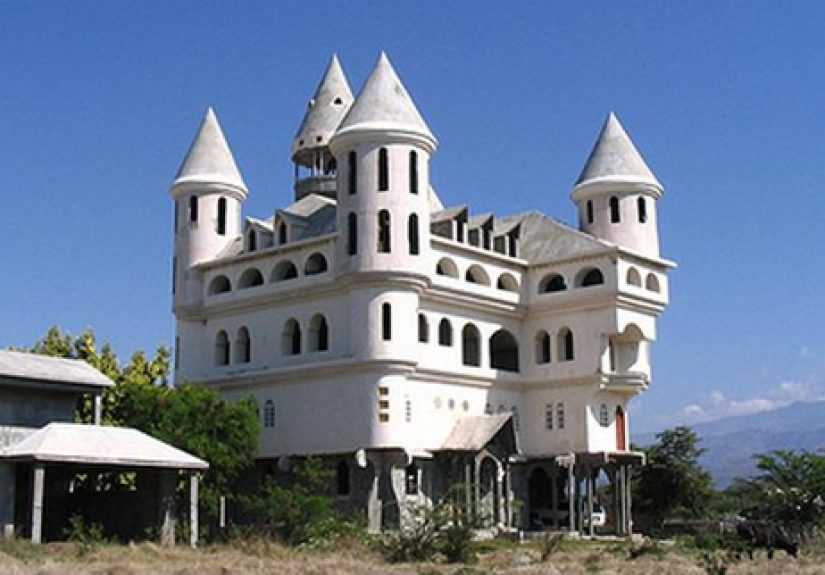
3. The Castle House (Dominican Republic)
Some people build a vacation home. Some people build a castle. The Castle House leans into medieval fantasytowers,
stonework vibes, the whole “I might host a banquet or a dramatic monologue” energy. Even when it’s modern inside, the
outside commits to the role: here be royalty (or at least really enthusiastic homeowners).
4. The Dog House (USA)
If you’ve ever joked, “I’m going to live in a doghouse,” this one takes it literally. Dog-themed structures tend to be
part folk art, part roadside landmarkdesigned to make you smile before you even know what’s inside. Architecture doesn’t
always need gravitas; sometimes it needs a wagging tail.
5. The Egyptian House (USA)
Egyptian Revival never really diesit just waits for someone bold enough to decorate their life like an ancient riddle.
This style usually brings pyramidal geometry, symbolic ornament, and “I definitely own at least one book about mysteries”
vibes. Whether it’s sincere fascination or tongue-in-cheek spectacle, it turns a neighborhood drive into a history-themed
plot twist.
6. The “WTF” House (USA)
Some homes earn their nickname honestlyno committee, no branding agency, just pure public reaction. The “WTF House”
category is for designs that seem to ignore the rules of balance and expectation: weird angles, unexpected cutouts,
surfaces that look mid-glitch. You don’t have to love it. You just have to notice it.
7. The Hovercraft House (USA)
This Albuquerque home is associated with architect Bart Prince and has collected nicknames like souvenirsHovercraft
House, Bug House, and more. It’s a sculptural take on residential form that feels aerodynamic even when it’s sitting
still, like it might gently levitate on a good day.
8. The Kettle House (USA)
Galveston’s Kettle House looks like a teapot that got tired of floating and decided to become real estate. It’s often
described as a small metal structure with a bowl-like body and a spout-like extensionan architectural oddity that locals
remember even if they can’t explain it. It’s the kind of building that makes you slow down without meaning to.
9. The UFO House (USA)
The UFO House genre is basically “mid-century futurism meets beach vibes meets ‘please don’t call it weird.’” These
homes lean into saucer shapes, circular plans, and windows that feel like spaceship portholes. Whether inspired by
sci-fi optimism or pure playful rebellion, they turn everyday living into a low-budget space opera.
10. The Saxophone House (USA)
Imagine your favorite jazz riffnow turn it into a façade. The Saxophone House in California is famous for golden,
instrument-like architectural elements and musical details that make it feel like the building is performing. It’s
unapologetically theatrical: a house that doesn’t just have character, it has a whole soundtrack.
11. The Ship House (Croatia)
A ship-shaped home is the landlocked version of saying, “I was born to sail, but I also enjoy plumbing.” These structures
often exaggerate hull lines and deck-like terraces. Even when they’re not near water, they carry a sense of motionlike
the building is still dreaming of waves.
12. The Boot House (USA)
If novelty architecture had a mascot, it might be a giant boot you can walk into. Boot-shaped buildings are classic
roadside charm: instantly readable, oddly comforting, and impossible to forget. They’re proof that a building can be
both shelter and punchlineand still be weirdly beautiful at sunset.
13. The Shoe House (South Africa)
Somewhere between fairy tale and tourist magnet lives the shoe-shaped building. The shoe house tradition pops up in
multiple countries for the same reason: it’s universally legible. You don’t need a brochure. You see it and your brain
goes, “Oh! That’s a shoe. I must stop.”
14. Another UFO House (USA)
Because one UFO house is never enough. The U.S. has a long love affair with “future homes” that look like they were
designed during the Space Race. Some are sleek. Some are delightfully awkward. Either way, they’re time capsules of
optimismwhen the future was supposed to be rounded, shiny, and possibly hovering.
15. The Sphere House (USA)
A spherical house is the architectural equivalent of refusing to pick a side. No front, no backjust a smooth, continuous
form that challenges the boxy logic of typical living spaces. Spheres can be efficient, strong, and wind-friendly, but
mostly they’re mesmerizing: the home looks like a thought bubble that solidified.
16. The Thin House (UK)
Thin houses are what happens when the available land says, “Good luck,” and the architect replies, “Challenge accepted.”
These narrow buildings often turn constraints into personality: clever staircases, light tricks, built-ins everywhere,
and a layout that feels like living inside a well-designed secret.
17. The Lopsided House (Japan)
Japan has a deep tradition of inventive residential design, especially where space is tight and creativity is the only
expandable resource. A lopsided house plays with asymmetrytilting volumes, unexpected angles, and a deliberate sense of
imbalance that, when done well, feels oddly calm. It’s controlled chaos as shelter.
18. Another Dome House (Australia)
Dome homes show up around the world because the shape is structurally efficient and visually bold. The Australian versions
often feel especially at home in open landscapesrounded silhouettes against big skies. Whether built for resilience,
energy efficiency, or pure aesthetics, domes always look like they’re from a friendlier future.
19. The Log House (Russia)
A log house can be cozy. A bizarre log house usually goes beyond cozy into “storybook fortress.” Think exaggerated
timberwork, ornamental carvings, and scale that’s more cathedral than cabin. It’s craftsmanship turned theatricallike
someone looked at a forest and saw architecture waiting to happen.
20. Palacio de las Artes (Spain)
Some buildings don’t just host performancesthey look like one. Valencia’s modern cultural architecture includes dramatic
curves and monumental forms that feel sculpted rather than constructed. These projects invite strong opinions (love it or
side-eye it), but nobody forgets walking past a building that looks like it’s mid-flight.
21. The Mushroom House (USA)
Cincinnati’s Mushroom House is a lush, organic-feeling residence associated with architect Terry Brown, known for rounded
“cap” forms, sculptural columns, and a handmade, storybook sensibility. It’s the kind of house that makes you believe
architecture can be grown, not just builtlike a secret garden decided it deserved a roof.
22. The Bubble House (France)
The Bubble Palace (often linked with designer Pierre Cardin) looks like a cluster of terracotta spheres pressed together
by a giant with excellent taste. Designed around rounded rooms and curving transitions, it rejects sharp corners like
they’re emotionally negative. The result is half home, half futuristic habitatsoft-edged and strangely glamorous.
23. The Robot Ranch (USA)
Robot Ranch in Texas is an earth-sheltered, dome-style home that leans into the sci-fi-meets-hideout aesthetic: you
approach what looks like a mysterious entrance, then descend into a surprisingly livable underground world. It’s a great
example of how “bizarre” can be practicalquiet, cool, and built to withstand the real world.
24. The Crazy House (Vietnam)
Da Lat’s “Crazy House” (often described as a surreal guesthouse) feels like a fairy tale collided with a fever dreamin
a good way. Organic tunnels, twisting forms, and whimsical details make it more like an inhabitable sculpture than a
conventional building. It’s architecture that invites you to wander, not just arrive.
25. The Holed House (USA)
The “holed house” concept is instantly visual: a structure defined by a dramatic voidlike someone carved a tunnel through
the middle of a normal home just to see what would happen. Sometimes it’s art. Sometimes it’s a statement about light,
circulation, or play. Either way, it’s a reminder that absence can be as powerful as walls.
What These Buildings Teach Us About “Normal” Architecture
The funny thing about bizarre buildings is that they expose the quiet assumptions we don’t realize we’ve made. We assume
homes must be rectangular. We assume roofs must behave. We assume ornament is optional and humor is unprofessional.
Then a basket-shaped office or a teapot house shows up and reveals the truth: most “rules” are habits, not laws.
They also prove a marketing reality: attention is a currency, and architecture can mint it. A logo on a billboard is easy
to ignore; a giant boot on the roadside is not. And once you’ve noticed it, you’ve already formed a relationship with it.
That’s brand awareness with legssometimes literally.
How to Visit Bizarre Buildings Without Being “That Tourist”
- Assume it’s someone’s home first. If it’s residential, admire from a respectful distance unless tours are clearly offered.
- Don’t block driveways or roads. Weird buildings attract trafficbe the person who doesn’t create a new local legend.
- Learn the nickname and the real name. “Shoe House” is fun, but knowing the story behind it is better.
- Photograph thoughtfully. Cool angles are fine; trespassing is not.
- Support preservation when possible. Many oddities survive because locals care enough to maintain them.
of Experiences: How Weird Buildings Feel in Real Life
Seeing bizarre buildings online is fun, but encountering them in person is a different kind of delightmore physical,
more surprising, and honestly a little more emotional than you’d expect. The experience usually starts the same way:
you’re driving or walking along, half-focused on directions, when something in your peripheral vision yanks your attention
like a cartoon hook. Your brain does a double-take. Your body follows. You slow down without deciding to. That’s the first
sensationinvoluntary curiosity.
Up close, the second sensation arrives: scale confusion. A building shaped like an object you can hold
(a basket, a kettle, a boot) messes with perspective. The “handle” becomes taller than trees. The “spout” is suddenly a
hallway. You feel briefly unmoored, the way you do in a themed environmentexcept this one is real, with real weathering
and real shadows. It’s less like stepping into a museum and more like stepping into a punchline that committed to building
permits.
Then you notice the details that photos rarely capture: how materials behave at odd angles, where water drains, how
windows are tucked into curved surfaces, how staircases twist to fit inside shapes that weren’t designed for furniture
catalogs. This is where the experience becomes unexpectedly respectful. Even if the building is playful, making it
functional requires serious problem-solving. Weird architecture has to do the same chores as normal architecturekeep out
rain, carry loads, manage heat, welcome peoplewhile also living in a costume. It’s like watching an athlete run a marathon
in a mascot suit and still finish strong.
The best part is the human layer. Bizarre buildings attract stories the way campfires attract people. Locals will tell you
how long it’s been there, who built it, whether it’s a symbol of pride or an ongoing neighborhood debate. You’ll overhear
strangers inventing narratives on the spot: “This is where the wizard lives,” or “This house definitely knows your secrets.”
The building becomes a social objectan excuse for conversation, laughter, and shared surprise.
And when you leave, you carry something oddly lasting: not just a photo, but a refreshed sense that the world isn’t fully
standardized. There are still corners of reality where someone decided to build the ridiculous idea instead of dismissing
it. You return to ordinary buildings with different eyesmore aware of shapes, braver about imagination, and slightly more
willing to believe that creativity can be permanent. That’s the quiet gift of bizarre buildings: they make the everyday
feel less inevitable.
Conclusion
“Bizarre” buildings aren’t mistakes in the urban fabric. They’re reminders that architecture can be joyful, stubborn,
theatrical, and wildly human. Some started as marketing. Some started as art. Some started as an architect asking,
“What if?” and refusing to stop at the sensible answer. In a world racing toward sameness, these buildings keep insisting
on personalitybig, weird, unforgettable personality.