Table of Contents >> Show >> Hide
- What “being good at math” actually means
- 17 Easy Ways to Become Better at Math
- 1) Start with a quick “math checkup” (so you stop guessing what to study)
- 2) Fix foundational gaps first (math is a Jenga tower)
- 3) Practice in short, consistent sessions (your brain likes “often,” not “once”)
- 4) Do retrieval practice: try to recall first, then check
- 5) Space your practice (repeat topics across days, not in one mega-session)
- 6) Interleave problem types (mix it up so you learn choosing, not copying)
- 7) Use worked examples the smart way (don’t just admire them like museum art)
- 8) Explain your steps out loud (yes, even to your lamp)
- 9) Keep an “error log” (make your mistakes work for you)
- 10) Slow down strategically: do a “two-pass” approach
- 11) Learn math vocabulary like it’s a new language (because it is)
- 12) Master estimation (your built-in lie detector)
- 13) Strengthen mental math with tiny daily reps
- 14) Draw it, map it, visualize it (math loves pictures)
- 15) Break word problems into a repeatable script
- 16) Get feedback faster (tutors, study groups, or “teach-back”)
- 17) Build a growth mindset and manage math anxiety (your brain needs calm to compute)
- A simple weekly plan you can actually follow
- Real-Life Experiences: What Improving at Math Actually Feels Like
- Conclusion: Better at Math Is a Skill, Not a Personality Type
Math has an unfair reputation. People talk about it like it’s a secret club with a bouncer who only lets in “math people.”
Spoiler: there is no bouncer. There’s just practicedone the right way.
Becoming better at math doesn’t require genius-level brainwaves or a magical calculator tattoo. It requires a few smart habits:
building fundamentals, practicing with a plan, learning from mistakes, and training your brain to recognize patterns under pressure.
If you’ve ever improved at a video game, a sport, cooking, or guitar, congratulationsyou already understand the process.
What “being good at math” actually means
Most strong math students aren’t faster because they were born with “the math gene.” They’re faster because they’ve built:
(1) solid foundations, (2) flexible strategies, (3) accuracy checks, and (4) confidence handling unfamiliar problems.
The goal isn’t just getting answersit’s understanding why a method works and when to use it.
17 Easy Ways to Become Better at Math
1) Start with a quick “math checkup” (so you stop guessing what to study)
Before you grind through random worksheets, figure out what’s actually tripping you up. Take a short diagnostic quiz, review a past test,
or do 10 mixed problems and mark what types cause mistakes. You’re looking for patterns: Is it fractions? Negative numbers? Word problems?
Once you know the real pain point, you can practice with purpose instead of wandering the math wilderness like it’s a reality show.
2) Fix foundational gaps first (math is a Jenga tower)
A lot of “I’m bad at algebra” is secretly “fractions and negatives still feel fuzzy.” Foundations like place value, fractions, ratios,
and basic algebra rules show up everywhere. Spend a week tightening one weak skill (like adding fractions) and you’ll feel improvement
across multiple topics. In math, small repairs prevent big collapses.
3) Practice in short, consistent sessions (your brain likes “often,” not “once”)
Cramming is like watering a plant with a fire hose once a month. Better: 20–30 minutes, 4–6 days a week. Your brain gets repeated exposure
without burnout, and you’ll remember more between sessions. Consistency also makes math less scarybecause your brain stops treating it like
an unexpected jump-scare.
4) Do retrieval practice: try to recall first, then check
Reading notes feels productive, but it can trick you into thinking you know it because the answers are right there. Retrieval practice means
you try to solve (or explain) from memory firstthen check. Use flashcards for formulas, cover your notes and rewrite key steps, or do a few
problems without looking at examples. Struggling a little while recalling is a feature, not a bug.
5) Space your practice (repeat topics across days, not in one mega-session)
If you do 30 identical problems in one night, you might feel amazing… until tomorrow. Spacing works better: do a smaller set today, another set
two days later, another set next week. That time gap forces your brain to rebuild the skill, which strengthens memory and speed. Think of it as
“math cardio”your brain gets stronger between workouts.
6) Interleave problem types (mix it up so you learn choosing, not copying)
Real tests don’t label questions “Now use the quadratic formula!” They make you decide. Interleaving means mixing different problem types in one
practice set (for example: a linear equation, then a factoring problem, then a word problem). This trains strategy selectionone of the biggest
differences between “I practiced” and “I can solve.”
7) Use worked examples the smart way (don’t just admire them like museum art)
Worked examples are powerful when you actively engage. Try this: read one step, then pause and predict the next step before looking. Or cover the
solution and re-derive it. Another great trick is “example → similar problem”: study a solved example, then immediately do a near-twin problem
without looking. You’re converting “I understand it” into “I can do it.”
8) Explain your steps out loud (yes, even to your lamp)
If you can explain why you did each step, you understand it. If you can’t, you’ve found the exact spot to practice. Use “because” sentences:
“I divided both sides by 3 because I’m isolating x.” This self-explanation reduces careless errors and strengthens conceptual understanding.
Bonus: your lamp is a very patient study partner.
9) Keep an “error log” (make your mistakes work for you)
Mistakes are data. When you miss a problem, don’t just write the correct answer and move on. Record:
what went wrong (misread? arithmetic? wrong formula?), why it happened, and what you’ll do next time.
After 1–2 weeks, you’ll notice repeat offenderslike sign errors or skipping units. Fixing your top 3 error types can raise scores fast.
10) Slow down strategically: do a “two-pass” approach
Speed comes from accuracy, not panic. Try two passes: first pass, do the easy and medium problems confidently and quickly; mark the tough ones.
Second pass, return to the marked problems with time left and a calmer brain. This prevents spending 12 minutes wrestling one problem while other
points sit untouched, lonely, and unclaimed.
11) Learn math vocabulary like it’s a new language (because it is)
Words like “factor,” “evaluate,” “simplify,” “increase by,” “at least,” and “per” are loaded with meaning.
Many “math mistakes” are actually translation mistakes. Make a small glossary for words that confuse you, and write an example next to each term.
When the language becomes clear, the math becomes easier.
12) Master estimation (your built-in lie detector)
Estimation helps you catch nonsense answers. If 19.8 × 5 becomes 990, your brain should raise an eyebrow.
Practice rounding and checking reasonableness: “Is my answer too big? too small? does the unit make sense?”
Estimation is also a confidence boosterit lets you know you’re in the right neighborhood before you knock on the exact door.
13) Strengthen mental math with tiny daily reps
Mental math isn’t about becoming a human calculator. It’s about fluency: adding, multiplying, working with fractions/percents, and spotting patterns.
Do 5 minutes a day: times tables you still hesitate on, percent-of-a-number practice, or quick fraction comparisons.
Over time, your working memory gets freed up for the “real” math (the thinking part).
14) Draw it, map it, visualize it (math loves pictures)
Diagrams and visual models turn abstract problems into something your brain can grip. Draw number lines for negatives, bar models for ratios,
sketches for geometry, and quick graphs for relationships. Even a rough picture can prevent errors and reveal shortcuts.
Many strong problem-solvers don’t “see answers”they build them with visuals.
15) Break word problems into a repeatable script
Word problems feel messy because they hide the math inside a paragraph. Use a script:
1) underline what’s asked, 2) list known values, 3) define variables,
4) write an equation, 5) solve, 6) answer in a sentence with units.
Example: “A tank fills at 3 gallons/min for 12 minutes” becomes total = rate × time = 36 gallons. The script keeps you from guessing.
16) Get feedback faster (tutors, study groups, or “teach-back”)
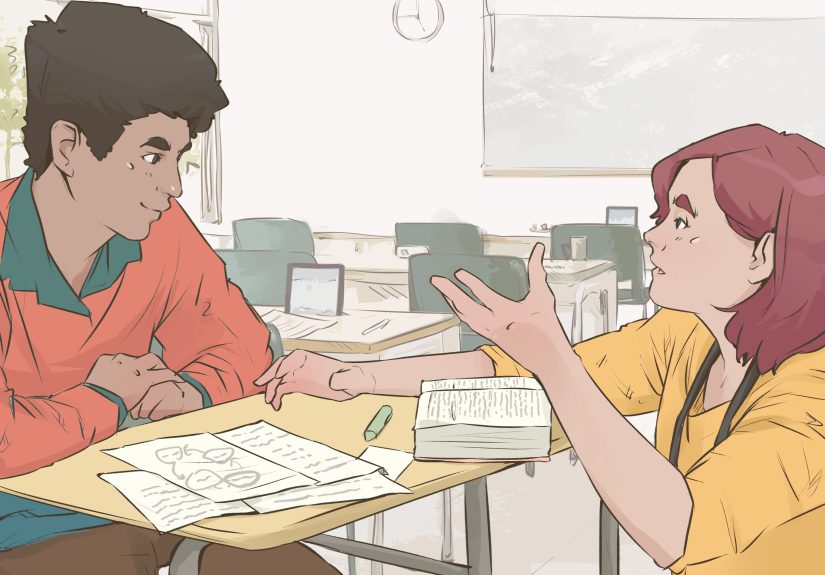
Math improves faster when someone (or something) corrects you quickly. A tutor, teacher, friend, or study group can spot misconceptions you can’t see
from inside your own head. Another powerful option: teach a concept to someone else, or record a 2-minute “lesson” for yourself.
Teaching exposes gaps and locks in understanding.
17) Build a growth mindset and manage math anxiety (your brain needs calm to compute)
Anxiety steals working memorythe mental “scratch space” you use to hold steps while solving. If math makes you tense, build routines that lower stress:
slow breathing for 30 seconds, writing down what you know, starting with an easy warm-up problem, and reminding yourself that mistakes are part of learning.
Progress in math is often a confidence problem disguised as a numbers problem.
A simple weekly plan you can actually follow
- Mon: Foundations + 10 focused problems
- Tue: Mixed practice (interleaving) + error log
- Wed: Retrieval practice (no notes) + 5-minute mental math
- Thu: Worked examples + “example → similar problem”
- Fri: Word problems + estimation checks
- Sat: Short quiz + review mistakes
- Sun: Rest (yes, rest is part of the strategy)
Real-Life Experiences: What Improving at Math Actually Feels Like
When people say they want to “get better at math,” they usually imagine a dramatic moment where everything suddenly clickslike a lightbulb flicking on
and angels singing in perfect fractions. The real experience is more like upgrading your phone: it doesn’t transform in one second; it gets smoother
in a bunch of small, noticeable ways.
One common experience is the confidence whiplash. You practice a topic and feel great… then a slightly different problem shows up and you
feel like you’ve never met math before. That’s not failureit’s your brain learning the difference between “I memorized a procedure” and “I understand
when to use it.” This is exactly why mixing problem types (interleaving) matters. It’s normal to feel a little slower at first when you stop doing
identical problems. Slower here often means stronger later.
Another very real experience is the mystery of the recurring mistake. You swear you know how to do the work, but you keep making the same
small error: dropping a negative sign, forgetting a square root, flipping a fraction, or mixing up slope formulas. It can feel personal, like the universe
is targeting your pencil. In reality, it’s just a habit loop. Once you start an error log, you notice patternsthen you can build tiny “speed bumps” to
stop them. People often report that a simple checklist (“Did I distribute the negative?” “Did I label units?”) feels silly… until it saves them multiple
points in one week.
Many learners also experience a shift from “math is memory” to “math is meaning.” At first, it’s tempting to collect formulas like trading cards.
But the turning point often comes when you connect ideas: fractions link to division, ratios link to slopes, exponents link to repeated multiplication,
and graphs link to relationships. That’s when math starts feeling less like a pile of rules and more like a system. Visualization helps this a lotdrawing
quick sketches, number lines, or bar models can make an abstract idea feel surprisingly concrete.
There’s also the practice paradox: the sessions that feel hardest are often the ones that help most. Retrieval practicetrying to solve
without lookingcan feel uncomfortable because you’re forcing your brain to work. But that discomfort is the “training effect.” People often describe a
strange moment a couple weeks in where they realize they’re remembering steps faster, not because they tried harder once, but because they practiced
smarter repeatedly.
Finally, a lot of students notice that improving at math changes how they see everyday life. Percent discounts stop being scary, recipes become easier
to scale, sports stats start making more sense, and budgeting feels less like guesswork. That’s the best kind of progressthe kind that follows you out
of the classroom. And it usually comes from boring-sounding habits done consistently: short practice sessions, spaced review, learning from mistakes,
and keeping your mind calm enough to think clearly.
Conclusion: Better at Math Is a Skill, Not a Personality Type
If you want to become better at math, focus on the processnot the myth. Practice consistently, space your review, mix problem types, learn actively
by retrieving and explaining, and treat mistakes like clues instead of verdicts. Stack these habits for a few weeks and you’ll notice the change:
fewer “blank page” moments, fewer careless errors, and more “oh, I’ve seen something like this” confidence.