Table of Contents >> Show >> Hide
- Table of Contents
- What “Traditional” Means for a Wall-Mounted Sink
- Why Choose a Wall-Hung Sink?
- Buying Checklist: Size, Faucet Holes, and Mounting
- Installation Reality Check (a.k.a. Your Wall Needs Homework)
- 10 Easy Pieces: Traditional Wall-Mounted Bath Sinks
- 1) KOHLER Greenwich Wall-Mount Lavatory (8" Centers)
- 2) KOHLER Greenwich Commercial Wall-Mount (4" Centerset Option)
- 3) KOHLER Soho K-2053 (Classic Rectangular, Vitreous China)
- 4) American Standard Declyn Wall-Hung Sink (4" Centerset)
- 5) American Standard Lucerne Wall-Hung Lavatory (4" Centerset)
- 6) American Standard Lucerne (8" Centers Option)
- 7) TOTO LT307 Series (Commercial Wall-Hung Lavatory with High Back)
- 8) Barclay Corbin Wall-Hung Lavatory (Bigger, More “Furniture-Like”)
- 9) Signature Hardware Burleson 34" Wall-Mount Sink
- 10) “Classic Compact” Wall-Hung Lavatory (Traditional Hotel Vibe)
- How to Make It Look Intentionally Classic
- Real-World Experiences: What People Love (and Grumble About)
- Experience #1: The space win is realespecially in powder rooms
- Experience #2: Cleaning is easier… until you ignore the plumbing details
- Experience #3: Splash is the sneaky dealbreaker
- Experience #4: Faucet drilling mistakes are painfully common
- Experience #5: The wall support is not optionalever
- Experience #6: Height customization is the underrated luxury
- Experience #7: Traditional style doesn’t mean boringif you style the “zone”
- Conclusion
If bathrooms had a “little black dress,” it would be the traditional wall-mounted sink: classic,
crisp, and instantly makes the room feel more put-togetherwithout demanding a full vanity’s
worth of floor space. These wall-hung beauties have been showing up in old hotels, charming
bungalows, and “we swear we’re not fancy” powder rooms for decades. And they’re still winning
for one simple reason: they do more with less.
In this guide, we’ll cover what makes a wall-mounted bath sink feel traditional (not trendy),
how to choose the right size and faucet drilling, what installation realities you should know
before the drywall gets cut, and a curated “10 Easy Pieces” list of time-tested models
with practical notes (because “timeless” is greatuntil the faucet holes don’t match your faucet).
What “Traditional” Means for a Wall-Mounted Sink
“Traditional” doesn’t have to mean frilly, floral, or “grandma’s guest bath.” In sink-world,
it usually means a few dependable design cues:
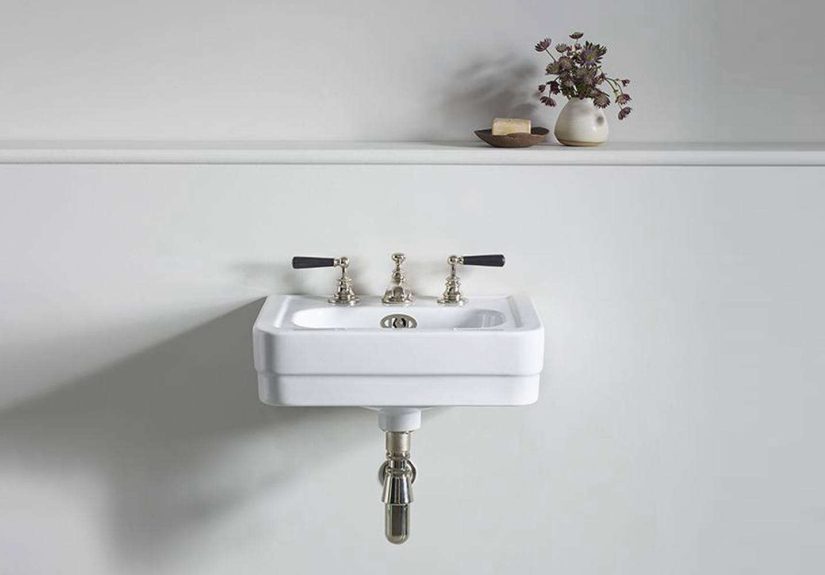
- A faucet ledge (a real deck for the faucet, not a minimalist rim).
- Symmetry and simple geometryoften rectangular or softly squared.
- Classic vitreous china or porcelain with a glossy, easy-clean finish.
- Functional details like a backsplash, splash shields, overflow, or a soap depression.
- Old-school faucet drilling: single-hole, 4″ centerset, or 8″ widespread.
In other words: it looks like it belongs in a house that has crown molding somewhereeven if
it’s only on your Pinterest board.
Why Choose a Wall-Hung Sink?
Wall-mounted bathroom sinks aren’t just a style move. They’re a layout move.
Here’s what they do especially well:
They visually “open” the room
By floating off the floor, a wall-hung sink lets you see more tile (or, realistically, more
baseboard). That makes small bathrooms feel less cramped, which is basically the bathroom
version of adding mirrors to a gym.
They let you choose the height
Unlike a standard vanity, a wall-mounted sink can be installed to suit the household
or accessibility needs. This is especially useful in a kids’ bath, a multi-generational home,
or a powder room where you want it to feel comfortable for guests.
They’re easier to clean underneath
If you’ve ever vacuumed around a vanity toe-kick and questioned all your life choices,
you’ll appreciate the open floor underneath a wall-hung sink.
They can support accessible layouts
Many wall-hung lavatories are designed with accessibility in mindproviding knee/toe clearance
and allowing a compliant mounting height when installed correctly. (Translation: they can work
beautifully in a home and still be practical.)
Buying Checklist: Size, Faucet Holes, and Mounting
1) Measure more than the wall
A wall-hung sink’s “footprint” isn’t just width and depth. Also consider:
the door swing, towel bar clearance, and whether you’ll bump the sink corner every morning
while half-asleep. (Ask your hip bone. It remembers.)
2) Pick your faucet drilling first (yes, really)
- Single-hole: simplest, cleanest look; great for small spaces.
- 4″ centerset: classic and widely available; usually easiest for replacements.
- 8″ widespread: the most “traditional-luxury” vibe; gives you faucet flexibility.
Pro tip: if you already own the faucet, match the sink to the faucet, not the other way around.
Otherwise, you’ll be pricing new faucets while whispering, “It’s fine. It’s all fine.”
3) Understand the support style
- Wall hanger (bracket): often included with the sink; simpler installs.
- Concealed arms / carrier: a sturdier system hidden behind the sink; common in commercial-grade lavs.
- Decorative legs or a shroud: optional pieces that hide plumbing and add a more traditional profile.
4) Decide: exposed plumbing, or “please hide it”?
Traditional wall-hung sinks can look great with exposed chrome or brass. But if you’re not
into seeing a P-trap every time you brush your teeth, choose a sink with a shroud option
or plan for a decorative trap/cover.
Installation Reality Check (a.k.a. Your Wall Needs Homework)
A wall-mounted sink is not like hanging a framed print. You can’t “eyeball it,” and drywall
alone is not structural support. Most manufacturers assume proper reinforcement, and many
installation guides call for blocking between studs.
Blocking is the quiet hero
Typical guidance for wall-mounted sinks is to open the wall, add sturdy blocking between studs
(often 2×6 or 2×8), and mount hardware into that reinforcement. This is one of those moments
where the invisible work matters the mostlike flossing, but with lumber.
Height matters (comfort + accessibility)
Residential comfort heights often land in the low-30-inch range, but accessible installations
commonly reference a maximum rim height of 34 inches. If accessibility is a goal, also plan for
knee/toe clearance and keep plumbing from intruding into required clearances.
Don’t forget the “plumbing choreography”
Wall-hung sinks make supply lines and traps more visible. That’s good if you want an old-hotel
look with polished metal. It’s less cute if you end up with mismatched valves, crooked stub-outs,
or a trap that looks like it gave up halfway through.
10 Easy Pieces: Traditional Wall-Mounted Bath Sinks
Below are ten traditional-leaning wall-mounted bath sinks that balance classic style with practical
details like backsplash protection, real faucet decks, and proven mounting systems. Think:
“heritage,” not “here today, cringe tomorrow.”
1) KOHLER Greenwich Wall-Mount Lavatory (8″ Centers)
The Greenwich line is a greatest-hit for classic bathrooms: straightforward shape, traditional faucet
drilling, and a clean profile that works in vintage-inspired or transitional spaces.
- Best for: guest baths that want a subtle “nice hotel” feel.
- Why it works: traditional deck layout + easy pairing with widespread faucets.
- Watch for: confirm your wall support method (hanger vs concealed arms) per model.
2) KOHLER Greenwich Commercial Wall-Mount (4″ Centerset Option)
Prefer a centerset faucet? This version keeps the Greenwich look but leans into practical plumbing:
easy faucet swaps, fewer parts, less drama.
- Best for: rentals, busy family baths, and “I want one handle and peace.”
- Why it works: classic silhouette, simpler faucet compatibility.
3) KOHLER Soho K-2053 (Classic Rectangular, Vitreous China)
Soho is clean and tailoredmore “traditional-adjacent” than ornatebut it plays nicely with classic
bathrooms because it has the right fundamentals: vitreous china, a real deck, and standard drilling.
- Best for: traditional bathrooms that want a slightly updated edge.
- Why it works: durable spec-grade build and a no-nonsense shape.
- Watch for: it’s designed for concealed arm carrier mountingplan support accordingly.
4) American Standard Declyn Wall-Hung Sink (4″ Centerset)
Declyn is a classic wall-hung lavatory with practical touches like a soap depression, faucet ledge,
and overflowdetails that feel traditional because they’re rooted in function.
- Best for: powder rooms, basement baths, and high-traffic households.
- Why it works: dependable shape, commercial-grade sensibility, easy faucet match.
- Watch for: confirm your support method (concealed arms vs hanger version).
5) American Standard Lucerne Wall-Hung Lavatory (4″ Centerset)
Lucerne is a long-running favorite for a reason: it’s compact, has built-in splash control, and feels
“classic public restroom” in the best wayclean, sensible, and surprisingly charming when styled well.
- Best for: small bathrooms that still need real counter-like deck space.
- Why it works: integrated splash shields + a traditional deck format.
- Watch for: pick the correct variant (hanger vs concealed arms vs bracket support).
6) American Standard Lucerne (8″ Centers Option)
Want widespread faucets but still need a compact wall-hung sink? This version keeps the Lucerne
profile while giving you the classic 8″ faucet spacing that screams “heritage bath.”
- Best for: vintage-inspired bathrooms where the faucet is a feature.
- Why it works: classic faucet layout + practical wall-hung footprint.
7) TOTO LT307 Series (Commercial Wall-Hung Lavatory with High Back)
The LT307 family blends traditional utility with subtle refinement: a high backsplash, anti-splash rim,
and concealed overflow details that keep things tidy.
- Best for: busy bathrooms, guest baths, and anyone tired of water on the wall.
- Why it works: splash control and a proven mounting ecosystem.
- Watch for: match your faucet drilling (single-hole, 4″, or 8″).
8) Barclay Corbin Wall-Hung Lavatory (Bigger, More “Furniture-Like”)
If you want a wall-mounted sink that feels more substantialmore like a piece of bathroom furniture
look at larger traditional wall-hung basins like Corbin. The generous deck and classic proportions read
“custom renovation,” even when the budget says “reasonable choices were made.”
- Best for: primary baths or larger guest baths that want presence.
- Why it works: a roomier deck makes it feel more traditional and less utilitarian.
9) Signature Hardware Burleson 34″ Wall-Mount Sink
Burleson is for people who love the idea of a wall-hung sink but still want “vanity energy.”
It’s wide, hefty, and visually groundedwithout actually touching the floor.
- Best for: statement powder rooms and guest baths with enough wall space.
- Why it works: wide traditional proportions + simple rectangular styling.
- Watch for: because it’s substantial, proper wall reinforcement is non-negotiable.
10) “Classic Compact” Wall-Hung Lavatory (Traditional Hotel Vibe)
The most traditional look is sometimes the simplest: a compact vitreous china wall-hung lavatory,
classic faucet ledge, overflow, and clean edges. These are the sinks that show up in older homes
because they’re practical, and they show up in renovated older homes because they’re charming.
- Best for: tight powder rooms where every inch counts.
- Why it works: timeless shape, easy styling, and uncomplicated daily use.
How to Make It Look Intentionally Classic
Use “period-friendly” metals
Polished chrome is the classic default, but brushed nickel, unlacquered brass, or oil-rubbed bronze
can read traditional depending on the rest of the room. The trick is consistency: match faucet,
supply stops, and trap finish so it looks like a plannot a scavenger hunt.
Choose a faucet that suits the sink’s era
If you pick an 8″ widespread drilling, lean into it with a faucet that has traditional lines:
cross handles, gentle curves, or a bridge-like silhouette. For centerset, keep it simple and
classicnothing too angular unless you’re deliberately mixing styles.
Add a mirror that completes the “old hotel” story
Traditional wall-hung sinks love a framed mirror, a medicine cabinet with detail, or a simple
oval mirror that feels timeless. Bonus points for sconces. Extra bonus points if they’re installed
at a height that doesn’t turn your face into a haunted flashlight scene.
Hide or celebrate the plumbingdon’t do “halfway”
Either commit to exposed plumbing (and make it beautiful) or choose a shroud/leg option.
The awkward middlewhere the trap is visible but the valves are mismatchedrarely looks intentional.
Real-World Experiences: What People Love (and Grumble About)
To make this extra practical, here are the most common “lived-in” takeaways homeowners and pros
report after choosing traditional wall-mounted bath sinks. Consider this the part where the glossy
showroom lighting turns on, and reality walks in holding a measuring tape.
Experience #1: The space win is realespecially in powder rooms
In a tight powder room, a wall-hung sink can change the whole vibe. People describe it as
“less claustrophobic,” “easier to move around,” and “why did we ever shove a bulky vanity in here?”
You gain visible floor area, which makes the room feel bigger even when the square footage
stubbornly refuses to increase.
Experience #2: Cleaning is easier… until you ignore the plumbing details
The floor under the sink is a breezemop, vacuum, done. But many people underestimate how much
exposed plumbing becomes part of the room’s look. If you choose exposed chrome, you’ll want the
supply lines and trap to look intentional. That often means upgrading shutoff valves, using neat
escutcheons, and selecting a decorative trap (or at least one that doesn’t look like it was installed
during a power outage).
Experience #3: Splash is the sneaky dealbreaker
Traditional wall-hung sinks often have a backsplash or higher back for a reason: water goes places.
Users who pick very shallow basins sometimes regret itespecially with high-pressure faucets.
If you have kids, a high arc faucet, or anyone who washes their face like they’re trying to reenact
a shampoo commercial, prioritize a basin shape with decent depth and a splash-controlling rim.
Experience #4: Faucet drilling mistakes are painfully common
One of the most frequent complaints is also the easiest to prevent:
“We bought a beautiful faucet and then realized the sink has different holes.”
Traditional sinks come in multiple drillingssingle-hole, 4″ centerset, 8″ widespreadand sometimes
the same sink line has several variants. The fix can be simple (exchange a faucet) or annoying
(return a sink you already unboxed in a bathroom full of optimism).
Experience #5: The wall support is not optionalever
When installed correctly, a wall-mounted sink feels rock-solid. When it’s not, it can feel bouncy,
shift slightly over time, or crack at mounting points. The consistent advice from pros is:
plan reinforcement early. If you’re remodeling, add blocking while the wall is open. If you’re not
remodeling, be prepared for some wall surgery. It’s better to patch drywall once than to repair a
sink (and the drywall) after a failure.
Experience #6: Height customization is the underrated luxury
People love being able to set the sink height for their household. Taller adults appreciate not
hunching over; shorter users appreciate not reaching. And in homes planning for accessibility,
wall-hung sinks make compliant clearances more achievableespecially when paired with thoughtful
pipe placement and protective covers where needed.
Experience #7: Traditional style doesn’t mean boringif you style the “zone”
The sink may be simple, but the whole sink wall can still be special. A classic wall-hung lavatory
becomes a design feature when you add a framed mirror, interesting sconces, and a small shelf or
art piece nearby. Many homeowners report that, once installed, the sink becomes the anchor of the
powder room’s entire personalitylike a well-dressed friend who makes everyone else look better.
Conclusion
Traditional wall-mounted bath sinks are one of the rare bathroom choices that feel both classic and
clever. They save space, open up sightlines, andwhen installed with proper supportoffer a sturdy,
timeless setup that fits everything from vintage homes to modern-traditional refreshes.
The winning formula is simple: choose the right size, match the faucet drilling, plan your wall support,
and decide whether plumbing is part of your décor or something you’d rather politely hide. Do that,
and you’ll get a sink that feels like it’s always belonged thereeven if your bathroom was installed
sometime after smartphones became a thing.