Table of Contents >> Show >> Hide
- Where the Kid Rock Story Came From
- Kid Rock, Trump, and the Celebrity Pipeline to Power
- The North Korea Problem Was Not a Joke
- Trump’s North Korea Approach: From Threats to Handshakes
- Why the Anecdote Felt Believable
- What the Story Really Says About Power
- The Media Was Never Going to Ignore This
- Experience Section: What Living Through This Kind of Headline Felt Like
- Final Take
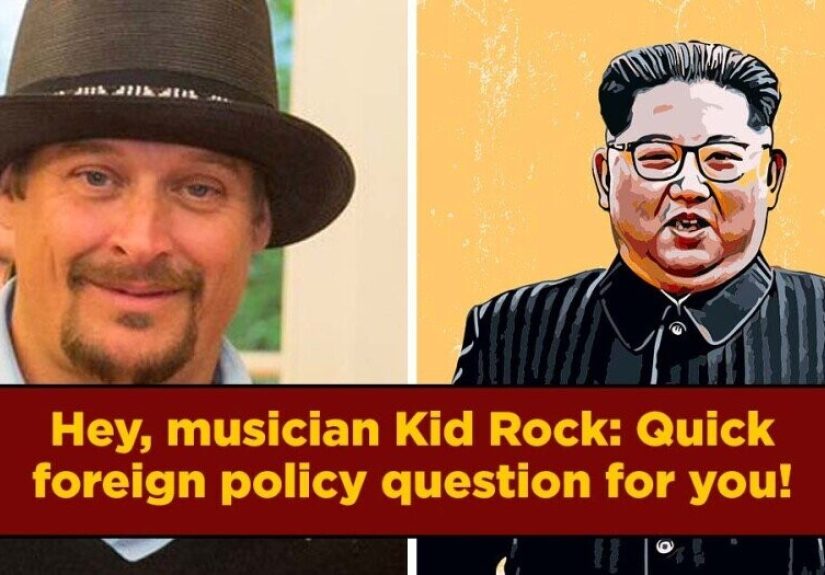
American politics has produced plenty of surreal moments, but few lines land with the same “wait, hold on, rewind that” energy as this one: according to Kid Rock, Donald Trump once asked him what the United States should do about North Korea. Yes, that Kid Rock. The musician. The man more associated with arena rock, red Solo cups, and unapologetic chaos than nuclear diplomacy.
Now, to keep the record straight before the internet starts doing backflips, the famous line comes from Kid Rock’s own retelling during a 2022 television interview. It is not the same thing as a released White House memo, a Situation Room transcript, or a declassified foreign-policy briefing stamped with “Reviewed by the Department of Bob Ritchie.” Still, the story exploded because it felt perfectly tailored to the Trump era: celebrity access, improvisational leadership, media frenzy, and a geopolitical issue serious enough to make everyone put down their coffee for a second.
This is what made the anecdote so sticky. It was funny, alarming, absurd, and somehow completely believable to millions of Americans who had already lived through years of unconventional politics. It also arrived against the backdrop of Trump’s very real, very consequential North Korea strategy, which swung from “fire and fury” threats to historic summit handshakes. That contrast is the real story. The headline is weird; the context is wilder.
Where the Kid Rock Story Came From
The headline traces back to Kid Rock’s account of time spent with Trump after the two became friendly. Kid Rock said Trump showed him maps, asked about tweets, and at one point asked what should be done about North Korea. Kid Rock’s own reaction was basically the only reasonable reaction available: Why are you asking me? In his retelling, he admitted he did not think he was qualified to answer. Frankly, points for self-awareness.
That detail matters because it turns the anecdote from a simple punchline into a revealing character sketch. The story was not, “Kid Rock crafted U.S. foreign policy.” The story was that Trump, known for operating in an off-the-cuff, highly personal style, sometimes blurred the line between official deliberation and informal conversation. Trump was famous for treating politics like a rolling conversation, not always like a carefully scripted institution. Supporters saw that as authenticity. Critics saw it as improvisation with the world’s most dangerous stakes attached.
Either way, the anecdote caught fire because it fit a pattern. Trump often favored gut instincts, personal chemistry, television optics, and outsider energy. He liked personalities. He liked loyalty. He liked surprising the room. So when a musician says, “He asked me about North Korea,” people did not respond with, “Impossible.” They responded with, “That is somehow the most 2017 sentence ever assembled in English.”
Kid Rock, Trump, and the Celebrity Pipeline to Power
Kid Rock did not materialize out of thin air in this story. He had already become a visible Trump ally. Back in 2017, he visited the White House alongside Sarah Palin and Ted Nugent, and the photos from that visit generated a full-scale internet circus. That meeting helped cement the image of Kid Rock not merely as a fan from afar, but as someone with actual access to the president.
And access is the key word here. In Washington, access is its own currency. You do not have to hold a Cabinet title to influence mood, framing, or conversation. Sometimes being in the room is the entire story. Trump’s political style often collapsed the distance between entertainment and government, and Kid Rock fit that ecosystem perfectly. He was outspoken, media-savvy, culturally polarizing, and very comfortable performing loyalty in public.
That is why the North Korea anecdote landed harder than a random celebrity story. Americans have long seen entertainers drift into politics, endorse candidates, or campaign at rallies. That part is old news. What made this different was the idea of a celebrity being pulled into the orbit of a live national-security question. That is not just campaign culture. That is power brushing up against show business in a way that made many people wonder whether the line between the two had become a smudge.
The North Korea Problem Was Not a Joke
The reason the story resonated so strongly is simple: North Korea is not some low-stakes policy sideshow. It is one of the most sensitive and dangerous foreign-policy issues any American president can face. North Korea has a nuclear weapons program, a missile program, a long record of brinkmanship, and a history of raising tensions on the Korean Peninsula. A casual conversation about North Korea is not like casually debating pizza toppings. No one wants a “let’s workshop this” vibe attached to nuclear diplomacy.
During Trump’s first year in office, tensions with North Korea escalated dramatically. The rhetoric was sharp, the missile testing was alarming, and the mood was tense enough that phrases like “fire and fury” entered the political bloodstream. This was not symbolic theater alone. It was a period in which people were genuinely discussing the risk of military conflict, miscalculation, and escalation.
That is exactly why the Kid Rock anecdote stuck. It brought a tabloid-shaped spotlight to an issue that was deadly serious. The image of a president bouncing ideas off a rock star may sound like late-night comedy material, but it collided with a reality involving sanctions, deterrence, military planning, and diplomatic risk. It was the weirdness of pop culture attached to the gravity of nuclear politics. America, apparently, had decided to livestream irony straight into history.
Trump’s North Korea Approach: From Threats to Handshakes
To understand the headline, you have to understand the larger Trump–North Korea story. Early on, Trump’s rhetoric was confrontational. His administration responded to North Korean missile activity with aggressive language and pressure tactics. The world heard warnings, watched military signaling, and wondered whether a rhetorical spiral might turn into something far worse.
Then came a dramatic shift. In 2018, Trump met Kim Jong Un in Singapore in what was billed as a historic summit. The symbolism alone was enormous. A sitting U.S. president and a North Korean leader had never met like that before. The event generated photographs, headlines, handshakes, and a sense that something unexpected might actually happen.
Trump leaned hard into personal diplomacy. He spoke repeatedly about his relationship with Kim, emphasizing rapport and dealmaking. For supporters, this was bold disruption. They argued that previous presidents had relied on stale formulas and gotten nowhere. For critics, it looked like spectacle outrunning substance. They worried that Kim gained legitimacy and global stagecraft without making concrete enough concessions.
That debate intensified after the second summit in Hanoi in 2019 ended without a deal. The gap between headline diplomacy and durable policy outcomes became harder to ignore. Another meeting followed at the Korean Demilitarized Zone, where Trump and Kim shared another visually dramatic moment. But the deeper negotiations stalled, and the promise of a breakthrough faded.
So when people revisited Kid Rock’s anecdote, they did not hear it in isolation. They heard it against a real policy arc that had already moved from threats, to summit optimism, to breakdown, to stalemate. The story felt like a strange side window into an administration that often fused theater and statecraft into one loud, unpredictable production.
Why the Anecdote Felt Believable
1. Trump governed like a broadcaster
Trump was not a conventional institutional communicator. He favored direct commentary, instinctive reactions, and headline-making remarks. He often sounded less like a policy committee and more like a host reacting live on air. In that atmosphere, an informal conversation with a celebrity did not sound like a glitch. It sounded like brand consistency.
2. Celebrity culture was part of the administration’s DNA
Trump came into politics from entertainment, tabloid fame, and reality television. He understood the value of spectacle and personality. His orbit regularly included athletes, entertainers, pundits, and media figures. The Kid Rock story felt believable because it matched that ecosystem. It was not a random departure from the script. It was the script wearing sunglasses indoors.
3. Americans were already desensitized to the improbable
By the time the anecdote surfaced publicly, Americans had already seen years of norm-breaking political moments. Cabinet shakeups, viral tweets, unusual photo ops, abrupt reversals, and diplomacy conducted with a heavy side of drama had become familiar. In other words, the nation’s disbelief muscles were already exhausted.
What the Story Really Says About Power
The deeper lesson is not that Kid Rock secretly ran foreign policy. He did not. The real lesson is about how power can look in a media-saturated era. Formal processes still matter, but public imagination often locks onto the informal moment: the aside, the anecdote, the room, the personality, the access. Those moments become shorthand for how people think an administration works.
In this case, the shorthand was devastatingly efficient. “Trump asked Kid Rock what to do about North Korea” instantly communicated a broader critique: that governance under Trump could seem personal, improvisational, and oddly casual around matters of enormous consequence. Even people who defended Trump’s willingness to think outside the bureaucracy could understand why that sentence rattled nerves.
And yet, there is another side to why the story mattered. It also highlighted Trump’s unusual confidence in his own style of consultation. He often seemed comfortable inviting reactions from unconventional people, treating conversation itself as a useful testing ground. To admirers, that was anti-elitist and refreshing. To detractors, it was a dangerous substitute for disciplined expertise. The argument, as always in the Trump era, was not just about what happened. It was about what kind of leadership people believed they were watching.
The Media Was Never Going to Ignore This
Of course the story blew up. It had everything the modern media machine loves: a famous musician, a former president, a nuclear flashpoint, a wild quote, and a built-in “you have got to be kidding me” factor. Editors did not have to decorate that headline. The headline arrived pre-seasoned.
But media fascination was not only about novelty. It was about symbolism. The anecdote worked as a tiny, vivid summary of a larger political era. It condensed years of debates over expertise, celebrity influence, populism, anti-establishment swagger, and governance-by-performance into one unforgettable line. Some stories travel because they are important. Others travel because they are revealing. This one managed to be both.
Experience Section: What Living Through This Kind of Headline Felt Like
If you lived through the Trump years in real time, stories like this carried a very specific emotional texture. It was not just shock. It was a combination platter: one part laughter, one part dread, one part “surely this is satire,” and one part “nope, apparently this is Tuesday.” The Kid Rock–North Korea anecdote belongs to that category of modern American political experiences that made people stare at their phones a little too long, then walk into another room and ask someone else, “Are you seeing this too?”
The experience was strangely communal. You could almost predict the choreography. First came the viral headline. Then came the flood of posts from people making jokes about foreign policy being crowd-sourced from a backstage trailer. Then came the serious analysts pointing out that North Korea is a nuclear-armed state and this is not exactly the issue you want framed like an unscripted bar conversation. Then came the inevitable split-screen reaction: one audience treating the whole thing as proof of political absurdity, another shrugging and saying Trump just talks to everybody. Same facts, wildly different blood pressure.
There was also a uniquely exhausting quality to headlines like this. In another era, one anecdote of this magnitude might have dominated national discussion for weeks. In the Trump era, it often became just another bead on a very crowded necklace of improbability. People barely had time to finish one sentence beginning with “Can you believe…” before another news alert arrived to replace it. That constant acceleration changed the experience of politics itself. Absurdity stopped being a rare event and started feeling like background weather.
For reporters, commentators, and ordinary readers alike, the sensation was often the same: trying to separate the comic surface from the serious core. On the surface, the story was undeniably funny. It sounded like the setup to a late-night monologue written at 2 a.m. by someone fueled entirely by vending-machine coffee. But underneath the joke was an unnerving question about who gets proximity to power, how presidents make judgments, and whether the performance of informality can distort the public’s trust in institutions.
That lived experience matters because it explains why this headline lasted. People do not remember it merely because Kid Rock is famous. They remember it because the story captured the emotional rhythm of a political era that felt continuously unsteady, intensely theatrical, and weirdly intimate all at once. Government felt less distant than usual, but not in a comforting way. It felt like the backstage door had been left open, and the audience could suddenly hear the chatter, the improvisation, and the occasional clatter of something very important being handled with suspiciously casual energy.
In that sense, the experience attached to this story was larger than the story itself. It was the experience of watching American politics operate at the intersection of entertainment, personality, and global consequence. It was the experience of realizing that a line which sounds like satire can still tell you something true about the culture that produced it. And it was the experience of understanding, perhaps a little too clearly, that in modern America the unbelievable does not always stay unbelievable for long. Sometimes it becomes the headline, then the meme, then the debate, and finally the historical footnote that makes future readers say, “Wait, that actually happened?”
Final Take
So, did Trump ask Kid Rock what to do about North Korea? According to Kid Rock, yes. Was that exact exchange independently documented through official records? Not publicly. But the reason the story mattered had less to do with courtroom-level proof and more to do with how perfectly it illuminated the political mood of the time.
It captured a presidency built on access, spontaneity, image, and disruption. It highlighted the collision between celebrity culture and state power. It underscored how serious North Korea policy was, and how unnerving it felt to see that seriousness brushing up against casual, personality-driven politics. Most of all, it showed why certain stories endure: not because they are the whole truth, but because they reveal something essential about the era in which they were told.
And that is why this headline still has legs. It is funny. It is bizarre. It is slightly terrifying. It is very online. And, in its own strange way, it is a pretty solid summary of a chapter in American politics when the line between Oval Office diplomacy and pop-culture spectacle often looked less like a line and more like a disappearing magic trick.