Table of Contents >> Show >> Hide
- A Country House Without Costume Drama
- The Power of a Small, Precise Footprint
- Material Honesty: Local Wood, Light, and a Little Restraint
- Floating Above the Field
- From Jean Prouvé to Japanese Calm to California Ease
- Bioclimatic Thinking and the Rhythm of the Seasons
- Redefining French Country for a Modern Audience
- Why This House Matters
- The Experience of a House Like This: 500 Extra Words on Living the Idea
- Conclusion
Some houses whisper. Some houses shout. And some, like the remarkable country house in Saint-Julien-le-Petit, France, do something far more impressive: they stand quietly in a field and make everyone else look a little overdressed. Designed by Ciguë, this compact rural retreat rethinks what a country house can be in the 21st century. It is not a castle, not a cliché, not a Pinterest board wearing muddy boots. It is a stripped-back, intelligent, beautifully composed home that turns the classic idea of retreat into architecture.
Set in Haute-Vienne, in west-central France, the house revisits the archetype of the country home without leaning on nostalgia as a crutch. Instead of imitating village stone houses or staging a theatrical version of rustic life, it asks a better question: what does a country house actually need to do? The answer here is wonderfully simple. It should frame the landscape, welcome light, respond to seasons, use honest materials, and allow life to slow down without becoming boring. That is a difficult balance to strike. Ciguë makes it look annoyingly easy.
A Country House Without Costume Drama
The phrase country house often carries a lot of baggage. It can summon images of bulky stone walls, antique armoires, faded florals, and enough decorative pottery to open a small museum gift shop. But this house in Saint-Julien-le-Petit is after something more essential. Rather than reproducing a romantic image of rural France, it distills the country-house idea down to its core values: shelter, calm, connection to the land, and a slower rhythm of living.
That is what makes the project so compelling. It does not deny history; it edits it. The house is anchored in its rural setting, yet it stands apart from the traditional stone architecture of the village. That contrast is the point. The building respects the countryside without pretending it was built two centuries ago by a man named Étienne who definitely owned geese. Instead, it offers a neo-vernacular approach, one that feels rooted in place while remaining unmistakably contemporary.
In design terms, this is the difference between imitation and interpretation. The house does not cosplay as “French country.” It studies the logic of rural architectureorientation, economy, material honesty, weather awareness, and seasonal useand reassembles those ideas in a fresher language. The result is a house that feels both familiar and surprising, which is usually where the best architecture lives.
The Power of a Small, Precise Footprint
One of the most striking facts about the Saint-Julien-le-Petit house is its size. At just 88 square meters, it is not trying to win any awards for excessive square footage or aggressive luxury. Good. The discipline of the plan is part of its charm. A country retreat does not need to behave like an airport terminal. It needs to give you enough room to breathe, cook, read, nap, stare at trees, and occasionally remember that your phone exists.
Small houses reveal whether an architect actually knows what matters. Here, every decision seems purposeful. The compact footprint encourages a clear relationship between inside and outside. There is no sprawling maze of extra rooms with vague identities like “formal sitting room” or “music salon,” which are usually code for “places where furniture goes to die.” Instead, the spaces feel open, legible, and direct.
This efficiency also helps sharpen the emotional effect of the house. Because the plan is concise, the landscape becomes an extension of the interior. The field, the changing light, the weather, and the horizon do some of the spatial heavy lifting. The house feels bigger than it is because it borrows from the outdoors rather than trying to dominate it.
Material Honesty: Local Wood, Light, and a Little Restraint
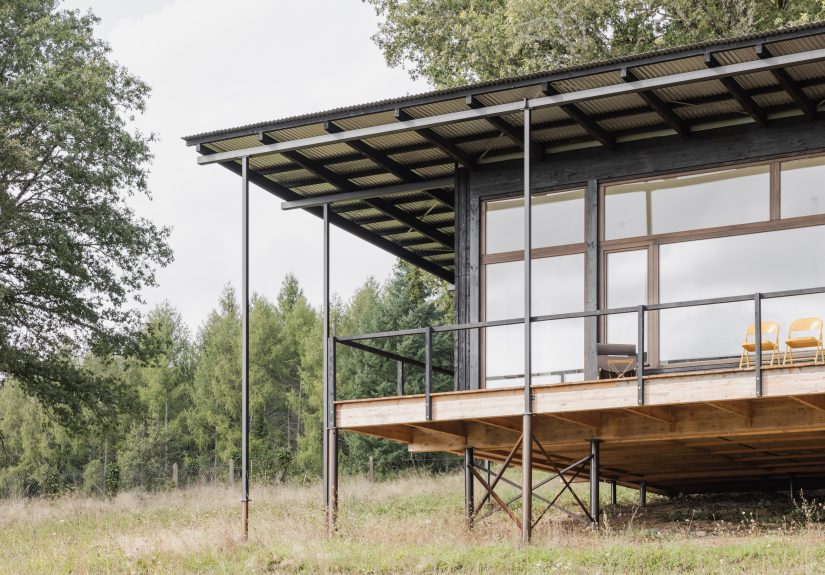
The building is mainly made of local wood, and that choice matters on several levels. First, it deepens the connection between the house and its setting. Second, it gives the structure a tactile warmth that concrete or glossy finishes would struggle to achieve. Third, it reinforces the project’s ecological intelligence. The house is not simply placed in nature like a glamorous visitor; it is materially shaped by the region around it.
Wood also helps the house express its central idea: simplicity without coldness. Minimalism can sometimes feel like a room has been punished for having personality. Not here. The timber surfaces soften the geometry and bring a sense of ease to the architecture. There is enough texture, grain, and warmth to keep the minimalism human.
Ciguë’s approach to materials aligns beautifully with broader design movements that value natural finishes, muted palettes, and spaces that feel lived-in rather than overly styled. But the Saint-Julien-le-Petit house avoids trendiness. It is not performing “new rustic” for social media. It is simply using a durable, local, expressive material in a way that feels right for the site.
The restraint is equally important. The house is not cluttered with decorative flourishes meant to announce its charm. Charm arrives anyway, which is much more elegant. When architecture relies on proportion, light, and material quality, it does not need many accessories. That is good news for the walls, which can finally enjoy a day off.
Floating Above the Field
One of the project’s most memorable gestures is the way it appears to float lightly above the landscape. Installed on removable steel foundations, the house has a subtle lift that changes its relationship to the ground. Instead of pressing heavily into the site, it touches down with a little humility. That is a powerful move in a rural setting where too much architectural swagger would feel misplaced.
This slight elevation gives the house a poised, almost watchful presence. It sits in the field, but it also hovers just enough to suggest care, lightness, and reversibility. The removable foundations are not merely a technical solution; they express a philosophy. The land is not treated as something to conquer. The building arrives as a guest, albeit a very stylish one.
There is also a visual benefit. By lifting the structure, the architects heighten the experience of looking out across the terrain. The home feels tuned to the horizon, positioned to catch views, breezes, and changing daylight. This is where the country-house archetype gets updated most convincingly: not through nostalgic decoration, but through a refined awareness of site and atmosphere.
From Jean Prouvé to Japanese Calm to California Ease
The references behind the house are wonderfully diverse and unusually well-behaved. Ciguë cites influences ranging from Japanese architecture to Californian Case Study Houses, with an additional nod to Jean Prouvé. That sounds like the setup for a very niche dinner party, but the combination makes real sense.
From Japanese architecture comes a respect for restraint, proportion, threshold, and the emotional power of emptiness. Space is not filled for the sake of comfort theater. It is left open enough to let light, silence, and movement do their work. From California’s Case Study tradition comes a confidence in indoor-outdoor living, functional planning, and the idea that a modern house can be both rigorous and relaxed. And from Prouvé comes a certain structural clarity and practical intelligence, the belief that construction can be elegant without becoming precious.
These references are not copied literally. You are not looking at a French house pretending to be in Los Angeles or Kyoto. Instead, the influences are metabolized into a rural French context. That is what makes the house feel so coherent. It draws from international modernism while remaining grounded in its field, its weather, and its region.
Bioclimatic Thinking and the Rhythm of the Seasons
Good country houses are seasonal instruments. They do not simply occupy land; they register climate. In Saint-Julien-le-Petit, large window openings flood the interior with light and help the home live “to the rhythm of the seasons” according to bioclimatic principles. That phrase may sound technical, but its effect is deeply human.
In practical terms, the house is carefully oriented and exposed. Sunlight is treated as a building material. Views are not random bonuses but part of the design logic. The result is a living environment that changes meaningfully throughout the day and across the year. Morning light, late-afternoon glow, cloud cover, rain, and winter sharpness all become active participants in the experience of the home.
This seasonal responsiveness is central to the project’s identity. A country retreat should not insulate you from nature so completely that you could be anywhere. It should allow you to feel where you are. That does not mean discomfort. It means awareness. The Saint-Julien-le-Petit house creates comfort through attentiveness rather than through excess.
In that sense, it reflects a broader shift in design culture toward homes that nurture rather than merely impress. Increasingly, the most admired rural houses are not the loudest ones. They are the ones that understand air, light, material, and mood. This house clearly got the memo and then improved it.
Redefining French Country for a Modern Audience
It would be easy to call this a French country house and leave it there. But that label only tells part of the story. Traditional French country style often leans on stone facades, pitched roofs, antique furniture, and a balance of rustic charm with polished elegance. The Saint-Julien-le-Petit project shares the spirit of rural calm and material authenticity, yet it strips away the ornamental side of the equation.
What remains is something sharper and, arguably, more relevant: a country house defined by atmosphere rather than stylistic signals. The elegance here is not decorative. It lives in the siting, the timber, the proportions, the openness, and the confidence to leave things out. This is not anti-history. It is history edited for clarity.
That makes the house particularly resonant now. Many homeowners and designers are moving away from crowded interiors and toward spaces that feel open, tactile, and restorative. The best modern rustic homes balance simplicity with soul, and this French retreat does exactly that. It shows how a rural house can feel timeless without looking rehearsed.
Why This House Matters
The Saint-Julien-le-Petit house matters because it proves that archetypes are not fixed. They can be revisited, revised, and made newly useful. The “country house” is not just a style category. It is a cultural idea about rest, landscape, shelter, and distance from urban intensity. Ciguë takes that idea seriously, then translates it into a form that feels contemporary, ecological, and deeply livable.
It is also a reminder that architecture does not need to be large to be ambitious. This modest house carries big ideas: reversibility, local sourcing, seasonal awareness, international reference, and emotional clarity. It respects the countryside without sentimentalizing it. It embraces minimalism without becoming austere. It feels relaxed without losing precision.
In short, it is the kind of house that makes you rethink what luxury really is. Not more rooms. Not more stuff. Not a dining table long enough to host a minor diplomatic summit. Real luxury, here, is time, light, landscape, and the pleasure of living with only what matters. That is an old lesson, but this house tells it exceptionally well.
The Experience of a House Like This: 500 Extra Words on Living the Idea
Imagine arriving at this house late in the afternoon, after a long drive through the French countryside. The road narrows, the village quiets, the sky opens, and suddenly the building appears above the field with that calm, lifted stance. It does not perform a dramatic entrance. It simply waits there, composed and unbothered, like it already knows your weekend plans involve reading three pages of a book and then falling asleep face-down on a blanket.
The first experience would likely be one of decompression. The architecture does not bombard you with visual noise. Instead, it gives your eyes somewhere to rest. The timber surfaces, the broad openings, and the uncluttered rooms would make the transition from busy life to rural time feel almost immediate. You would notice sound differently too: wind, birds, rain on the roof, footsteps on the floor. In houses like this, silence is not empty. It is textured.
Morning would probably be the real revelation. A country house built around light does not let you forget the hour or the weather. As sunlight moves across the rooms, the interior changes character without anyone touching a lamp. Coffee tastes better when the kitchen is flooded with pale morning light. Toast becomes a philosophical event. Even standing by a window in socks starts to feel like an important cultural practice.
By midday, the relationship to the outdoors would become even more obvious. Large openings do more than provide a nice view. They turn the landscape into part of daily life. You cook while watching the field. You sit at the table and track the clouds. You step outside more often, not because you planned a wholesome rustic lifestyle reset, but because the house gently nudges you in that direction.
The best part of a place like this may be its refusal to overschedule your emotions. It does not insist on coziness in a theatrical way. It just creates the conditions for ease. Reading feels natural. Doing nothing feels legitimate. A simple lunch feels enough. In a larger or more decorative house, you might feel pressure to “use” the space properly. Here, the architecture seems to say, very kindly, “Relax. Existing is fine.”
Evenings would bring a different atmosphere. As daylight lowers, the house would become more intimate, more concentrated. The windows that opened the interior to the landscape during the day would begin to frame darkness instead. The field would recede, reflections would appear in the glass, and the rooms would gather inward. It is easy to imagine dinner stretching pleasantly, conversation slowing, and the ordinary rituals of domestic life feeling somehow sharper and more memorable.
Across seasons, the experience would keep changing. In summer, the house might feel airy and loose, almost like a covered terrace with walls. In autumn, the timber and muted light would grow warmer and more enveloping. In winter, the compact size would likely become an advantage, making the house feel protective rather than sparse. And in spring, with the landscape renewing itself, the entire building would seem to wake up again.
That is ultimately the magic of this kind of country house. It does not offer spectacle. It offers recalibration. It reminds you that architecture can support a different tempo of living, one built on light, weather, materials, and attention. And once you spend time in a place like that, the idea of returning to a noisy, overfurnished room with bad lighting feels slightly offensive. Politely offensive, but still.