Table of Contents >> Show >> Hide
- What Is Konstellation, Exactly?
- The Backstory: Titanium, Eyewear, and a Stairwell That Needed Drama
- The Engineering Detail That Makes Designers Grin: “Dry-Fit” Joints
- Precision String Lights: What You Get That Regular Strands Can’t Do
- Where Konstellation Shines (Literally): Best Spaces for the Effect
- Designing Your Own Constellation: A Practical Layout Mindset
- Safety and Performance: The Unsexy Stuff That Keeps the Pretty Stuff Pretty
- Can You Buy Konstellation Today? And What If You Can’t?
- Maintenance and Troubleshooting: Keep Your Constellation Crisp
- Conclusion: The Real Magic Is the Control
- Experience Add-On: Living With “Precision String Lights” ( of Real-World Vibe)
String lights are the design world’s universal peace treaty. Minimalist? String lights. Maximalist? More string lights.
“I just moved and my living room echoes like an empty cereal box”? String lights. They’re the quickest way to make a space
feel intentionallike you meant to create “atmosphere,” not just “a place where laundry happens.”
But most string lights share a lovable flaw: they’re basically noodles with a glow. You drape, you tape, you step back,
and the result is either charmingly casual or “why does this look like a sad party in a shoebox?” That’s where
Konstellation comes ina lighting concept by designer Peter Marigold that treats string lighting
like architecture. Not just decoration. Not just sparkle. A structure. A system. A constellation you can actually build.
What Is Konstellation, Exactly?
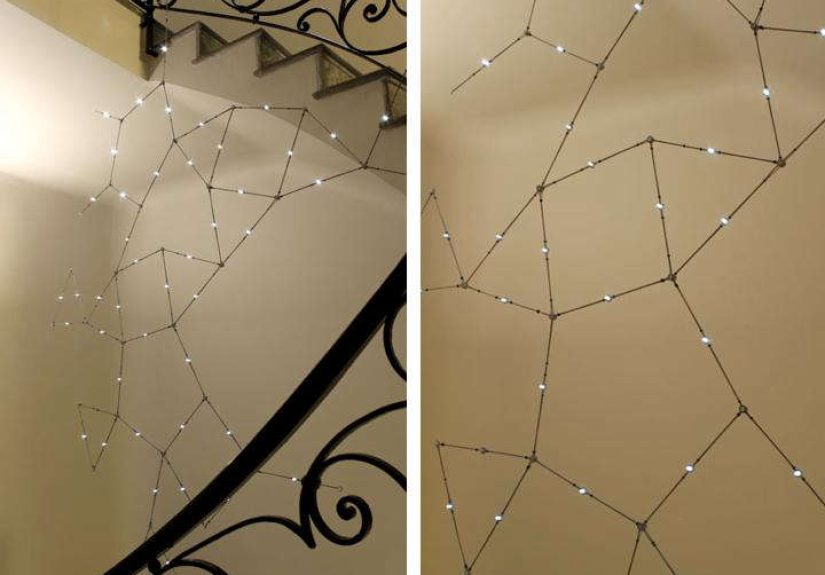
Konstellation is a modular lighting system built from individual metal components that connect together to form
branching, geometric, or web-like patterns. Instead of a single floppy strand, you get a kit-of-parts approach:
pieces link, joints lock, and tiny LEDs appear where you choose to place them. The vibe is less “holiday aisle”
and more “star map drawn in midair.”
The key idea is beautifully nerdy: the structure carries the electricity. That means the design isn’t
something you hang around the lightsthe design is the lights. With the right placement (and a dark-ish background),
the connecting elements visually recede and the points of light can read as floating dotslike a hand-made galaxy
you installed in your stairwell because you’re emotionally prepared for compliments.
The Backstory: Titanium, Eyewear, and a Stairwell That Needed Drama
Konstellation emerged from a collaboration with the Danish eyewear worldspecifically, the kind of precision manufacturing
that produces lightweight titanium frames. The “borrowed” logic is what makes the project so compelling: treat lighting
like a high-performance object, not a fragile afterthought.
The system gained attention as an installation created for a design exhibition context, and it’s often described as a
branching, twinkling constellation of LEDsdesigned to work in a stairwell setting where vertical space begs for a
statement (and where a standard strand would just… droop sadly).
Why titanium matters (besides sounding cool)
Titanium isn’t just a flex. It’s strong for its weight, corrosion-resistant, andcrucially for this conceptcapable of
conducting electricity when designed appropriately. In Konstellation, the metal becomes both the skeleton and the circuit.
That’s why the system can feel so crisp: fewer bulky wires, more intentional lines, and cleaner control over where the
light points land.
The Engineering Detail That Makes Designers Grin: “Dry-Fit” Joints
Most DIY lighting projects eventually involve a moment of panic that smells faintly of melted plastic.
Konstellation’s charm is the opposite: components are designed to connect in a simplified, assembly-friendly way,
with joints that can be handled and reconfigured without turning your dining table into an electrical experiment.
The system is often described with “dry-fit” connectionsmeaning the parts hold and conduct without the need for soldering
during assembly. In plain English: you can iterate. You can tweak the pattern. You can undo your choices without feeling like
you’ve committed a crime against circuitry.
Precision String Lights: What You Get That Regular Strands Can’t Do
1) Negative space becomes part of the design
Regular string lights fill space by draping through it. Konstellation draws space. Because the points of light
can be placed intentionally, the “empty” areas between them start to matter. You can create symmetry, clusters, gradients,
or sparse star fieldswithout relying on gravity’s questionable taste.
2) The pattern is yours, not pre-baked
Standard light strings arrive as a finished product: bulb spacing, length, and layout are decided for you.
A modular system flips that. Want a circle? Build a circle. Want a branching “lightning” shape that crawls along the wall
and then leaps across the ceiling? That’s the point.
3) It can look “installed,” not “hung”
There’s a big difference between “decor” and “design feature.” Konstellation leans toward feature.
It’s closer to a custom chandelier or a light sculpture than to seasonal lighting, even though it still delivers that
cozy, twinkly hit your nervous system is clearly chasing.
Where Konstellation Shines (Literally): Best Spaces for the Effect
Stairwells and double-height volumes
Staircases are notoriously hard to light well: you need safety, you need consistent illumination, and you also want the space
to feel welcoming instead of like a hospital corridor. A constellation-style installation works because it gives you light points
in the vertical zonewhere typical fixtures are either too harsh or too boring.
Dining tables and long corridors
Over a table, a structured constellation can act like a chandelier with personalityespecially if you keep the pattern tighter
over the center and let a few “stars” drift outward. In corridors, a linear “spine” with small branching points can guide the eye
without flooding the space.
Gallery-like moments at home
If you have a blank wall, a sculptural shelf arrangement, or a corner that’s begging for attention, constellation lighting can
frame objects without screaming. Think of it as a spotlight that learned manners.
Designing Your Own Constellation: A Practical Layout Mindset
Even if you never touch the actual Konstellation system, the design logic is worth stealing. Here’s a planning approach
that works for any “precision string light” conceptmodular, wire-guided, or just very thoughtfully hung.
Step 1: Pick a “gravity-defying” anchor line
Choose the main path first: a ceiling line, a wall-to-ceiling transition, or a central point above a landing.
This is your spine. If the spine looks intentional, everything else reads intentionaleven the parts you added at midnight
while whispering “trust the process.”
Step 2: Decide on a rhythm (cluster, grid, or drift)
- Cluster: Dense points of light in one area, fading outward. Great for cozy corners.
- Grid-ish: Repeating spacing that feels architectural. Great for modern interiors.
- Drift: Irregular spacing like a star field. Great for organic, playful spaces.
Step 3: Use “landmarks” to make it feel deliberate
Add a recognizable shape somewhere: a circle, an arc, a zig-zag, or a clean diagonal that crosses a corner.
The human brain loves patterns it can name. Give it one, and the rest feels curated.
Step 4: Control glare and comfort
Tiny LEDs can be gentle, but direct points of light at eye level can still feel pokyespecially on stairs.
Angle points away from typical sightlines, avoid placing bright nodes directly at seated eye height, and lean on
dimming when possible. Warm-toned light also helps keep the mood “inviting” instead of “airport gate.”
Safety and Performance: The Unsexy Stuff That Keeps the Pretty Stuff Pretty
Precision lighting is still lighting, which means it needs the boring basics: safe power, proper ratings, and sane installation.
If you’re using standard string lights (indoors or out), these are the essentials.
Choose modern LEDs and consider efficiency labels
LED lighting is widely recognized for strong efficiency compared with older incandescent tech, and decorative LED strings can be
dramatically more efficient than incandescent strands. In real-world terms: you get the sparkle without turning your electric bill
into a jump scare.
Look for appropriate listings and intended use
If you’re installing year-round or outdoors, use products intended for that purposeespecially if moisture, sun, or physical wear
is involved. Safety standards and product markings exist for a reason, and “I thought it would be fine” is not a recognized
electrical engineering method.
Don’t overload cords, and don’t treat extension cords like permanent wiring
Overloading is a classic problem with decorative lighting. Follow manufacturer guidance for how many strands can be connected,
keep connections away from water, and avoid routing cords where they can be pinched, covered, or tripped over.
(Yes, this is the part where the fun police are technically right.)
Outdoor? Use GFCI protection and outdoor-rated components
For patios and yards, outdoor-rated lights and outdoor-rated extension cords matter. Weather, UV exposure, and temperature swings
are brutal on indoor-only gear. Plug into a GFCI-protected outlet where required and keep connections elevated and protected.
Can You Buy Konstellation Today? And What If You Can’t?
Konstellation is best understood as a designer system and installation concept rather than a commodity product you toss into a cart
with paper towels. Availability can vary, and some versions are shown in exhibition contexts.
But you can absolutely steal the principles:
- Make the structure intentional: Use guide wires, rigid supports, or neat anchor points so the layout holds its shape.
- Hide what you can: Dark cords against dark backgrounds make the points of light feel like they float.
- Choose a consistent bulb scale: Mixed bulb sizes read messy unless you commit hard to “eclectic.”
- Use clips, hooks, or proper hangers: Avoid puncturing cords; choose hardware that supports the load cleanly.
- Layer the lighting: Let string lights be the sparkle, not the only illuminationespecially on stairs.
If you want “precision,” the trick is to stop thinking of string lights as something you drape and start thinking of them as something
you compose. Like drawing with dots.
Maintenance and Troubleshooting: Keep Your Constellation Crisp
Do a seasonal check (even indoors)
Look for pinched cords, loose connections, or areas where tension has increased because anchors shifted.
Small problems are easy to fix early and annoying laterlike every home maintenance issue ever invented.
Protect the “stress points”
Anywhere the lights turn a corner, cross a doorway, or hang from a single anchor is a stress point. Add support there.
Good lighting design is 40% aesthetics and 60% “will this still look good after someone slams the door?”
Conclusion: The Real Magic Is the Control
The reason Konstellation feels special isn’t just the sparkleit’s the sense of intention. It takes something casual and makes it precise.
It turns “decorative lights” into a design system, where the geometry matters, the negative space matters, and the result can feel as
architectural as it does atmospheric.
Whether you’re admiring Konstellation as a piece of modern lighting design or borrowing its logic for your own setup, the takeaway is the same:
don’t just hang lights. Place them. Build a constellation that fits your space the way a good plan fits a great ideacleanly,
safely, and with just enough drama to make the room feel alive.
Experience Add-On: Living With “Precision String Lights” ( of Real-World Vibe)
The first thing you notice when you switch from casual string lights to a more precise, composed setup is that the room starts behaving differently.
Not emotionally (though… maybe a little), but visually. A loose strand gives you “ambient glow.” A structured constellation gives you a focal point.
Your eye has somewhere to land, then somewhere to travel, then a reason to stop and stare like you’re waiting for the universe to text back.
Planning it is half the fun and half the dangerbecause once you realize you can “draw” with points of light, you will absolutely keep refining it.
You’ll nudge a node two inches left. You’ll re-space a cluster so it looks less like a punctuation mark. You’ll stand in three different corners of
the room and squint, because the constellation looked perfect from the couch but suspiciously like a floating question mark from the hallway.
This is normal. This is also how you end up with a lighting setup that feels custom instead of copied.
The day-to-day experience is surprisingly practical. On a staircase, for example, a constellation approach can make the space feel safer without
blasting it with a single bright fixture. The light points can visually “trace” the route upward, which is comforting at nightespecially when you’re
doing that careful step-and-reach maneuver while carrying a laundry basket the size of a small planet. In living rooms, the effect is softer: it’s
that “evening café” mood, except you control the playlist and nobody charges you $9 for sparkling water.
The biggest lesson is restraint. When you’re excited, you want more lights. More points! More sparkle! More everything! But precision lighting rewards
editing. A few deliberate clusters often look richer than an even blanket of dots. Leaving some darkness makes the lit areas feel intentional, like
negative space in a good poster design. If you’ve ever heard a designer say “let it breathe,” this is what they meanexcept here the thing breathing
is your hallway, and it’s doing it with tiny stars.
There’s also a social side. People notice it. Not in a “wow, you bought string lights” way, but in a “wait, how did you do that?” way. Guests will
assume it’s a custom installation. They’ll ask if it came with the house. They’ll compliment your “lighting plan,” which is an extremely fun phrase
to receive, even if your plan was originally scribbled on a receipt while eating leftover pizza. And when you dim it down, the room takes on that
low-stakes magic that makes conversations last longerbecause nobody wants to leave a space that feels like a warm, well-designed night sky.
If you take anything from the Konstellation idea, let it be this: treat decorative lighting like composition. You don’t need a gallery budgetyou need
a point of view, a little patience, and the willingness to move one “star” at a time until the whole thing clicks.