Table of Contents >> Show >> Hide
- Why Crystals That Look Like Something Else Are So Addictive
- The Science Behind Crystal Lookalikes
- 21 Crystal Lookalikes People Cannot Stop Sharing
- 1. Agate That Looks Like a Sunset Landscape
- 2. Rose Agate That Looks Like Deli Meat
- 3. Amethyst Geodes That Look Like Purple Caves
- 4. Botryoidal Chalcedony That Looks Like Grapes
- 5. Malachite That Looks Like a Forest Map
- 6. Pyrite That Looks Like a Tiny Robot City
- 7. Fluorite That Looks Like Candy Cubes
- 8. Quartz Points That Look Like Ice Shards
- 9. Desert Rose That Looks Like a Stone Flower
- 10. Celestite That Looks Like a Frozen Ocean
- 11. Rhodochrosite That Looks Like Strawberry Dessert
- 12. Watermelon Tourmaline That Looks Like Candy
- 13. Dendritic Agate That Looks Like Winter Trees
- 14. Calcite Crystals That Look Like Dog Teeth
- 15. Selenite That Looks Like Fiber Optic Light
- 16. Azurite-Malachite That Looks Like Earth From Space
- 17. Jasper That Looks Like a Painted Canyon
- 18. Geodes That Look Like Dragon Eggs
- 19. Labradorite That Looks Like the Northern Lights
- 20. Hematite That Looks Like Melted Metal
- 21. Agate Slices That Look Like Food
- Why These Crystal Pictures Go Viral
- How to Spot Your Own Crystal Lookalikes
- Experience Section: What It Feels Like to Discover Crystals That Look Like Something Else
- Conclusion
Crystals are already dramatic enough on their own, but every now and then nature looks at a mineral specimen and says, “What if I made this look like dessert, a tiny planet, a frozen wave, or a suspiciously expensive piece of cheese?”
Why Crystals That Look Like Something Else Are So Addictive
There is a special kind of joy in spotting a crystal that looks like something completely unrelated. A slice of agate becomes a sunrise over the desert. A rose-colored mineral looks like a slice of ham. A cluster of amethyst turns into a purple cave where a fairy landlord would absolutely charge too much rent.
The internet loves these strange little visual jokes because they sit right between science and silliness. On one side, crystals are real geological objects shaped by heat, pressure, chemistry, water, time, and patience. On the other side, our brains are professional pattern-hunters. We see faces in outlets, animals in clouds, and apparently cheesecake in agate. That brain trick is called pareidolia, and when it meets mineral collecting, the results are both beautiful and hilarious.
The viral idea behind “People Share Crystals That Look Like Something Else” is simple: collectors and casual rock fans post photos of minerals that resemble food, landscapes, animals, planets, body parts, tiny buildings, or mysterious objects from a fantasy movie prop department. The pictures are funny, but they also show how wildly diverse mineral forms can be.
The Science Behind Crystal Lookalikes
Crystals form when atoms arrange themselves in repeating patterns. That internal order can influence the outside shape, known as crystal habit. Some minerals grow as sharp prisms. Others form cubes, blades, needles, plates, spheres, bands, stalactites, or branching tree-like shapes. Add impurities, temperature shifts, pressure changes, empty cavities, fractures, and flowing mineral-rich water, and suddenly the Earth becomes an artist with no fear of weirdness.
Quartz, one of the most common minerals in Earth’s crust, is a frequent star in these lookalike collections. It appears in varieties such as amethyst, smoky quartz, rose quartz, citrine, chalcedony, and agate. Because quartz can form crystals, bands, geodes, druzy surfaces, and polished stones, it can imitate everything from candy to clouds to miniature landscapes.
Agate is especially good at fooling the eye. Its bands can resemble ocean waves, bacon strips, tree rings, mountain silhouettes, or the layered frosting of a cake that is not, sadly, edible. Geodes can look like caves, alien eggs, frozen volcanoes, or glittering mouths full of gemstone teeth. Botryoidal minerals form rounded, grape-like surfaces. Dendritic patterns mimic ferns, moss, lightning, or little black trees painted inside stone.
21 Crystal Lookalikes People Cannot Stop Sharing
1. Agate That Looks Like a Sunset Landscape
A polished agate slice can contain bands of orange, cream, gray, and blue that look like a desert sunset. It is the kind of stone that makes you pause and wonder whether a mountain range got trapped inside a mineral like it missed its bus home.
2. Rose Agate That Looks Like Deli Meat
Some rose agate and pink chalcedony pieces have soft folds and fleshy colors that look suspiciously like prosciutto or ham. It is beautiful, confusing, and probably the only “meat” you should not put in a sandwich unless you enjoy dental emergencies.
3. Amethyst Geodes That Look Like Purple Caves
Amethyst geodes are classic crowd-pleasers. Crack open the plain-looking outer rock and inside waits a glittering purple cave. Some specimens look like secret rooms designed by a wizard with excellent lighting taste.
4. Botryoidal Chalcedony That Looks Like Grapes
Botryoidal minerals grow in rounded clusters, creating a grape-like texture. Purple chalcedony examples can look so much like a bunch of grapes that your brain briefly asks, “Snack?” before your common sense replies, “Absolutely not.”
5. Malachite That Looks Like a Forest Map
Malachite’s green bands often swirl in circles, waves, and eye-like patterns. Some polished pieces resemble aerial views of jungles, mossy ponds, or mysterious fantasy kingdoms where every road leads to an emerald castle.
6. Pyrite That Looks Like a Tiny Robot City
Pyrite, famously nicknamed fool’s gold, often grows in metallic cubes and blocky shapes. A good cluster can look like a futuristic city skyline or a pile of gold bricks built by extremely organized robots.
7. Fluorite That Looks Like Candy Cubes
Fluorite can appear in green, purple, blue, yellow, and clear forms, sometimes in stacked cubic shapes. It often looks like hard candy, frozen gelatin, or something a luxury bakery would sell for twelve dollars while calling it “mineral-inspired confectionery.”
8. Quartz Points That Look Like Ice Shards
Clear quartz crystals can resemble pieces of ice pulled from a magical glacier. Their sharp points, glassy shine, and internal veils create the illusion of frozen water, even when the specimen formed through a completely different geological process.
9. Desert Rose That Looks Like a Stone Flower
Desert rose formations, commonly made from gypsum or barite, grow in petal-like clusters. They look like roses sculpted from sand, proving that nature can do floral design without owning scissors, ribbon, or a Pinterest account.
10. Celestite That Looks Like a Frozen Ocean
Celestite’s pale blue crystals can look like frozen waves or chunks of sky trapped in stone. A good cluster has that calm, icy look that makes collectors whisper “ocean cave” even when the specimen is sitting on a desk beside unpaid bills.
11. Rhodochrosite That Looks Like Strawberry Dessert
Rhodochrosite often displays pink and white bands that resemble strawberry ice cream, jam-filled pastry, or fancy candy. It is gorgeous, but once again, geology has cruelly produced a dessert you cannot eat.
12. Watermelon Tourmaline That Looks Like Candy
Watermelon tourmaline gets its nickname from its pink center and green outer zone. Sliced pieces can resemble tiny watermelon candies. The resemblance is so strong that the mineral practically needs a warning label: “Admire, do not chew.”
13. Dendritic Agate That Looks Like Winter Trees
Dendritic agate contains branching mineral patterns that look like trees, ferns, or frost on a window. Some pieces feel like tiny black-and-white landscapes, as if someone painted a quiet winter forest inside a stone.
14. Calcite Crystals That Look Like Dog Teeth
Some calcite forms are called dogtooth calcite because of their pointed shape. They can resemble rows of small teeth, which sounds creepy until you see them sparkling and realize they are more “geology goblin smile” than horror movie prop.
15. Selenite That Looks Like Fiber Optic Light
Selenite can grow in long, silky, translucent crystals. Certain pieces seem to glow from within, like frozen moonlight or a low-budget science-fiction energy wand that somehow still looks elegant.
16. Azurite-Malachite That Looks Like Earth From Space
Azurite and malachite together create intense blues and greens. Polished specimens can resemble satellite images of oceans, forests, islands, and clouds. One small stone can feel like an entire planet in pocket size.
17. Jasper That Looks Like a Painted Canyon
Picture jasper and landscape jasper often contain earthy bands that resemble deserts, cliffs, dunes, or canyon walls. It is easy to see why collectors love them: they are travel posters made by plate tectonics.
18. Geodes That Look Like Dragon Eggs
Some geodes are rounded, rough outside, and glittering inside. That combination makes them look like dragon eggs from a fantasy series. The only disappointment is that they hatch into zero dragons and one very happy mineral collector.
19. Labradorite That Looks Like the Northern Lights
Labradorite is famous for its flashes of blue, green, gold, and violet. Tilt it in the light and it can look like the aurora borealis got folded into a gray stone and decided to be dramatic forever.
20. Hematite That Looks Like Melted Metal
Hematite’s shiny, metallic surface can look like liquid metal frozen mid-flow. Some pieces feel futuristic, industrial, and oddly sleek, like something a stylish robot would keep on a nightstand.
21. Agate Slices That Look Like Food
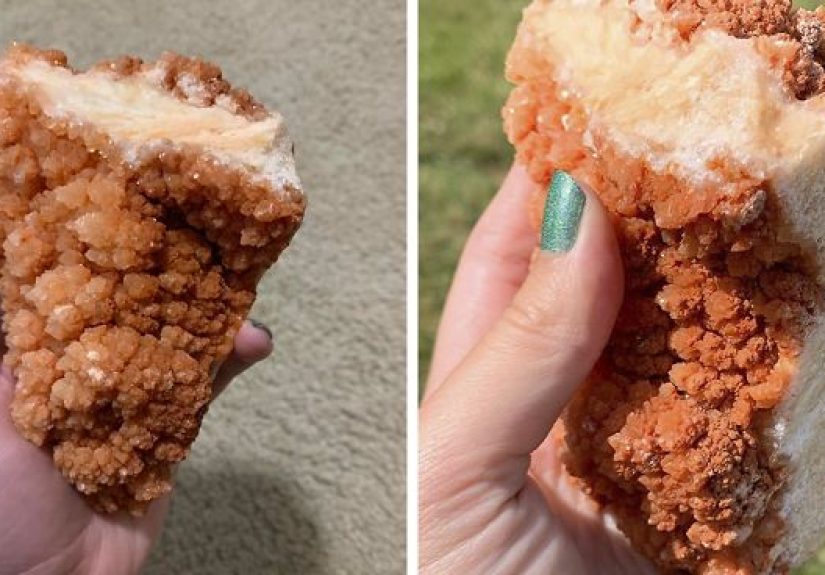
Some agate slices look like cheesecake, citrus fruit, bacon, caramel, toast, or layers of jelly. These are often the favorites online because the comparison is immediate. Your eyes say “dessert,” your hand says “rock,” and your brain quietly files a complaint.
Why These Crystal Pictures Go Viral
Crystals that look like something else spread quickly because they are easy to enjoy. You do not need a geology degree to understand why a purple geode looks like a magic cave or why a pink banded stone looks like forbidden ham. The joke arrives instantly, and the beauty keeps you looking longer.
There is also a satisfying mix of surprise and recognition. A normal rock becomes more interesting when someone points out that it resembles a planet, a fruit, a face, or a tiny storm cloud. Once you see the resemblance, you cannot unsee it. That is exactly what makes these images perfect for social media: they invite comments, arguments, jokes, and the classic response, “Wait, I thought that was food.”
The best crystal lookalike photos also make people more curious about minerals. A person who clicks for the joke may stay to learn about agate banding, quartz varieties, crystal habit, inclusions, or geode formation. That is the hidden charm of the trend. It turns a funny image into a doorway for science.
How to Spot Your Own Crystal Lookalikes
You do not need a museum-grade collection to find a crystal that resembles something else. Start by looking at color, outline, texture, internal pattern, and shine. A rounded mineral cluster may suggest fruit. A banded slice may resemble a landscape. A metallic crystal may look architectural. A translucent point may resemble ice, glass, or a movie prop from a frozen kingdom.
Lighting matters. A crystal that looks ordinary under dim indoor light may suddenly show hidden bands, flashes, clouds, or inclusions near a window. Rotating the specimen can reveal a new shape. Sometimes the “thing” appears only from one angle, which is also how many humans look good in selfies, so let us not judge the rock.
Background also changes perception. Place a blue celestite cluster on a white surface and it may look icy. Put a green malachite piece beside a plant and its forest-like pattern becomes stronger. Photograph an agate slice with backlighting and the whole stone may look like stained glass, caramel, or a tiny sunrise.
Experience Section: What It Feels Like to Discover Crystals That Look Like Something Else
The funniest part of collecting or browsing unusual crystals is the moment of double vision. At first, you are just looking at a mineral. Then your brain sneaks in wearing a tiny detective hat and says, “Excuse me, that is clearly a pancake.” Suddenly, the stone is not just a stone anymore. It has personality. It has a backstory. It may even have breakfast energy.
Many people experience this while walking through gem shows, museum halls, rock shops, flea markets, or even online galleries. One tray may be full of ordinary-looking stones, and then one piece jumps out because it looks like a miniature landscape. A slice of agate becomes a beach at sunset. A smoky quartz point resembles a shard from an ancient ice palace. A bubbly chalcedony cluster looks like grapes that were left in a wizard’s pantry for 400 years.
There is a playful thrill in showing someone else. You hold up the specimen and ask, “What does this look like?” If they see it immediately, the room gets that little spark of shared discovery. If they do not see it, you rotate the piece, point at the pattern, squint dramatically, and become a courtroom lawyer defending the case of “This crystal definitely looks like lasagna.” The debate is half the fun.
These experiences also make mineral collecting feel more personal. A collector may choose a stone not because it is rare or expensive, but because it looks like a tiny moon, a sleeping animal, a candy cube, or a stormy ocean. That emotional connection matters. It turns a specimen into a conversation piece. Guests may not remember the mineral name, but they will remember “the rock that looks like a slice of cake.” Honestly, that is branding.
For beginners, lookalike crystals are a friendly entrance into geology. Technical terms can feel intimidating at first: crystal habit, cleavage, luster, inclusions, hydrothermal growth, botryoidal formation. But when those concepts are attached to something memorable, they become easier to understand. Botryoidal means grape-like. Dendritic means branch-like. Banded agate looks layered because minerals were deposited over time. Suddenly, the science stops feeling like a textbook and starts feeling like a treasure hunt.
Photographing these pieces can be just as enjoyable. A simple phone camera, natural light, and a clean background are often enough. The goal is not to fake the resemblance but to reveal it. Tilt the stone slowly. Try side light. Use a darker background for pale crystals and a lighter background for dark stones. Avoid over-editing because the natural weirdness is already doing all the comedy work. The best photos make viewers say, “That cannot be real,” followed by, “Where can I see more?”
There is also a relaxing quality to the whole activity. Looking closely at mineral patterns slows you down. You notice lines, bubbles, fractures, colors, shadows, and textures. In a world where everyone scrolls at the speed of a caffeinated squirrel, spending a few minutes with a crystal that looks like a tiny forest can feel oddly grounding. It is curiosity without pressure. You do not have to be an expert. You just have to look.
That is why “crystals that look like something else” remains such an appealing topic. It blends humor, beauty, science, collecting, and imagination. Whether the specimen looks like food, a landscape, a galaxy, a flower, or a dragon egg, it reminds us that nature has an excellent sense of design and, occasionally, a suspiciously good sense of humor.
Conclusion
Crystals that look like something else are more than pretty internet curiosities. They are tiny reminders that the Earth makes patterns in ways that surprise both scientists and casual viewers. A mineral can be chemically ordinary and visually extraordinary. It can grow according to natural laws and still look like dessert, a forest, a frozen cave, or a tiny planet.
The magic comes from both sides: geology creates the shapes, and the human brain supplies the comparison. Together, they turn stones into stories. So the next time you see a crystal that looks like cheesecake, grapes, dragon eggs, or a miniature mountain range, enjoy the jokebut also appreciate the long natural process that made the punchline possible.
Note: This article is original, publication-ready web content based on real mineralogy concepts, visual perception science, and public crystal-lookalike trends. It does not copy captions or descriptions from the original photo collection.