Table of Contents >> Show >> Hide
- A Boutique Hotel Rooted in Gowanus, Brooklyn
- The Robert Bechtle Influence: Fifties Americana Without the Kitsch
- Industrial Meets Old Americana
- Guest Rooms: Compact, Warm, and Clever
- Custom Furniture as Storytelling
- Branding That Matches the Building
- How Gowanus Shapes the Hotel’s Identity
- Why Fifties Americana Works in a Brooklyn Hotel
- Design Lessons From Gowanus Inn & Yard
- Experiences Inspired by Gowanus Inn & Yard and Fifties Americana
- Conclusion
Some hotels whisper luxury. Others shout it from a marble lobby while a chandelier tries to look important. Gowanus Inn & Yard, the Brooklyn boutique hotel that arrived in the industrial-edged Gowanus neighborhood, took a much more interesting route: it borrowed the mood of Fifties Americana, filtered it through concrete, oak, red brick, muted color, and a little Brooklyn attitude, then turned the result into a place that felt both nostalgic and refreshingly unpolished.
The phrase “Fifties Americana” can easily go wrong. Think too many chrome stools, jukebox clichés, and enough cherry-red vinyl to make a diner booth blush. But Gowanus Inn & Yard was not designed as a theme park. Its interiors were inspired by the quiet American optimism found in Robert Bechtle’s painting ’61 Pontiac, a work associated with suburban family life, the family car, and a midcentury sense of everyday aspiration. Instead of copying the 1950s literally, Savvy Studio translated that feeling into a hospitality design language: warm but restrained, familiar but modern, and practical without becoming boring.
The result is a hotel that tells a very Brooklyn story. It sits in Gowanus, a neighborhood known for old warehouses, creative studios, changing real estate, and the famously polluted but historically important Gowanus Canal. In that context, the hotel’s mix of industrial surfaces and Old Americana details makes sense. This is not a polished Midtown tower pretending to be edgy. It is a small hotel shaped by its surroundings, where concrete walls, white-painted brick, oak wood, custom furniture, and faded tones work together like a well-edited vintage record collection.
A Boutique Hotel Rooted in Gowanus, Brooklyn
Gowanus Inn & Yard was designed as a 76-room boutique hotel in Brooklyn, near Park Slope and close to the industrial corridor that has long defined this part of the borough. The neighborhood has always had a layered personality: part manufacturing district, part artist haven, part development frontier, part canal-side urban experiment. That tension gives the hotel its strongest design advantage. Instead of hiding the area’s grit, the interiors lean into it.
The hotel’s five-story scale feels neighborhood-friendly rather than overwhelming. It does not try to erase the warehouse character around it. Instead, it responds to that context with exposed textures, honest materials, and built-in furniture that feels more crafted than decorative. In a city where hotel rooms often seem designed by someone who has never owned a suitcase, Gowanus Inn & Yard makes storage and function part of the aesthetic. Beds with drawers, built-in bookcases, and compact layouts show how small-space hospitality can still feel intentional.
The Robert Bechtle Influence: Fifties Americana Without the Kitsch
The central design reference for Gowanus Inn & Yard is Robert Bechtle’s ’61 Pontiac, a painting that captures a family and their car with a calm, almost photographic eye. The car represents more than transportation. It suggests comfort, mobility, middle-class aspiration, and the sunny confidence of postwar America. Savvy Studio did not turn the hotel into a museum of tailfins and soda fountains. Instead, the studio extracted the emotional palette of the image: optimism, familiarity, modest glamour, and the everyday beauty of ordinary materials.
This is what makes the interiors work. The hotel’s Fifties Americana inspiration appears in subtle ways: red and blue upholstery, warm wood, vintage-leaning lighting, custom seating, and a lobby atmosphere that feels like a meeting point rather than a photo backdrop. The effect is nostalgic, but not trapped in the past. It is the design equivalent of hearing an old song remastered well: recognizable, warm, and much cleaner than the original record probably sounded.
Industrial Meets Old Americana
The strongest visual move at Gowanus Inn & Yard is the balance between industrial Brooklyn and Old Americana. Concrete walls and ceilings create a raw, urban foundation. White-painted brick softens the mood. Red brick floors, including herringbone patterns in the lobby, add depth and rhythm. The furniture brings in color and comfort, with blue and red tones that nod to Americana without waving a flag in your face.
The lobby is where this mix becomes most visible. High ceilings allow natural light to fill the space, while custom seating creates areas for guests to gather, wait, work, or perform the ancient hotel ritual of pretending not to check whether the room is ready yet. Potted plants and velvet furniture in faded colors keep the space from feeling cold. The atmosphere is social but not loud, stylish but not precious.
The Blue Door and the First Impression
A hotel entrance has one job: make you feel like you have arrived somewhere. Gowanus Inn & Yard does that with a black-and-white striped awning and a bright blue door set in an iron frame. The blue is bold, almost cinematic, and it gives the exterior a memorable identity. Against the neighborhood’s industrial backdrop, the door acts like a visual wink. It says, “Yes, there is concrete here, but there is also personality.”
Guest Rooms: Compact, Warm, and Clever
The guest rooms continue the theme of functional design with local character. Oak floors and ceilings bring warmth to otherwise simple rooms. Custom built-in beds and bookcases echo the old warehouse language of the neighborhood, where utility often becomes beauty by accident. The rooms avoid the generic hotel formula of beige carpet, anonymous art, and a desk chair that appears to have been designed by a committee with back pain.
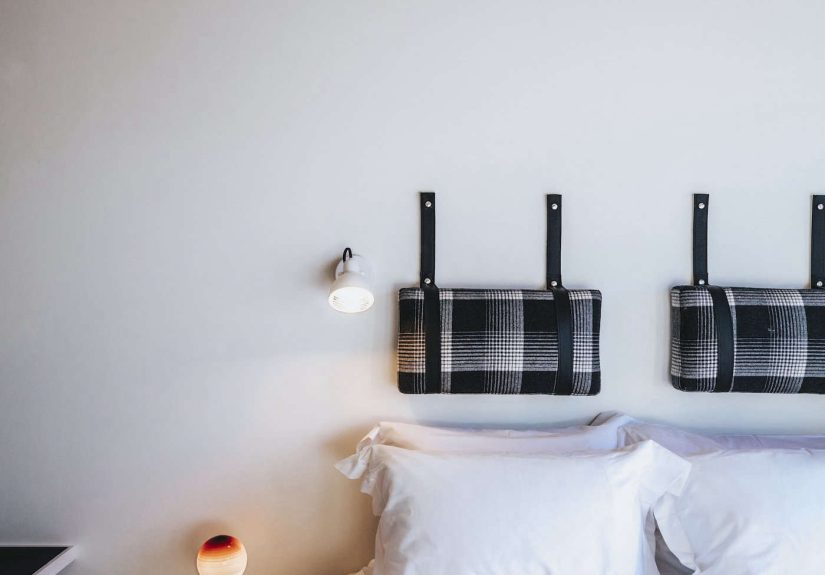
Instead, the details are specific. Some headboards use plaid black-and-white wool fabric with leather hanging straps. Lighting is soft and restrained, including lantern-like fixtures that add atmosphere without clutter. Storage is integrated into the furniture, making the room feel efficient rather than cramped. Bathrooms include simple white sinks, modern fixtures, and custom toiletries, all of which support the hotel’s “simple but considered” design philosophy.
Why the Rooms Feel More Personal Than Standard Hotel Rooms
The best boutique hotels understand that personality does not require chaos. A room can be minimal and still memorable if the details are tactile, useful, and connected to the place. Gowanus Inn & Yard uses wood, wool, leather, concrete, and carefully selected fixtures to give each room a sense of texture. Nothing needs to scream. The materials do the talking, and thankfully, they do not use hotel brochure language.
Custom Furniture as Storytelling
One of the hotel’s most distinctive features is its use of custom furniture. Savvy Studio worked with collaborators, including designers involved in lobby furniture and interior details, to create pieces that support the narrative. Banquettes, sectionals, armchairs, tables, and chandeliers are not treated as afterthoughts. They are part of the brand identity.
This matters because furniture is often where hotel design succeeds or collapses. A beautiful lobby with uncomfortable seating is just a waiting room wearing expensive shoes. At Gowanus Inn & Yard, the seating groups encourage gathering. The custom pieces help create a sense of place, while the red, blue, earth-tone, and neutral palette brings warmth into the concrete-heavy environment.
Branding That Matches the Building
The branding of Gowanus Inn & Yard was also handled with a design-first approach. The name itself suggests contrast: “Inn” brings hospitality and intimacy; “Yard” suggests utility, openness, and industrial Brooklyn. That pairing neatly captures the hotel’s concept. It is both welcoming and rough-edged, both domestic and urban.
Inside, details such as custom-labeled toiletries, vintage-style room signage, and carefully chosen finishes help the brand feel complete. This is an important lesson for hotel design: branding is not just a logo at the front desk. It is the way the hallway feels, the way the bathroom fixtures look, the way the chair sits in the corner, and the way a guest remembers the door color three weeks later.
How Gowanus Shapes the Hotel’s Identity
Gowanus is not a neutral backdrop. The neighborhood’s history is too strong for that. Long associated with manufacturing, warehouses, and the canal, it has also become known for artists, performance spaces, bars, restaurants, creative businesses, and rapid redevelopment. The Gowanus Canal is undergoing long-term environmental cleanup, while rezoning has brought major residential construction and debate about the future of the area.
In that changing landscape, Gowanus Inn & Yard reflects a specific moment in Brooklyn hospitality. It captures the period when travelers increasingly wanted hotels that felt local, not interchangeable. The hotel’s interiors do not pretend that Gowanus is polished. They embrace the warehouse vocabulary, the handmade spirit, and the unusual beauty of a neighborhood in transition.
Why Fifties Americana Works in a Brooklyn Hotel
At first, Fifties Americana and Gowanus might seem like an odd pairing. One suggests suburban driveways, family cars, and postwar optimism. The other suggests canal-side industry, brick warehouses, and creative grit. But that contrast is exactly the point. The hotel does not recreate the 1950s; it uses Americana as an emotional reference. It borrows the mood of comfort, familiarity, and optimism, then sets it against the rough textures of contemporary Brooklyn.
This combination prevents the design from becoming too nostalgic or too industrial. Too much Americana can feel costume-like. Too much concrete can feel like sleeping inside a parking structure with better towels. Together, they create balance. The warm colors soften the raw materials. The industrial backdrop keeps the retro references grounded. The result is a hotel interior that feels lived-in before it has even aged.
Design Lessons From Gowanus Inn & Yard
For homeowners, designers, and hotel lovers, Gowanus Inn & Yard offers several practical design lessons. First, inspiration works best when it is interpreted, not copied. The hotel did not fill the lobby with literal 1950s props. It translated a painting’s mood into color, material, and atmosphere.
Second, local context matters. A boutique hotel should feel like it belongs where it is. In Gowanus, that means concrete, brick, wood, and industrial references. In another city, the same concept would need a different material story.
Third, storage can be beautiful. Built-in beds, drawers, and bookcases make small rooms more usable while also creating architectural character. This is especially relevant in New York, where every square foot has the emotional value of beachfront property.
Finally, color does not have to be loud to be memorable. The hotel’s faded reds, blues, earth tones, and neutral surfaces create a palette that feels nostalgic without becoming cartoonish. It is proof that Americana can be sophisticated when it stops trying to sell you a milkshake.
Experiences Inspired by Gowanus Inn & Yard and Fifties Americana
Staying in or simply studying a hotel like Gowanus Inn & Yard invites a slower kind of travel experience. Instead of treating the hotel as a place to drop luggage and collapse after walking 20,000 steps, guests are encouraged to notice the setting. The lobby becomes a transition zone between the street and the room, between industrial Brooklyn and the softer nostalgia of the interiors.
A good experience might begin at the entrance, where the striped awning and blue door create a strong first impression. From there, the lobby’s mix of plants, brick, concrete, and custom seating sets the tone. You can imagine arriving after a day in Brooklyn, sitting down with a coffee or a drink, and feeling that the space is relaxed enough for sneakers but designed enough for a second look. That balance is rare. Many hotels either feel too formal or too forgettable. This one aims for the middle ground: casual, crafted, and quietly stylish.
The neighborhood adds another layer to the experience. Gowanus is the kind of place where a walk can take you past old industrial buildings, new apartments, creative studios, restaurants, and canal views that are more fascinating than conventionally pretty. It is not postcard Brooklyn in the brownstone-only sense. It is messier, stranger, and more interesting. That makes the hotel’s design feel even more appropriate. The interiors do not fight the neighborhood; they translate it.
For travelers interested in interior design, the hotel offers a useful case study in how to build atmosphere without overdecorating. The rooms show how natural wood can warm up a compact space. The bathrooms demonstrate how simple fixtures can look refined when the surrounding materials are well chosen. The lobby proves that custom seating and a clear color story can make a public space feel memorable without needing enormous square footage.
For anyone trying to bring a similar mood home, the lesson is not to buy a neon diner sign and call it a day. Start with a restrained base: white walls, warm wood, brick, concrete, or simple plaster. Add one or two Americana-inspired colors, such as faded red, navy, denim blue, cream, or tobacco brown. Choose furniture with clean lines and honest materials. Use leather straps, wool textures, simple metal frames, or vintage-style lighting sparingly. The goal is not to recreate a 1950s living room. The goal is to capture the warmth, optimism, and everyday charm of the era while keeping the space usable today.
Food, drink, and neighborhood exploration can complete the experience. A hotel inspired by Fifties Americana naturally invites thoughts of road trips, diners, and the pleasure of simple rituals: morning coffee, a well-made bed, a quiet lobby corner, a walk through a changing neighborhood. In Gowanus, those rituals become urban rather than suburban. Instead of a Pontiac in a driveway, the backdrop is Brooklyn brick, canal infrastructure, and creative reinvention.
That is why Gowanus Inn & Yard remains interesting as a design story. It is not just about retro inspiration. It is about how memory, place, and hospitality can overlap. The hotel takes a familiar American image and places it inside a neighborhood known for industry and transformation. The result is a design that feels specific rather than generic, nostalgic rather than sentimental, and stylish without trying too hard. In hotel terms, that is a pretty good checkout experience.
Conclusion
Gowanus Inn & Yard shows how boutique hotel design can use nostalgia intelligently. Its interiors inspired by Fifties Americana do not rely on obvious retro tricks. Instead, they translate the quiet optimism of Robert Bechtle’s suburban imagery into a Brooklyn setting shaped by warehouses, concrete, brick, and creative energy. With its 76 rooms, custom furniture, oak details, industrial finishes, and warm Old Americana palette, the hotel became a thoughtful example of place-based hospitality design.
The most successful part of the concept is its restraint. Gowanus Inn & Yard does not shout “1950s.” It suggests it. It does not hide the neighborhood’s industrial character. It frames it. And in doing so, it offers a design lesson that works far beyond Brooklyn: the best interiors are not built from trends alone. They are built from stories, materials, memories, and just enough surprise to make guests look twice.
Note: This article is an original, publication-ready synthesis based on publicly available design, hospitality, neighborhood, and art references. It contains no source-link blocks or citation placeholders inside the HTML article body.