Table of Contents >> Show >> Hide
- The speaking voices of HUNTR/X: the women who built the characters
- The singing voices of HUNTR/X: the artists who make the songs explode
- Why the split casting works so well
- Jinu, the Saja Boys, and the male voices behind the chaos
- The supporting cast that deepens the world
- The music team behind the music team
- Why these real voices matter to the film’s legacy
- Experience section: what it feels like once you know who the real voices are
- Final thoughts
If you watched KPop Demon Hunters and immediately thought, “Hold on, who is actually singing this?” congratulations: you have working ears and excellent instincts. One of the smartest things about the movie is that it feels like a fully formed pop event, not just an animated feature with a few catchy songs sprinkled on top like decorative glitter. The performances hit because the film blends two kinds of talent: voice actors who sell the characters on screen, and powerhouse singers who make the soundtrack feel ready for stadium speakers, dance challenges, and one dramatic mirror performance at 1:14 a.m.
That split is the secret sauce. The movie’s world works because the dialogue performances give HUNTR/X and the Saja Boys real personalities, while the musical performances make them sound like idols who could dominate charts outside the movie. In other words, KPop Demon Hunters does not just ask you to believe these characters are stars. It hands you the proof, turns up the volume, and lets the chorus do the rest.
So who are the real voices behind the phenomenon? Let’s meet the actors, singers, and music-makers who turned this neon-bright demon-slaying fantasy into one of the most talked-about animated music projects in recent memory.
The speaking voices of HUNTR/X: the women who built the characters
Arden Cho as Rumi
Rumi is the center of HUNTR/X, and Arden Cho gives her exactly the kind of presence a leader needs. She sounds confident without becoming cold, polished without feeling robotic, and emotionally guarded in a way that makes the character more interesting, not less. Rumi is the one holding the group together while also carrying her own inner chaos, so the performance has to do a lot of heavy lifting. Cho handles that balance beautifully.
What makes her voice work especially well is the control. Rumi never feels like a generic “strong female lead.” She feels like a performer who has learned how to speak like someone the whole world is watching. That matters in a film about fame, pressure, and public image. Cho gives Rumi the sound of a person who is always half on stage, even when she is emotionally falling apart behind the scenes.
May Hong as Mira
Mira is the one with edge. She is rebellious, sharp, observant, and not especially interested in pretending otherwise. May Hong leans into that energy without making Mira one-note. Instead of turning her into the standard “cool girl with attitude,” Hong gives her warmth under the steel. You hear skepticism, wit, and loyalty all living in the same performance.
That is a big reason Mira lands with viewers. She can look like the toughest person in the room and still feel emotionally legible. Hong’s delivery gives the character texture, and that texture helps HUNTR/X feel like a real trio rather than three archetypes sharing one spotlight.
Ji-young Yoo as Zoey
Every great trio needs the member who can inject fresh energy into almost any scene, and that is Zoey. Ji-young Yoo makes her lively, eager, funny, and emotionally sincere. Zoey could have easily been written as the youngest member who exists mainly to react, but Yoo gives her identity. She sounds hungry to prove herself, deeply attached to her friends, and just a little bit chaotic in the most lovable way.
Her performance also helps ground the group dynamic. When Zoey speaks, the movie gets a jolt of momentum. She feels like the sparkler in the fireworks box: bright, fast, and impossible to ignore. That contrast makes the trio work, because Rumi brings composure, Mira brings bite, and Zoey brings bounce.
The singing voices of HUNTR/X: the artists who make the songs explode
Now we get to the part that sends many viewers straight to the soundtrack and then straight into detective mode. The singing voices behind HUNTR/X are EJAE, Audrey Nuna, and REI AMI. Their work is a huge reason the music does not feel like “movie songs” in the dismissive sense. These tracks sound like songs built to live beyond the film, and the singers perform them like they know exactly how much pressure that kind of mission carries.
EJAE as Rumi’s singing voice
EJAE gives Rumi her vocal identity, and it is a major part of why HUNTR/X feels believable as a top-tier group. Her voice carries both shine and urgency. When the soundtrack needs lift, she provides it. When it needs emotion, she does not oversell it. When it needs a huge, center-stage moment, she sounds like someone who was born under a spotlight and then taught the spotlight better manners.
She is also more than a singer on the project. EJAE is part of the songwriting engine that helped shape the movie’s biggest musical moments, including “Golden.” That matters because you can hear intention in the performance. Rumi’s songs do not just sound well sung; they sound connected to character, story, and emotional stakes.
Audrey Nuna as Mira’s singing voice
Audrey Nuna brings cool confidence to Mira’s musical side. Her tone adds bite, style, and a modern edge that fits the character perfectly. Where EJAE often feels like the emotional and melodic center, Audrey Nuna helps sharpen the group’s sound. She gives HUNTR/X contrast, which is exactly what a memorable pop group needs. No one wants three identical textures stacked together like audio wallpaper.
What Audrey Nuna contributes is attitude with precision. Her delivery feels contemporary and self-aware, which makes Mira’s songs and group parts feel especially slick. If the soundtrack has a side-eye in vocal form, there is a good chance Audrey Nuna is nearby.
REI AMI as Zoey’s singing voice
REI AMI completes the trio with swagger, force, and rhythm-first charisma. Her voice gives Zoey a sharper musical edge and helps the group avoid sounding too polished in a predictable way. Great pop groups need a little spark, a little surprise, and at least one member who sounds like she could start a chorus and a fight in the same breath. REI AMI handles that lane beautifully.
Together, EJAE, Audrey Nuna, and REI AMI do more than sing the songs. They create the illusion that HUNTR/X is not an illusion at all. By the time the hooks hit, the question is no longer whether the group sounds real. The question is whether your playlist is emotionally prepared.
Why the split casting works so well
Some fans are surprised to learn that the speaking cast and singing cast are not the same for the three leads. But in a project like this, the split makes creative sense. Voice acting and pop performance are related skills, not identical ones. One requires emotional nuance in dialogue scenes and character interaction. The other demands vocal identity strong enough to carry chart-level songs. KPop Demon Hunters decided not to compromise on either side.
That choice pays off. The actors make the characters feel alive, while the singers make the group feel famous. Instead of asking one performer to do everything at an equally elite level, the film assembles a dream team. The result is a movie where the story scenes feel emotionally grounded and the musical numbers feel large, glossy, and commercially convincing. In plain English: the film gets to be both a solid character piece and a total banger factory.
Jinu, the Saja Boys, and the male voices behind the chaos
Ahn Hyo-seop as Jinu
Jinu has to be many things at once: heartthrob, threat, mystery, and emotional complication with excellent cheekbones. Ahn Hyo-seop gives him the right vocal presence for all of it. His speaking performance carries charm and danger in the same breath, which is exactly what the character needs. Jinu has to sound like someone fans would adore and someone the audience should absolutely not trust too easily. That is a narrow lane, and Ahn drives it smoothly.
On the music side, the film treats the Saja Boys as a group effort. The standout male vocal lineup on the soundtrack includes Andrew Choi, Neckwav, Danny Chung, Kevin Woo, and samUIL Lee. Their performances on songs like “Soda Pop” and “Your Idol” help the rival group sound polished, seductive, and strategically irresistible. Andrew Choi also stands out on “Free,” the duet that gives the soundtrack one of its most emotionally open moments.
This is another place where the movie gets smart. The Saja Boys do not sound like filler villains with nice hair. They sound like a real competitive threat. Their songs are catchy enough to explain why in-universe fans would be obsessed, and that makes the story conflict much stronger.
The supporting cast that deepens the world
The movie’s vocal world extends far beyond the central group, and the supporting cast adds a lot of flavor to the entire project.
Byung Hun Lee as Gwi-Ma
Every fantasy-musical-action hybrid needs a villain voice that can haunt the room before the room knows it has been haunted. Byung Hun Lee brings exactly that energy to Gwi-Ma. His performance gives the movie weight and menace, which keeps the tone from floating away on pure sparkle.
Yunjin Kim as Celine
As Celine, Yunjin Kim adds elegance, authority, and emotional history. She helps anchor the film’s more serious themes, especially the ones tied to legacy, sacrifice, and the cost of trying to protect someone you love.
Ken Jeong as Bobby
Ken Jeong gives Bobby the right frantic-manager energy. He is funny, loud, supportive, and exactly the kind of person who seems one iced coffee away from either solving a crisis or causing one. In a movie full of intensity and spectacle, that comic timing matters.
Daniel Dae Kim, Liza Koshy, and Joel Kim Booster
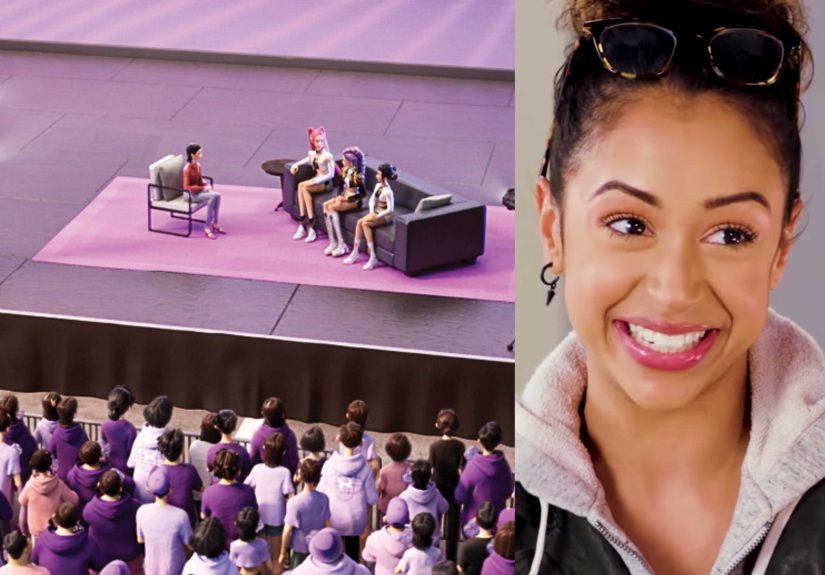
Daniel Dae Kim brings calm credibility as the Healer, Liza Koshy adds pop-energy flair as the Host, and Joel Kim Booster lends his voice to multiple supporting parts. Together, they make the world feel fuller, busier, and more entertaining. Good ensemble casting is like seasoning: you only notice how important it is when it is missing.
The music team behind the music team
If the voices are the stars, the producers and songwriters are the architects. The soundtrack did not happen by accident, and it definitely did not happen because someone tossed a synthesizer into the room and wished for the best. The film’s music was built by a team with serious pop and K-pop credibility, including executive music producer Ian Eisendrath and creators such as TEDDY, 24, IDO, Lindgren, Jenna Andrews, Stephen Kirk, Danny Chung, and others.
That matters because KPop Demon Hunters never sounds like it is imitating K-pop from a distance. The songs feel informed by the genre’s theatricality, precision, and emotional scale. They are built for character storytelling, yes, but they are also built to stand on their own. That is why tracks from the movie connected so strongly with listeners. They are not just functional soundtrack songs. They are songs-songs.
The film also wisely brought in real K-pop star power beyond the main cast. The credits version of “Takedown” performed by TWICE members Jeongyeon, Jihyo, and Chaeyoung adds another layer of authenticity and fan appeal. It is the kind of choice that tells viewers the project understands the culture it is playing with and wants to participate in it seriously.
Why these real voices matter to the film’s legacy
What makes the vocal casting of KPop Demon Hunters so compelling is not just celebrity recognition. It is the way the film builds a bridge between animation, pop performance, and Korean cultural influence without flattening any of them. The actors give the characters emotional truth. The singers give the songs commercial electricity. The producers give the whole thing shape. And the result is a project that feels collaborative in the best way.
It also helps explain why the movie inspired such intense fan curiosity. Viewers did not want to know who the real voices were because the illusion failed. They wanted to know because the illusion worked so well. When fictional idols sound this convincing, people naturally go looking for the real artists behind the curtain. Then they discover there is not just one curtain. There is a whole velvet backstage operation, and almost everyone back there is wildly talented.
In that sense, the real voices behind KPop Demon Hunters are not trivia. They are the reason the movie sticks. They are the reason the songs linger after the credits. They are the reason fans start with “Who was that?” and end with “Why is this soundtrack running my life now?”
Experience section: what it feels like once you know who the real voices are
There is a very specific kind of joy that hits after you learn who is actually behind the voices in KPop Demon Hunters. The first time through, you are just trying to keep up with the visual candy, the demon-fighting, the performances, and the fact that the soundtrack has no business being this addictive. The second time, though, something changes. You stop watching only the characters and start listening for the people behind them. Suddenly, the movie becomes a layered performance puzzle, and that makes it even more fun.
For a lot of viewers, the experience starts with one song. Maybe it is “Golden.” Maybe it is “How It’s Done.” Maybe it is one of those tracks that sneaks into your head while you are doing something painfully ordinary, like folding laundry or pretending to answer emails. You hear it again and realize the vocals do not just sound good. They sound specific. One voice cuts through with emotional shine. Another adds attitude. Another brings rhythmic bite. Then curiosity takes over, and down the rabbit hole you go.
Once you know that Arden Cho, May Hong, and Ji-young Yoo are the speaking heartbeat of HUNTR/X, while EJAE, Audrey Nuna, and REI AMI are the singing pulse, the movie starts to feel even more impressive. You notice how carefully the parts fit together. The dialogue performances establish the characters’ personalities, and the songs extend those personalities rather than replacing them. That creates a strange and wonderful effect: the illusion becomes more visible, but the magic gets stronger anyway.
The fan experience gets even richer when you explore the soundtrack outside the movie. Listening on its own, you can hear how intentionally the group sound was built. HUNTR/X does not feel like a random trio assembled in post-production. The voices complement one another in a way that mirrors actual pop-group chemistry. That is why fans started treating the songs like real releases instead of simple soundtrack extras. The music invites that behavior. Honestly, it practically demands it.
Then there is the emotional side of it. Learning that these performers come from different corners of acting, songwriting, and music makes the project feel bigger than a clever casting trick. It feels like a meeting point for artists with different strengths, all contributing to one shared fantasy. That kind of collaboration gives the film heart. It reminds you that pop spectacle is not shallow when it is built well. It is craftsmanship wearing rhinestones.
There is also a special thrill in recognizing how the male vocals work on the soundtrack. The Saja Boys songs are not just catchy because the movie needs villains with hooks. They sound convincing because the vocal performers give them the smooth, polished danger of a real rival group. That makes every musical face-off more satisfying. You are not watching heroes sing against cardboard antagonists. You are watching one carefully crafted sound battle another.
And maybe that is the biggest experience this movie offers: delight that deepens with knowledge. Usually, explaining the trick makes the trick less magical. Here, the opposite happens. The more you learn about the real voices behind KPop Demon Hunters, the more impressive the whole production becomes. You appreciate the actors more. You appreciate the singers more. You appreciate the music team more. And before long, you are not just a viewer anymore. You are the kind of fan who knows exactly who is singing, exactly why it works, and exactly which song you are about to replay for the fourth time today. No judgment. The demons would understand.
Final thoughts
KPop Demon Hunters works because it respects performance at every level. It casts strong actors for character work, elite singers for the musical identity, and experienced producers for the soundtrack’s architecture. The result is a film that sounds as good as it looks and feels as convincing as any fictional pop phenomenon has a right to feel. So yes, HUNTR/X may be animated. But the voices behind them are very real, very skilled, and a huge reason the movie leaves such a lasting mark.