Table of Contents >> Show >> Hide
A stroke is already a medical emergency. A massive stroke is the
kind of emergency that makes doctors move faster, call extra teams, and clear
hallways. While the term “massive” isn’t an official diagnosis, it’s commonly
used to describe a very large stroke that affects a big area of the brain, often
with severe symptoms and a high risk of complications.
If you or a loved one has heard the phrase “massive stroke” in the ER, it can feel
terrifying and confusing. This guide breaks down what that term usually means,
how massive strokes show up, what treatment options exist, how recovery works,
and what life can look like afterward – in clear language, with a dash of warmth,
and zero medical jargon for its own sake.
What Is a Massive Stroke?
A stroke happens when part of the brain suddenly stops getting the blood and
oxygen it needs. Brain cells begin to die within minutes. That’s true for any
stroke. A massive stroke usually means:
- A large area of brain tissue is damaged (often a whole territory of a big artery).
- Symptoms are severe – such as coma, paralysis on one side, or inability to speak.
- There’s a high risk of brain swelling, disability, or death without rapid treatment.
Doctors may use more precise terms in your chart, like
large hemispheric infarction, malignant middle cerebral artery (MCA) infarction,
or large intracerebral hemorrhage. But families often hear the shorter, blunter
version: “massive stroke.”
Is “Massive Stroke” an Official Diagnosis?
Technically, no. It’s a descriptive phrase, not a formal diagnosis code.
Neurologists think in terms of:
- Type: ischemic vs. hemorrhagic stroke.
- Location: which artery or brain region is affected.
- Size: small, moderate, or large territory.
- Complications: swelling, pressure in the skull, or herniation (dangerous shifting of brain tissue).
When these factors add up to a large, life-threatening event, the team may call it
“massive” while explaining it to families. Think of it as shorthand for:
“This is very serious, and we need to act quickly.”
Ischemic vs. Hemorrhagic Massive Stroke
Most strokes – including many massive ones – are
ischemic strokes, caused by a clot that blocks blood flow in a brain artery.
When that clot affects a large artery (like the middle cerebral artery), a big section of
brain tissue can be starved of oxygen at once.
A hemorrhagic stroke happens when a blood vessel in the brain bursts and
bleeds into or around the brain. A large bleed can cause rapid swelling and pressure,
often leading to sudden loss of consciousness. These strokes are less common but often
more deadly.
In everyday language, both a huge ischemic stroke and a large brain bleed might be
described as “massive.”
Warning Signs and Symptoms of a Massive Stroke
Massive strokes usually don’t sneak in quietly. Symptoms tend to be dramatic and
sudden. The classic rule to remember is F.A.S.T. (or the expanded
B.E. F.A.S.T.):
- B – Balance: Sudden loss of balance or coordination.
- E – Eyes: Sudden trouble seeing in one or both eyes.
- F – Face: One side of the face droops when smiling.
- A – Arm: One arm is weak or drifts downward when raised.
- S – Speech: Slurred speech or difficulty speaking or understanding.
- T – Time: Time to call emergency services immediately.
Common Symptoms in Massive Stroke
While any stroke can cause these signs, massive strokes often bring multiple symptoms
at once and may progress quickly:
- Sudden paralysis or severe weakness on one side of the body.
- Inability to speak or understand language (aphasia).
- Severe confusion or sudden loss of awareness.
- Sudden, very severe headache with no known cause (more common in hemorrhagic stroke).
- Loss of vision on one side or complete visual changes.
- Sudden collapse, decreased consciousness, or coma.
One important point: symptoms may appear, improve slightly, and then worsen again.
If someone has stroke-like symptoms – even if they fade – this is still an emergency.
It can be a warning shot before a major stroke.
Why Massive Strokes Happen: Types and Causes
Understanding the “why” doesn’t change what’s happening in the moment, but it can help
with prevention and long-term planning.
Large-Vessel Ischemic Stroke
Many massive strokes are large-vessel ischemic strokes, where a major brain
artery is suddenly blocked by a clot. That clot may come from:
- Atherosclerosis (plaque buildup) in large arteries like the carotids.
- Heart rhythm problems, especially atrial fibrillation, which can send clots to the brain.
- Heart valve disease or recent heart attack.
- Blood clotting disorders or rare vascular conditions.
When these clots lodge in a major artery, a huge volume of brain tissue loses its blood
supply at once. This is the neurological equivalent of a city-wide blackout, not just a
flickering lamp.
Hemorrhagic Massive Stroke
A massive hemorrhagic stroke can occur when:
- Long-standing high blood pressure weakens a brain vessel until it bursts.
- An aneurysm (a ballooned, weak spot in an artery) ruptures.
- Abnormal tangles of blood vessels (arteriovenous malformations) bleed.
- Blood thinners or bleeding disorders increase the risk of a large bleed.
The leaked blood increases pressure inside the skull, compressing brain tissue. In large
hemorrhages, this pressure can build rapidly and become life-threatening within minutes
to hours.
Risk Factors You Can (and Can’t) Change
Common risk factors for massive stroke include:
- High blood pressure (the number one modifiable risk factor).
- Smoking and vaping nicotine products.
- Diabetes and high cholesterol.
- Obesity and physical inactivity.
- Heavy alcohol use or illicit drugs (such as cocaine or amphetamines).
- Atrial fibrillation and other heart conditions.
- Age, family history, and certain genetic conditions (non-modifiable factors).
You can’t negotiate with your genes or your birthdate, but you can work with your
healthcare team on blood pressure, cholesterol, diabetes, and lifestyle – all of which
dramatically affect stroke risk.
Emergency Treatment: What Happens After a Massive Stroke?
When someone arrives in the emergency department with suspected stroke, time is
everything. You may hear the phrase “time is brain,” because millions of brain cells
can die each minute the brain stays blocked or bleeding.
Stroke Evaluation in the ER
After quick triage, the team typically:
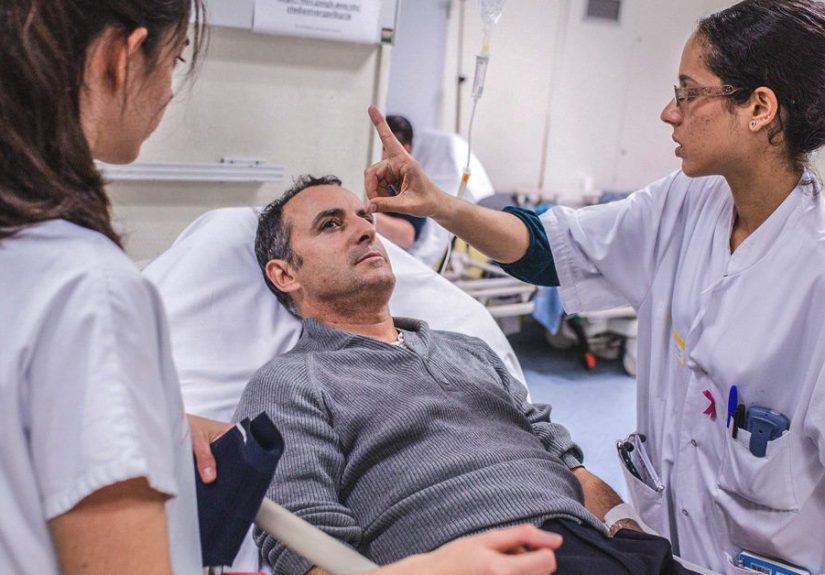
- Performs a rapid neurological exam.
- Checks blood pressure, heart rhythm, oxygen level, and blood sugar.
- Orders urgent brain imaging – usually a CT scan, sometimes an MRI.
- Looks at arteries in the neck and brain with CT or MR angiography.
- Draws blood to check clotting, electrolytes, and other critical values.
The main goal: figure out fast whether this is an ischemic or hemorrhagic stroke and
how large and severe it is. Those answers guide treatment.
Ischemic Massive Stroke: Clot-Busting and Clot-Removing Treatments
For large ischemic strokes, the team may consider:
-
Thrombolytic (“clot-busting”) medication given through a vein if the
patient arrives within a strict time window and meets safety criteria. -
Mechanical thrombectomy, a procedure where a specialist threads a
catheter into the blocked artery and physically removes the clot, usually within up to
24 hours of symptom onset for selected patients.
These treatments don’t guarantee a full recovery, but they can reduce the size of the
stroke and improve the chances of meaningful function later.
Managing Swelling: Decompressive Surgery
One major danger of a massive stroke is brain swelling. As injured tissue
swells, pressure inside the skull rises, which can squeeze and shift brain structures.
If this pressure becomes too high, it can be fatal.
In selected patients with large strokes, surgeons may perform a
decompressive hemicraniectomy or decompressive craniectomy.
In this procedure:
- A portion of the skull is removed temporarily.
- The swollen brain has more room to expand without being crushed.
- The bone flap is usually replaced later once swelling has gone down.
This surgery can significantly reduce the risk of death in some patients, especially
younger adults with large ischemic strokes. However, survivors may still have moderate
to severe disability, so families and doctors often have deep conversations about goals,
expectations, and quality of life before proceeding when possible.
Hemorrhagic Massive Stroke: Stopping the Bleeding
For a large brain bleed, the treatment focus shifts to:
- Controlling blood pressure.
- Reversing blood thinners or clotting problems.
- Relieving pressure in the skull.
- Repairing aneurysms or abnormal vessels when appropriate.
Neurosurgeons may remove a large blood clot or secure a ruptured aneurysm through open
surgery or minimally invasive techniques (like coiling). The exact approach depends on
the location and size of the bleed and the patient’s overall condition.
Recovery After a Massive Stroke
Let’s be honest: recovery from a massive stroke is rarely a quick “get some rest and
you’ll be fine” situation. It’s often a marathon that involves ICU care, rehabilitation,
and major life adjustments. That said, people do regain abilities over time, and many
survivors find new routines, roles, and joys in life.
The First Days: ICU and Acute Care
In the first hours to days, the medical team focuses on:
- Stabilizing breathing and circulation.
- Managing brain swelling and preventing complications like pneumonia or blood clots.
- Monitoring neurological status almost constantly.
- Starting early mobilization and therapy as soon as it’s safe.
Families may see ventilators, IV lines, monitors, and sometimes feeding tubes. It can be
overwhelming, but this stage is about survival and protecting the brain from further harm.
Weeks to Months: Rehabilitation and Regaining Function
Once medically stable, many patients move to an inpatient rehabilitation unit
or specialized rehab hospital. Others go home with intensive outpatient therapy or
receive care in a skilled nursing facility.
A typical rehab plan may include:
- Physical therapy to improve strength, balance, and mobility.
- Occupational therapy to relearn daily activities like dressing, bathing, and cooking.
- Speech-language therapy for speech, language, swallowing, and cognitive skills.
- Neuropsychology or counseling for mood, memory, and behavior changes.
Many studies suggest the fastest improvements often happen in the first three to six
months, but progress can continue for a year or more with ongoing therapy and practice.
Recovery is rarely a straight line; it looks more like a zigzag graph with victories,
plateaus, and occasional setbacks.
Long-Term Outlook After a Massive Stroke
The long-term outcome varies widely and depends on:
- The size and location of the stroke.
- How quickly treatment began.
- Age and overall health before the stroke.
- Access to rehabilitation and support.
Some people with massive strokes remain dependent on others for daily care. Others walk,
talk, and manage many activities with adaptations. Many live meaningful lives with
mobility aids, communication tools, or help from family and caregivers.
Emotionally, depression and anxiety are common after stroke – for both survivors and
caregivers. Screening and treatment for mental health are just as important as physical
rehab. A brain injury isn’t just about muscles and speech; it touches identity,
independence, and relationships.
Preventing Another Stroke
After a massive stroke, preventing a second one becomes priority number one. This may
involve:
- Strict blood pressure control.
- Cholesterol-lowering medication (such as statins).
- Blood thinners or antiplatelet drugs when appropriate.
- Quitting smoking and limiting alcohol.
- Improving diet, sleep, and physical activity within safe limits.
- Managing diabetes, heart disease, and sleep apnea.
It’s not about perfection. It’s about stacking the odds in your favor, one small
habit at a time.
Real-Life Experiences With Massive Stroke: What It Feels Like
Every massive stroke story is different, but many survivors and caregivers describe
patterns that repeat. While these aren’t direct quotes from any one person, they
reflect the kinds of experiences commonly shared in stroke support groups and clinics.
The Moment Everything Changes
For some survivors, the beginning is a blank space. They remember making coffee or
answering a text, and the next clear memory is waking up in the ICU days later.
Others recall a sudden, terrifying moment – one side of the body going heavy, words
tumbling out wrong, or a crushing headache that felt “different from any headache
I’ve ever had.”
Caregivers often describe shock mixed with adrenaline: calling emergency services,
following the ambulance, signing forms, and being asked to make fast decisions about
treatments they’d never heard of before that day. The word “massive” can land like
a punch. Many families say they hear almost nothing after that for a while.
The ICU Bubble
Those early days feel surreal. Machines beep, alarms sound, and different specialists
appear at the bedside. Sleep happens in short bursts. Meals are eaten standing in a
hallway, or not at all. Caregivers sit in uncomfortable chairs, reading the same line
of a book over and over without absorbing any of it.
Small signs become huge sources of hope: a hand squeezing back, a brief moment of
eye contact, a tiny movement on the paralyzed side. At the same time, uncertainty is
exhausting. Families may be told, “We don’t know yet how much function they’ll get
back,” which is honest but deeply unsatisfying when you want guarantees.
The Work of Rehabilitation
Once the medical crisis stabilizes, the story shifts from “Will they survive?” to
“What can they recover?” Rehab is often much harder than people expect. Imagine
re-learning how to sit up, stand, swallow, or tie your shoes when your brain and
muscles no longer work together smoothly.
A typical day in inpatient rehab might include three or more hours of therapy spread
across multiple disciplines. It’s physically and mentally draining. Survivors have
good days when everything “clicks” and bad days when fatigue or frustration makes
progress feel impossible. Therapists often become part coach, part cheerleader,
part detective – figuring out what works for each person.
Adjusting to a New Normal
Months after a massive stroke, people talk about a “new normal” rather than “getting
back to normal.” Maybe that means using a cane or wheelchair, speaking more slowly,
or relying on a partner for complex tasks like managing finances or driving.
Some survivors describe feeling like a different version of themselves: more easily
overwhelmed by noise or crowds, quicker to tire, or less patient than before. Others
discover new hobbies – painting with their non-dominant hand, doing adapted yoga,
or volunteering in stroke support groups. Many say that connecting with other stroke
survivors is one of the most powerful tools for coping. It’s easier to hear “me too”
from someone who’s actually been there.
Caregivers: The Hidden Patients
Massive strokes almost always create a second patient: the caregiver. Spouses, adult
children, siblings, or close friends become care coordinators, medication managers,
drivers, advocates, and emotional anchors. They juggle work, finances, paperwork,
and their own health while trying to be endlessly patient and strong.
Over time, many caregivers realize they need boundaries and backup. Taking breaks,
asking for help, joining support groups, and seeing their own doctor are not luxuries –
they’re essential to surviving the long haul of stroke recovery. Burnout helps no one.
Finding Hope Without Sugarcoating Reality
Massive stroke is serious. It can be life-changing or life-ending. But “serious”
doesn’t always mean “hopeless.” People do adapt. They rebuild skills, relationships,
and routines in ways that would have seemed impossible in those first ICU nights.
The most realistic mindset is often this: hope for improvement, work hard in rehab,
plan for support, and accept that life may look different – but different can still
be meaningful. If you or someone you love is dealing with a massive stroke, you are
not alone, and it’s okay to ask for every bit of help available – medical, emotional,
financial, and practical.
Finally, remember: this article is for general education. It can’t replace
personalized medical advice. For specific questions about diagnosis, treatment options,
prognosis, or recovery, the best source is the healthcare team that knows the full
medical picture.