Table of Contents >> Show >> Hide
- When Lisa Simpson Became the Internet’s Most Questionable Film Critic
- The Backstory: Lisa, Marge, and the Ella McCay Promo
- Why Fans Dragged Elon Musk Into a Movie Promo
- “The Musk Who Fell to Earth” and the Problem With Fawning Cameos
- Does One Bad Take Really Invalidate Lisa’s Movie Taste?
- The Bigger Issue: When Satire Becomes Advertising
- How Ella McCay Fits Into the Debate
- Why Lisa Is the Perfect Target for This Joke
- Fan Culture, Receipts, and the Joy of Overthinking Cartoons
- Is This Really About Elon Musk, or About Trust?
- Specific Examples That Explain the Backlash
- What This Says About Celebrity Culture in The Simpsons
- Experiences and Reflections: Watching Lisa’s Taste Get Put on Trial
- Conclusion: Lisa Can Keep Her Taste, But Fans Get the Last Laugh
Note: This article is written for web publication and synthesizes verified entertainment reporting, official movie information, fan discussion, episode history, and critical commentary without inserting source-link blocks into the article body.
When Lisa Simpson Became the Internet’s Most Questionable Film Critic
Lisa Simpson has spent decades as Springfield’s resident conscience: the saxophone-playing vegetarian, the bookworm, the little girl who can spot moral hypocrisy from three blocks away and still have time to correct your grammar. So when Lisa praises a movie, viewers are trained to listen. She is not Homer, who might call a film “cinema” because it came with nachos. She is not Bart, whose critical standards begin and end with “Was something blown up?” Lisa is supposed to be the careful one.
That is why a recent wave of Simpsons fan chatter landed with such comic force. After Marge and Lisa appeared in a promotional clip praising James L. Brooks’ film Ella McCay, some fans jokingly argued that Lisa’s opinion on movies should no longer be trusted because of one old and very awkward stain on her fictional résumé: her enthusiastic admiration for Elon Musk in the Season 26 episode “The Musk Who Fell to Earth.”
The claim is half-joke, half-pop-culture audit, and entirely online. In the promo, Lisa reacts to Ella McCay as if she has just witnessed the invention of democracy, emotional healing, and premium theater popcorn all at once. Marge is more measured, but still approving. The problem, according to skeptical fans, is that Lisa once treated Musk like a once-in-a-generation genius in an episode many viewers now consider one of the show’s most uncomfortable celebrity showcases. If Lisa could be that wrong about Musk, the joke goes, maybe her movie taste deserves a tiny Springfield parking ticket.
The Backstory: Lisa, Marge, and the Ella McCay Promo
Ella McCay is a political comedy-drama written and directed by James L. Brooks, the Oscar-winning filmmaker behind classics such as Terms of Endearment, Broadcast News, and As Good as It Gets. Brooks is also one of the key creative figures in The Simpsons, which explains why Marge and Lisa could be folded into the film’s promotional campaign without reality immediately collapsing into a chalkboard gag.
The movie stars Emma Mackey as an idealistic young woman balancing political pressure, family chaos, and personal ambition. Its cast includes Jamie Lee Curtis, Woody Harrelson, Albert Brooks, Ayo Edebiri, Kumail Nanjiani, Jack Lowden, Rebecca Hall, Julie Kavner, and others. The official premise sells it as a comedy about the people you love and how to survive them, which sounds like a family Thanksgiving where everyone has a campaign manager.
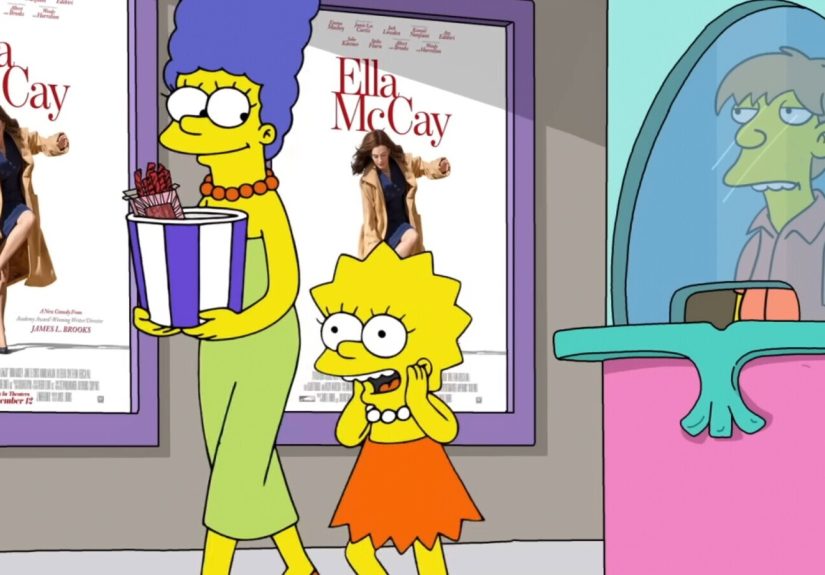
In the Simpsons-branded promo, Marge and Lisa leave Springfield’s Aztec Theater praising the film. Lisa, in particular, reacts with dramatic intensity, presenting the movie as emotionally meaningful and personally validating. That is where fans started sharpening their digital pitchforks. Not because Lisa liked a movie, but because the clip felt like an unusually direct piece of cross-promotion. When fictional characters who once mocked consumer culture suddenly behave like tiny studio publicists, longtime fans notice. They have seen enough Krusty merchandise to know when a sales pitch is wearing yellow skin.
Why Fans Dragged Elon Musk Into a Movie Promo
The Elon Musk connection comes from “The Musk Who Fell to Earth,” the twelfth episode of The Simpsons Season 26, which first aired in January 2015. In the episode, Musk guest stars as himself, lands in Springfield, befriends Homer, inspires technological changes around town, and clashes with Mr. Burns after his innovations become financially disastrous for the nuclear power plant.
At the time, Musk’s public image was very different from the more divisive reputation he carries today. In 2015, he was widely presented in mainstream media as a futuristic entrepreneur associated with Tesla, SpaceX, electric vehicles, rockets, and big ideas. The episode leans heavily into that image. Lisa recognizes him immediately, admires his intellect, and regards him as a visionary figure. For some viewers, even then, the episode felt less like classic Simpsons satire and more like a celebrity tribute basket wrapped in yellow ribbon.
That reaction has only intensified with time. As Musk became a more polarizing figure due to controversies around Twitter/X, public statements, labor criticism, politics, and online behavior, the episode aged like a carton of milk left in the Springfield Elementary music room. A celebrity cameo that may have seemed merely awkward in 2015 now looks, to many fans, like a time capsule of tech-industry hero worship.
“The Musk Who Fell to Earth” and the Problem With Fawning Cameos
The Simpsons has always used celebrity guests. Some of the show’s best cameos worked because the celebrity was willing to be teased, twisted, or turned into a joke. Leonard Nimoy, Adam West, George Harrison, and countless others became funny because the show did not simply bow at their feet. It put them inside Springfield’s absurd moral physics and let chaos do the rest.
The complaint about “The Musk Who Fell to Earth” is that the episode often seems too impressed by its guest. Homer provides accidental inspiration, Musk invents miraculous devices, Burns becomes the villain, and Lisa serves as the in-universe stamp of intellectual approval. Yes, the episode includes some jokes about Musk’s ego and the disruption caused by innovation. But for critics, those jokes do not cut deeply enough. The satire arrives with a rubber knife.
This is why the Lisa angle matters. Lisa is not just any character. She is the show’s moral compass, its overachieving brain, and frequently its voice of reason. When Lisa admires someone, the show often signals that the audience should at least take that person seriously. So when fans revisit her Musk admiration today, they are not only mocking Lisa. They are mocking the show’s decision to let her admiration carry emotional weight.
Does One Bad Take Really Invalidate Lisa’s Movie Taste?
Of course, in a literal sense, no. Lisa Simpson is fictional. She has been eight years old since the Reagan administration, has survived dozens of contradictory futures, and lives in a universe where celebrities routinely wander into town with the confidence of people who have never seen Springfield’s safety record. Holding her to a consistent canon is like asking Homer to maintain a balanced diet: noble, doomed, and likely to end in frosting.
But the joke works because fans understand character credibility. Lisa’s taste is part of her identity. She likes jazz, literature, independent thinking, environmentalism, and causes that require pamphlets. If she suddenly becomes the face of enthusiastic movie promotion, viewers judge that enthusiasm against everything they remember about her. And what they remember includes the Musk episode.
The fan argument is not really “Lisa is bad at movies.” It is more like, “The show has previously used Lisa’s intelligence to endorse a questionable cultural figure, so maybe we should not treat her latest endorsement as sacred.” In other words, Lisa’s fictional taste becomes a proxy for the show’s real-world promotional choices.
The Bigger Issue: When Satire Becomes Advertising
The controversy also taps into a larger frustration with modern entertainment marketing. Audiences are increasingly sensitive to the difference between storytelling and promotion. When a character organically discusses a movie, brand, or celebrity, viewers may accept it. When a beloved character appears to be drafted into a marketing campaign, viewers smell corporate synergy faster than Comic Book Guy smells a continuity error.
The Simpsons has a long history with advertising and branded tie-ins, from Butterfinger commercials to fast-food promotions. That is not new. What is different now is the speed and intensity of online reaction. A one-minute promo can be clipped, shared, mocked, reframed, and debated within hours. Fans do not just watch the ad; they interrogate it. They ask who benefits, why the characters are saying what they are saying, and whether the joke is funny enough to justify the sell.
In the case of Ella McCay, the added wrinkle is James L. Brooks’ deep connection to The Simpsons. Because Brooks helped shape the series, the promo feels less random than a generic celebrity endorsement. But that connection also makes the praise feel more inside-baseball. To some fans, Marge and Lisa supporting a Brooks film reads as affectionate cross-promotion. To others, it feels like Springfield was briefly turned into a billboard with better voice acting.
How Ella McCay Fits Into the Debate
The reaction to the promo was sharpened by the film’s own critical conversation. Ella McCay arrived with a prestigious pedigree: Brooks returning to directing, a strong ensemble cast, and a political-family premise built for emotional comedy. Yet early responses were mixed to negative, with some critics calling the film dated, tonally uneven, or difficult to connect with.
That does not mean the movie has no defenders. Brooks’ work has always leaned into messy families, big emotions, awkward sincerity, and characters who speak as if every conversation might become a turning point. For some viewers, that style is warm and humane. For others, especially in a faster, more irony-heavy media environment, it can feel old-fashioned. The Marge-and-Lisa promo unintentionally amplified that split: if the movie already seemed divisive, having Lisa gush over it gave skeptics a perfect punchline.
And that is where Musk re-enters the chat wearing a spacesuit nobody asked for. Fans used Lisa’s old admiration for Musk as shorthand for “Lisa’s endorsements are not automatically reliable.” It is a joke about taste, but it is also a joke about cultural memory. The internet never forgets, especially when a cartoon child once praised a billionaire and then later tried to sell everyone on a political dramedy.
Why Lisa Is the Perfect Target for This Joke
Lisa is funny because she wants to be right. That is one of her best traits and one of her most human flaws. She is compassionate, intelligent, and brave, but she can also be intense, self-serious, and occasionally blind to her own certainty. When Lisa overpraises something, the joke lands because we recognize the type: the smart person who has turned one opinion into a TED Talk before anyone has finished their soda.
Her Ella McCay enthusiasm fits that pattern. The promo presents her as deeply moved, maybe even transformed. Marge, being Marge, tries to keep things grounded. That contrast is classic Simpsons family chemistry. But fans who remember the Musk episode see another layer: Lisa’s sincerity can be manipulated by whatever the story wants her to admire.
That does not ruin Lisa. In fact, it makes her more interesting. Smart characters should be allowed to have bad takes. A perfect Lisa would be unbearable, like a school assembly that never ends. The humor comes from watching an intelligent character occasionally misfire with total confidence. The issue is not that Lisa once admired Musk. The issue is that the episode around that admiration seemed to share too much of it.
Fan Culture, Receipts, and the Joy of Overthinking Cartoons
Modern fandom runs on receipts. Someone makes a claim, someone else finds a clip from 2015, and suddenly an animated eight-year-old is on trial for crimes against film criticism. This is ridiculous, but it is also part of the fun. The Simpsons has been on television so long that almost every new moment can be compared with an old one. The show is not just a series; it is an archive of American pop culture, celebrity obsession, political jokes, changing technology, and jokes about doughnuts that remain scientifically valid.
The Lisa-Musk-movie-taste debate is a perfect example of how fans engage with long-running shows now. They do not simply ask, “Was the promo funny?” They ask, “What does this say about Lisa? What does it say about the show’s relationship with celebrities? What does it say about using beloved characters as promotional tools? And most importantly, can we make a joke that gets 10,000 likes before lunch?”
That may sound excessive, but The Simpsons invites this kind of analysis. The show built its reputation on satire, cultural references, and jokes that reward close attention. Fans learned from the series itself to be suspicious of institutions, celebrities, corporations, and easy moral answers. So when the show appears to offer a straightforward endorsement, fans naturally respond with skepticism. The show trained them too well.
Is This Really About Elon Musk, or About Trust?
Elon Musk is the headline magnet, but the deeper subject is trust. Fans trusted Lisa’s intelligence. They trusted The Simpsons to puncture celebrity mythology rather than inflate it. They trusted Springfield to be the place where powerful people came to be humbled, not gently polished. “The Musk Who Fell to Earth” challenged that trust for many viewers, and the Ella McCay promo reopened the file.
This is why the phrase “invalidates her movie taste” is funny rather than truly serious. Nobody is actually canceling Lisa’s Letterboxd account. The joke is a compact way of expressing discomfort with endorsements that feel too easy. It says, “We remember when the show got swept up in tech-genius mythology, and we are not letting that slide just because Lisa now has opinions about cinema.”
In that sense, the fan reaction is less about punishing Lisa and more about protecting the show’s satirical edge. Viewers want The Simpsons to be sharp. They want guest stars to be funny, not worshiped. They want Lisa to be brilliant, but not used as a credibility dispenser. And they want movie promos to understand that Springfield fans have long memories and very little patience for being marketed to without a decent joke.
Specific Examples That Explain the Backlash
1. Lisa’s Intellectual Approval Carries Weight
When Homer likes something, it might mean the thing is good, or it might mean the thing contains pork chops. When Lisa likes something, the show usually frames it as thoughtful, meaningful, or morally serious. That gives her endorsement power. Fans mock the Musk connection because her approval once seemed attached to a public figure whose reputation later became far more divisive.
2. The Musk Episode Felt Too Soft to Many Viewers
The best Simpsons celebrity appearances usually make the guest look slightly foolish. In “The Musk Who Fell to Earth,” however, Musk is often treated as a brilliant disruptor whose biggest flaw is caring too much about the future. For critics, that is not satire; that is a commemorative plate.
3. The Promo Made Lisa Sound Like a Studio Blurb
Lisa’s reaction to Ella McCay is intentionally exaggerated, but the exaggeration still serves a promotional purpose. That creates an awkward tension: is the joke that Lisa is overreacting, or are viewers supposed to absorb the praise? Fans chose option three: make fun of the whole thing.
4. Long-Running Shows Cannot Escape Their Past
Because The Simpsons has decades of episodes, every new joke sits on top of a mountain of old jokes. Lisa’s Musk fandom may have been a small part of one episode, but fans can revive it whenever her judgment becomes relevant. Springfield canon is messy, but screenshots are forever.
What This Says About Celebrity Culture in The Simpsons
The conversation also highlights the changing role of celebrity cameos in animation. In earlier decades, a guest appearance felt special because celebrities were less constantly available. Now, public figures are everywhere: podcasts, social media, brand campaigns, cameos, interviews, reaction videos, apology videos, and apology videos for the apology videos. Audiences are more skeptical because fame itself feels more manufactured.
That skepticism affects how viewers look back at episodes like “The Musk Who Fell to Earth.” What once may have seemed like a topical guest spot now feels, to many, like evidence of a cultural moment when tech billionaires were treated as philosopher-inventors with rocket fuel. Lisa’s admiration becomes symbolic of that moment. She is not just praising Musk; she is representing a broader era of uncritical innovation worship.
By contrast, the best Simpsons satire usually punctures hype. It asks what happens when big ideas meet small-town stupidity, greed, laziness, bureaucracy, and human weirdness. That is why Springfield is such a powerful comic setting. It can shrink any grand narrative down to a town hall meeting, a power plant disaster, or a family argument over dinner.
Experiences and Reflections: Watching Lisa’s Taste Get Put on Trial
The funniest part of this whole debate is how familiar it feels. Everyone knows a “Lisa” in real life: the friend who recommends a movie with the intensity of a Supreme Court argument, the classmate who says a film “changed the architecture of empathy,” or the coworker who cannot simply enjoy a drama without explaining how it redefines narrative space. These people are often smart, sincere, and occasionally exhausting. We love them, but we also reserve the right to check their past recommendations.
That is why “Lisa’s Elon Musk fandom invalidates her movie taste” lands as a relatable joke. It mirrors how people evaluate taste in everyday life. If your friend once told you a terrible movie was “underrated,” you remember. If they recommended a restaurant where the chicken had the emotional texture of printer paper, you remember. If they insisted a celebrity was “misunderstood” and then the celebrity spent the next decade generating headlines like a malfunctioning fireworks stand, you definitely remember.
Pop culture taste is never just about the object being judged. It is also about the judge. When someone recommends a movie, album, book, or show, we weigh their history. Do they like slow dramas? Do they overpraise anything with a violin score? Do they think every superhero movie is “actually about grief”? Do they describe three-hour films as “brisk”? Lisa, as a character, has a history too. Her taste is intellectual, earnest, justice-oriented, and sometimes comically overcommitted. That makes her both trustworthy and easy to tease.
The Musk episode functions like an old bad recommendation. Fans are not literally saying Lisa can never have another valid opinion. They are doing what friends do after someone makes a questionable call: they bring it up forever. It becomes part of the group mythology. “Remember when you said that was the best pizza in town?” “Remember when you thought that haircut was Parisian?” “Remember when Lisa Simpson thought Elon Musk was an inspiring intellectual soulmate?” The joke gets funnier because it is petty, specific, and just grounded enough to sting.
There is also a lesson here for entertainment brands. Audiences today are unusually good at detecting when a beloved character is being used as a megaphone. They may accept promotion if it is clever, self-aware, and funny. But if the praise feels too clean, fans will add dirt themselves. The Ella McCay promo tried to use Marge and Lisa’s affection as a warm endorsement. The internet responded by dragging in a decade-old Musk cameo like a surprise witness in a cartoon courtroom.
From a viewer’s perspective, that is not necessarily bad. It keeps the conversation lively. It proves people still care about Lisa as a character. It shows that The Simpsons, even after so many seasons, remains a shared language for jokes about media, marketing, politics, and celebrity culture. A weaker show would not inspire this level of forensic silliness. Nobody digs through old episodes to challenge the taste of a character they do not care about.
Personally, the debate feels less like a takedown of Lisa and more like a celebration of why she works. Lisa is admirable because she tries. She thinks deeply, cares loudly, and sometimes gets things wrong in a way only a smart person can: with footnotes, confidence, and a saxophone solo waiting in the background. Her Musk fandom may be embarrassing in hindsight, but embarrassment is part of being a long-running character in a long-running satire. If the rest of us had our old opinions archived in high-definition animation, we would all be begging for a Treehouse of Horror reset button.
So does Lisa’s Elon Musk fandom truly invalidate her movie taste? Not permanently. But it does give fans a very funny objection whenever she praises a film too dramatically. It reminds us that taste is contextual, reputations change, and even Springfield’s smartest kid can have a take that ages like unrefrigerated cafeteria pudding. In the end, Lisa remains Lisa: brilliant, flawed, passionate, and occasionally one promotional clip away from being cross-examined by the internet.
Conclusion: Lisa Can Keep Her Taste, But Fans Get the Last Laugh
The claim that Lisa’s Elon Musk fandom invalidates her movie taste is not really a serious verdict. It is a fan-made punchline built from old canon, modern hindsight, and suspicion toward promotional entertainment. The Ella McCay promo gave viewers a new Lisa endorsement. The Musk episode gave them the perfect reason to distrust it. Together, they created a miniature internet trial about taste, satire, celebrity worship, and whether Springfield’s brightest kid should be allowed near a movie blurb.
What makes the debate stick is that it touches real questions beneath the jokes. How should long-running shows handle celebrity cameos? When does satire become flattery? Can a fictional character’s credibility be weakened by old writing choices? And how much should fans trust a promotional clip starring characters they love?
Lisa Simpson will survive this, obviously. She has survived bad teachers, broken saxophones, Springfield politics, and being related to Homer. But the next time she calls a movie life-changing, fans may raise an eyebrow and whisper, “Sure, Lisa but you also liked Elon Musk.” Somewhere, Comic Book Guy is already typing the definitive 4,000-word forum post.