Table of Contents >> Show >> Hide
- What Moz was really trying to answer (and what it wasn’t)
- A quick refresher: why links still matter (even if they’re not “top 3” forever)
- Methodology: what Moz measured
- Finding #1: page-level links correlate more strongly than domain-level links
- Finding #2: “authoritative link” metrics beat raw link counts
- Finding #3: brand demand can predict rankings surprisingly well (especially on page one)
- What people misread from studies like this (please don’t be these people)
- A modern playbook: use links and brand together (instead of fighting about them on social media)
- 1) Build links where they matter: to pages that need to rank
- 2) Get picky: prioritize relevance, editorial context, and trust
- 3) Make your brand easier to search for and easier to trust
- 4) Use link attributes correctly (and don’t get cute with policy)
- 5) Measure like an adult: beyond “how many links did we get?”
- Concrete examples: what to do with this insight
- FAQ: quick answers without the hype
- Field Notes: 3 real-world-style experiences you can learn from (without the fairy tales)
- Conclusion: the sane takeaway
SEO has two personalities. One is the calm scientist who says, “Let’s measure what’s happening.” The other is the
caffeinated gremlin who screams, “BUY MORE BACKLINKS!” at 2 a.m. If you’ve ever felt torn between those two,
Moz’s 2021 correlation study on links and brand is basically therapy in blog-post form.
In plain English: the study looked at how well different link and brand-related metrics line up with Google rankings.
Not “what Google uses,” not “the one weird trick to rank #1,” but what’s associated with higher positions.
That distinction matters because correlation studies are magnets for bad takesand Moz tried very hard to put a lid on that jar.
What Moz was really trying to answer (and what it wasn’t)
The headline question is simple: do link metrics and brand demand correlate with ranking positions? The tricky part is
interpretation. Moz framed this as a correlation study on purpose, because “ranking factor study” tends to
inspire people to treat a scatterplot like it’s a sacred tablet delivered from the Algorithm Mountain.
Correlation studies are not causation vending machines
Moz’s key reminder: multiple things can be true at the same time. Links can be fundamental to how search works,
links can correlate with rankings, and yet building links won’t always move the needle in a predictable way.
Sometimes links are a symptom of success (great brands earn attention), not the sole cause of it.
A quick refresher: why links still matter (even if they’re not “top 3” forever)
Google has long treated links as signals that help it discover pages and understand relationships between content.
In modern documentation, Google still describes links as a signal for relevance and crawling, which is about as close
as you’ll get to an “official” nod without someone at Google sighing deeply on stage.
Meanwhile, Bing has historically been even more direct: links are commonly treated as a signal of popularity, and
the best way to earn them is to create something worth linking to. Different engine, similar philosophy:
links can helpbut the how matters.
Methodology: what Moz measured
Moz used a large keyword set (MozCast keywords) and pulled the first 20 organic results per keyword on both desktop
and mobile from a U.S. suburban location. Then they used Spearman’s rank correlation, which is a
fancy way of saying: “Do pages that score higher on this metric tend to appear higher in the ranking order?”
That choice is important because SEO data has weird extremes. A few pages have absurd link counts, and many pages
have modest numbers. Spearman’s method focuses on the order of results rather than getting overly impressed by outliers.
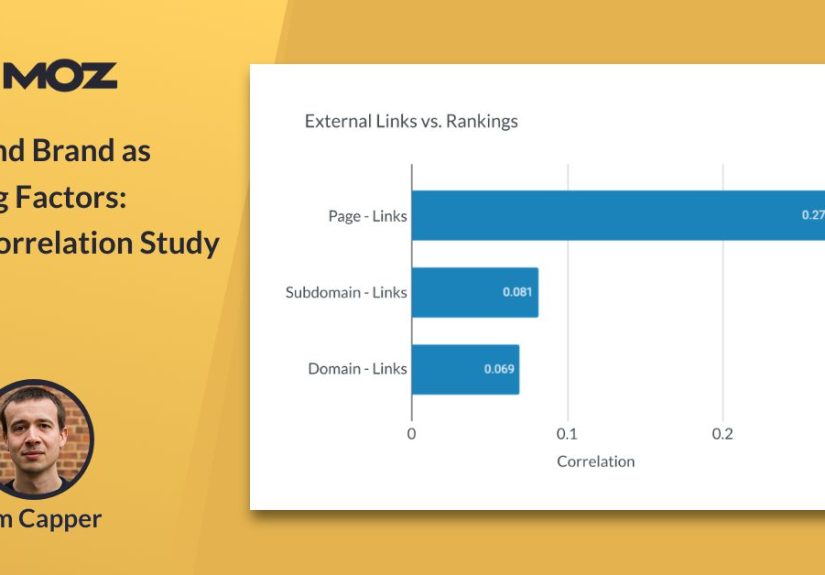
Finding #1: page-level links correlate more strongly than domain-level links
One of the cleanest takeaways: links pointing to the specific ranking page were a stronger predictor
of higher rankings than links to the overall domain or subdomain. That’s catnip for anyone who’s ever tried to rank a
stubborn category page while the homepage hogs all the love.
Why this makes sense (without turning into a math lecture)
If the page is what’s ranking, signals about that page often track more closely with its position. But Moz also noted
two practical realities:
- Homepages attract most links, so when a homepage ranks, it can inflate the “page-level links win” story.
- Internal linking can mimic some of the benefit by moving authority from heavily linked pages to the pages that need it.
In other words, you don’t always need a heroic PR campaign to build links to every single page. Sometimes you need a
smarter internal linking plan so your strongest pages “share the wealth.”
Finding #2: “authoritative link” metrics beat raw link counts
Moz compared raw followed link counts to Moz metrics like Domain Authority (DA) and
Page Authority (PA), which are designed to estimate link quality and authority, not just quantity.
The result wasn’t shocking, but it was useful: DA/PA tended to correlate better than just counting links.
The KPI trap: “We built 50 links!” (…to what, exactly?)
This is where many campaigns go off the rails. A link from a strong, relevant site can carry far more value than ten
links from forgettable pages that exist purely to link out. Counting links is easy. Counting meaningful links is harder.
The study reinforces a common-sense rule: treat link quality, relevance, and placement as first-class citizens,
not afterthoughts.
Finding #3: brand demand can predict rankings surprisingly well (especially on page one)
Now for the spicy part: Moz compared branded search volume to domain-level metrics like DA. The relationship was nuanced.
Overall, DA could outperform branded search volume deeper in results, but on the first pagewhere competition is intense
brand demand often looks very competitive as a predictor.
Does this mean branded search volume is a ranking factor?
Not necessarily. Moz was very careful here: “correlates” doesn’t mean “Google directly uses this exact metric.”
It may be that branded search volume reflects other things Google does valuelike trust, popularity, and user preference.
Brand demand may also be a byproduct of activities that naturally strengthen SEO: PR, partnerships, word-of-mouth,
great products, and content people actually talk about outside your website.
The practical takeaway isn’t “manufacture fake brand searches.” It’s “build a real brand people remember and seek out.”
You want people to look for younot because you tricked them, but because you’re the obvious choice.
What people misread from studies like this (please don’t be these people)
Myth 1: “If I add links, I will rank. Always.”
Links can help, but they’re not a universal cheat code. If your page is slow, confusing, thin, off-intent, or competing
against stronger pages with better satisfaction signals, links might be the wrong leveror not the first lever.
Myth 2: “DA is what Google uses.”
DA is a third-party metric built to approximate authority from link patterns. It can be useful for comparisons, but it’s
not a Google-owned dial you can turn. Treat DA like a thermometer: it helps you understand conditions, but it doesn’t
control the weather.
Myth 3: “Brand is all that matters now; links are dead.”
If you’ve heard “links are dead,” it’s usually followed by someone trying to sell you something. Links are still
part of how the web is organized and understood. But the study nudges us toward a more mature view:
the best SEO outcomes often come from links + brand + on-page relevance + user experience,
not just one magic ingredient.
A modern playbook: use links and brand together (instead of fighting about them on social media)
1) Build links where they matter: to pages that need to rank
If page-level links correlate most strongly, stop treating all links as interchangeable. When you need a specific page
to win (a service page, category page, or cornerstone guide), ask:
- Can we earn links directly to this page because it’s uniquely useful?
- If not, can we earn links to a related asset and route authority internally?
- Are we supporting that target page with clear internal links from high-authority pages on our site?
2) Get picky: prioritize relevance, editorial context, and trust
High-quality links tend to be earned, not “placed.” That usually means:
- Original research, tools, templates, and genuinely helpful resources
- Digital PR campaigns tied to timely, interesting data or stories
- Expert commentary that earns citations from publishers in your industry
- Partnerships and community participation that produce real references
3) Make your brand easier to search for and easier to trust
“Brand” sounds fluffy until you measure it. Practical brand-strengthening work often includes:
- Consistent naming (no identity crisis across your site, socials, and listings)
- Clear “about,” author, and contact signals (especially for YMYL topics)
- Visible proof: reviews, testimonials, press mentions, case studies
- Distinct positioning so users don’t confuse you with every other “best-in-class solution”
4) Use link attributes correctly (and don’t get cute with policy)
Paid links should be marked appropriately, and user-generated content links may need proper annotation too.
Not because Google is out to get you personally, but because the rules exist to keep search results less… scammy.
Play it straight. Your future self will thank you.
5) Measure like an adult: beyond “how many links did we get?”
A healthier reporting stack might include:
- Referring domains quality and topical relevance
- Link destination mix (homepage vs key commercial pages)
- Brand demand indicators (branded impressions/clicks, “share of search” style metrics)
- SERP performance for non-brand and brand queries
- Conversion impact (because traffic that doesn’t do anything is just cardio)
Concrete examples: what to do with this insight
Example 1: eCommerce category page that refuses to rank
Scenario: You sell ergonomic office chairs. Your blog posts get links, but the “Ergonomic Office Chairs” category page
sits on page two like it pays rent there.
Move: Create a link-worthy resource that naturally supports the category (e.g., “The Chair Fit Guide” with original
measurements, a printable checklist, and expert input). Earn links to the guide through outreach and PR. Then build
strong internal links from the guide to the category page using descriptive anchor text and supporting navigation.
The correlation study’s logic supports this: page-level strength matters, and internal links can help route authority.
Example 2: local service business competing with big directories
Scenario: You’re a dental clinic in a competitive city. You’re up against directory pages and big brands.
Move: Yes, earn a few strong local links (community sponsorships, local media, chamber listings). But also build brand
demand: consistent reviews, local press mentions, recognizable doctor bios, and content that answers local intent.
The goal is that people search for you by name (or name + service). That kind of demand tends to travel with trust.
Example 3: SaaS company trying to win a competitive non-brand keyword
Scenario: You want to rank for “project management software,” and you’re not a household name.
Move: Combine a credible link strategy (integration partners, industry publications, data studies) with a brand strategy
(opinionated POV, recognizable category narrative, consistent messaging across channels). The study hints that on the
most competitive SERPs, brand demand becomes an increasingly meaningful predictor. You don’t “hack” thatyou earn it.
FAQ: quick answers without the hype
Are links still important?
Yes. Even if Google reps debate whether links are “top 3” today, links remain part of how pages are discovered and evaluated.
The smarter question is: “Which links, to which pages, in which context, for which SERP?”
Should I focus on branded search volume as an SEO tactic?
Focus on brand building, not gaming search volume. If your marketing makes more people genuinely look
for your brand, that’s usually a sign you’re doing something right. Don’t try to manufacture it artificially.
Should I chase Domain Authority?
Use DA as a comparative metric, not a goal. Chasing DA can lead to goofy decisions like collecting random links that
don’t help your real pages rank or convert.
How many backlinks do I need?
The honest answer: “Enough to be competitive for the specific SERP you’re targeting.” That’s why competitor link
analysis and SERP intent research matter more than a universal number.
Field Notes: 3 real-world-style experiences you can learn from (without the fairy tales)
Below are three composite “from-the-trenches” scenarios based on common patterns SEOs run into. Think of them as
realistic storyboards you can map to your own site.
Experience #1: The brand that stopped worshipping the homepage
A mid-sized retailer had a classic problem: the homepage had plenty of authority, but revenue pages underperformed.
Their link reports looked greatuntil you realized 80% of earned links pointed to the homepage or blog. They ran a
targeted campaign around a “buyer’s guide” asset that was genuinely useful to publishers, then connected that guide
to a set of category pages with internal links that were impossible to miss (sidebar modules, contextual links, and
a navigational path that didn’t require a treasure map). Over the next few months, the category pages started to
climbnot because the site got “more links,” but because link equity finally reached the pages competing in the SERP.
This aligns perfectly with the study’s reminder that page-level strength correlates strongly, and internal links can
create PageRank-like effects without begging journalists to link to your money pages.
Experience #2: The “link count” campaign that flatlined, then got fixed
A services company hired an agency with a monthly target: “Build 30 links.” They hit the number every month like a
metronome. Rankings didn’t budge. A deeper review showed the links were mostly low-impact placements with weak
topical relevance, often pointing to pages that weren’t even intended to rank. The fix wasn’t dramaticit was grown-up
strategy: fewer links, better sources, clearer destination mapping, and content upgrades that made the target page
genuinely competitive. The campaign shifted from “link volume” to “authority + relevance + intent match.”
Within a quarter, the pages began improving because they finally looked like they belonged on page one.
The lesson: correlation with “authoritative link metrics” doesn’t magically transfer from bulk link counts.
If your reporting sounds like a factory output log, your results may too.
Experience #3: The brand-demand lift that made SEO easier
A SaaS company launched a small but focused brand campaign: webinars with respected partners, a handful of strong
industry mentions, and a signature concept they repeated everywhere (so people remembered it). Nothing about it screamed
“SEO campaign,” but branded searches rose, direct traffic increased, and more third-party sites referenced their
framework. Non-brand rankings became easier to win because the brand stopped feeling anonymous in the market.
This is the part people miss when they obsess over tactical checklists: brand demand isn’t just a vanity metric.
It can reflect trust, familiarity, and “click confidence.” Even if Google isn’t literally reading your mind and
rewarding brand love, the web ecosystem doesand Google’s job is to rank what users prefer and trust.
Conclusion: the sane takeaway
Moz’s 2021 correlation study doesn’t tell you to spam links or chase a single metric. It tells you something more
useful: links correlate with rankings, but how links work depends on where they point, how authoritative
they are, and how they interact with your site architecture. And brand demandespecially on fiercely competitive SERPs
can be a strong predictor of who wins the top spots.
The modern SEO path is not “links vs brand.” It’s links that strengthen the right pages plus
brand building that makes people choose you. Do both, and your rankings won’t feel like a lottery.