Table of Contents >> Show >> Hide
- Why These Photos Scream “Africa”
- The 35 Animal Photos That Would Fool My Group Chat
- What These Animals Are Actually Doing (So Your Captions Don’t Accidentally Lie)
- How to Get “Safari Energy” Without Boarding a Plane
- Wildlife Photography Etiquette (Because Animals Aren’t Props)
- Conclusion
- My Not-So-African “African” Photo Experience (Extra )
- SEO Tags
Confession: I did not board a plane, drink a tiny ginger ale at 35,000 feet, or pretend my neck pillow was “totally worth it.”
And yetif you dropped 35 absolutely wild animal photos into a group chat, people would start texting things like,
“OMG, when were you in the Serengeti?!” and “Did you… make eye contact with a lion?!?”
That’s the power of African wildlife imagery: it’s instantly recognizable, ridiculously cinematic, and somehow manages to be both majestic and
“sir, please stop licking your friend’s face.” Whether you’re scrolling stunning nature photography, watching conservation footage,
or snapping pics at a reputable zoo or safari park closer to home, certain animals and moments just feel like Africa.
Why These Photos Scream “Africa”
1) The light looks like it has a film deal
A lot of the classic “Africa vibe” comes from warm, low-angle lightgolden hour spilling across open landscapes. Add dust in the air,
long shadows, and a big sky, and suddenly your brain is playing dramatic documentary music.
2) The cast is iconic
The so-called Big Five (lion, leopard, rhino, elephant, and African buffalo) are famous partly because they’re visually bold and
behaviorally intense. But the deeper magic is the supporting castzebras with fingerprint stripes, giraffes with gravity-defying elegance,
painted dogs running like coordinated chaos, and vultures doing the unglamorous work that keeps ecosystems healthy.
3) Every frame tells a story
African wildlife photos often land because they imply a plot: a hunt about to start, a herd deciding whether the river is “worth it,” a tiny animal
performing a tiny act of bravery, or a giant one being surprisingly gentle. You’re not just looking at an animalyou’re watching a moment.
The 35 Animal Photos That Would Fool My Group Chat
Below are “photo-moments” so Africa-coded that your friends will assume you were out there whispering “nature is healing” into the wind.
Each one includes what makes the scene popand what’s actually going on, so you can caption it like a pro (or at least like someone who Googled once).
Big Cats & Main-Character Energy (1–9)
-
The lion yawn that looks like a roar.
A wide-open mouth, big canines, and a face that says “I own this savanna.” Lions are famously social cats, living in groups called prides
so the drama often comes with background extras. -
Cubs in a pile like fuzzy laundry.
Lion cubs wrestle, nap, and climb on each other with the confidence of creatures who have never paid rent. The best photos catch tiny ears,
oversized paws, and one cub clearly biting a sibling’s tail for fun. -
The cheetah “I’m built for speed” stare.
Cheetahs are streamlined for sprintingthe kind of animal that looks like it could outrun your Wi-Fi. Photos hit hardest when the body is low,
eyes locked, and the background blurs into pure motion. -
Two male cheetahs acting like a synchronized swim team.
Unlike many other big cats, adult male cheetahs are often social, sometimes forming coalitions. A crisp image of them walking shoulder-to-shoulder
gives instant “we came as a pair” energy. -
The leopard you “didn’t see” until you did.
A leopard’s superpower is camouflage. The best shots are half-hide, half-revealrosettes melting into tree shade, eyes glowing like tiny lanterns,
and a posture that says “I was here the whole time.” -
A leopard draped over a branch like a luxury scarf.
Leopards are famous for using trees as chill zones and snack storage. A photo with a relaxed leopard in a tree reads like effortless confidence
the wildlife equivalent of looking good in a candid. -
The serval’s spring-loaded pounce.
Long legs, giant ears, and a hop that looks like the animal is briefly levitating. If the frame catches the moment of liftoff (or landing),
it’s equal parts elegant and cartoonish. -
A caracal with ears that look like punctuation marks.
Those black ear tufts make every photo feel styled. A close-up caracal portrait is basically “high fashion, but make it predator.” -
A spotted hyena laughing at your assumptions.
Hyenas look like they’re giggling, but they’re serious operators in African ecosystems. A good hyena photo is all attitudehead tilt, curious eyes,
and a grin that makes you question who’s watching whom.
Giants, Tanks & “Did That Just Happen?” Moments (10–18)
-
An elephant silhouette at sunset.
Massive body, swinging trunk, and ears like sails. African elephants use their trunks for everythingpicking up food, greeting, warning, drinking
so a photo with the trunk mid-gesture feels instantly alive. -
Elephants dust-bathing like they’re seasoning themselves.
Dust helps with sun protection and bug control, and it looks incredible on camera. The perfect frame catches the dust cloud blooming around a tusked face
like an action-movie explosion, but gentler. -
The baby elephant “I’m helping!” moment.
Babies trying to use trunks is adorable chaos. A photo where a calf is awkwardly tugging grass or bonking a sibling is a guaranteed heart-stealer. -
A rhino close-up that feels prehistoric.
Rhinos look like they walked out of an ancient mural and chose violence. Fun fact: black rhinos and white rhinos are basically the same color
and their names aren’t about shade, but about mouth shape and history. -
The rhino lip comparison photo (wide vs. prehensile).
White rhinos have a wider mouth suited for grazing; black rhinos have a more hooked, prehensile lip for browsing leaves. A side profile shot
makes this surprisingly easy to “see” once you know it. -
A Cape buffalo giving “I don’t trust you” eyes.
Buffalo are a Big Five member for a reason: they’re tough, they’re unpredictable, and they look like they’ve never once apologized.
A head-on portrait with heavy horns is pure intensity. -
Hippos stacked like boulders with feelings.
Hippos look sleepy, but they can be extremely territorialespecially in water. A photo of just nostrils and eyes above the surface looks funny…
until you remember it’s basically a tank in a bathtub. -
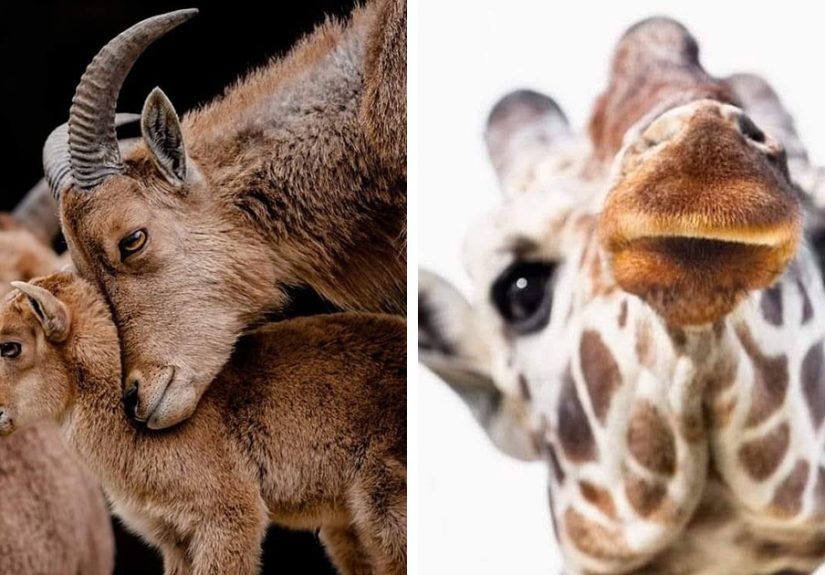
A giraffe tongue cameo.
Giraffes have famously long, dark tongues (often described as purple/black). Catch one curling around leaves and suddenly your photo says,
“Yes, I did learn something today.” -
An okapi standing in forest shade like a cryptid.
Okapis look like someone combined a giraffe and a zebra in a dream. They’re the giraffe’s closest living relative, but built for dense rainforest life,
so the “zebra legs” in shadow are a perfect mind-bender.
Stripes, Herds & The Art of Looking Like You Planned This (19–25)
-
Zebras in a tight group that turns into optical illusion.
Zebra stripes are unique to each animal, and when they overlap, predators can have trouble picking out a single target. On camera, it becomes
wearable art for mammals. -
One zebra side-eyeing the camera like a meme template.
Sometimes the most “Africa” photo is also the most “internet.” A single zebra with a perfectly timed expression turns wildlife photography into comedy. -
Wildebeest at the edge of a river, negotiating with fear.
The Great Migration is famous for its scalehuge numbers moving in cycles to follow seasonal rains. A shot of hesitant animals at the waterline
screams suspense. -
The river crossing chaos frame.
Hooves, splashes, dust, and a thousand choices happening at once. Even if you don’t photograph the whole event, a tight crop of water + bodies
instantly reads “migration.” -
An impala or gazelle mid-leap, looking unreal.
Antelope can “stot” (spring) in a way that looks like gravity took a coffee break. Freeze one leap with clean background and it becomes a poster. -
A warthog trotting with tail up like a tiny flag.
It’s hard to photograph a warthog without smiling. That upright tail is basically the animal equivalent of saying, “I’m busy, please hold my calls.” -
Baboons on a rock, holding court.
Baboons are expressive and social, which makes them gold for storytelling. A wide shot of a troop perched on a ridge looks like a chaotic board meeting
where everyone has opinions.
Small Legends & Oddballs (26–31)
-
A meerkat standing guard like it’s paid hourly.
Meerkats live in groups often called mobs. A classic photo is the lookout poseupright, alert, scanning the horizonwhile the rest of the mob
conducts important business (mostly digging). -
Meerkats in a line like a suspiciously organized family.
Catch multiple meerkats facing different directions and you’ve got instant “neighborhood watch” energy. The humor is real, but the behavior is practical:
someone’s always looking out. -
An aardvark emerging at dusk like a shy celebrity.
Aardvarks are nocturnal and famously into ants and termites. A photo of one stepping into low lightlong ears up, snout forwardfeels like you unlocked
a secret level in nature. -
A bat-eared fox with ears set to “satellite dish.”
Big ears do double duty: hearing and heat management. A close portrait with those ears wide and eyes bright is basically “cute, but also listening to everything.” -
A genet in headlights (but, like, tastefully).
These small, catlike carnivores look like they were designed by someone who loves spots. A night photo with gentle eye-shine turns into a mysterious,
“What else lives out here?” vibe. -
A chameleon doing a color-gradient masterpiece.
If the photo catches the texturethose tiny toes, the curled tail, the turret eyesit reads instantly exotic and otherworldly, like nature decided to try fashion.
Birds, Reptiles & “Wait, That’s Real?” (32–35)
-
An ostrich running like it forgot an appointment.
Ostriches are built for speed with long legs and serious attitude. A running shot is pure comedy-meets-power: feathers bouncing, legs blurring,
and a face that says “I’m fine!” -
A secretary bird mid-stomp.
Secretary birds hunt by walking the grasslands and, famously, can stomp prey. A sharp action frame of those long legs is cinematic in a very
“nature is metal” wayminus the need for sound effects. -
A vulture in perfect flight, proving scavengers can be stunning.
Vultures ride thermals and do essential cleanup work that helps limit disease spread. A soaring silhouette with wings in a steady V shape is
surprisingly elegantlike a glider with opinions. -
A Nile crocodile half-submerged, eyes locked on the shoreline.
Crocodiles are the definition of patience. A low-angle photo where only the head breaks the surface looks calmuntil you realize it’s built
for ambush and isn’t here for small talk. -
African penguins on a beach, breaking everyone’s “Africa = only savanna” brain.
African penguins are real, coastal, and in troublepopulations have declined dramatically due to shifting food availability and other threats.
A beach photo with tuxedo birds is the ultimate plot twist.
What These Animals Are Actually Doing (So Your Captions Don’t Accidentally Lie)
Reading body language beats guessing
The difference between “majestic” and “please back up slowly” is often posture. Ears pinned back, sudden stillness, tail flicking, or direct staring can
signal agitation. Meanwhile, yawns, stretches, and relaxed ears usually mean “I’m tired,” not “I’m threatening your entire bloodline.”
Behavior makes photos feel authentic
A photo that feels “real safari” often captures a behavior that belongs to the species: lions interacting as a social group, cheetahs scanning open ground,
giraffes browsing high leaves, zebras clustering, elephants dusting, meerkats posting a lookout, vultures circling.
When the behavior matches the animal, the story clicks.
Context sells the scene
Even without an African landscape, context matters. A low angle, natural vegetation, and space around the animal can create the illusion of wild openness.
Tight crops can feel intimate, but wide frames feel like a placelike you’re witnessing a chapter of a bigger ecosystem.
How to Get “Safari Energy” Without Boarding a Plane
Go local, go ethical
If you want photos that feel like Africa without traveling there, your best route is ethical wildlife access:
accredited zoos, safari parks, conservation centers, and (depending on your region) wildlife refuges. The goal is not to fake being on safari
it’s to capture the wonder responsibly and honestly.
Use the tools that protect animals and improve photos
- Long lenses over close approaches: Distance protects animals and gives you natural behavior.
- Patience over pressure: The best frames usually happen after you stop trying to “make” them happen.
- Light over chaos: Early morning or late afternoon gives softer shadows and richer texture.
- Clean backgrounds: Move your position (when allowed) to avoid fences, signs, or clutter behind the subject.
Edit for mood, not misinformation
A little warmth, contrast, and clarity can make fur, feathers, and dust look cinematic. But keep edits honestavoid turning a gray rhino neon-blue
just because it “matches your feed.” The animal already has better branding than any of us.
Wildlife Photography Etiquette (Because Animals Aren’t Props)
If there’s one rule that beats every camera setting, it’s this: animal welfare comes first.
Ethical wildlife photography practices are simple, powerful, and non-negotiable.
- Keep a respectful distance: If the animal changes behavior because of you, you’re too close.
- Don’t bait, lure, or harass: Getting “the shot” is never worth stressing or endangering wildlife.
- Respect habitat: Stay on permitted paths, don’t trample vegetation, and don’t block animals’ exit routes.
- Be mindful with flash and noise: Especially around nocturnal animals and birds.
- Let the moment happen: The most meaningful photos are the ones you didn’t force.
Conclusion
You don’t have to step foot on the African continent to appreciate why African wildlife photography hits so hard. The animals are iconic, the behaviors
are dramatic, and the visuals are unforgettablewhether you’re watching migrations follow seasonal rains, seeing how elephant families move together,
or realizing that a beach penguin can absolutely belong in an “Africa” photo set.
If these 35 photo-moments proved anything, it’s that “Africa energy” isn’t about your passport stamp. It’s about light, story, respect for wildlife,
and the kind of wonder that makes you whisper, “How is that real?” into your phone screen.
My Not-So-African “African” Photo Experience (Extra )
The first time someone asked, “Wait… did you go to Africa?” I almost choked on my iced coffee. Because no. I did not. The closest I’d gotten to a safari
was dramatically shoving snacks into my bag for a day trip and telling myself, “This is basically fieldwork.”
What I did have was a camera roll full of animals that looked like they belonged in a documentary trailer. The trick started innocently:
I went to a reputable local zoo with the mindset of a person who had absolutely no chill. I showed up early, when the light was soft and the crowds were
still at home negotiating with their alarm clocks. I didn’t rush. I watched. And that’s when the “photos that feel like Africa” started happeningbecause
the animals were actually doing animal things.
I learned quickly that composition is basically polite lying. If you shoot through the right gap, crop with intention, and wait for a natural background,
you can remove a surprising amount of “gift shop energy” from the frame. A lion doesn’t look like a lion statue when it’s yawning in golden light.
A zebra doesn’t look “contained” when it’s angled against tall grass and you focus on the stripes like they’re a fingerprint map.
And elephants? Elephants don’t need help looking cinematic. If an elephant flicks dust into the air, it’s like the universe is editing for you.
My favorite part was realizing how many moments are pure personality. A meerkat popped up like it had just heard gossip. A warthog trotted by with its tail
up like a tiny antenna broadcasting, “I’m busy.” A giraffe extended that long dark tongue and I had an immediate, sincere thought: “Nature is so weird.
Thank you.”
I also got humbled. Because you can’t “direct” wildlife. The second you try, you miss the shot. The good stuff happens when you pay attention:
a hyena’s side-eye, a baboon’s dramatic pause, a bird landing at just the right angle. I stopped thinking like a collector (“I need a lion photo!”)
and started thinking like a storyteller (“What’s happening right now?”). That one shift made everything better.
And honestly? The biggest lesson was respect. I kept distance, avoided anything that would disrupt behavior, and treated every shot like I was a guest.
That’s when the images stopped feeling like “pics of animals” and started feeling like moments in a living world. So no, I didn’t go to Africa
but I did learn how to photograph wildlife in a way that feels big, real, and worth slowing down for. And if my group chat wants to believe I was on safari?
I won’t fight them too hard. (I will, however, accept snacks as tribute.)