Table of Contents >> Show >> Hide
- The Quick Answer: What Is “Sit” in Spanish?
- Why Sentarse Matters More Than Sentar
- How to Say “Sit Down” in Spanish
- How to Say “Take a Seat” in Spanish
- Formal vs. Informal: The Tiny Choice That Changes Everything
- Regional Spanish: Why You May Hear Sentate or Sentaos
- How to Be More Natural Than Just Saying One Word
- Common Mistakes Learners Make
- Best Examples for Real-Life Situations
- What Learners Experience When Using These Phrases in Real Life
- Final Thoughts
If you have ever frozen mid-conversation and wondered, “Wait, how do I say ‘sit’ in Spanish without sounding like a malfunctioning robot?” welcome to the club. This is one of those tiny phrases that seems simple until Spanish politely reminds you that context matters, tone matters, and yes, grammar absolutely brought receipts.
The good news is that Spanish gives you several natural ways to say sit, sit down, and take a seat. The better news is that once you understand the difference between siéntate, siéntese, toma asiento, and sentarse, you will sound far more natural in classrooms, restaurants, offices, and family conversations. The best news? You can learn it without crying into a conjugation chart.
In this guide, we will break down the most useful ways to say “sit” in Spanish, when to use each one, how formality changes everything, and which versions show up in different Spanish-speaking regions. By the end, you will know not just the translation, but the vibe. And honestly, the vibe is half the battle.
The Quick Answer: What Is “Sit” in Spanish?
The most common Spanish verb for “to sit” or “to sit down” is sentarse. This is the form you will usually see in dictionaries because it is the infinitive. In real conversation, though, people usually use conjugated versions depending on who is speaking and who is being addressed.
Here are the most important forms to know:
- sentarse = to sit / to sit down
- siéntate = sit down (informal, singular)
- siéntese = sit down (formal, singular)
- siéntense = sit down (formal or plural, depending on region)
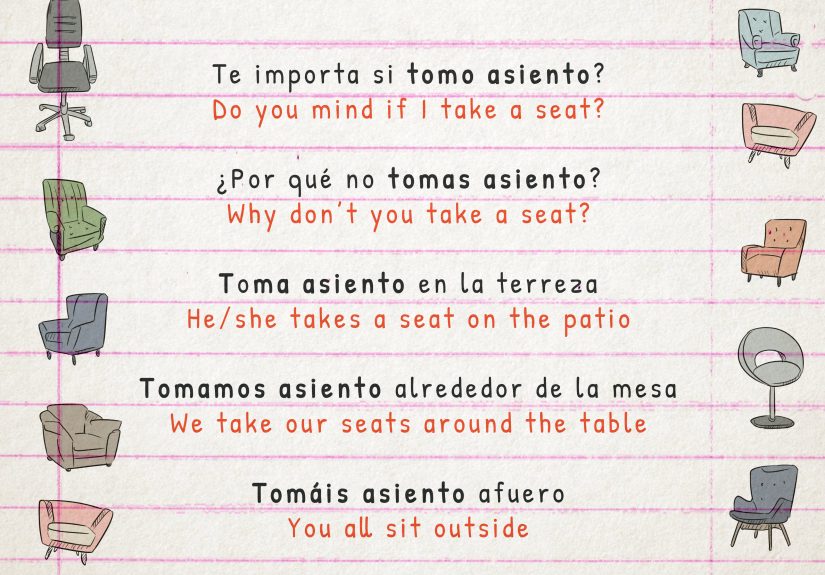
- toma asiento = take a seat (informal)
- tome asiento = take a seat (formal)
- tomar asiento = to take a seat
So if you only remember one thing, remember this: “sit” in Spanish is usually built around sentarse, while “take a seat” often uses tomar asiento.
Why Sentarse Matters More Than Sentar
This is where learners often step on a grammatical banana peel. In Spanish, sentarse and sentar are related, but they are not the same thing.
Sentarse is reflexive and usually means to sit oneself down, or simply to sit. It describes the person doing the action to themselves.
Examples:
- Voy a sentarme aquí. = I’m going to sit here.
- ¿Puedes sentarte un momento? = Can you sit down for a moment?
Sentar, by contrast, is often transitive. It can mean to seat someone or to place someone in a seat.
Examples:
- El mesero nos sentó junto a la ventana. = The waiter seated us by the window.
- Sentó al niño en la silla. = He seated the child in the chair.
If you want to tell a person to sit down, you almost always want the reflexive form based on sentarse, not the plain verb sentar. Otherwise, you may accidentally say something that sounds more like “seat someone” than “have a seat.” Awkward? A little. Fixable? Absolutely.
How to Say “Sit Down” in Spanish
1. Siéntate Sit Down (Informal)
Siéntate is the most common way to say “sit down” when talking to one person informally. Use it with a friend, sibling, classmate, child, or anyone you would address with tú.
Examples:
- Siéntate aquí. = Sit down here.
- Siéntate, por favor. = Sit down, please.
- Siéntate y escúchame. = Sit down and listen to me.
This is the version that feels direct, everyday, and natural. It is not rude by itself, but like many commands, tone matters. Said warmly, it is helpful. Barked across a room, it becomes less “language lesson” and more “principal’s office.”
2. Siéntese Sit Down (Formal)
Siéntese is the formal singular command. Use it when speaking to someone you address as usted, such as a stranger, an older person, a client, a professor, or someone in a more respectful setting.
Examples:
- Siéntese, por favor. = Please sit down.
- Puede sentarse aquí. = You may sit here.
- Señor, siéntese un momento. = Sir, sit down for a moment.
If you are unsure whether to use informal or formal Spanish, siéntese is usually the safer choice. Spanish speakers may forgive a grammar slip. What they remember more clearly is whether you sounded respectful or weirdly overfamiliar.
3. Siéntense Sit Down (Plural)
Siéntense is commonly used for you all in many Spanish-speaking regions, especially in Latin America where ustedes handles plural “you.”
Examples:
- Niños, siéntense. = Kids, sit down.
- Por favor, siéntense en la sala. = Please sit down in the living room.
In Spain, if you are speaking informally to a group and using vosotros, the common command is different. That brings us to the plot twist Spanish always keeps in its back pocket.
How to Say “Take a Seat” in Spanish
1. Toma asiento Take a Seat (Informal)
Toma asiento literally means “take a seat”. It sounds slightly more polished than siéntate, though still natural. You might hear it in semi-formal settings, or when someone wants to sound courteous rather than bossy.
Example:
- Toma asiento mientras llega el doctor. = Take a seat while the doctor arrives.
2. Tome asiento Take a Seat (Formal)
Tome asiento is a very common polite phrase in offices, waiting rooms, interviews, and customer-service situations. It feels professional, welcoming, and a little more elegant than a plain command.
Examples:
- Pase, tome asiento. = Come in, take a seat.
- Por favor, tome asiento y enseguida lo atiendo. = Please take a seat and I’ll help you shortly.
If siéntese sounds like “sit down,” then tome asiento sounds closer to “please have a seat.” Same destination, slightly nicer ride.
Formal vs. Informal: The Tiny Choice That Changes Everything
One reason this topic trips up English speakers is that English uses the same basic “you” for almost everyone. Spanish does not. Your command changes depending on whether you are speaking informally, formally, to one person, or to a group.
| English Meaning | Spanish | Best Use |
|---|---|---|
| Sit down | Siéntate | One person, informal |
| Sit down | Siéntese | One person, formal |
| Sit down | Siéntense | Group, common in Latin America |
| Take a seat | Toma asiento | One person, informal |
| Take a seat | Tome asiento | One person, formal |
| Take a seat | Tomen asiento | Group or formal plural |
When in doubt, choosing the more polite form is usually smart. Nobody has ever said, “How dare you respect me too much?” Well, probably somebody has, but not often.
Regional Spanish: Why You May Hear Sentate or Sentaos
Spanish changes by region, and commands are no exception. If you travel or learn from native speakers in different countries, you may hear forms that look a little different from textbook Spanish.
Sentate
In areas where vos is used instead of tú, especially in places like Argentina, Uruguay, and parts of Central America, you may hear sentate instead of siéntate. It means the same thing: sit down, but it belongs to a different system of address known as voseo.
Example:
- Sentate acá. = Sit here.
Sentaos
In Spain, the informal plural command for a reflexive verb like sentarse is often sentaos. This corresponds to vosotros.
Example:
- Chicos, sentaos. = Guys, sit down.
If you are learning Spanish mainly for Latin America, you can usually focus on siéntate, siéntese, and siéntense. If Spain is your target, it helps to recognize vosotros forms too.
How to Be More Natural Than Just Saying One Word
Real conversations rarely live on flashcards. Native speakers often soften commands, especially in polite settings. Instead of a direct order, they may use gentler phrases that sound more welcoming.
Natural Alternatives
- Puedes sentarte. = You can sit down.
- Puede sentarse. = You may sit down.
- Si quieres, puedes tomar asiento. = If you’d like, you can take a seat.
- Adelante, tome asiento. = Go ahead, take a seat.
- ¿Quieres sentarte? = Do you want to sit down?
These softer phrases are especially useful in customer service, healthcare, hospitality, and professional settings. They feel less like an order and more like an invitation. Spanish, like life, often works better when you do not sound like a drill sergeant.
Common Mistakes Learners Make
Using sentar when you mean sentarse
If you mean “sit down,” do not default to the plain verb sentar. In many contexts, that shifts the meaning toward seating someone else.
Ignoring formality
Siéntate and siéntese are not interchangeable in tone. Grammar may survive the mix-up, but social nuance takes a hit.
Forgetting regional differences
If someone says sentate, do not panic. You are not witnessing a typo in the wild. You are hearing regional Spanish.
Overtranslating English
English often says “have a seat,” “grab a seat,” “take your seat,” or “sit down” with subtle differences. In Spanish, context matters more than literal word-for-word matching. Sometimes siéntate is perfect; sometimes tome asiento sounds better.
Best Examples for Real-Life Situations
At a doctor’s office
Por favor, tome asiento. El doctor estará con usted en un momento.
Please take a seat. The doctor will be with you in a moment.
At home with a friend
Siéntate donde quieras.
Sit wherever you want.
In a classroom
Chicos, siéntense y abran sus libros.
Guys, sit down and open your books.
At a job interview
Pase, por favor. Tome asiento.
Come in, please. Take a seat.
In Spain with friends
Sentaos aquí.
Sit here.
What Learners Experience When Using These Phrases in Real Life
There is a funny moment that happens to almost every Spanish learner: you study a phrase, you feel ready, the moment arrives, and your brain suddenly decides to reboot like an old laptop. You know you want to say something as basic as “sit down,” but instead of producing smooth, confident Spanish, your mind starts juggling siéntate, siéntese, sentarse, and possibly the names of every snack you have eaten that day. Language learning is glamorous like that.
In real life, though, this topic becomes useful fast. Imagine visiting a Spanish-speaking friend for the first time. You walk into the living room, and they smile and say, “Siéntate” or “Siéntate aquí”. That moment teaches more than a worksheet ever could. You hear the tone, see the body language, and understand instantly that this is the casual, everyday version. It feels warm. Familiar. Human. Not a grammar exercise with suspiciously cheerful stock photos.
Now picture a different experience: a clinic, office, or formal reception area. Instead of the relaxed siéntate, someone says “Tome asiento” or “Siéntese, por favor.” The phrase carries a different energy. It is respectful, polished, and a little more professional. Learners often remember this version because it appears in settings where tone matters. You are not just learning vocabulary; you are learning social rhythm.
Travelers also notice how quickly regional Spanish enters the chat. Maybe you learned standard classroom Spanish, then arrive in Argentina and hear “Sentate”. For one brief second, you may wonder whether your textbook betrayed you. It did not. Spanish is simply doing what living languages do: adapting, stretching, and showing off its local personality. Once learners recognize that these variations are normal, their confidence improves a lot. Instead of chasing one “perfect” version, they start listening for patterns.
Another common experience happens in conversation practice. Many learners begin by memorizing direct commands, but later discover that native speakers often soften them. So instead of hearing only siéntese, they hear “Puede sentarse” or “Si quiere, puede tomar asiento.” That is an important leap. It moves you from translation into communication. You stop asking, “What is the exact word?” and start asking, “What sounds natural in this situation?” That is where real fluency begins.
Perhaps the most encouraging part is this: people usually understand you even if you are not perfect. If you say siéntate when a softer phrase would have been better, the conversation will probably survive. If you hesitate between tome asiento and siéntese, the world will keep spinning. Learners grow by using the language, not by waiting until every accent mark lines up like obedient little soldiers. The goal is not robotic precision. The goal is being understood, sounding natural, and gradually building better instincts every time you speak.
Final Thoughts
If you want the simplest answer, here it is: “sit” in Spanish is usually sentarse, and “sit down” is often siéntate or siéntese. If you want to sound more polite or professional, toma asiento and tome asiento are excellent choices. And if you hear sentate or sentaos, that is not Spanish trying to confuse you for sport. It is just regional Spanish being gloriously regional.
Learn the form, learn the context, and learn the tone. Once you do, this tiny phrase becomes one of those satisfying wins that makes your Spanish sound smoother almost immediately. Not bad for a verb that literally just wants everyone to sit down.