Table of Contents >> Show >> Hide
- Why Climbers Need a Different Kind of Prosthetic Leg
- From Mountain Goat to Human-Centered Design
- A Great Idea Is Not the Same as a Finished Product
- Testing on Real Rock Changed Everything
- What This Design Says About Adaptive Sports
- The Bigger Lesson: Empathy Is a Design Tool
- Where Climbing Prosthetics Could Go Next
- Experiences From the Wall: What This Kind of Design Means in Real Life
- Conclusion
Some inventions begin in a lab. Others begin with a sketch. And a few begin with a person staring at mountain goats on the internet and thinking, “Hold on… those little weirdos might be onto something.”
That is more or less how designer Kai Lin’s climbing prosthetic story started. Lin, an industrial designer trained at Pratt Institute, became fascinated by the way mountain goats move across impossibly steep terrain with accuracy, balance, and what looks like supernatural calm. Instead of treating that as a fun wildlife rabbit hole, he treated it like a design brief. The result was KLIPPA, a prosthetic leg concept built specifically for rock climbers.
On paper, the idea sounds beautifully simple: design a prosthetic leg that helps amputee climbers move on rock with more control, more confidence, and less compromise. In reality, it was an enormously difficult problem. A climbing foot cannot behave like a casual walking foot. It has to edge, smear, wedge into cracks, hold tension on steep terrain, and still offer enough stability that the user does not feel like they are balancing on a broom handle in a windstorm.
What makes this story so compelling is that Lin was not just designing a product. He was designing for a sport where tiny differences in shape, friction, articulation, and feedback can decide whether a move feels elegant or impossible. And he was doing it for athletes who had long been underserved by mainstream prosthetic development.
Why Climbers Need a Different Kind of Prosthetic Leg
Most everyday lower-limb prostheses are designed around walking, standing, and general mobility. That makes sense. Most people would prefer not to face-plant in the grocery store produce aisle. But climbing asks for a completely different performance profile.
A climber’s foot is not just a platform. It is a precision tool. On a technical route, the foot must stand on tiny edges, pivot into position, press into the wall, and sometimes jam into narrow cracks. A standard prosthetic foot may be fine for sidewalks and stairs, yet feel blunt and uncooperative on vertical stone. That is one reason adaptive climbers and their prosthetists have spent years modifying feet, shoes, sockets, and knees to match the demands of specific terrain.
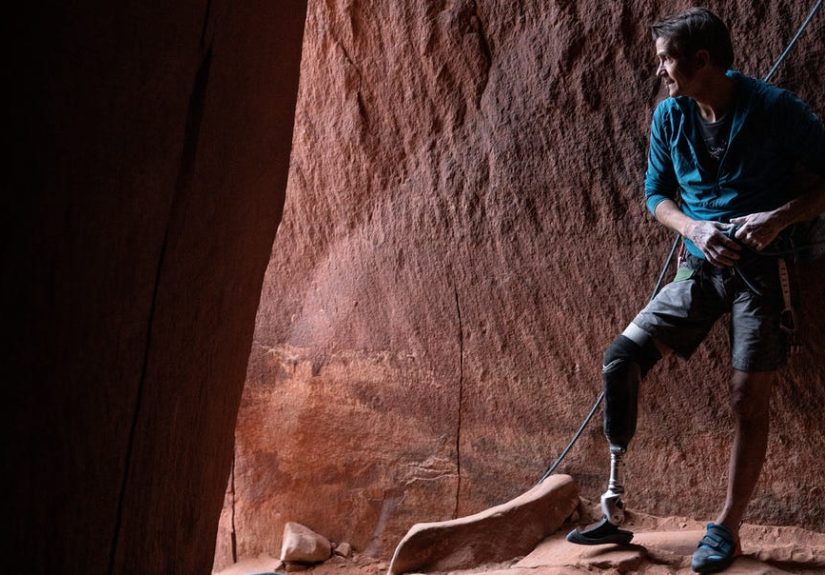
Craig DeMartino understood that problem in a very personal way. After a catastrophic 100-foot climbing fall in Rocky Mountain National Park in 2002, he survived injuries that included a fused back, a fused neck, and eventually the loss of his right leg below the knee. Climbing remained central to his life, but the available equipment was not exactly rolling out the red carpet for amputee climbers. He returned to the wall anyway, because climbers are a stubborn species and because identity has a funny way of refusing to retire quietly.
That gap between what climbers needed and what the market supplied became the opening for Lin’s work. DeMartino had the lived experience. Lin had the design brain. Together, they made a pretty formidable team.
From Mountain Goat to Human-Centered Design
Lin’s early insight was not that humans should literally wear goat hooves and start free-soloing barn walls. It was more specific than that. Mountain goats succeed on steep terrain because of how their feet combine grip, stability, and contact precision. Their hoof structure includes a hard outer edge for support and softer surfaces that help them hold onto uneven ground. For a designer, that is catnip.
Lin began by studying both animal anatomy and human movement. He also looked at the needs of amputee athletes, including veterans and adaptive climbers who used climbing as recreation, recovery, and sometimes a way back to themselves after trauma. Then he went into the field. He interviewed climbers at Brooklyn Boulders, studied technique, and even experimented on himself by climbing on foam stilts to simulate reduced sensory feedback. That is the kind of research method that says, “I care deeply about user experience,” and also, “I am willing to look ridiculous in pursuit of better design.”
What Lin found was important: a foot that is too large blocks visual precision and makes placement harder, while a foot that is too small reduces balance. In climbing, you do not want a giant platform. You want something accurate, stable, and responsive. That insight shaped KLIPPA’s final direction.
The Key Design Features of KLIPPA
KLIPPA was not just a pretty concept render with dramatic lighting and a heroic backstory. It included specific functional ideas. Lin developed multiple prototypes using blue foam and 3D-printed parts before combining the strongest elements into a more refined design.
The prosthetic foot tapered into a small pointed toe, which was intended to help climbers wedge into tight cracks and stabilize on narrow footholds. The heel was wider and slightly textured to improve standing stability and assist with certain placements. An elastic pivot joint, combined with an internal spring and bungee cord, was designed to improve shock absorption and ankle articulation. In plain English: the thing was meant to move more like a climbing tool than a stiff peg.
That detail matters because the human foot is outrageously complicated. It contains 26 bones, 33 joints, and more than 100 muscles, tendons, and ligaments. Replacing even a fraction of that function for climbing is not a small ask. Lin approached the problem the way good designers often do: not by pretending he could recreate biology perfectly, but by identifying the most important performance traits and engineering around them.
A Great Idea Is Not the Same as a Finished Product
Here is the part that makes the story feel real rather than glossy: KLIPPA did not instantly become a mass-produced miracle limb with a triumphant soundtrack playing in the background. The project hit the usual barriers that ambitious adaptive tech often hits: money, testing, manufacturing, collaboration, and time.
Back in 2014, KLIPPA became a U.S. national finalist in the James Dyson Award. The design attracted attention, which was great for visibility but did not magically solve the hard stuff. Lin still needed a functional prototype, more testing, and partners who could help push the concept into practical use. Like many promising ideas, it risked becoming one of those “this could change everything” stories that then quietly disappears into a folder labeled someday.
What kept it alive was persistence. Lin continued refining the concept, drawing feedback from climbers, prosthetists, and families. Later, Arc’teryx helped relaunch the work by providing access to tools such as 3D printing and reconnecting Lin with DeMartino for further development. That matters because adaptive product design is almost never a solo performance. It is usually a relay race between the designer, the athlete, the prosthetist, the fabricator, and the tester who is brave enough to put the thing on and trust it above the ground.
Testing on Real Rock Changed Everything
A climbing prosthetic can look brilliant in the workshop and still fall apart the second it meets actual stone. That is why DeMartino’s testing was such a crucial stage in the project.
Early prototypes were tested in Indian Creek, Utah, a place famous for crack climbing and also for humbling anyone who underestimates it. Those early versions did not fully hold up to the demands of straight-in crack climbing. That was not a failure so much as valuable data wearing a dusty disguise.
Later rounds performed better on vertical face routes. DeMartino used the KLIPPA on 5.10 and 5.11 climbs on the Crystal Wall in Colorado’s Poudre Canyon, where the design reportedly gave him improved mobility, articulation, sensitivity, and control. That combination is huge. Adaptive athletes do not need gear that merely exists. They need equipment that actually expands what is possible.
This is also where the story becomes bigger than one prototype. The project showed that climbing-specific prosthetic design should not be treated as a niche curiosity. It is a legitimate field of athletic equipment design, and it deserves the same seriousness given to ski boots, bike frames, or elite running shoes.
What This Design Says About Adaptive Sports
One of the smartest things about Lin’s work is that it did not assume the goal was to make amputee climbers look as close to non-amputee climbers as possible. The goal was function. Better edging. Better articulation. Better stability. Better climbing.
That may sound obvious, but it is a meaningful shift in prosthetic thinking. The history of prosthetics has often been dominated by the idea of restoring a “normal” gait or appearance. Those are important goals, of course. But for athletes, “normal” can be too small an ambition. The right question is often: what does this person need to do their sport well?
Adaptive climbing has been moving in that direction for years. Specialized harnesses help wheelchair users climb safely. Adaptive feet and knees have widened options for lower-limb amputees. Community organizations have made gyms and crags more accessible. Competitive paraclimbing has grown, and the broader adaptive climbing scene has become more visible and more innovative. In that ecosystem, KLIPPA fits naturally. It is not an oddball invention. It is part of a larger movement insisting that disabled athletes deserve gear built for performance, not just participation.
The Bigger Lesson: Empathy Is a Design Tool
If there is a quiet hero in this whole story, it is empathy. Not the soft, poster-on-an-office-wall version. The practical version. The kind that asks, “What is this person trying to do? Where does the current tool fail them? How do we make something better?”
Lin brought that mindset to the project from the beginning. He did not enter as a climber claiming expertise he did not have. He entered as an observer, researcher, and builder. He listened. He tested. He adjusted. He learned from athletes rather than designing over them. That is often the difference between a flashy concept and a genuinely useful product.
Modern prosthetic research reinforces that lesson. Clinical and engineering studies keep pointing to the same fundamentals: comfort matters, fit matters, component choice matters, user priorities matter, and no single setup works for everybody. In other words, adaptive design is not about making one perfect leg for all users. It is about building the right solution for a particular body, activity, and environment.
That makes climbing an especially revealing challenge. Rock is inconsistent. Moves are awkward. Terrain changes fast. Small design flaws become obvious immediately. A good climbing prosthetic, then, is almost like an honesty test for design itself.
Where Climbing Prosthetics Could Go Next
KLIPPA was not the end of the story. It was a strong signal about where the story could go.
The next wave of prosthetic technology is already exploring smarter control systems, more responsive sensors, and better integration between the user’s nervous system and the device. Researchers such as Hugh Herr and teams at MIT have pushed the field toward prostheses that do more than passively exist. They aim to respond to intention, terrain, and movement with much more natural control. Even if those systems are not built specifically for climbing, the lessons matter. Climbers need precise placement, confidence under load, and a better sense of what the device is doing beneath them.
There is also a design opportunity in affordability. Some adaptive climbing tools remain expensive or hard to access. That creates a frustrating gap between innovation and actual use. A future breakthrough will not just be lighter or smarter. It will also be easier to obtain, easier to repair, and easier to customize.
That is part of what makes Lin’s project memorable. It was not imagining a sci-fi limb for some distant future. It was focused on a real athlete, a real sport, and a real problem that needed solving now.
Experiences From the Wall: What This Kind of Design Means in Real Life
To really understand why a prosthetic leg for climbers matters, you have to imagine the experience from the climber’s side. Climbing is already an intimate sport. You feel everything: the roughness of the stone, the insecurity of a smear, the tiny moment when your shoe bites into an edge and your whole body relaxes because the move might actually work. Remove part of the natural foot and ankle system from that equation, and every placement becomes more complicated. Not impossible, but negotiated.
That is why adaptive climbers often talk less about “overcoming” and more about problem-solving. They are not standing at the base of a wall thinking in motivational-poster slogans. They are thinking about load transfer, body tension, hip position, trust, and whether the gear under them will do what it is supposed to do when it counts. A prosthetic built for daily walking may get someone to the crag. A prosthetic built for climbing might help them dance on the rock again.
There is also the emotional side. For many climbers, the sport is not just exercise. It is identity, community, therapy, and joy dressed up as suffering. Losing access to it after an injury can feel like losing a language you once spoke fluently. That is one reason projects like KLIPPA resonate so deeply. They are not only about hardware. They are about restoring fluency. They are about giving somebody the chance to move through a beloved environment with less hesitation and more expression.
And then there is the social experience. Adaptive climbing has grown because people share techniques, gear hacks, and encouragement. One climber’s prototype becomes another climber’s clue. One awkward test session becomes the beginning of a better design standard. In that sense, Lin’s work belongs to a broader culture of experimentation. It is not just a story about one inventor having one good idea. It is a story about what happens when a designer takes an athlete seriously enough to build around their real ambitions.
That seriousness is powerful. It says an amputee climber does not need to be limited to gear that is “good enough.” It says performance matters. Precision matters. Style matters. The feeling of clipping the anchor on a hard route matters. When DeMartino tested improved versions of KLIPPA on real routes, the success was not abstract. It lived in the body: in balance, in stability, in confidence, in the ability to commit to the next move without second-guessing the tool beneath him.
In the end, that may be the most inspiring part of the whole story. Not that a designer made a cool object. Plenty of people make cool objects. It is that he looked at a difficult, highly specific human challenge and refused to flatten it into a generic solution. He treated climbing as climbing, not as walking on a steeper inconvenience. He treated the athlete as an athlete, not as a patient with a side hobby. That shift in perspective is what makes innovation meaningful. And on a rock wall, where inches matter and trust matters even more, meaningful design can feel a lot like freedom.
Conclusion
Kai Lin’s prosthetic leg for climbers is a powerful example of what happens when curiosity, empathy, and technical thinking meet a real athletic need. By studying mountain goats, listening to adaptive climbers, and collaborating with Craig DeMartino, Lin developed a prosthetic concept that aimed to improve how amputee climbers edge, balance, articulate, and move on rock. The project also highlighted a larger truth: adaptive athletes deserve specialized equipment built for performance, not just basic access.
Even though KLIPPA’s journey involved stalled progress, prototype failures, and repeated testing, that is exactly what makes it credible. Real innovation is messy. It evolves through field use, feedback, and relentless iteration. And in the case of climbing prosthetics, that process does more than improve equipment. It expands possibility. It helps athletes reclaim movement, identity, and adventure on their own terms. That is not just smart design. That is design with a pulse.