Table of Contents >> Show >> Hide
- The Short Version: How George Lucas Leads to Springfield
- George Lucas’s Star Wars Deal Changed Hollywood’s View of Merchandising
- Enter Matt Groening and Life in Hell
- The Meeting That Almost Gave Us Animated Life in Hell
- Why The Simpsons Worked Better Than Life in Hell for Television
- The Tracey Ullman Shorts: Crude, Quick, and Historic
- From Studio Anxiety to Pop-Culture Earthquake
- Lucas and Groening: Two Different Kinds of World-Builders
- The Simpsons Also Turned Star Wars Into Comedy Fuel
- Why This Story Matters Beyond Trivia
- Experience Notes: What Creators, Writers, and Fans Can Learn From This
- Conclusion: No Lucas, No Springfield? Not ExactlyBut Maybe
At first glance, George Lucas and The Simpsons seem to live in different galaxies. Lucas gave the world lightsabers, droids, Jedi philosophy, and a merchandising empire large enough to require its own moon-sized warehouse. The Simpsons gave us Homer choking on responsibility, Bart turning underachievement into a lifestyle brand, Lisa carrying the moral weight of Springfield on a saxophone strap, and Marge holding civilization together with hair that could receive satellite signals.
Yet behind the scenes, there is a strange, funny, and very Hollywood connection between them. George Lucas did not write The Simpsons. He did not design Homer’s overbite, invent the couch gag, or whisper “D’oh!” into Dan Castellaneta’s ear. But Lucas’s landmark business deal with 20th Century Fox over Star Wars helped create the conditions that led Matt Groening to invent the Simpson family instead of adapting his existing comic strip, Life in Hell.
In other words, without George Lucas negotiating for rights that Fox later regretted giving away, television history might have looked very different. We might have gotten animated rabbits on The Tracey Ullman Show instead of the yellow family that became the longest-running scripted primetime series in television history. That is not just a fun bit of trivia. It is a perfect example of how one contract, one creative compromise, and one studio’s fear of repeating an expensive mistake can accidentally change pop culture forever.
The Short Version: How George Lucas Leads to Springfield
The chain reaction goes something like this: George Lucas negotiated to keep merchandising and sequel rights related to Star Wars. Fox agreed because few people expected a strange space opera full of laser swords, desert planets, and a tall walking carpet to become a global phenomenon. Then Star Wars exploded into a commercial empire, especially through toys, sequels, and licensed products.
After that, Fox reportedly became much more cautious about letting creators keep valuable characters and merchandising rights. Years later, producer James L. Brooks invited cartoonist Matt Groening to create animated segments for The Tracey Ullman Show. Groening originally considered adapting Life in Hell, his darkly funny comic strip featuring characters such as Binky, Bongo, Akbar, and Jeff. But when he realized Fox would want ownership and marketing rights, he hesitated.
Groening did not want to hand over the world he already owned. So instead, he created a new family: Homer, Marge, Bart, Lisa, and Maggie Simpson. The rest is television history, although “television history” sounds too elegant for a show that once turned a three-eyed fish into political commentary.
George Lucas’s Star Wars Deal Changed Hollywood’s View of Merchandising
Before Star Wars, movie merchandise was not treated as the golden goose it later became. Studios cared about ticket sales, theatrical distribution, and basic licensing, but action figures, lunch boxes, posters, T-shirts, and sequels were not always seen as the main course. They were more like the parsley next to the steak: technically there, but not the reason anyone came to dinner.
Lucas understood, or at least strongly believed, that his space fantasy could live beyond the screen. When negotiating with Fox, he accepted a smaller immediate payday in exchange for valuable rights, including sequel and merchandising rights. It was a gamble. At the time, Star Wars was not yet Star Wars the universe-swallowing franchise. It was a risky science-fiction film from a talented but still unconventional filmmaker.
Fox’s agreement became legendary because Star Wars did not merely succeed. It detonated. The film turned into a cultural event, and its toys became part of childhood itself. Kenner action figures, plastic lightsabers, Darth Vader helmets, trading cards, bedsheets, and every imaginable branded object helped prove that the real money in a hit movie could continue flowing long after the credits rolled.
The lesson for studios was painfully clear: never again casually give away character rights, sequel rights, or merchandising rights. Hollywood learned that intellectual property was not just a legal phrase. It was the treasure chest. Fox, having watched the Star Wars galaxy become enormously profitable outside the box office, became much more alert when another creator walked in with memorable characters.
Enter Matt Groening and Life in Hell
Before The Simpsons, Matt Groening was already known in alternative-comics circles for Life in Hell. The strip began as a bleak, witty, oddly adorable look at anxiety, work, love, school, childhood, and adult disappointment. Its characters were simple, expressive, and instantly recognizable. The humor was sharp but not glossy. It had the flavor of a photocopied zine, a punk flyer, and a therapy session held in a copy shop at midnight.
Life in Hell found an audience in alternative weekly newspapers and built Groening’s reputation as a cartoonist with a distinctive voice. It was cynical without being empty, silly without being stupid, and personal without begging for sympathy. That mix would later become essential to The Simpsons: the ability to laugh at American life while still caring about the people trapped inside it.
James L. Brooks, already a major television and film figure, noticed Groening’s work. Brooks had a rare instinct for character-based comedy. His career included involvement with shows and films known for blending laughs with emotional intelligence. When The Tracey Ullman Show was being developed for the young Fox network, Brooks wanted short animated segments to help give the variety series extra texture and energy. Groening seemed like the right person for the job.
The Meeting That Almost Gave Us Animated Life in Hell
The famous version of the story says Groening went to meet Brooks with the idea of adapting Life in Hell. That would have made sense. The comic already had characters, a tone, and a following. Turning it into short animated pieces could have been a natural next step.
But there was a problem. If Fox owned the animated version, Groening risked losing control of characters he had built from scratch. For a creator, that is not a small detail. It is the difference between renting out a room and handing over the deed to the house, the furniture, the family photos, and possibly the toaster.
Groening later explained that Fox’s caution was tied to the Star Wars experience. In the simplest telling, Fox had let George Lucas keep rights that became wildly valuable, and the studio did not want to repeat that mistake. So when Groening faced the possibility of giving up Life in Hell, he pivoted. Rather than sacrifice his existing characters, he invented new ones.
That pivot produced the Simpsons: a family loosely inspired by Groening’s own family names, reshaped into a television-ready unit of dysfunction. Homer became the flawed father. Marge became the patient mother. Lisa became the bright, sensitive child. Maggie became the silent baby with suspiciously good timing. Bart, whose name is an anagram of “brat,” became the chaos engine.
Why The Simpsons Worked Better Than Life in Hell for Television
Here is the twist: Fox’s rights pressure may have accidentally pushed Groening toward a more powerful television concept. Life in Hell was brilliant, but The Simpsons had something network television understands immediately: a family.
A family sitcom comes with built-in conflict. Parents argue with children. Children argue with parents. Siblings fight, bond, betray each other, and then share the last cookie anyway. A family can go to church, school, work, the grocery store, city hall, outer space, or a dental appointment that somehow becomes a satire of capitalism. Springfield became expandable because the Simpson family was both specific and universal.
Homer was not merely a dad; he was American appetite with legs. Bart was not merely a prankster; he was rebellion in a slingshot. Lisa was not merely smart; she was conscience surrounded by noise. Marge was not merely a mother; she was the last functional institution in town. Maggie was not merely a baby; she was proof that silence can still have punchlines.
The family structure gave the show emotional grounding. The satire could be wild because the characters were recognizable. Springfield could mock politics, religion, advertising, education, television, celebrity culture, fast food, nuclear power, and neighborly resentment because the stories usually came back to a household trying, failing, and trying again.
The Tracey Ullman Shorts: Crude, Quick, and Historic
The Simpsons first appeared as animated shorts on The Tracey Ullman Show in 1987. The earliest designs were rough compared with the polished look viewers know today. The animation was bumpy. The voices were still settling. Homer sounded different. The family looked like they had been assembled during a power outage by someone holding a pencil in a moving car.
And yet, the core was there. The shorts had attitude. They had timing. They had a family dynamic that felt familiar but slightly radioactive. Viewers responded, and the shorts grew popular enough to justify expanding the concept into a half-hour series.
In December 1989, The Simpsons became its own show with “Simpsons Roasting on an Open Fire.” At the time, a primetime animated sitcom for adults was not an obvious bet. Animation was still widely treated as children’s entertainment or Saturday morning territory. Fox was young, hungry, and willing to take risks that older networks might have avoided. That gave The Simpsons room to become something strange and new.
From Studio Anxiety to Pop-Culture Earthquake
There is a beautiful irony in this story. Fox’s fear of losing another Star Wars-sized merchandising fortune helped produce another merchandising phenomenon. The studio did not want Matt Groening to keep full control of Life in Hell, so he created The Simpsons. Then Bart Simpson T-shirts, lunch boxes, posters, toys, video games, albums, comics, and countless other products became part of the early 1990s cultural landscape.
“Bartmania” was real. Bart’s catchphrases appeared everywhere. Some schools banned shirts with slogans like “Underachiever,” which naturally made them cooler. Nothing helps a youth-culture product like adults publicly declaring it dangerous. The more authority figures complained, the more Bart looked like the patron saint of detention.
Fox had tried to avoid another rights mistake and ended up with a character universe that became extraordinarily valuable. That does not mean Fox’s caution was foolish. From a corporate perspective, it was rational. But from a creative-history perspective, the result is hilarious: the studio’s effort to prevent another Star Wars situation helped create the closest television equivalent to a permanent pop-culture galaxy.
Lucas and Groening: Two Different Kinds of World-Builders
George Lucas and Matt Groening built very different fictional worlds, but both understood the power of details. Lucas filled his galaxy with worn-out machines, strange species, political mythology, and background characters who looked like they had entire tax problems of their own. Groening filled Springfield with side characters who could carry scenes, episodes, and sometimes entire fan obsessions: Mr. Burns, Moe, Krusty, Principal Skinner, Chief Wiggum, Apu, Milhouse, Comic Book Guy, Sideshow Bob, and dozens more.
Both worlds also became quote machines. Star Wars gave fans “May the Force be with you.” The Simpsons gave them “D’oh!” and enough lines to replace normal conversation for several generations of socially awkward people. One franchise made mythology feel commercial; the other made commercial television feel satirical, personal, and weirdly literary.
And both franchises became so large that their creators had to share them with audiences. Fans argue about Star Wars canon with the intensity of constitutional scholars. Fans argue about the golden age of The Simpsons as if Springfield were a real city that once had better zoning laws. In both cases, the creator lit the match, but the culture kept feeding the fire.
The Simpsons Also Turned Star Wars Into Comedy Fuel
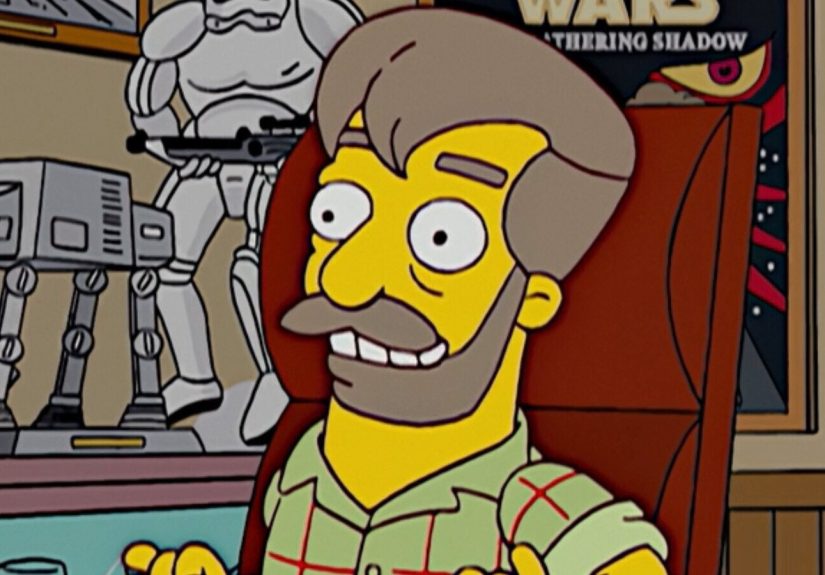
The connection did not stop with the origin story. Over the years, The Simpsons repeatedly joked about Star Wars, science-fiction fandom, and Lucas-style franchise culture. Mark Hamill famously appeared in the Season 10 episode “Mayored to the Mob,” where the show turned fan conventions, celebrity worship, and musical theater into one wonderfully strange stew.
The series also created “Cosmic Wars,” an obvious parody of Star Wars, and Randall Curtis, a George Lucas-like creator figure. In “Co-Dependent’s Day,” Bart and Lisa complain that the newer Cosmic Wars movies have lost the spirit of the originals. That plot works because it reflects a real fan conversation: what happens when the creator of a beloved universe changes it in ways fans dislike?
That is another reason the Lucas-Simpsons connection is so delicious. The Simpsons exists partly because of the business shockwave created by Star Wars, and then The Simpsons later satirized the very kind of franchise culture that Star Wars helped define. It is pop culture eating its own tail, then making a joke about the tail being undercooked.
Why This Story Matters Beyond Trivia
This origin story matters because it reveals how creativity often works in the real world. We like to imagine art arriving fully formed from inspiration, as if a muse descends from the heavens and says, “Please draw a yellow family with four fingers and emotional damage.” But creative history is usually messier. It involves contracts, deadlines, ownership disputes, nervous executives, lucky accidents, and people making fast decisions in hallways.
Matt Groening’s decision to protect Life in Hell was not merely defensive. It was creative self-preservation. He understood that characters are not disposable. They are assets, yes, but they are also extensions of a creator’s voice. By refusing to give away the world he already had, he created a new one that fit the opportunity better.
Lucas’s earlier decision was similar in spirit. He wanted control over his creation. He wanted the ability to continue building his universe and promoting it beyond the film itself. Both Lucas and Groening were thinking like artists and businesspeople. That combination can make executives nervous, but it can also produce empires.
Experience Notes: What Creators, Writers, and Fans Can Learn From This
One of the most useful experiences connected to the story of George Lucas and The Simpsons is the reminder that creative ownership matters before success arrives. Lucas negotiated for rights when Star Wars was still a risky project. Groening protected Life in Hell before The Simpsons became a global institution. In both cases, the big decision happened before everyone else could see the full value.
For writers, designers, cartoonists, bloggers, filmmakers, and independent creators, that lesson is practical. The thing you are making today may look small. It may be a comic, a newsletter, a YouTube series, a podcast, a character sketch, a game prototype, or a niche website. But if it contains a strong voice and memorable characters, it has long-term potential. Do not treat your best ideas as throwaway material just because they have not yet become famous.
Another experience worth taking from this story is that constraints can create better work. Groening did not get the ideal situation. He could not simply bring Life in Hell to television while keeping everything exactly as he wanted. That obstacle forced him to invent something new. Many creators panic when a door closes, but sometimes the closed door saves the better idea from being ignored in the hallway.
There is also a publishing lesson here. Audiences love origin stories because they reveal how fragile famous things once were. The Simpsons now feels inevitable, as if Homer Simpson has always been sitting on America’s couch. But the show began as short, rough interstitial cartoons on a sketch-comedy program. It could have failed quietly. It could have remained a footnote. Instead, it grew because the characters were flexible, funny, emotionally readable, and perfectly suited to satire.
For fans, the story adds a new layer of enjoyment. The next time you watch Homer panic at work, Bart test the limits of school discipline, or Lisa try to reason with a town allergic to reason, it is funny to remember that the family exists partly because a movie studio once underestimated the value of plastic spaceships. Pop culture is full of these accidental bridges. A business deal in one decade becomes a cartoon family in another. A space opera helps create a sitcom. A studio’s regret becomes a viewer’s comfort show.
Finally, this story is a warning and an encouragement. The warning is that contracts shape culture more than audiences usually realize. The encouragement is that creative detours can be gifts. Groening did not lose Life in Hell; he kept it and invented The Simpsons. Lucas did not simply make a film; he changed how Hollywood understood franchises. Neither outcome was guaranteed. Both depended on creators recognizing the value of their own worlds before the marketplace fully caught up.
Conclusion: No Lucas, No Springfield? Not ExactlyBut Maybe
So, is George Lucas directly responsible for The Simpsons? No. That honor belongs to Matt Groening, James L. Brooks, Sam Simon, the early writers, animators, voice actors, and the many artists who shaped Springfield into a living comic universe. Lucas did not create Homer, Bart, Lisa, Marge, or Maggie.
But is Lucas indirectly responsible in a fascinating way? Absolutely. His Star Wars deal changed how Fox thought about character rights and merchandising. That corporate lesson influenced the environment in which Groening chose not to adapt Life in Hell. That choice led to the creation of the Simpson family. A galaxy far, far away helped make room for a town called Springfield.
It is one of those stories that sounds like a joke until you follow the business logic. George Lucas wanted to keep control of his space saga. Fox learned a painful lesson. Matt Groening protected his rabbits. Homer Simpson got born. Somewhere in the cosmic writers’ room, that is the kind of punchline even The Simpsons would respect.