Table of Contents >> Show >> Hide
- Who Is Alexandra Kasmin?
- What Defines Alexandra Kasmin’s New York Landscape Style?
- The Long Island Project: Quiet, Coastal, and Smart
- Dutchess County and Brooklyn: Same Language, Different Accent
- Why Alexandra Kasmin’s Gardens Feel So Timeless
- Design Lessons Homeowners Can Borrow
- The Experience of Walking an Alexandra Kasmin Landscape in New York
- Final Thoughts
If some gardens shout for attention, an Alexandra Kasmin landscape tends to do the opposite. It lowers its voice, straightens its jacket, and somehow ends up being the most interesting thing at the party. That quiet confidence is exactly what makes Kasmin’s work in New York so memorable. Her landscapes don’t look desperate to impress you. They look as though they’ve always belonged therewhich, in design, is about as close as you get to magic.
Kasmin’s world is rooted in a distinctly refined mix of art, architecture, interiors, and old-world decorative taste. That combination matters. It explains why her gardens feel less like random collections of “pretty plants” and more like outdoor rooms with grammar, proportion, and manners. In a state like New Yorkwhere one project may involve a wind-whipped property on Long Island and another a tailored townhouse garden in Brooklynthat kind of discipline is not just elegant. It is practical.
This is what makes a visit into Alexandra Kasmin’s landscape language so compelling. Whether she is shaping a coastal garden in the Hamptons, contributing structure to a Brooklyn backyard, or helping frame the grounds of a house in Dutchess County, the effect is remarkably consistent: clean bones, restrained beauty, and a sense that every plant has been given a job description. No slackers. No botanical freeloaders. Everyone contributes.
Who Is Alexandra Kasmin?
Before becoming associated with antiques and decorative arts in upstate New York, Alexandra Kasmin worked exclusively as a landscape designer. That early focus still shows. Her design sensibility has not been diluted by trend-chasing or over-decoration. Instead, it has matured into an approach that treats landscape as part architecture, part atmosphere, and part long game.
Her own firm’s profile points to work that spans the Hamptons, Dutchess County, a Normandy farmhouse reconstruction, and a pied-à-terre at the Sherry-Netherland. Even that brief list says a lot. Kasmin is clearly drawn to projects where place, history, and visual restraint matter. She is not designing outdoor spaces as seasonal afterthoughts. She is building environments that need to hold up beside serious interiors, strong architecture, and clients who likely know the difference between “tasteful” and “just expensive.”
That background also helps explain why her gardens often carry a subtle European current. Not in the theme-park senseno cartoon Versailles, no tragic little faux chateau routinebut in the more intelligent sense of order, clipped forms, gravel, symmetry, and the use of evergreen structure to create calm. Her landscapes feel informed by travel and decorative history, yet grounded in the conditions of New York living.
What Defines Alexandra Kasmin’s New York Landscape Style?
1. Structure Comes First
One of the clearest through-lines in Kasmin’s work is structural planting. In a Brooklyn Heights project, she used Japanese maples and lots of boxwoods for year-round form. That phraseyear-round structureis basically the Rosetta Stone for understanding her style. She is not building gardens that disappear when the flowers do. She is building compositions that remain legible in spring, summer, fall, and the bleakest part of winter when the garden is reduced to line, mass, bark, and silhouette.
Boxwood is central to that approach, and for good reason. It delivers evergreen clarity, edge definition, screening, and the kind of clipped formality that can make a garden feel established rather than improvised. In traditional garden design, structure is what keeps beauty from turning into chaos. Kasmin appears to understand that instinctively. Her work suggests that before you ask what color a flower should be, you ask what shape the space needs.
2. Softness Never Becomes Sloppiness
Of course, a great landscape cannot survive on boxwood alone. That would be less “garden” and more “very stylish green chessboard.” Kasmin’s talent lies in balancing control with softness. Hydrangeas, for example, are a natural fit in coastal New York landscapes because they tolerate wind and sandy conditions better than their fluffy looks suggest. They offer volume, romance, and seasonal abundance without disrupting the formal bones of a space.
This is likely why hydrangeas keep appearing across East Coast design inspiration: they soften hedges, border pools gracefully, and suit summer houses without feeling flimsy. In the right composition, they act like linen curtains for the gardenlightening the room without erasing its architecture.
Kasmin’s landscapes also feel comfortable with textural counterpoints. Ornamental grasses, when used with restraint, can introduce movement, seasonality, and a slight wild note into otherwise disciplined compositions. That combination matters in New York gardens, especially on larger properties where a landscape can easily feel too stiff or too suburban. Kasmin’s best spaces seem to understand that elegance needs tension: clipped versus loose, evergreen versus bloom, stone versus leaf, geometry versus breeze.
The Long Island Project: Quiet, Coastal, and Smart
The Long Island garden associated with the original “Designer Visit” is described as a low-key landscape project, and that phrase is more revealing than it sounds. “Low-key” in skilled hands does not mean underdesigned. It means edited. It means not every corner is performing acrobatics. It means the project understands the real luxury of an outdoor space: comfort, atmosphere, and confidence.
On Long Island, that restraint is especially wise. Coastal conditions can be unforgiving. Salt air, sandy soil, drying wind, bright light, and the pressure to make everything look “summery” can push less disciplined gardens into chaos. Kasmin’s answer appears to be a calmer one. Instead of overloading a site with flashy planting, she leans into the virtues of shape, repetition, and livable outdoor moments.
The screened porch highlighted in later coverage of the project reinforces that point. This is not a landscape designed merely to be looked at from a distance. It is meant to be inhabited. Dining tables, casual seating, softened transitions between indoors and outthese elements suggest that Kasmin treats landscape as part of domestic life, not just the scenery around it.
That distinction is crucial for good garden design in New York. A successful landscape in the Hamptons or on the East End must do more than photograph well in peak hydrangea season. It has to support weekends, family meals, wet towels, guests with drinks, children running through gravel paths, and the occasional dog with absolutely no respect for a carefully planned border. Beauty is welcome, obviously. But usability is what keeps a garden beloved.
Dutchess County and Brooklyn: Same Language, Different Accent
If Long Island reveals Kasmin’s coastal restraint, Dutchess County and Brooklyn show her versatility. In Dutchess County, Architectural Digest featured a fountain garden designed by Kasmin, complete with a granite basin and benches. Another image from the same project shows a sculptural parterre with boxwood clipped to resemble clouds. That is classic Kasmin territory: formal structure, but not severity; artfulness, but not fuss.
The cloudlike boxwood is especially telling. It nods to a more sculptural, almost painterly use of evergreen mass. The effect is formal, but it is not rigid. The shapes have softness and humor. They suggest a designer who respects tradition without becoming trapped by it. In the wrong hands, clipped shrubs can feel uptight. In the right hands, they become rhythm.
Brooklyn, meanwhile, demands a different scale and temperament. Urban gardens are tighter, more architectural, and less forgiving. There is less room for visual wandering. Every element has to earn its square footage. Kasmin’s use of Japanese maples and boxwoods in Brooklyn Heights makes perfect sense in that context. Japanese maples bring sculptural branching, seasonal color, and a light canopy; boxwoods provide permanence and discipline below. It is a compact lesson in contrast: airy overhead movement, grounded evergreen mass beneath.
What links all these projects is not a single plant list. It is a way of thinking. Kasmin seems to begin with the framework of a placeits architecture, lines, views, and circulationand then layers in plants that reinforce the mood rather than compete with it. That is why her landscapes feel coherent across wildly different settings.
Why Alexandra Kasmin’s Gardens Feel So Timeless
Timelessness is one of the most abused words in design writing. Usually it means “I hope this doesn’t look embarrassing in three years.” In Kasmin’s case, the word fits because her work relies on principles that age well: structure, proportion, repetition, restraint, and seasonal intelligence.
Design voices across the shelter world have repeatedly emphasized that good gardens start with order. Formal garden experts continue to return to geometry, clipped hedges, and defined spaces because structure gives even modest landscapes a sense of permanence. Kasmin’s gardens live squarely in that tradition, but they avoid becoming museum pieces because they also embrace softness, comfort, and site-specific planting.
There is another reason her landscapes endure: they are not overcommitted to novelty. They do not read like trend reports translated into shrubs. You won’t look at them and think, “Ah yes, this was obviously designed during the Great Outdoor Beanbag Era.” Instead, you see stone, hedge, tree, path, lawn, porch, fountain, and bloom arranged with enough intelligence that they remain attractive long after the design conversation moves on to the next fad.
Design Lessons Homeowners Can Borrow
Start with Bones
If you want a garden that still works in February, build the bones first. That means evergreen massing, defined edges, clear paths, and a composition that holds together even without flowers.
Repeat Plants for Calm
Kasmin’s work suggests the power of repetition. A limited palette repeated well feels more luxurious than a collector’s mix of random specimens. Repetition turns planting into design.
Use Soft Plants Against Strong Forms
Hydrangeas, grasses, and looser perennials can soften clipped hedges, stone walls, and gravel paths. The contrast is what creates charm.
Think Like an Interior Designer Outdoors
Where do people sit? Where do they enter? What do they see first? What happens at dusk? Kasmin’s landscapes succeed because they seem arranged for real experience, not just curb appeal.
Edit Ruthlessly
A refined garden often comes from removing one-third of what was initially tempting. More plants do not always equal more beauty. Sometimes they just equal more maintenance and more regret.
The Experience of Walking an Alexandra Kasmin Landscape in New York
What does it actually feel like to move through a landscape shaped by Alexandra Kasmin’s sensibility? First, you notice the calm. Not the boring kindthe good kind, the kind that makes your shoulders drop a little because the space is doing the hard work for you. The entrance is usually legible. The path makes sense. The greenery is not lunging at you from every direction like it has had three espressos and a creative brief.
You start to register the layers slowly. A clipped hedge gives the space a boundary, but it does not feel harsh. A small treemaybe something with an elegant branching patternpulls your eye upward. Flowers appear, but they do not hijack the scene. Instead, they seem to have been invited carefully, like guests who know not to dominate the conversation.
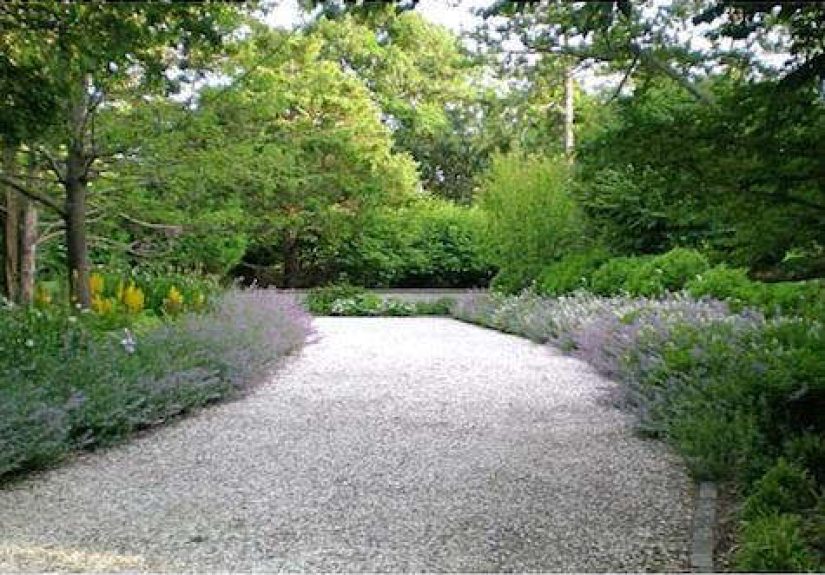
In a coastal setting, the atmosphere is part of the design. There is often a sense of air moving through the space, of materials and plantings chosen to tolerate weather rather than pretend it does not exist. Gravel sounds right underfoot. Hydrangeas soften the edges. A porch or seating area feels connected to the garden instead of stranded beside it. You get the sense that the designer understands how a summer day unfoldssun, shade, lunch, breeze, eveningand has given each moment a place to land.
In a more architectural setting, such as an urban garden, the experience becomes tighter and more concentrated. Every line matters more. Here, a Kasmin-style landscape feels like a conversation between masonry and planting, between the fixed envelope of the city and the seasonal life inside it. Boxwood can anchor the lower level of the composition; Japanese maples or other sculptural forms provide height and grace. You do not need acres to feel transported. You just need discipline and proportion.
There is also something psychologically persuasive about this kind of garden. Because it is ordered, you trust it. Because it is soft, you relax in it. Because it is edited, you notice things you might otherwise miss: the shape of a clipped shrub against evening light, the shadow cast by a porch screen, the way grasses move differently from hydrangea leaves, the hush created by a hedge around a seating area. It is not a garden that screams, “Look at me!” It is a garden that keeps rewarding you for paying attention.
That may be the best compliment one can give a landscape designer. Kasmin’s work appears to value not just appearance, but tempo. Her spaces unfold at a human pace. They invite strolling, sitting, noticing, and returning. They feel finished without feeling frozen. They feel cultivated without feeling fussy. And in New York, where so many outdoor spaces are either overproduced or underconsidered, that balance is rare.
By the end of the visit, what lingers is not a single plant or object but a mood: tailored but breathable, formal but livable, European in spirit yet deeply attuned to New York conditions. It is the kind of landscape that makes you want to steal not just the look, but the discipline behind it. Sadly, discipline is harder to buy than hydrangeas. But at least the hydrangeas are pretty.
Final Thoughts
Alexandra Kasmin’s landscape work in New York offers a useful reminder that great garden design is rarely about spectacle. It is about control, restraint, livability, and the confidence to let structure do the heavy lifting. From Long Island to Dutchess County to Brooklyn, her projects point to a design philosophy that values evergreen bones, sculptural planting, and outdoor spaces that feel genuinely inhabited.
In other words, Kasmin designs gardens for adults. Stylish adults, yes. Adults who probably own very good linen napkins. But stillgardens for people who want beauty with backbone. And in a design culture that often confuses “more” with “better,” that may be her most refreshing idea of all.