Table of Contents >> Show >> Hide
- Why DIY Building Projects Are So Good for Kids
- Before You Build: A Simple Safety Checklist
- 10 DIY Toys You Can Build With Your Kids
- How to Make These Projects More Educational Without Making Them Boring
- Budget-Friendly Supplies to Keep on Hand
- Real-Life Experiences: What Building Toys With Kids Actually Teaches
- Conclusion
There are two kinds of toys in a house: the ones that arrive in shiny packaging and the ones your child proudly announces were “engineered” on the kitchen table with cardboard, tape, and enough enthusiasm to power a small city. The second kind may not always look like something from a toy store, but it often becomes the favorite. Why? Because kids do not just play with it. They build it, test it, rename it, rebuild it, and occasionally give it a dramatic backstory involving dinosaurs, outer space, or a rescue mission under the couch.
Building projects for kids are more than rainy-day boredom busters. They help children practice problem-solving, hand-eye coordination, patience, measuring, creative thinking, and basic STEM skills. Better yet, DIY toys give families a reason to slow down and make something together. A cardboard car ramp can become a physics lesson. A rubber band car can become an engineering challenge. A puppet theater can turn a quiet afternoon into a full Broadway production, minus the expensive tickets and parking stress.
This guide shares 10 DIY toys you can build with your kids using simple materials like cardboard, craft sticks, recycled containers, string, wood scraps, paper tubes, and washable paint. Each project is designed to be flexible, affordable, and friendly for beginners. You do not need a professional workshop. You need a safe workspace, a few basic supplies, and a sense of humor when the first prototype looks less like a race car and more like a potato with wheels.
Why DIY Building Projects Are So Good for Kids
Children learn best when their hands are busy and their minds are curious. Building toys encourages them to ask practical questions: What makes it move? Why did it fall over? How can we make it stronger? What happens if we change the angle, weight, shape, or material? These questions are the heart of engineering and design, even when the project involves googly eyes and glitter.
DIY toy projects also help kids understand that mistakes are part of making. A wheel that wobbles is not a disaster; it is data. A tower that collapses is not a failure; it is an invitation to try a wider base. When children see adults calmly adjust a plan, they learn resilience in a very real way. No lecture required.
Another bonus: homemade toys encourage open-ended play. Unlike many electronic toys that come with fixed buttons and predictable sounds, DIY toys can change. A cardboard garage can become a castle. A puppet theater can become a grocery store. A paper rocket can become a weather experiment, a space mission, or a competition to see whose rocket lands closest to the laundry basket.
Before You Build: A Simple Safety Checklist
Fun is the goal, but safety gets the first chair at the craft table. Always match the project to your child’s age and ability. Adults should handle cutting with sharp blades, drilling, sanding power tools, hot glue, and anything that requires strong pressure or heat. Younger kids can measure, decorate, hold pieces in place, peel stickers, paint, test, and make design choices.
- Avoid small parts for children under 3. Buttons, beads, marbles, small wheels, bottle caps, loose magnets, and tiny craft pieces can be choking hazards.
- Skip strong magnets and button batteries. These can be extremely dangerous if swallowed.
- Use non-toxic, washable supplies. Choose child-safe paints, markers, glue, and finishes.
- Smooth rough edges. Sand wood, trim sharp cardboard corners, and cover wire ends with tape.
- Supervise testing. Launchers, ramps, and moving toys should use soft items like pom-poms, paper balls, or foam pieces.
- Create a cleanup zone. A tray, tablecloth, or flattened cardboard box can keep the creative explosion contained.
Now, roll up your sleeves. Here are 10 DIY toys you can build with your kids, from quick cardboard creations to simple woodworking projects that feel satisfyingly “real.”
10 DIY Toys You Can Build With Your Kids
1. Cardboard Race Ramp and Toy Garage
Best for: Ages 3 and up with supervision
Time: 30 to 60 minutes
Materials: Large cardboard box, paper towel tubes, tape, washable markers, ruler, scissors, toy cars
A cardboard race ramp is one of the easiest building projects for kids because the materials are usually already waiting in the recycling bin. Cut a long strip of cardboard for the ramp and tape it to a sturdy box or chair at an angle. Add side rails using folded cardboard strips so cars do not fly off like tiny stunt drivers with no insurance.
Next, turn a shoebox into a garage. Cut parking bays, draw doors, label each spot, and add a “car wash” made from strips of paper. Kids can test how ramp height affects speed, compare different toy cars, and adjust the surface with paper, foil, or fabric. For younger builders, use larger vehicles and avoid any loose small decorations.
2. Rubber Band Car
Best for: Ages 6 and up
Time: 45 to 90 minutes
Materials: Cardboard or lightweight wood, bottle caps or cardboard wheels, bamboo skewers, straws, rubber bands, tape, glue
A rubber band car teaches motion, stored energy, friction, and patience. Start with a small rectangular base made from cardboard. Tape two straw pieces across the bottom as axle holders. Slide skewers through the straws, then attach wheels to each end. Bottle caps work well, but cardboard circles are easier for kids to decorate.
Hook a rubber band to the rear axle and anchor the other end to the front of the car. Wind the wheels backward, set the car down, and release. If it veers left, check whether the wheels are even. If it does not move, reduce friction or tighten the rubber band setup. Kids quickly learn that engineering is mostly asking, “Why did it do that?” and then trying again.
3. Wooden Toolbox or Treasure Caddy
Best for: Ages 7 and up with adult help
Time: 1 to 2 hours
Materials: Pre-cut wood pieces, wood glue, small nails or screws, sandpaper, handle dowel, paint
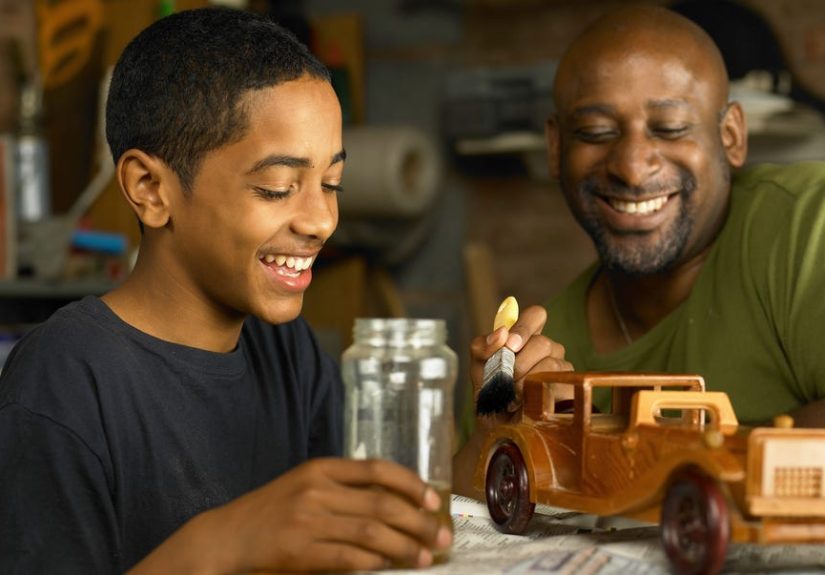
A simple wooden caddy is a wonderful starter woodworking project. It can become a toy toolbox, art-supply carrier, rock collection crate, doll picnic basket, or “important stuff transporter,” which is a very serious category in childhood.
Use pre-cut wood pieces to keep the project manageable. Adults can drill pilot holes or help with hammering while kids sand, glue, paint, and plan the layout. Add a dowel as the handle and let your child personalize the caddy with stripes, stars, initials, or dramatic warning labels like “Do Not Open: Dragon Snacks.”
This project builds confidence because the finished toy feels sturdy and useful. It also introduces measuring, alignment, tool safety, and the satisfaction of making something that does not collapse when someone breathes near it.
4. Craft Stick Catapult
Best for: Ages 5 and up
Time: 20 to 40 minutes
Materials: Craft sticks, rubber bands, plastic spoon, pom-poms, tape
A craft stick catapult is a classic STEM toy because it is fast, fun, and just chaotic enough to thrill kids without turning your living room into a medieval battlefield. Stack several craft sticks and secure both ends with rubber bands. Use two more craft sticks as the launching arm, placing the stacked bundle between them near one end. Attach a plastic spoon to the top stick.
Launch only soft pom-poms, cotton balls, or paper balls. Set up targets using cups or paper plates. Kids can experiment with arm length, rubber band tension, and launch angle. Ask questions like: What makes the pom-pom fly farther? What happens if the target is higher? Can you launch accurately instead of just far?
5. Balloon-Powered Bottle Boat
Best for: Ages 6 and up
Time: 30 to 60 minutes
Materials: Empty plastic bottle, balloon, straw, tape, rubber band, shallow tub of water
This DIY toy turns recycled materials into a floating physics lesson. Use an empty plastic bottle as the boat body. Tape a straw along the top so one end points behind the boat. Attach a balloon to the front end of the straw with a rubber band, making sure air can flow through the straw.
Blow up the balloon through the straw, pinch it closed, place the boat in water, and release. The escaping air pushes the boat forward. If it spins in circles, adjust the straw so it points straight back. If it sinks, use a smaller balloon or improve the boat’s balance. Build a fleet and race them in a bathtub or storage bin. Keep water play supervised and dry the floor before anyone performs an accidental ice-skating routine.
6. Paper Straw Rockets
Best for: Ages 4 and up
Time: 20 to 45 minutes
Materials: Paper, tape, scissors, straws, markers
Paper straw rockets are simple, inexpensive, and perfect for kids who like the phrase “blast off.” Roll a small rectangle of paper around a straw to form a loose tube. Tape the side, fold and seal the top, then add paper fins. Decorate with flames, windows, alien passengers, or mission names.
Place the rocket on the straw and blow through the straw to launch. Kids can compare long rockets versus short rockets, large fins versus small fins, and pointed tops versus flat tops. Make a landing zone with tape on the floor and see who can reach the moon, also known as the far side of the hallway.
7. Cardboard Puppet Theater
Best for: Ages 4 and up
Time: 1 hour
Materials: Large cardboard box, fabric scraps, craft sticks, paper, markers, glue, tape
A puppet theater is both a building project and a storytelling machine. Cut a window in the front of a large cardboard box. Tape fabric scraps or paper curtains on each side. Let kids decorate the theater with signs, stars, lights drawn in marker, or a fancy name like “The Grand Wobbly Stage.”
Make puppets from paper, socks, wooden spoons, or craft sticks. Children can build characters, write short scenes, and perform for the family. This toy supports creativity, language, confidence, and collaboration. It is also excellent for children who enjoy being in charge, which is to say most children.
8. DIY Ball Maze
Best for: Ages 5 and up; use larger balls for younger kids
Time: 45 to 90 minutes
Materials: Shoebox lid, cardboard strips, glue, tape, ping-pong ball or large wooden bead
A ball maze is a hands-on design challenge. Use a shoebox lid as the base. Cut cardboard strips for walls and glue them into a maze pattern. Add a start, finish, dead ends, tunnels, bridges, and silly signs like “Wrong Way, Tiny Traveler.”
For safety, use a ping-pong ball or another large ball instead of a marble if younger children are nearby. Kids can test whether the ball gets stuck, whether paths are too narrow, and whether corners need more space. Once the maze works, decorate it as a jungle, city, space station, or candy kingdom.
9. Pool Noodle Hobby Horse
Best for: Ages 3 and up
Time: 30 to 60 minutes
Materials: Pool noodle, yarn, felt, ribbon, large googly eyes or felt eyes, duct tape
A pool noodle hobby horse is a big-energy toy for kids who prefer movement over sitting still. Bend one end of the pool noodle down to make the horse’s head and secure it with duct tape or ribbon. Add felt ears, yarn mane, and safe eyes made from felt or securely attached large craft pieces.
Kids can name their horse, design a stable from a cardboard box, and create obstacle courses using pillows or cones. This project encourages imaginative play and gross motor movement. It is also a fine reminder that sometimes the best toy is basically a foam tube with a personality.
10. Recycled Robot with Moving Arms
Best for: Ages 6 and up
Time: 1 hour
Materials: Small boxes, paper tubes, brad fasteners, foil, tape, glue, markers, bottle caps for older kids only
Build a robot from recycled boxes and paper tubes. Use one box for the body and a smaller box for the head. Paper tubes can become arms and legs. Attach arms with brad fasteners so they can move up and down. Cover parts with foil or silver paper for a shiny robot look.
Kids can add buttons, control panels, antennas, and a job for the robot. Is it a snack-delivery robot? A homework-destroying robot? A dance robot with questionable rhythm? For younger children, skip small caps and use drawn-on buttons instead. This project is great for creative problem-solving because kids must think about balance, attachment, movement, and character design all at once.
How to Make These Projects More Educational Without Making Them Boring
The fastest way to drain the fun from a DIY toy project is to turn it into a lecture with glue. Instead, use short questions that invite kids to think. Try asking, “What do you predict will happen?” before testing. After testing, ask, “What would you change?” or “How could we make it stronger, faster, taller, lighter, or easier to use?”
Let kids make real design decisions. Give them two material choices instead of ten. For example, ask whether the rocket should have big fins or small fins. Ask whether the garage needs two parking spaces or four. Ask whether the robot should have long arms for reaching or short arms for strength. When children make choices, they become invested in the outcome.
It also helps to celebrate the second version. Many kids feel disappointed when the first build does not work. Normalize redesign by saying, “Great, now we know what to fix.” Engineers, artists, inventors, and carpenters all revise. The goal is not a perfect toy. The goal is a child who believes, “I can make things.”
Budget-Friendly Supplies to Keep on Hand
You do not need a closet full of expensive craft supplies. A simple DIY toy kit can include cardboard, painter’s tape, washable markers, craft sticks, straws, string, yarn, paper tubes, child-safe scissors, glue sticks, rubber bands, paper fasteners, scrap fabric, and sandpaper. If you do woodworking projects, add pre-cut wood pieces, wood glue, a small hammer, safety glasses, and clamps.
Recycled materials are especially useful. Cereal boxes become ramps. Oatmeal containers become drums. Egg cartons become sorting trays. Plastic bottles become boats. Shoeboxes become garages, theaters, mazes, doll beds, and secret treasure vaults. Once kids understand that “trash” can become a toy, the recycling bin starts looking like a toy store with worse branding.
Real-Life Experiences: What Building Toys With Kids Actually Teaches
One of the most valuable parts of building projects for kids is watching how differently children approach the same materials. Give three kids a cardboard box, tape, and markers, and you may get a race car, a dragon cave, and a vending machine that only accepts imaginary coins. That variety is the magic. DIY toys leave room for personality.
In a typical family building session, the adult often begins with a plan while the child begins with a story. The adult may say, “Let’s build a rubber band car.” The child may respond, “This is a rescue vehicle for a penguin doctor.” Both ideas can live together. The car still needs wheels, axles, and a working rubber band system, but now it also needs a tiny medical kit and perhaps a siren. That storytelling keeps the project playful while the building teaches real skills.
Another common experience is the “almost worked” moment. The cardboard ramp is too steep. The boat tips over. The catapult launches backward. The first instinct may be to fix it quickly for the child, but the better move is to pause and ask, “What do you notice?” Children are surprisingly good at diagnosing problems when adults give them time. They may see that one wheel is crooked, the tape is blocking the axle, or the balloon is too heavy for the boat. When they solve the problem themselves, the pride is enormous.
DIY projects also reveal that kids love responsibility. Letting a child sand a wooden edge, measure a cardboard wall, count craft sticks, or test the first launch gives them ownership. Even small jobs matter. A preschooler who decorates the rocket is not “just coloring”; they are making design decisions. An older child who adjusts a maze path is learning iteration. A middle-grade builder who drills under supervision is practicing focus, patience, and respect for tools.
Parents often discover that the best conversations happen during the messy middle of a project. While hands are busy, kids talk. They explain their ideas, tell jokes, share frustrations, and ask questions. The project becomes a low-pressure space for connection. Nobody has to force a meaningful family moment. It sneaks in while someone is looking for the tape.
The finished toy is wonderful, but it is not the only reward. Sometimes the toy lasts for months. Sometimes it falls apart by dinner. Either way, the child has practiced planning, building, testing, revising, and imagining. Those skills last longer than cardboard. They help kids approach future challenges with a maker’s mindset: try something, learn from it, improve it, and keep going.
So when the house is quiet for three suspicious seconds, consider pulling out a box of supplies instead of turning on another screen. Build a boat, a robot, a maze, or a puppet theater. The results may be crooked. The table may look like a craft tornado passed through. But somewhere in that glorious mess, your child is learning that ideas can become real things. That is a pretty powerful toy.
Conclusion
Building projects for kids do not have to be complicated to be meaningful. A simple DIY toy can teach engineering, creativity, patience, storytelling, and practical problem-solving. Whether you build a cardboard race ramp, a balloon boat, a rubber band car, or a recycled robot, the real value is the shared process. Kids learn by doing, testing, laughing, and trying again.
The best DIY toys are safe, flexible, and open-ended. They invite children to decorate, redesign, and invent new ways to play. They also remind adults that family time does not need to be fancy. Sometimes all it takes is a cardboard box, a little tape, and a child with a big idea.