Table of Contents >> Show >> Hide
- Introduction: A Tiny Robot With Big “Why Didn’t I Think of That?” Energy
- What Is BEAM Robotics?
- The Dragonfly Project: Broken Toy, New Wings
- Why the Gearbox Is the Secret Sauce
- The Solar Engine: How the Dragonfly Flaps Without a Brain
- Why No Microcontroller Is a Feature, Not a Limitation
- Biomimicry: Why Dragonflies Keep Inspiring Engineers
- Upcycling Electronics: The Project’s Quiet Superpower
- Why Makers Loved This Tiny Flapping Machine
- What Beginners Can Learn From the BEAM Dragonfly
- Where the BEAM Dragonfly Fits in Modern Robotics
- Practical Tips for Building a Similar BEAM Dragonfly
- Experiences Related to “BEAM Dragonfly Causes A Flap”
- Conclusion: Small Wings, Big Lessons
Note: This article is written for web publication and synthesizes real information about BEAM robotics, solar-engine circuits, dragonfly-inspired design, maker culture, and the well-known recycled flapping dragonfly robot project.
Introduction: A Tiny Robot With Big “Why Didn’t I Think of That?” Energy
Some projects make noise because they are massive, expensive, and packed with processors. Others make noise because they flap their little wings after being rescued from the junk drawer. “BEAM Dragonfly Causes A Flap” belongs proudly to the second group: a charming, solar-powered robotic dragonfly built from recycled parts, brass rods, flashing LEDs, capacitors, and the kind of maker stubbornness that looks at a broken toy and says, “You’re not dead. You’re just becoming art.”
The project became popular in maker circles because it captured the spirit of BEAM robotics: Biology, Electronics, Aesthetics, and Mechanics. Instead of relying on a microcontroller, software, Wi-Fi, sensors, or a tiny onboard computer yelling instructions like a nervous project manager, this dragonfly uses analog electronics and simple mechanical behavior. It stores solar energy, releases it in bursts, and flaps its wings through a salvaged gearbox. That is not only adorable; it is also a surprisingly elegant lesson in robotics design.
At first glance, the BEAM dragonfly looks like a quirky desktop sculpture. Look closer, and you see a working example of sustainable electronics, biomimetic thinking, mechanical reuse, solar energy, and minimalist engineering. It is part robot, part insect, part science lesson, and part “please do not throw away that broken RC toy just yet.”
What Is BEAM Robotics?
BEAM robotics is a design philosophy that favors simple, reactive machines inspired by living organisms. The acronym is most commonly understood as Biology, Electronics, Aesthetics, and Mechanics. That combination explains almost everything: BEAM robots are not just machines that move; they are small mechanical creatures designed to behave in interesting, life-like ways with as few parts as possible.
Unlike many modern robots, traditional BEAM robots usually avoid microcontrollers. There is no Arduino sketch, no Raspberry Pi, no Python script, and no firmware update waiting to ruin your afternoon. Instead, BEAM designs often use analog circuits, capacitors, transistors, Schmitt triggers, motors, solar cells, and feedback loops. The “thinking” happens through the circuit itself.
That sounds simple, but simple does not mean boring. In fact, BEAM robotics is famous for producing surprisingly organic behavior from minimal hardware. A tiny solar-powered walker may hesitate, twitch, recover, and continue forward like a bug deciding whether your kitchen floor is safe territory. A solar pendulum may swing when its capacitor charges enough. A vibrobot may jitter around a table as if late for a meeting. The magic is not in complex programming; it is in the relationship between power, timing, mechanics, and environment.
The Dragonfly Project: Broken Toy, New Wings
The BEAM dragonfly that “caused a flap” began with a familiar maker story: a cheap robotic dragonfly toy broke. Most people would throw it away. A maker saw the gearbox and imagined a second life. That decision is the beating heart of the project.
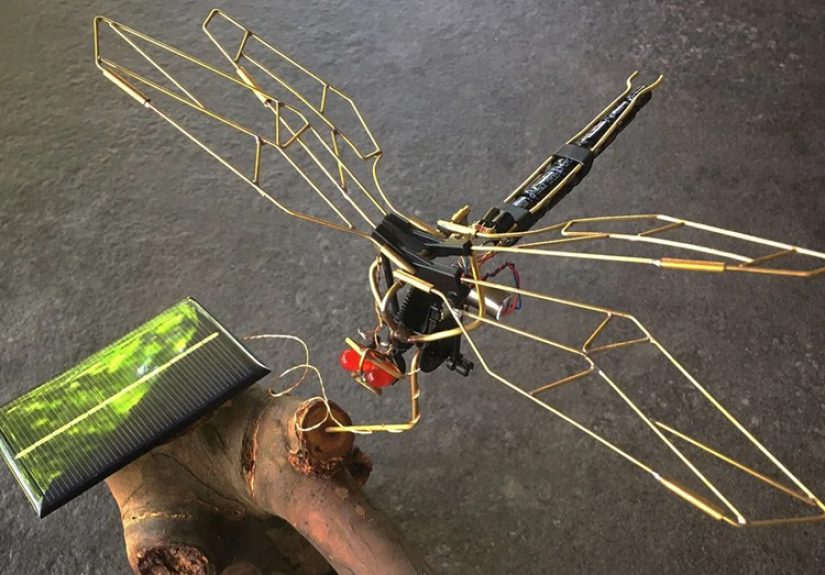
The original toy’s gearbox became the mechanical core. The builder used brass rod to create a new dragonfly-like body and wing structure. Flashing LEDs became the eyes. A solar panel provided power. A capacitor bank acted like a tiny energy reservoir. The result was a flapping dragonfly robot that looked handmade in the best possible way: delicate, purposeful, and slightly mischievous.
This is where BEAM robotics shines. Rather than beginning with a shopping list full of specialty parts, the project begins with salvage. The gearbox is not just a part; it is the reason the project works. Gears are difficult to fabricate at small scale, and wing-flapping mechanisms are especially tricky. By reusing the original gearbox, the builder skipped one of the hardest mechanical problems and focused on the new body, solar engine, and overall design.
Why the Gearbox Is the Secret Sauce
In a flapping robot, the motor alone is not enough. A DC motor spins; dragonfly wings flap. The gearbox translates fast rotational motion into slower, stronger mechanical motion that can move the wings. Without it, the project would need a custom crank, linkage, cam, or gear train. That is possible, but it is much harder than it sounds, especially when the robot is small enough to look like it might perch on a pencil.
The salvaged gearbox makes the dragonfly practical. It reduces speed, increases torque, and gives the wings a motion pattern that resembles flapping instead of frantic spinning. This is a classic maker lesson: sometimes the most valuable part in a broken device is not the motor, the battery, or the circuit board. It is the weird little mechanical assembly that nobody sells separately.
That also explains why replicating this project exactly can be difficult. If another builder does not have the same toy, they may need to adapt a different gearbox or modify the wing linkage. BEAM robots often invite this kind of improvisation. The plans are not always “copy this perfectly.” They are more like, “Here is a clever creature. Now go build its cousin.”
The Solar Engine: How the Dragonfly Flaps Without a Brain
The dragonfly’s motion depends on a FLED-based solar engine. FLED stands for flashing LED. In simple terms, a solar engine collects small amounts of energy from a solar cell and stores that energy in capacitors. When the voltage reaches a certain threshold, the circuit releases the stored energy into the motor. The motor runs briefly, the wings flap, the stored charge drops, and the process begins again.
It is a little like waiting for a tiny robot to finish drinking an energy smoothie. Charge, pause, flap. Charge, pause, flap. In strong light, the cycle may happen more often. In dimmer light, the robot waits longer between bursts. That behavior is not a bug; it is the point. The robot responds directly to available energy.
The flashing LEDs do double duty. They are part of the circuit behavior and also serve as the dragonfly’s eyes. That is peak BEAM aesthetics: a component is not hidden simply because it is electronic. It becomes part of the creature’s personality. The capacitor bank on the tail is also functional. It stores energy for wing movement, and when the first version needed more power, an extra capacitor was added to increase the stored charge. The robot did not need a software patch. It needed more “juice.” Honestly, relatable.
Why No Microcontroller Is a Feature, Not a Limitation
Modern hobby robotics often starts with microcontrollers. That approach is powerful, flexible, and beginner-friendly in many ways. But the BEAM dragonfly reminds us that not every robot needs code. In this design, the environment, circuit, and mechanics create the behavior together.
The solar panel senses light by producing energy. The capacitors create timing by charging and discharging. The FLED threshold helps decide when energy should be released. The motor turns when the circuit allows it. The gearbox converts rotation into flapping. The wings move because the mechanical system is shaped to move that way.
This kind of robotics teaches a different skill set. Instead of asking, “What should I program the robot to do?” the maker asks, “What behavior naturally emerges if I connect these parts correctly?” That question is valuable for students, artists, engineers, and anyone who wants to understand robotics beyond screens and code editors.
Biomimicry: Why Dragonflies Keep Inspiring Engineers
Dragonflies are not just pretty insects with excellent branding. They are extraordinary flyers. Real dragonflies can hover, dart forward, turn quickly, glide, and maneuver with impressive control. Their two pairs of wings can operate with complex timing, giving them agility that fascinates researchers working on micro air vehicles and insect-inspired robots.
Engineers study dragonfly wings because they combine lightness, flexibility, strength, and aerodynamic efficiency. The wing veins create structure without too much weight. The flexible membrane can deform during movement. The front and rear wings interact with airflow in ways that can improve lift, stability, or maneuverability depending on timing.
The BEAM dragonfly is not a flying research drone, and nobody should expect it to patrol a greenhouse or chase mosquitoes with superhero confidence. Its charm is different. It takes the idea of dragonfly motion and turns it into an accessible kinetic sculpture. It is biomimicry at a garage-workbench scale: not a perfect copy of nature, but a respectful wink in nature’s direction.
Upcycling Electronics: The Project’s Quiet Superpower
One of the strongest lessons from the BEAM dragonfly is the value of upcycled electronics. Old toys, discarded gadgets, broken RC vehicles, dead printers, obsolete CD drives, and retired consumer electronics often contain useful parts: motors, gears, springs, switches, LEDs, wires, battery contacts, and plastic mechanisms.
In a world drowning in electronic waste, projects like this offer a small but meaningful alternative. They show that broken devices can become educational tools, art pieces, or new machines. Not every component must come in a fresh anti-static bag. Sometimes the best part is already sitting in a drawer, attached to something that stopped working three years ago.
For classrooms and maker spaces, this matters. Salvage-based robotics lowers cost and encourages experimentation. Students learn to identify components, understand mechanical assemblies, and adapt designs around available materials. They also learn that engineering is not always a straight line from diagram to product. Sometimes it is a treasure hunt with solder fumes.
Why Makers Loved This Tiny Flapping Machine
The BEAM dragonfly attracted attention because it sits at the intersection of several maker-friendly ideas. It is visual, so people immediately understand that something is happening. It is solar-powered, so the energy story is clear. It uses recycled parts, so it feels resourceful. It is analog, so it stands apart from the usual microcontroller projects. And it resembles a living creature, so it has personality.
That personality matters more than people admit. A wheeled robot can be useful, but a flapping dragonfly feels alive in a different way. When it twitches after charging in sunlight, the motion seems earned. The pause before each flap adds suspense. You watch the capacitors gather enough energy, then suddenly the wings move. It is a tiny drama starring voltage.
This is why kinetic BEAM projects often make people smile. They do not simply demonstrate a concept; they perform it. The circuit becomes visible through motion. The energy flow becomes understandable. The robot’s body becomes the user interface.
What Beginners Can Learn From the BEAM Dragonfly
1. Mechanics Are Just as Important as Electronics
Many beginners focus on circuits first, but the dragonfly shows that mechanics can make or break a project. The gearbox, wing hinges, rod alignment, solder joints, and body balance all matter. A perfect circuit will not save wings that bind, twist, or weigh too much.
2. Energy Budgeting Is Real
The robot must store enough energy before it can move. That makes power management visible. Add too much weight, and the motor struggles. Use too little capacitance, and the wings may twitch instead of flap. Improve light exposure, and the behavior changes. This is hands-on energy literacy.
3. Components Can Have Personality
In BEAM robotics, parts are often visible and expressive. LEDs become eyes. Capacitors become a tail. Brass rods become anatomy. The project teaches that function and beauty do not need to be enemies. In fact, they can share a solder joint.
4. Failure Is Part of Tuning
Analog robots usually need adjustment. A capacitor value may need changing. A motor may draw too much current. A wing may be too stiff. A solar panel may be underpowered. This is not failure in the dramatic movie-trailer sense. It is tuning, and tuning is where much of the learning happens.
Where the BEAM Dragonfly Fits in Modern Robotics
Today’s robotics world is full of AI, computer vision, autonomous drones, machine learning, and advanced sensors. Against that backdrop, a solar-powered analog dragonfly might seem like a charming antique. But that would miss the point.
Minimalist robots are still valuable because they teach fundamentals. They reveal relationships that can be hidden inside software-heavy systems. Power, timing, friction, load, balance, and material stiffness are not abstract ideas when a tiny wing refuses to flap. They are right there on the workbench, demanding attention.
The project also connects to a larger trend in bio-inspired engineering. Researchers continue to explore flapping-wing robots, insect-scale flight, soft actuators, and micro air vehicles. Those advanced systems are far beyond a simple BEAM sculpture, but they share a common curiosity: nature has already solved many movement problems in elegant ways. Engineers can learn by watching carefully.
Practical Tips for Building a Similar BEAM Dragonfly
If you want to build something inspired by this project, start with the mechanics. Find a small gearbox from a broken toy, especially one that already created flapping or oscillating motion. Test it with a low-voltage motor before building the body around it. If the gearbox runs smoothly, you have a strong foundation.
Next, keep the structure light. Brass rod is attractive and solderable, but weight adds up quickly. Thin wire, light plastic film, or delicate wing material can help reduce load. Wing symmetry matters too. If one wing is heavier or stiffer than the other, the motion may look awkward, unless awkward is your artistic goal. No judgment; some bugs have personality.
For the solar engine, choose components that match the motor’s needs. Capacitor size affects how much energy is stored and how long the robot waits between movements. More capacitance can provide a stronger burst, but it also takes longer to charge. Smaller capacitance charges faster but may not deliver enough power. This tradeoff is the soul of many BEAM projects.
Finally, document the build. BEAM robotics has a rich history, but many older resources have disappeared from the web. Clear photos, circuit notes, parts lists, and honest troubleshooting details help keep the knowledge alive for future builders.
Experiences Related to “BEAM Dragonfly Causes A Flap”
The first experience many people have with a project like the BEAM dragonfly is not technical. It is emotional. You see a broken toy become something new, and suddenly the junk box looks less like clutter and more like a sleeping robot zoo. That shift is powerful. It changes how you look at everyday objects.
Imagine opening a drawer and finding an old RC toy that no longer works. Before learning about BEAM robotics, you might see trash. After seeing the dragonfly project, you start noticing the gearbox, the small motor, the battery terminals, the lightweight plastic shell, and the screws that could hold a future frame together. The object has not changed. Your attention has.
A second experience is patience. Solar-powered BEAM robots do not always move on command. They make you wait. The capacitor charges quietly. The light angle matters. Your hand may accidentally shade the panel and delay the next flap. This can feel frustrating at first, especially if you are used to pressing a button and getting instant action. But that waiting becomes part of the charm. The robot is not ignoring you; it is negotiating with physics.
Another memorable experience is the first successful flap. In many builds, the first motion is not graceful. The wings may twitch unevenly. The body may jump. A solder joint may flex. The motor may buzz like an annoyed mosquito. But when the mechanism finally moves under solar power, the result feels bigger than it looks. You did not just power a motor. You created a tiny cycle of energy collection, storage, release, and motion.
The project also teaches humility. Small mechanisms are unforgiving. A wing that looks light may be too heavy. A rod that looks straight may create friction. A capacitor that seems close enough may change the entire rhythm. The BEAM dragonfly reminds builders that physical reality has opinions, and it will share them immediately.
For students, this kind of project can be more memorable than a worksheet because it makes abstract ideas tangible. Capacitance becomes the pause before movement. Voltage becomes the invisible line between stillness and action. Torque becomes the difference between a wing flap and a sad electrical sigh. Biomimicry becomes something you can hold.
For artists, the dragonfly offers a different lesson: electronics can be expressive. The circuit does not need to be hidden inside a plastic box. The visible components become part of the sculpture. The eyes flash, the tail stores energy, and the body reveals its own construction. It feels honest, like a machine wearing its thoughts on the outside.
For experienced makers, the BEAM dragonfly is a reminder that complexity is not always progress. There is joy in building a creature that works because its parts are carefully matched, not because a processor corrects every mistake. It is a small rebellion against overengineering. Sometimes the best robot is not the smartest one. Sometimes it is the one that flaps in the sunlight and makes everyone at the workbench grin.
That is why “BEAM Dragonfly Causes A Flap” continues to be an appealing topic. It is not merely about a single robotic insect. It is about a way of building that values reuse, simplicity, visible function, and playful experimentation. In a world where devices are often sealed, disposable, and mysterious, a handmade solar dragonfly feels refreshingly open. It says: here are my parts, here is my power, here is my motion. Now go make something stranger.
Conclusion: Small Wings, Big Lessons
The BEAM Dragonfly proves that a robotics project does not need a computer brain to feel alive. With a salvaged gearbox, brass structure, flashing LEDs, a solar panel, capacitors, and a clever analog solar engine, a broken toy can become a kinetic creature that teaches real engineering principles. It demonstrates power management, mechanical design, biomimicry, upcycling, and the charm of minimalist robotics.
More importantly, it reminds makers that creativity often begins where ordinary people stop looking. A broken device is not always the end of a product’s life. Sometimes it is the beginning of a tiny flapping robot that causes a delightful little flap of its own.