Table of Contents >> Show >> Hide
- What Kind of Baby Horse Was Cloned?
- Meet Kurt: The Foal with a 40-Year Backstory
- How Can a Horse Be Cloned from Old DNA?
- Why 40-Year-Old DNA Was So Valuable
- The Frozen Zoo: A Library Where the Books Are Cells
- Why Genetic Diversity Matters for Endangered Horses
- Is This De-Extinction?
- What Happened After Kurt?
- What This Means for Wildlife Conservation
- The Ethical Questions Behind Cloning Endangered Animals
- Why the Story Captured Public Attention
- Lessons from a Baby Horse with Old DNA
- Personal Reflections and Experiences Related to the Topic
- Conclusion: A Small Foal with a Big Future
A baby horse cloned from 40-year-old DNA sounds like the opening scene of a science-fiction movie where someone in a lab coat whispers, “Don’t worry, we’ve definitely thought this through.” But this story is not about bringing back dinosaurs, building a theme park with questionable security, or asking a foal to explain the mysteries of genetics. It is about a real, living Przewalski’s horse named Kurt, born through cloning technology using cells preserved for decades in the San Diego Zoo’s Frozen Zoo.
The result was more than a cute foal with fuzzy legs and an impressive scientific résumé. Kurt became the world’s first successfully cloned Przewalski’s horse, a milestone in endangered species conservation. His birth showed that old, carefully preserved cells can do more than sit quietly in cold storage. In the right hands, they can reintroduce valuable genetic diversity into a fragile population that needs every healthy gene it can get.
The phrase “baby horse cloned from 40-year-old DNA” is catchy, but the real story is richer. It involves wild horse history, genetic bottlenecks, conservation biology, cryopreservation, animal cloning, and a surprisingly emotional reminder that saving species is often a race against time. Sometimes, the finish line is not a dramatic rescue in the wilderness. Sometimes, it is a freezer.
What Kind of Baby Horse Was Cloned?
The cloned foal was not a regular domestic horse. He was a Przewalski’s horse, also known as the Mongolian wild horse or takhi. These animals are often described as the last truly wild horses on Earth. Unlike mustangs, which descend from domestic horses that returned to the wild, Przewalski’s horses represent a distinct wild lineage.
Przewalski’s horses are stocky, tough, and built for harsh steppe environments. They usually have a short upright mane, a dun-colored coat, darker legs, and a sturdy body that says, “I was designed by nature, not by a show-ring committee.” Their natural range once stretched across parts of Central Asia, especially Mongolia and nearby regions.
Unfortunately, hunting, habitat loss, competition with livestock, and environmental pressures pushed them to the brink. By the late 20th century, Przewalski’s horses were considered extinct in the wild. The species survived because zoos and conservation programs maintained captive populations and later supported reintroduction efforts in places such as Mongolia and China.
Meet Kurt: The Foal with a 40-Year Backstory
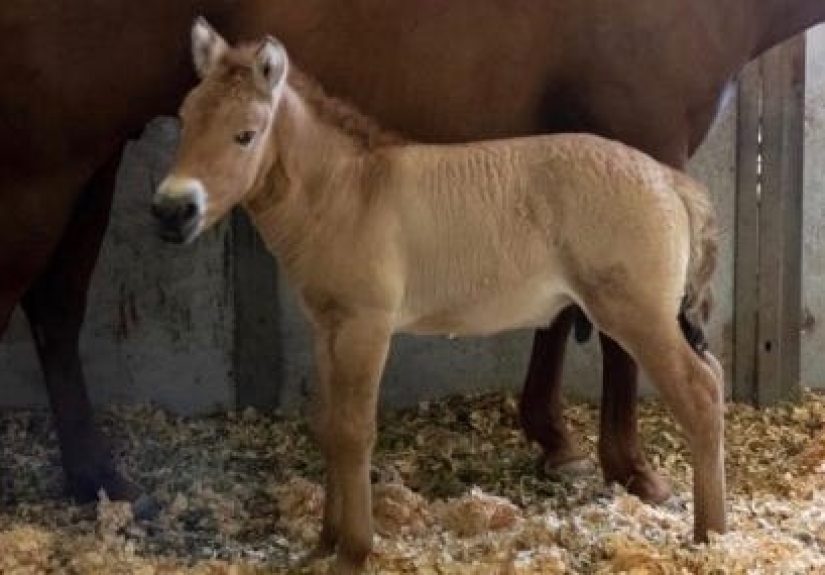
Kurt was born on August 6, 2020, in Texas to a domestic surrogate mare. Biologically, however, he was a clone of a male Przewalski’s horse whose cells had been preserved decades earlier. Those cells came from a stallion often identified by the studbook number SB615 and known as Kuporovic or Kuporovitch, a genetically valuable animal whose living cell line had been stored at the San Diego Zoo’s Frozen Zoo.
Kurt was named in honor of Dr. Kurt Benirschke, one of the key figures behind the creation of the Frozen Zoo. That name is wonderfully appropriate. A foal born from decades-old preserved cells and named after a pioneer of wildlife biobanking is basically conservation poetry with hooves.
The goal was not to create a novelty animal. Conservationists hoped Kurt would eventually contribute valuable genes to the living Przewalski’s horse population. Because many surviving Przewalski’s horses descend from a relatively small founder group, genetic diversity is a major concern. A narrow gene pool can increase the risk of inherited problems and reduce a species’ ability to adapt to disease, climate stress, and environmental change.
How Can a Horse Be Cloned from Old DNA?
The cloning method used in cases like Kurt’s is generally known as somatic cell nuclear transfer. It is the same broad category of technique made famous by Dolly the sheep, the first mammal cloned from an adult cell. The basic idea is simple enough to explain, even if the actual laboratory work is about as delicate as performing surgery on a soap bubble.
The Simple Version of the Science
Scientists begin with a donor cell from the animal they want to clone. That cell contains the animal’s nuclear DNA, which carries most of the genetic instructions. Then they take an egg cell and remove its nucleus, which means removing its own main genetic material. The donor nucleus is placed into that enucleated egg cell. With the right stimulation, the egg begins dividing like an embryo.
If the embryo develops properly, it can be implanted into a surrogate mother. In Kurt’s case, a domestic mare carried the pregnancy and gave birth to the cloned foal. So while Kurt’s surrogate mother provided the womb and the early-life care, his nuclear DNA came from the long-preserved Przewalski’s horse cell line.
A clone is not a photocopy in every possible sense. Environment, development, health, behavior, and even small biological differences matter. A cloned animal is more like an identical twin born at a different time. In Kurt’s case, that “different time” happened to be decades later, which is the kind of scheduling gap only conservation genetics can make sound normal.
Why 40-Year-Old DNA Was So Valuable
Not all old DNA is useful. A random hair from the back of a drawer will not magically produce a healthy foal. What made Kurt possible was the preservation of living cells, not just fragments of genetic material. The Frozen Zoo stores viable biological samples under extremely cold conditions, helping keep cells usable for future research and conservation work.
The stallion behind Kurt carried genetic variation that was underrepresented in the modern Przewalski’s horse population. In conservation, underrepresented genes can be precious. They may not sparkle like treasure in a pirate chest, but they can help a population become stronger, healthier, and more resilient over generations.
When a species passes through a population bottleneck, many genetic lines disappear. Even if the number of animals later increases, the lost genetic variety does not automatically come back. Cloning from preserved cells offers one possible way to reintroduce genetic material that would otherwise remain absent from the breeding population.
The Frozen Zoo: A Library Where the Books Are Cells
The San Diego Zoo’s Frozen Zoo is one of the most important wildlife biobanks in the world. Instead of shelves full of dusty books, it stores living cell cultures, genetic material, and reproductive samples from thousands of animals. Think of it as a biological library, except the librarians wear lab coats and the overdue fees are measured in extinction risk.
The Frozen Zoo began with a bold idea: preserve biological material today because future science may know what to do with it tomorrow. At the time, storing cells from rare animals may have seemed unusually optimistic. Decades later, Kurt proved that optimism can sometimes grow four legs and start running around a paddock.
Biobanking does not replace habitat protection, anti-poaching work, captive breeding, or reintroduction programs. Instead, it adds another tool. For species with shrinking populations, stored cells can act as a backup of genetic diversity. That backup becomes especially important when living populations are small, closely related, or vulnerable to sudden losses.
Why Genetic Diversity Matters for Endangered Horses
Genetic diversity is the raw material of resilience. A population with more genetic variation has a better chance of handling disease, environmental shifts, reproductive challenges, and unexpected pressures. A population with too little genetic variation may look stable on paper but remain fragile beneath the surface.
Przewalski’s horses survived because humans intervened through breeding programs and reintroduction projects. That recovery is remarkable, but it came with a genetic challenge. When most living animals trace back to a small number of founders, breeding managers must work carefully to avoid increasing relatedness too much.
Kurt’s value comes from the possibility that he may pass on genes from an older, underrepresented line. He is not meant to replace traditional conservation. He is meant to strengthen it. In other words, cloning is not the whole toolbox. It is a specialized wrenchexpensive, complicated, and not something you use to hang a picture frame, but very useful when the right problem appears.
Is This De-Extinction?
Kurt’s birth is sometimes discussed alongside de-extinction, but it is better understood as genetic rescue. De-extinction usually refers to efforts to recreate or approximate an extinct species. Przewalski’s horses are not extinct. They are endangered and have been reintroduced into the wild after disappearing from their native habitats for a time.
That distinction matters. Kurt was not an attempt to bring back a lost animal from fossils or ancient bone fragments. He was created from preserved living cells of a known Przewalski’s horse. The goal was practical conservation: increase genetic options for a living species.
This is why the project is so important. It shows that biotechnology can support real-world conservation without drifting into fantasy. No velociraptors. No theme park. No one dramatically shouting, “Life finds a way,” while ignoring the maintenance budget. Just a carefully planned effort to help an endangered wild horse population become genetically healthier.
What Happened After Kurt?
Kurt’s story did not end at birth. He later moved to the San Diego Zoo Safari Park, where conservationists planned his social development and eventual role in a breeding program. Because he was born to a domestic surrogate, he needed to learn the social language of his own species. Horses are social animals, and Przewalski’s horses have their own behaviors, signals, boundaries, and herd dynamics.
Conservation teams introduced Kurt carefully to other Przewalski’s horses so he could develop normal social skills. This part of the story is easy to overlook, but it is essential. A cloned animal is not just a genetic achievement. It is a living creature that must grow, socialize, adapt, and eventually participate in a conservation program.
In 2023, a second cloned Przewalski’s horse, later named Ollie, was born from the same preserved genetic line. Ollie’s birth strengthened the idea that cloning could be repeated and used as part of long-term genetic management for endangered species. One cloned foal is a scientific milestone. Two cloned foals begin to look like a practical conservation strategy.
What This Means for Wildlife Conservation
The baby horse cloned from 40-year-old DNA represents a shift in how conservationists think about time. Traditionally, conservation focuses on protecting living animals and habitats right now. That remains absolutely essential. But biobanking adds another timeline. It says that today’s samples may become tomorrow’s solutions.
This approach may help other endangered species, especially those with limited genetic diversity. Similar work has already been connected to black-footed ferrets, another species that passed through an extreme population bottleneck. The principle is the same: when the living population has lost genetic variation, preserved cells may help restore some of what disappeared.
However, cloning is not a magic wand. It is expensive, technically demanding, and not suitable for every species. It also depends on having preserved cells in good enough condition. Without a sample, there is nothing to clone. This is why the Frozen Zoo and similar biobanks matter so much. You cannot rescue genetic diversity in the future if nobody bothered to save it in the past.
The Ethical Questions Behind Cloning Endangered Animals
Any conservation cloning project raises ethical questions. Is it right to create an animal through cloning? Does it distract from habitat protection? Could it encourage people to think extinction is reversible, like hitting “undo” on a keyboard? These are fair questions, and responsible scientists do not brush them aside.
The strongest argument for projects like Kurt’s is that cloning can serve a specific conservation purpose. It is not about curiosity alone. It is about improving the genetic health of an endangered species. If the cloned animals are healthy, carefully managed, and integrated into breeding programs, cloning can become a tool for recovery.
The biggest caution is that technology must not become an excuse for neglect. A cloned horse cannot protect grasslands by himself. He cannot stop habitat loss, manage livestock competition, or fund conservation programs. Even a very impressive foal still has the administrative powers of a foal, which are limited mostly to standing adorably and making people care.
Why the Story Captured Public Attention
The headline works because it feels almost impossible: a baby horse cloned from 40-year-old DNA. It compresses decades of science into one sentence. But the emotional appeal is even stronger. People understand babies. People understand endangered animals. People understand the sadness of losing something forever. Kurt’s story sits at the intersection of all three.
It also changes the image of cloning. For many people, cloning still sounds like science fiction, celebrity pets, or old debates from the Dolly era. Kurt reframes cloning as a conservation tool. Instead of asking, “Can we copy an animal?” the better question becomes, “Can we restore genetic options that a species desperately needs?”
That is why this story matters beyond one foal. It invites readers to think about extinction not as a single dramatic event, but as a slow loss of choices. Each lost habitat, each vanished population, and each missing bloodline narrows the future. Kurt represents one carefully recovered choice.
Lessons from a Baby Horse with Old DNA
Kurt’s birth teaches several important lessons. First, conservation is not only about saving animals that are visible today. It is also about preserving genetic information that may be useful tomorrow. Second, technology works best when it supports, rather than replaces, traditional conservation. Third, long-term thinking matters. The people who preserved those cells decades ago could not know exactly how they would be used, but they understood that future scientists might be grateful.
There is something wonderfully humble about that. A sample stored in 1980 became a foal in 2020. That is a 40-year conservation relay race, with one generation passing a frozen baton to the next. The finish line is not just one healthy animal. It is a stronger, more genetically diverse population.
Personal Reflections and Experiences Related to the Topic
Reading about a baby horse cloned from 40-year-old DNA feels different from reading about a typical scientific breakthrough. Some discoveries impress the brain first. This one sneaks directly into the imagination. It makes you picture a quiet freezer, a tiny vial, a team of scientists who refused to treat endangered genes as disposable, and thendecades latera foal blinking at the world as if nothing unusual had happened.
The most powerful experience connected to this story is the realization that conservation is often patient work. Popular culture likes dramatic rescues: helicopters, nets, urgent music, and someone shouting into a radio. Real conservation can be much quieter. It can look like labeling samples, maintaining storage tanks, updating records, studying pedigrees, and waiting for technology to catch up with hope.
For anyone who has visited a zoo, wildlife center, or conservation park, Kurt’s story adds a new layer to the experience. The animals we see are not just exhibits. Many are part of complex genetic management plans. Behind every calm-looking herd may be years of research, careful breeding recommendations, veterinary work, and international cooperation. The public sees the horse. The conservation team sees the family tree, the genetic risks, the future breeding value, and the responsibility.
There is also a lesson here for how we think about technology. New tools often arrive with hype, fear, or both. Cloning is a perfect example. It can sound unnatural, risky, or excessive. But in the case of endangered species, the question is not whether the technology feels futuristic. The question is whether it can be used responsibly to solve a real biological problem. Kurt’s birth suggests that, under careful conditions, the answer can be yes.
Another experience this topic creates is a strange sense of time travel. Kurt was born in 2020, but part of his genetic story had been waiting since around 1980. That means his existence connects different eras of science: the early vision of the Frozen Zoo, the rise of modern cloning, and today’s urgent conservation challenges. He is not an animal from the past. He is an animal for the future, built from a decision someone made long before the technology was ready.
The story also makes extinction feel less abstract. When people hear that a species is endangered, the phrase can become background noise. But when you learn that nearly every surviving Przewalski’s horse traces back to a small founder population, the problem becomes more specific. It is not just about counting animals. It is about what genetic possibilities remain inside those animals. A population can grow in number while still needing help at the genetic level.
Finally, Kurt’s story is a reminder that hope in conservation is not passive. It is built. Someone has to collect the sample, freeze it, protect it, fund the research, improve the technology, care for the surrogate mother, raise the foal, and plan for the next generation. Hope, in this case, has paperwork, liquid nitrogen, veterinary expertise, and a very small horse with a very large legacy.
Conclusion: A Small Foal with a Big Future
The baby horse cloned from 40-year-old DNA is more than a viral science headline. Kurt represents a new chapter in conservation genetics, one where preserved cells can help restore lost genetic diversity to endangered populations. His birth does not solve every problem facing Przewalski’s horses, but it expands the set of tools available to protect them.
The lesson is clear: saving species requires both old-fashioned commitment and new scientific imagination. Protect the habitat. Manage breeding carefully. Support reintroduction. Store genetic material before it disappears. And when the right moment comes, let the past help rebuild the future.
Kurt may not know he is famous. He probably does not wake up thinking, “Ah yes, I am a landmark in applied conservation biotechnology.” He is a horse. He eats, grows, socializes, and behaves like a horse. But for scientists, conservationists, and anyone who cares about endangered wildlife, he is also proof that a tiny preserved cell can carry a very large promise.