Table of Contents >> Show >> Hide
- Who Is Nathan Gibson Judd?
- Why This Architect Visit Matters
- The Signature Moves That Define His Work
- Projects That Help Explain the Appeal
- What American Readers Can Learn From This Australian Visit
- Why the Work Still Feels Fresh
- Experience Section: What a Nathan Gibson Judd Visit Feels Like
- Conclusion
- SEO Tags
Some architect visits are all glass-box drama and big, cinematic gestures. Others are quieter, sharper, and frankly more useful if you want to understand how real people actually live. An architect visit to the work of Nathan Gibson Judd in Australia belongs to the second camp. It is less about shouting, “Look at me, I am architecture,” and more about proving that design can be disciplined, warm, funny, climate-aware, and still have enough personality to avoid becoming a beige lecture.
Judd’s public body of work points to a designer deeply interested in the relationship between everyday life and architectural atmosphere. His projects have been associated with Canberra and the surrounding region, with residential work that ranges from suburban houses to coastal retreats, plus mixed-use and urban work through his studio practice. That matters because the best way to understand his architecture is not as a collection of pretty images, but as a method: reduce the unnecessary, respect the site, let light do some heavy lifting, and use color only when it can change the mood of a room from “fine” to “why is this suddenly more joyful?”
Who Is Nathan Gibson Judd?
Nathan Gibson Judd is an Australian architect whose practice has been publicly connected with Canberra for years, first through earlier firm listings and later through JUDD studio. His work has been described as boutique in scale but broad in interest, spanning homes, mixed-use projects, and urban strategy. That combination is important. Architects who move between houses and urban work often develop a strong sense of how private space and public life relate to each other. You can see it in Judd’s projects: even when a house is modest in footprint, it rarely feels socially timid.
His name is especially associated with a string of residential projects that reinterpret familiar Australian types rather than bulldozing them into oblivion. Think beach shack logic, suburban compactness, practical materials, and informal living patternsbut updated with sharper planning, better environmental performance, and a more deliberate sense of interior character. In other words, this is not nostalgia with a better camera filter. It is nostalgia after a serious design education.
Why This Architect Visit Matters
The title Architect Visit: Nathan Gibson Judd in Australia sounds simple, but it opens the door to a bigger idea: why are certain architects worth visiting in the first place? The answer is not fame. It is legibility. Good architecture reveals how it works. You can read the plan in the way a hallway opens, in the way a deck becomes another room, in the way a wall catches morning sun, or in the way a splash of color stops a restrained material palette from drifting into monkish self-importance.
Judd’s work is especially rewarding to “visit” because it sits at the intersection of several ideas that American readers already care about: smaller, smarter homes; indoor-outdoor living; passive comfort; durable coastal materials; and houses that feel designed without feeling overdesigned. Those themes have been widely discussed in American architecture and design media for years, yet Judd’s projects show how they can be handled with an Australian regional sensibility that feels distinct rather than imported.
The Signature Moves That Define His Work
1. Reworking the Beach Shack Without Turning It Into a Theme Park
One of the clearest threads in Judd’s architecture is his reinterpretation of the Australian beach shack. That idea sounds casual, but it is not lazy. In his hands, the beach shack becomes a design framework: simple forms, easy circulation, durable finishes, social flexibility, and a strong connection to outdoors. It is architecture that understands vacation life, family overflow, sandy feet, and the eternal human desire to sit on a step and do absolutely nothing productive.
What makes this interesting is restraint. Instead of treating the coastal house as an excuse for excess glass, polished luxury, or nautical clichés that should be returned to the sea immediately, Judd keeps the forms legible and the materials robust. The mood is relaxed, but the planning is rigorous. That balance is much harder to achieve than it looks.
2. Small Footprint, Big Sense of Space
Judd’s public project descriptions repeatedly suggest that he is good at making compact sites feel generous. This is where the architecture becomes more than photogenic. A modest house can feel expansive when the plan is clear, storage is integrated, daylight is well managed, and exterior space is treated as part of the living sequence rather than a leftover patch of grass. The result is not “tiny house theater.” It is everyday spaciousness created by proportion, light, and circulation.
That idea has obvious relevance for readers in the United States, where rising costs and shrinking urban lots keep forcing the same question: how do you make less square footage feel like more life? Judd’s answer appears to be practical rather than mystical. Open the plan where it matters. Give rooms more than one relationship to outside. Use built-ins and clean material transitions. Keep clutter from becoming the unofficial interior designer.
3. Optimistic Color, Not Color for the Sake of Instagram
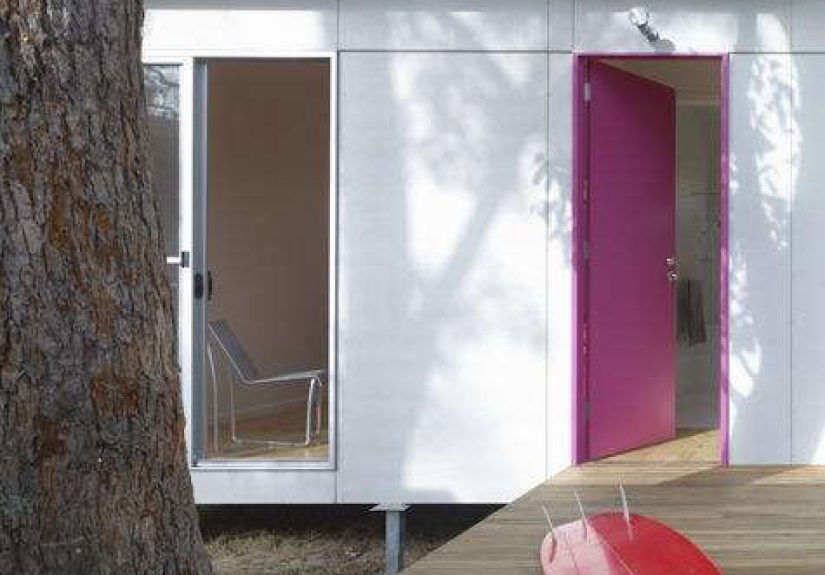
One of the most memorable details associated with Judd’s work is his use of what has been described as “optimistic” color. That phrase works because the color is not random. It is deployed as punctuation. A bright entry door, green cabinetry, or a vivid accent piece shifts the emotional temperature of a space without destroying the calm created by more elemental materials like brick, concrete, timber, and fiber cement.
This is one reason the work stays in your head. Many architects know how to do disciplined minimalism. Fewer know how to prevent disciplined minimalism from becoming emotionally undercooked. Judd’s approach suggests that a house can be materially plainspoken and still have a pulse. The architecture does not lose credibility when it smiles a little.
4. Tough Materials, Soft Experience
Another signature move is the use of robust, ordinary-seeming materials in ways that produce an unexpectedly rich atmosphere. Polished concrete, brick, plywood, fibro cladding, decking, and simple shelving systems all appear in descriptions of his projects. None of those materials are inherently glamorous. That is exactly the point. When ordinary materials are chosen carefully, detailed well, and paired with strong light and proportion, they stop reading as cheap and start reading as honest.
There is also an intelligence here about maintenance and longevity. Coastal and family houses do not need fragile perfection. They need surfaces that age with dignity, tolerate real life, and still look intentional when someone drops a wet towel on a chair for the 900th time. Judd’s projects seem to accept that reality instead of staging war against it.
5. Sustainability as Common Sense
The environmental side of Judd’s work is another reason the architect visit remains compelling. Project descriptions tied to his coastal houses mention cross-ventilation, careful orientation, winter sun, summer shade, insulation above code requirements, double glazing, and rainwater harvesting. None of that sounds flashy, and that is good news. Sustainable design works best when it is not treated like a decorative accessory. It should shape the building from the beginning.
That mindset aligns neatly with broader lessons from American sustainable design discourse: passive comfort, natural light, durable envelope strategies, and climate-responsive planning are often more meaningful than gadget-heavy eco branding. Judd’s work reads as if it understands a simple rule: a house should first be good at being a house.
Projects That Help Explain the Appeal
The projects most often associated with Judd help explain why the title of this article still resonates. Broulee Shack and Seal Rocks Shack reveal his interest in the Australian coastal retreat as an informal social stage. These are not sterile weekenders. They are places designed for repeat occupation, multi-generational use, and low-fuss living. Butterley House, meanwhile, shows how a small suburban setting can still support color, material texture, and spatial clarity without becoming visually noisy.
Then there is the urban side of the practice. Public records tied to the mixed-use project Ori point to an architect equally comfortable working at a larger scale in a changing neighborhood context. That matters because it suggests continuity in his thinking. Whether he is designing a family retreat or participating in a mixed-use urban building, the through-line appears to be the same: shape social life carefully, respect context, and avoid dead space in both the literal and emotional sense.
What American Readers Can Learn From This Australian Visit
For U.S. readers, the appeal of Nathan Gibson Judd’s work lies partly in its transferability. You do not need to live on the coast of New South Wales or in Canberra to borrow the lessons. A compact home in California, a lake retreat in Michigan, a renovated ranch in Texas, or a suburban infill project in the Northeast can all benefit from the same core principles.
First, design for climate before style. Second, let indoor and outdoor spaces support each other rather than compete. Third, treat material simplicity as a strength, not a budget apology. Fourth, use color strategically, like good seasoning: enough to wake up the dish, not enough to ruin dinner. Finally, remember that informality can be elegant. Some of the most livable houses are the ones that welcome real use instead of demanding ceremonial behavior.
Why the Work Still Feels Fresh
Plenty of houses age badly because they are built around trends instead of habits. Judd’s work avoids that trap by being rooted in patterns of living that do not expire every 18 months. Families still gather in kitchens. People still want breezes, shade, sunlight, a decent place to read, and a threshold that makes arriving home feel different from merely entering a container. Good architecture notices those rituals and gives them form.
That is why this architect visit still feels relevant. It is not just an appreciation of one designer’s portfolio. It is a reminder that architecture gets interesting when it is observant. Judd’s work does not seem interested in being loud for the sake of recognition. It is interested in being memorable because it is tuned to place, climate, and use. Frankly, that is a much better long-term strategy than designing homes that look like they were conceived entirely for drone footage and smug captions.
Experience Section: What a Nathan Gibson Judd Visit Feels Like
To understand the experience of a Nathan Gibson Judd project in Australia, imagine arriving at a house that does not try to flatten the landscape into a postcard. Instead, it meets its setting with a calm kind of confidence. The building does not puff out its chest. It sits. It frames. It waits. And then, almost immediately, you notice that the experience is being choreographed with subtle precision.
The first sensation is usually one of release. The approach is rarely about monumental drama. It is about easing you from outside to inside without making the threshold feel overworked. A door color might announce itself with a wink. A deck might stretch forward like an invitation rather than a formal platform. The materials feel sturdy underfoot, not precious. You sense that the architect expects people to live here, not tiptoe through it like nervous museum interns.
Once inside, the spaces tend to unfold in a way that feels both casual and exact. That combination is harder to pull off than people think. Casual architecture often becomes sloppy; exact architecture often becomes rigid. Here, the better version seems to happen: spaces line up to catch light, to frame a garden, to push your eye toward a deck, or to make a compact room feel a little deeper than it is. You are not overwhelmed by gesture. You are persuaded by sequence.
Then comes the atmosphere. This is where Judd’s architecture really earns attention. Light does not merely enter; it settles. It washes across concrete, brick, plywood, or painted surfaces and suddenly those humble materials feel composed, even tender. A bright element in the room does not scream for applause. It changes the energy. A green cabinet, a pink door, a sharp accent wall, or a playful furnishing note can make the whole place feel more alive, like the house has a private sense of humor and trusts you enough to share it.
The outdoor rooms matter just as much. In projects shaped by shack logic or coastal informality, decks and steps are not decorative appendages. They are part of daily life. You can imagine coffee there, conversations there, children colonizing the steps as if they invented sitting, towels draped over railings, and someone insisting that the best seat in the house is technically not in the house at all. That is the genius of the arrangement. The architecture expands social life without necessarily expanding the building very much.
There is also a kind of emotional practicality to the experience. Nothing feels designed to impress for five minutes and irritate for ten years. The spaces suggest maintenance awareness, climate awareness, and family awareness. They are generous, but not indulgent. Relaxed, but not careless. Memorable, but not desperate to be iconic. You leave with the sense that the architecture has paid attention to the way people actually occupy time: cooking, reading, napping, drying off after a swim, opening windows, closing off unused zones, gathering in loose circles rather than formal compositions.
That is why an architect visit like this lingers. You do not walk away remembering one spectacular stunt. You remember how the place made ordinary life look better. And honestly, that may be the strongest compliment architecture can get.
Conclusion
Architect Visit: Nathan Gibson Judd in Australia is more than a profile of one architect. It is a case study in how smart residential design can be regionally grounded, environmentally sensible, materially restrained, and still full of character. Judd’s publicly documented work suggests an architect who understands that great houses are not just viewed; they are used, weathered, laughed in, and returned to.
If you are searching for architecture that respects climate, celebrates informality, and proves that simplicity does not have to mean sterility, Nathan Gibson Judd is worth studying. His projects remind us that the most successful homes are often the ones that do not fight life. They shape it, support it, and occasionally brighten it with a very good pink door.