Table of Contents >> Show >> Hide
- Why NASA Wants to Go Back to the Moon Differently
- What Is the Human Landing System?
- SpaceX Starship HLS: The Giant Reusable Moon Elevator
- Blue Origin’s Blue Moon: A Second Path to the Surface
- Artemis III, Artemis IV, and the New Step-by-Step Road
- Why the Lunar South Pole Matters
- The Technology Challenges Behind Reusable Lunar Landers
- How Reusability Could Lower Costs and Boost Science
- Reusable Lunar Landers and the Road to Mars
- Real-World Experiences and Reflections on NASA’s Reusable Lunar Lander Era
- Conclusion
NASA’s return to the Moon is not shaping up to be a simple Apollo rerun with shinier helmets and better camera angles. This time, the plan is bigger, busier, more commercial, andif the hardware behaves itselffar more reusable. At the center of that strategy is the Human Landing System, or HLS, the spacecraft that will carry astronauts from lunar orbit down to the surface and back again. In plain English: it is the Moon taxi. But unlike Apollo’s lunar module, which was brilliant, brave, and very much disposable, the new generation of lunar landers may be designed for repeat service.
That possibility changes the entire mood of lunar exploration. A reusable lunar lander could help NASA move from “plant the flag and go home” missions toward regular expeditions, longer stays, heavier cargo, and eventually the infrastructure needed for a real lunar economy. The Moon is no longer being treated like a weekend camping spot. NASA wants it to become a proving ground for living and working beyond Earth, with Mars waiting in the background like the final boss in a video game.
The phrase “reusable lunar lander” sounds tidy, but the engineering behind it is anything but. It involves cryogenic fuels, docking systems, deep-space navigation, long-duration power, crew safety, dust management, launch cadence, and a level of precision that makes parallel parking look like a toddler activity. Still, NASA’s Artemis program is deliberately moving in this direction, working with commercial partners such as SpaceX and Blue Origin to develop landers that can support recurring lunar missions rather than one-off heroic stunts.
Why NASA Wants to Go Back to the Moon Differently
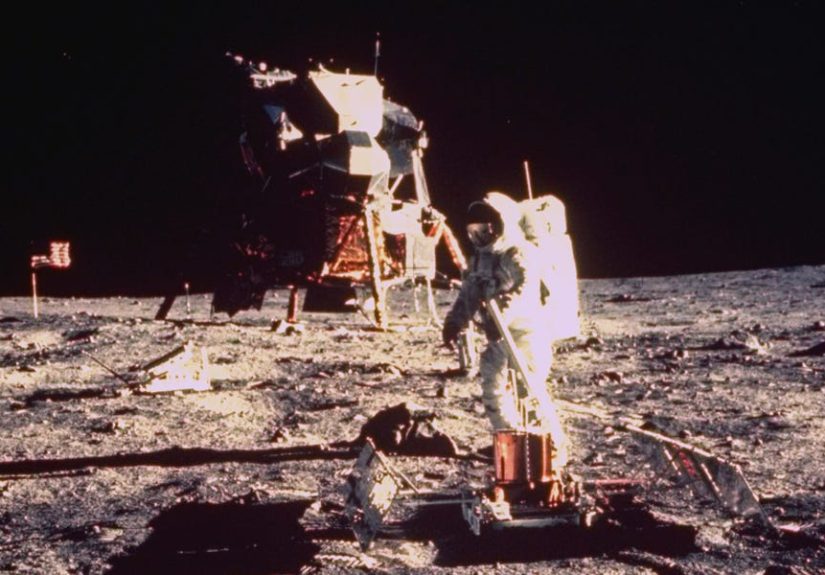
The Apollo program proved that humans could reach the Moon, walk on it, collect samples, drive around, hit golf balls, and return safely. That remains one of civilization’s greatest achievements. But Apollo was designed around a race, not a permanent presence. The hardware was used once, the mission pace was limited, and after Apollo 17 in 1972, human footprints on the Moon became history rather than routine.
Artemis has a different goal. NASA wants to return astronauts to the lunar surface, especially near the Moon’s South Pole, where permanently shadowed regions may hold water ice. That water could become one of the most important resources in space exploration. It may support life, produce oxygen, and eventually be processed into rocket propellant. In other words, lunar ice is not just scientifically interesting; it is the closest thing the Moon has to a convenience store for future explorers.
To make that future practical, NASA needs a transportation system that can do more than deliver two astronauts once. It needs landers that can dock with Orion or other spacecraft, carry equipment, support longer surface stays, and eventually work within a broader network of lunar infrastructure. Reusability is attractive because every mission does not have to begin with throwing away the most expensive pieces of the transportation chain.
What Is the Human Landing System?
The Human Landing System is the Artemis vehicle that carries astronauts between lunar orbit and the Moon’s surface. Orion, launched by NASA’s Space Launch System rocket, gets the crew to lunar orbit. The HLS takes over for the dramatic part: descending to the surface, supporting the astronauts during surface operations, and returning them to orbit for the ride home.
That sounds straightforward until you remember that the Moon has no air for parachutes, no gas stations, no rescue helicopters, and no friendly mechanic named Bob waiting with a wrench. A lunar lander must perform powered descent and powered ascent, manage fuel in space, handle extreme temperatures, keep astronauts alive, communicate with Earth, and land with remarkable precision on terrain that may include slopes, boulders, craters, and dust that behaves like powdered glass with a grudge.
From Single-Use Machines to Service-Based Landers
NASA’s approach is increasingly service-based. Instead of designing and owning every piece of the lander system in the traditional government-led style, the agency is buying landing services from private companies that develop, test, and operate the vehicles under NASA safety and mission requirements. This model is similar in spirit to how NASA helped build commercial cargo and crew transportation to the International Space Station.
For the Moon, the stakes are higher and the distance is much greater, but the logic is familiar: competition can drive innovation, reduce long-term costs, and give NASA more than one path to the surface. That matters because lunar exploration is too important to depend on a single vehicle, a single company, or a single perfect schedule. Space programs are famous for delays. Rockets do not care about PowerPoint timelines.
SpaceX Starship HLS: The Giant Reusable Moon Elevator
SpaceX’s Starship Human Landing System is one of the boldest elements in the Artemis plan. Based on the broader Starship architecture, the lunar version is designed to carry astronauts from lunar orbit to the surface and back. NASA selected SpaceX for the initial HLS development work, and later added an additional contract option to evolve Starship HLS toward sustainable lunar missions.
Starship HLS is huge by lander standards. NASA has described it as roughly 50 meters tall, about the length of an Olympic swimming pool. That size could offer major benefits: more habitable volume, more cargo capacity, and the ability to deliver large systems that smaller landers could not handle. A reusable Starship-derived lander could eventually help move crews, science gear, habitats, rovers, power systems, and construction equipment between lunar orbit and the surface.
The catch is that Starship’s lunar architecture depends heavily on in-space refueling. The lander must be launched, refilled in Earth orbit by tanker flights, sent toward the Moon, and then operate around the Moon. Cryogenic propellant management in space is a difficult technical challenge because extremely cold fuels can boil off, shift inside tanks, and behave in ways that are not always friendly to mission planners. If the technology matures, however, it could unlock a transportation system with far more capability than traditional single-use landers.
Why Starship HLS Could Change Lunar Logistics
The most exciting part of Starship HLS is not simply that it can land astronauts. It is the idea that a large reusable lander could make the Moon feel less like a distant destination and more like a reachable workplace. If NASA and SpaceX prove the refueling, docking, life support, elevator, propulsion, and surface systems, future missions could bring down heavier payloads and more ambitious scientific equipment.
Imagine a lunar mission where astronauts do not arrive with a few carefully rationed boxes but with pressurized rovers, power units, drilling tools, spare parts, and scientific instruments large enough to make geologists grin through their helmets. That is the long-term promise of a high-capacity reusable lunar lander: fewer “take only what fits in the suitcase” missions and more “let’s build something useful” missions.
Blue Origin’s Blue Moon: A Second Path to the Surface
NASA also selected Blue Origin to develop Blue Moon as a second Artemis lunar lander provider. This is important because two lander designs mean more resilience. If one system faces delays, technical problems, or cost issues, NASA has another path. Competition also encourages better performance and more creative engineering, which is exactly what you want when the destination is a rocky sphere 238,000 miles away.
Blue Moon is being developed for crew and cargo missions, with Blue Origin describing lander variants intended to provide recurring access to the Moon. NASA’s contract with Blue Origin covers development, testing, and demonstration work for a lander that can support recurring astronaut expeditions. The agency has emphasized requirements such as increased crew size, longer mission duration, more delivered mass, and the ability to support regular lunar surface access.
Blue Moon’s architecture differs from SpaceX’s Starship HLS, which is good news for NASA. Different approaches create useful redundancy. Space exploration does not reward putting every egg in one rocket-shaped basket. One system may offer greater cargo volume; another may offer different operational advantages. Over time, NASA can learn which designs work best for specific mission types, from brief science visits to cargo deliveries to base-building campaigns.
Reusable Does Not Mean Easy
Calling a lunar lander reusable is simple. Making it reusable is the hard part. A reusable lander must survive repeated exposure to deep-space radiation, thermal extremes, engine firings, abrasive lunar dust, docking loads, and long periods away from Earth-based maintenance. It must be inspected, refueled, certified, and trusted again. On Earth, reuse is already difficult for rockets. Around the Moon, the repair shop is a bit farther away.
Still, reuse does not have to mean the lander flies forever like a family minivan with 300,000 miles and a suspicious noise under the hood. Even partial reuse can matter. A lander that performs multiple sorties between lunar orbit and the surface could reduce the need to launch a brand-new descent-and-ascent vehicle for every crewed mission. Over time, that could lower costs, increase cadence, and make lunar planning more flexible.
Artemis III, Artemis IV, and the New Step-by-Step Road
NASA’s current Artemis plan has become more deliberate. Artemis III is now planned as a low Earth orbit demonstration mission in 2027, testing rendezvous and docking operations between Orion and one or both commercial landers from SpaceX and Blue Origin. That may sound less glamorous than a Moon landing, but it is exactly the kind of rehearsal that keeps astronauts alive. Spaceflight rewards boring tests. “Boring and successful” is basically the official love language of mission control.
Artemis IV is targeted as the mission that returns astronauts to the lunar surface in early 2028. The plan calls for the crew to travel to lunar orbit, transfer to a commercial lunar lander, descend to the Moon’s South Pole region, spend about a week conducting science, and then return to orbit. If successful, this would mark humanity’s first crewed lunar surface mission since Apollo 17.
NASA also aims to increase mission cadence after that, with roughly annual lunar surface missions. That is where reusable landers become especially valuable. A single spectacular landing is inspiring, but a steady rhythm of missions is what builds capability. Science improves when researchers can return to promising sites, compare data across seasons and lighting conditions, deploy instruments, and maintain equipment. Exploration becomes more useful when it stops being rare.
Why the Lunar South Pole Matters
The Moon’s South Pole is one of the most strategically interesting places in the solar system. Some crater floors never see sunlight, making them extremely cold traps where water ice may have accumulated over billions of years. Nearby high ridges may receive more sunlight than many other lunar locations, which could help power future surface systems. That combinationpossible ice in the shadows and solar energy nearbyis why NASA keeps talking about the region like it is prime real estate.
Water ice could support astronauts directly, but it could also support propulsion. Split water into hydrogen and oxygen, and suddenly the Moon has ingredients for rocket fuel. That does not mean a lunar gas station opens next Tuesday with a snack aisle and questionable coffee. It means long-term exploration planners see the South Pole as a place where local resources might reduce dependence on Earth launches.
A reusable lunar lander fits neatly into that vision. If propellant can eventually be produced, stored, or transferred in cislunar space, landers could make repeated trips with less mass launched from Earth each time. That is the dream: use the Moon not only as a destination but as part of the transportation network for deeper space exploration.
The Technology Challenges Behind Reusable Lunar Landers
Reusable landers must solve several engineering puzzles at once. First is propulsion. Engines must throttle deeply for landing, restart reliably for ascent, and perform again after long exposure to space. Second is propellant storage. Cryogenic fuels are powerful but fussy, and keeping them cold over long mission timelines requires advanced insulation, pressure control, and boil-off management.
Third is docking. The lander must safely meet Orion or another spacecraft in orbit, align precisely, connect securely, transfer crew, and separate cleanly. Docking in space is not new, but doing it as part of a lunar landing campaign adds layers of operational complexity. Fourth is surface durability. Lunar dust clings, scratches, contaminates, and sneaks into places where engineers very much do not want it. Any reusable lander must be designed with dust mitigation in mind.
Finally, there is human rating. A cargo lander can accept a higher level of risk than a crewed lander. When astronauts are aboard, every system must meet strict safety standards. Life support, power, communications, abort options, software, navigation, and thermal control must work together. Spacecraft do not get to have “minor glitches” when people are inside them and Earth is several days away.
How Reusability Could Lower Costs and Boost Science
Reusable lunar landers could make Artemis more affordable over time, but cost savings are not automatic. The first vehicles will be expensive because development, testing, certification, and infrastructure are expensive. Reusability pays off only if the systems fly often enough and can be refurbished or operated efficiently. A reusable lander that flies once every decade is not a revolution; it is a very fancy museum exhibit with engines.
But if NASA can achieve a regular mission cadence, the economics improve. Reusable landers could support cargo pre-positioning, crew transport, emergency logistics, and science campaigns. They could deliver instruments to multiple sites, help build habitats, and support surface mobility. Scientists could plan bolder investigations because they would not have to treat every kilogram like it was made of gold and wrapped in paperwork.
Recurring access also helps industry. Companies building power systems, communications networks, rovers, construction robots, navigation beacons, and resource-processing equipment need predictable transportation. The more often landers fly, the more realistic a lunar supply chain becomes. That supply chain could eventually support not just NASA missions but commercial research, technology demonstrations, and international partnerships.
Reusable Lunar Landers and the Road to Mars
NASA often describes Artemis as a Moon-to-Mars program, and that phrase is not just branding. The Moon offers a nearby environment where astronauts can practice living away from Earth, using local resources, operating surface systems, and responding to emergencies with limited support. Mars is much farther away and far less forgiving. If something breaks on Mars, nobody is coming with a replacement part next week.
A reusable lunar lander helps NASA test the habits of sustainable exploration. Can vehicles be refueled and reused beyond Earth? Can crews operate safely in dusty, low-gravity environments? Can mission planners coordinate orbiting spacecraft, surface assets, robotic scouts, and human explorers? Can commercial providers deliver reliable services in deep space? These are not side questions. They are exactly the questions that must be answered before sending humans to Mars.
In that sense, the reusable lunar lander is more than a Moon vehicle. It is a prototype for a future where space transportation becomes less disposable, more routine, and more capable. It is one step toward treating deep space not as a place for rare ceremonial visits but as a region where humans can work, learn, build, and maybe occasionally complain about the Wi-Fi.
Real-World Experiences and Reflections on NASA’s Reusable Lunar Lander Era
For anyone who grew up watching grainy Apollo footage, NASA’s new lunar lander plans feel both familiar and wonderfully strange. The familiar part is the destination: the Moon still hangs in the sky like humanity’s oldest invitation. The strange part is the approach. Instead of one government-built lunar module making one legendary trip, Artemis is becoming an ecosystem of rockets, capsules, commercial landers, spacesuits, rovers, training mockups, docking tests, and future surface infrastructure. It is less like a single expedition and more like the first messy season of building a neighborhood where nobody has invented sidewalks yet.
One experience that makes this topic easier to understand is commercial aviation. Early airplanes were experimental, fragile, and terrifyingly limited. Over decades, aircraft became reusable transportation systems with maintenance schedules, safety checks, trained crews, and standard operations. Spaceflight is nowhere near that level of routine, but the direction is similar. A reusable lunar lander suggests NASA wants to move beyond “Can we land?” toward “How often can we land, what can we bring, and what can we do once we get there?”
The emotional shift is just as important as the technical one. Apollo inspired awe because it proved the impossible was possible. Artemis may inspire a different kind of awe: the feeling that the impossible is becoming infrastructure. That is a quieter kind of wonder, but it may be more powerful in the long run. A reusable lander is not as poetic as a bootprint, but it is what turns bootprints into fieldwork, fieldwork into stations, and stations into a sustained human presence.
There is also a practical lesson here for students, engineers, writers, and space fans: progress is rarely a straight line. Artemis has seen delays, changing mission plans, budget debates, and technical challenges. That does not mean the program is failing. It means the job is hard. Returning humans to the Moon safely, then doing it repeatedly, requires patience and brutal honesty about risk. A low Earth orbit docking test may not make the same headlines as a Moonwalk, but it builds the confidence needed for the Moonwalk to happen.
The reusable lunar lander idea also changes how people imagine the Moon. Instead of a distant symbol, it becomes a workplace with transportation problems, supply problems, maintenance problems, and scheduling problems. That may sound less romantic, but it is actually thrilling. Humanity is beginning to think about the Moon not only as a place to visit, but as a place where systems must function day after day. That is the beginning of permanence.
If NASA, SpaceX, Blue Origin, and their partners succeed, future generations may look back at the first reusable Artemis landers the way we look at early ships, railroads, or aircraft: imperfect, risky, and absolutely essential. The Moon will still be harsh, silent, dusty, and dramatic. But with reusable landers, it may also become reachable in a way it has never been before.
Conclusion
NASA’s return to the Moon could include a reusable lunar lander, and that possibility is one of the most important differences between Artemis and Apollo. The goal is not simply to repeat history with better screens and more hashtags. The goal is to build a transportation system that can support recurring missions, longer surface stays, heavier payloads, and future exploration beyond the Moon.
SpaceX’s Starship HLS and Blue Origin’s Blue Moon represent different approaches to the same challenge: making lunar access more capable and more sustainable. Both must overcome serious engineering hurdles, from cryogenic fuel management to docking, crew safety, dust, and operations far from Earth. But if reusable landers work, they could transform the Moon from a rare destination into a regular proving ground for science, technology, and Mars preparation.
The next era of lunar exploration will not be won by flags alone. It will be built by systems that can return, refuel, relaunch, and keep going. That is why the reusable lunar lander matters. It is not just a spacecraft. It is a promise that humanity’s next steps on the Moon may not be footprints that fade into history, but the beginning of a road.